
AI & GEO
The 8 Best GEO Tools for AI Visibility (2026)

Copy for AI
What is the best GEO tool to track your AI visibility in 2026? There is no single best one: the right tool is the one that tracks your buying prompts on the engines your buyers use, at a price that fits your prompt count. Otterly.AI is the cheapest public entry, Peec AI suits marketing teams, Profound and Scrunch target larger brands.
If you already pay for Ahrefs or Semrush, start with their AI module, and add the free Bing Webmaster Tools report on top. Below you find all eight options, each with what it is best for, what it costs and one honest limitation.
How we tested: we took every screenshot on 17 October 2026, on each vendor’s own site or in our own accounts for customerimpact.be (Bing Webmaster Tools, Ahrefs, Semrush’s free snapshot). Prices come from each pricing page on the same day, in the currency the page showed. We also asked ChatGPT itself which tools to use. We do not have a paid seat in every tracker and no vendor pays us.
Which GEO tools are the best in 2026?
| Tool | Best for | Engines covered | Free option | Paid from (17 Oct 2026) |
|---|---|---|---|---|
| Peec AI | Marketing teams and agencies | ChatGPT, Perplexity, Gemini, AI Mode | Free trial | Not published on the pricing page |
| Otterly.AI | Cheapest public entry | ChatGPT, AI Overviews, Perplexity, Copilot (+ AI Mode, Gemini, Claude as add-ons) | Free trial | $29/mo, 15 prompts |
| Profound | Enterprise brands | Up to 9 engines on Enterprise | 50 prompts for 7 days | Custom |
| Scrunch | Larger brands, AI bot traffic | ChatGPT, Claude, Gemini, Perplexity, AI Mode, AI Overviews, Meta | 7-day trial | $250/mo yearly, $300 monthly |
| Ahrefs Brand Radar | Teams already on Ahrefs | AI Overviews, AI Mode, ChatGPT, Perplexity, Gemini, Copilot | No | From €179/mo |
| Semrush AI Toolkit | Teams already on Semrush | ChatGPT, AI Mode and more | Free domain snapshot | $99/mo |
| Bing Webmaster Tools | Free Copilot citation data | Copilot and Bing partners | Fully free | Free |
| Manual prompt test | A baseline before you buy | Any engine you open | Free | Your time |
Want three of these side by side in more depth? Our GEO tools comparison puts Profound, Otterly.AI and Peec AI next to each other. For the categories and methods behind the tools, read measuring AI visibility. At Customer Impact we are GEO specialists, so our test is simple: does a tool help you show up on the questions where your audience actually buys?
How do you recognize a good GEO tool?
A GEO tool is software that sends your buying prompts to AI engines on a schedule and records whether, where and how your brand appears in the answers. A good one does more than show a nice visibility number. Watch for these five criteria:
- It measures real AI mentions across multiple engines. ChatGPT alone is not enough. You want to see whether you show up in Perplexity, Gemini, Copilot, Google AI Overviews and the new players, because your audience is not all sitting in the same window.
- It shows source attribution, not just mentions. Is your brand merely named, or is your page actually cited as a source? That difference determines whether your content is citation-worthy or not.
- It measures sentiment and context. Does a model position you as the primary choice or as an afterthought, and does incorrect information appear next to your name? A neutral mention alongside three competitors is something different from a warm recommendation.
- It tracks prompts that matter to you. The better tools let you enter concrete buying prompts from your niche and show, per prompt, whether and how you appear. Our guide on which prompts to track helps you build that list.
- It is action-oriented. A dashboard that only shows a problem does not help. You want recommendations: which content to adjust, which sources to strengthen, where the gaps are. The indicators we use ourselves are laid out in the five core indicators of AI visibility.
Which dedicated AI visibility trackers are worth it?
1. Peec AI (best for marketing teams and agencies)
Best for: marketing teams and agencies that track several brands or projects. Price: plans Starter, Pro and Advanced are billed monthly, Enterprise is custom and yearly; the pricing page showed no amounts when we checked on 17 October 2026. Biggest strength: visibility, position and sentiment per competitor in one view.
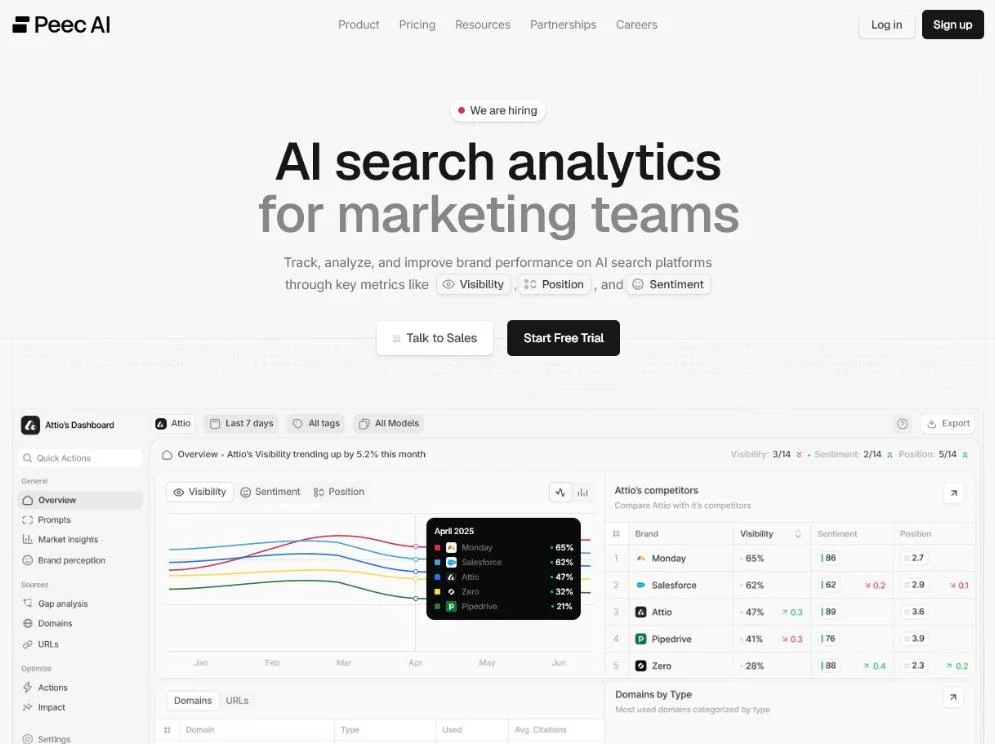 Peec AI’s homepage leads with three metrics: visibility, position and sentiment, compared against competitors.
Peec AI is built for teams that manage several brands at once. Beyond mention frequency it measures sentiment and position, compares you with competitors, and shows which domains and URLs the engines cite. For an agency with a handful of clients, that multi-project setup makes more sense than a tool that bills per site. More detail in our Peec AI review.
The honest limitation: coverage is priced per active model. The pricing page calculates your volume as tracked prompts times active models times tracking frequency, so adding engines quickly pushes you to a bigger plan. ChatGPT estimated Peec’s entry price at around €85 to €95 a month in our test below; we could not confirm that on Peec’s own page.
| Pros | Cons |
|---|---|
| Sentiment, position and competitors in one dashboard | No public prices on the pricing page |
| Source analysis per domain and URL | More engines means a bigger plan |
| Built for multi-brand teams and agencies | Enterprise features only on a yearly contract |
Alternative: Otterly.AI, if you want a public price and a smaller start.
2. Otterly.AI (best budget entry)
Best for: one brand that wants to start small and see whether GEO monitoring pays off. Price: Lite $29/mo (15 prompts), Standard $189/mo (100 prompts), Premium $489/mo (400 prompts), about 15% off yearly (pricing page). Biggest strength: the lowest public entry price, with a content audit on top.
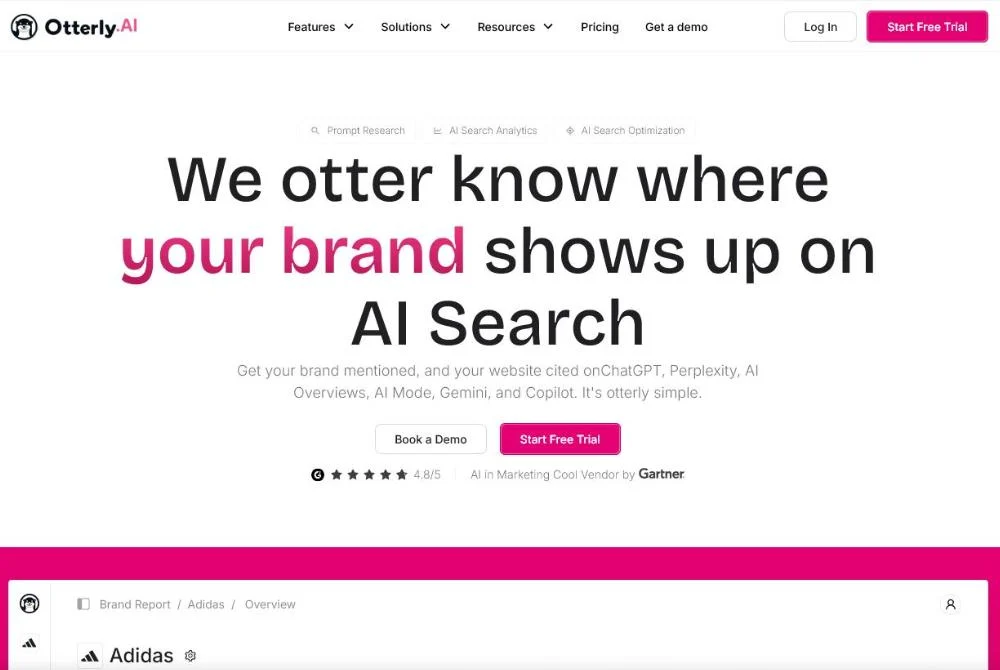 Otterly.AI’s homepage lists six engines, but only four are in the base plans.
Otterly.AI focuses on prompt research and tracking brand mentions and citations, with a content audit that checks crawlability and citation potential per page. It was named a Gartner Cool Vendor for AI in Marketing in 2025. Read our Otterly.AI review for the full picture.
The catch is in the plans: ChatGPT, Google AI Overviews, Perplexity and Copilot are included, while Google AI Mode and Gemini cost $9 a month each on Lite and Claude $29. And 15 prompts run out fast with a broad product range.
| Pros | Cons |
|---|---|
| Transparent public pricing | Only 15 prompts on Lite |
| Content audit next to tracking | AI Mode, Gemini and Claude cost extra |
| Free trial for new users | Extra prompts only from Standard up |
Alternative: Peec AI, if you manage several brands.
3. Profound (best for enterprise)
Best for: large brands that need the broadest engine coverage and deep analysis. Price: free trial with 50 prompts for 7 days; Enterprise is custom (pricing page). Biggest strength: breadth: up to nine answer engines, prompt volumes and agent analytics.
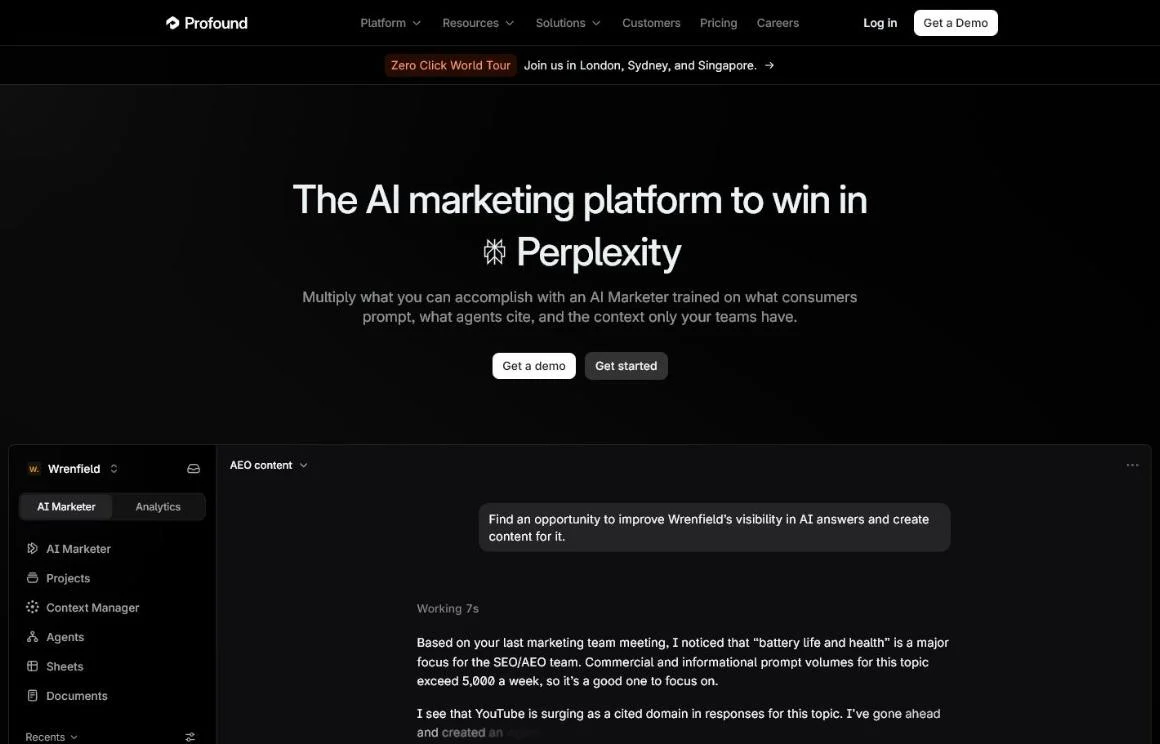 Profound now presents itself as an AI marketing platform, with an agent that proposes and drafts the work.
Profound is the heaviest platform in this list. On Enterprise it tracks up to nine engines: ChatGPT, Perplexity, Google AI Mode, Gemini, Copilot, DeepSeek, Claude, Google AI Overviews and Exa Search. It also analyzes prompt volumes, meaning what large numbers of people actually ask AI, and shows how AI bots crawl and cite your pages. Our Profound review goes deeper.
The flip side is the price: beyond the trial, the pricing page steers you to sales. For a small B2B brand that only tracks its core prompts, this is usually more tooling than needed.
| Pros | Cons |
|---|---|
| Broadest engine coverage | No public price beyond the trial |
| Prompt volumes and citation analytics | Built for enterprise budgets |
| Free 7-day trial to test it | The trial covers only three engines |
Alternative: Scrunch, if you want enterprise depth with a public price.
4. Scrunch (best for AI bot traffic and agent readiness)
Best for: larger organizations that treat AI visibility as a brand question and want to see how AI bots use their site. Price: Starter $250/mo billed yearly or $300 month to month (350 custom prompts), Growth $417/mo yearly or $500 monthly (pricing page). Biggest strength: AI bot traffic monitoring plus a machine-readable version of your site for agents.
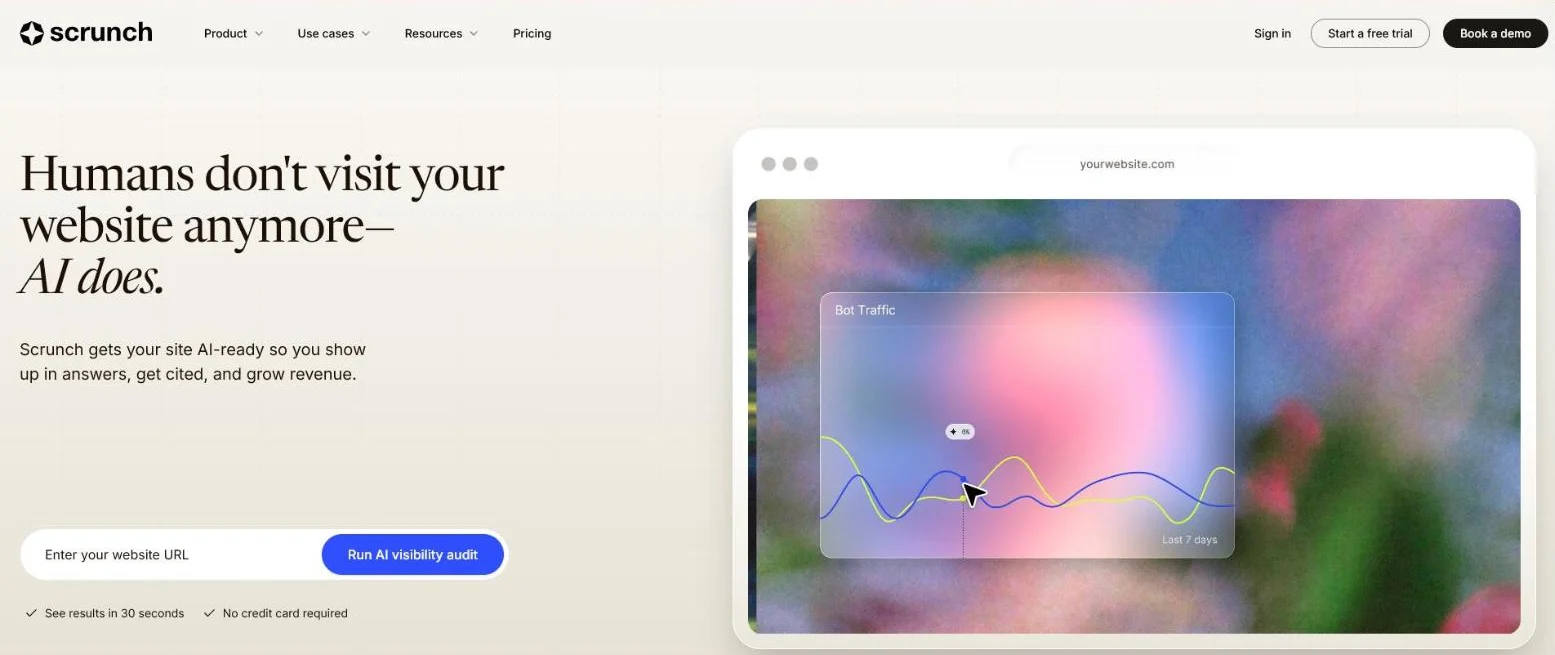 Scrunch puts AI bot traffic front and center, next to classic prompt tracking.
Scrunch tracks ChatGPT, Claude, Gemini, Perplexity, Google AI Mode, AI Overviews and Meta, and adds a real-time feed of how AI bots crawl your site. Its Agent Experience Platform serves a lightweight, machine-readable version of your pages to AI agents while the human site stays unchanged. Prices are public, and Starter comes with a 7-day trial without a credit card.
| Pros | Cons |
|---|---|
| Public prices and a free trial | Highest public entry price in this list |
| AI bot traffic per platform | Agent features need technical buy-in |
| 350 custom prompts on Starter | Overkill if you only need a few prompts |
Should you use the AI module of your SEO suite?
5. Ahrefs Brand Radar (best if you already use Ahrefs)
Best for: teams already on Ahrefs that want AI visibility next to their backlinks and rankings. Price: Brand Radar AI from €179/mo; regular Ahrefs plans start at Starter €27/mo and Lite €119/mo (pricing page). Biggest strength: AI share of voice built on an index of hundreds of millions of prompts, with YouTube and Reddit visibility.
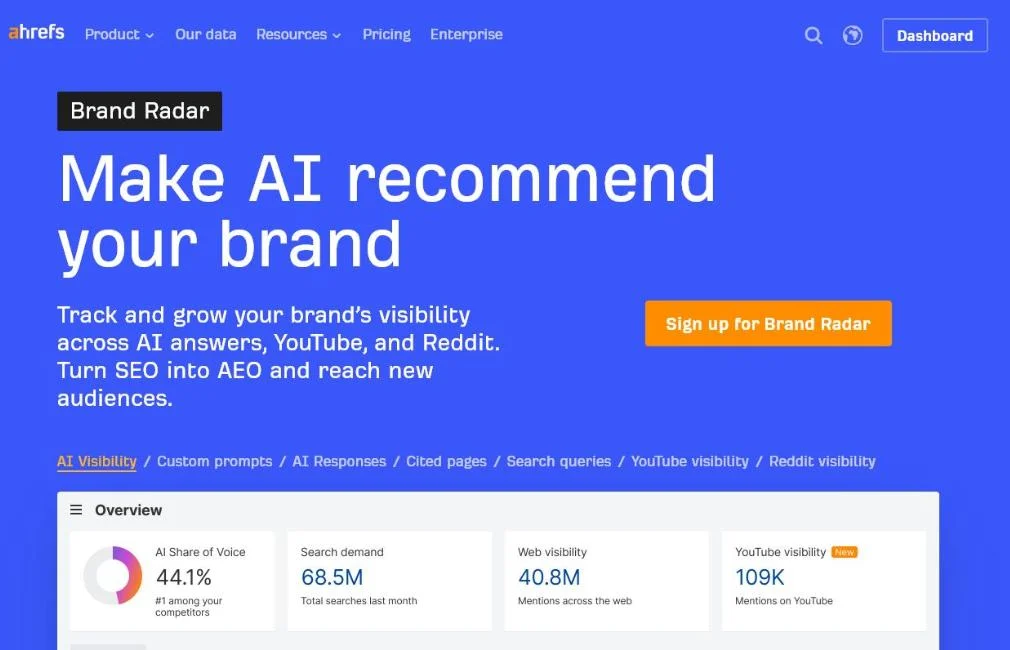 Brand Radar measures your share of AI answers against competitors, plus YouTube and Reddit visibility.
Brand Radar measures how often AI answers mention or cite your brand versus competitors across AI Overviews, AI Mode, ChatGPT, Perplexity, Gemini and Copilot. That is AI share of voice, and it sits next to the Ahrefs data you already use. Even without Brand Radar, the regular Site Explorer now counts AI responses.
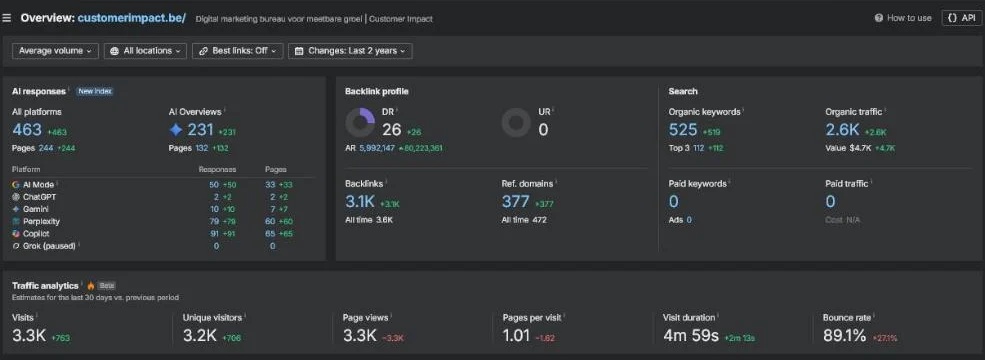 Our own Ahrefs Site Explorer: 463 AI responses mention customerimpact.be, without the Brand Radar add-on.
| Pros | Cons |
|---|---|
| No new interface to learn | From €179/mo for the AI part alone |
| Share of voice on a large prompt index | Less prompt-level control than a pure tracker |
| YouTube and Reddit visibility included | Pricing climbs with custom prompts |
6. Semrush AI Toolkit (best if you already use Semrush)
Best for: teams on Semrush that want AI visibility in the same platform. Price: $99/mo as a separate subscription, no free trial; +50 prompts cost $60/mo (Semrush knowledge base). Biggest strength: one platform for classic search and AI mentions, with a free first check.
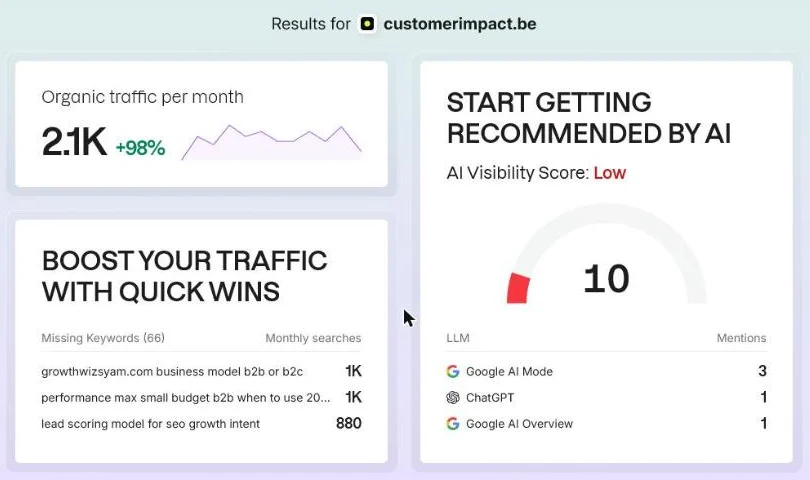 Semrush’s free snapshot for our own domain gives an AI Visibility Score of 10, no account needed.
The AI Toolkit adds AI visibility tracking to the existing platform. Before you pay anything, enter your domain on Semrush’s homepage: for customerimpact.be it showed an AI Visibility Score of 10 with mentions in AI Mode, ChatGPT and AI Overviews. That is a fair baseline. As with any all-in-one, the depth per engine does not always reach a pure tracker.
| Pros | Cons |
|---|---|
| Free AI Visibility Score per domain | Separate $99/mo subscription |
| Same environment as your SEO data | No free trial for the toolkit |
| Bundled in Semrush One plans | Extra prompts cost extra |
Alternative: Ahrefs Brand Radar, if link data is your main reason for the suite.
Which GEO tools are free?
7. Bing Webmaster Tools (the free baseline)
Best for: anyone who wants hard citation data from Microsoft Copilot for free. Price: free. Biggest strength: real citation counts per page and per query, from the source.
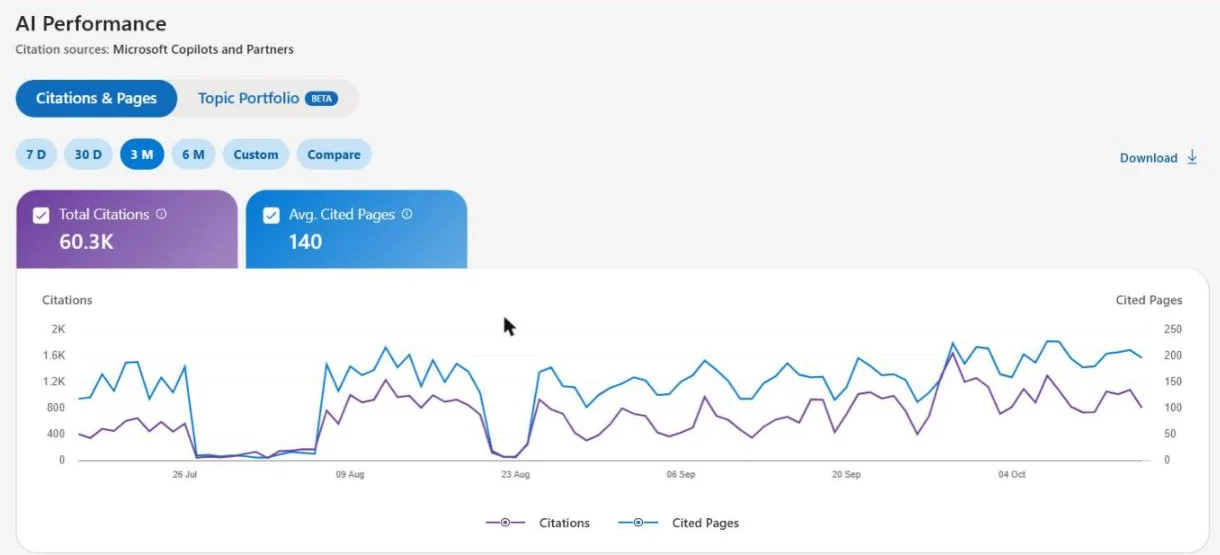 The AI Performance report in our own Bing Webmaster Tools: 60.3K citations in Copilot and partner answers in three months.
Every tracker above estimates visibility by sending prompts. Bing’s AI Performance report counts actual citations of your pages in Copilot and Bing’s partners, per page and per grounding query. For our own site it showed 60.3K citations in three months, a number no paid tool gives you. Pair it with the generative AI features report in Google Search Console, and read how to rank in Microsoft Copilot to act on it.
| Pros | Cons |
|---|---|
| Free, first-party citation data | Only Copilot and Bing partners |
| Per page and per query | No competitor view |
| Works with IndexNow for fast indexing | Beta report, interface changes often |
8. Testing prompts manually (free, and ChatGPT agrees on the shortlist)
Best for: a small brand that wants a baseline before buying a subscription. Price: free, it only costs time. Biggest strength: it forces you to decide which prompts really matter.
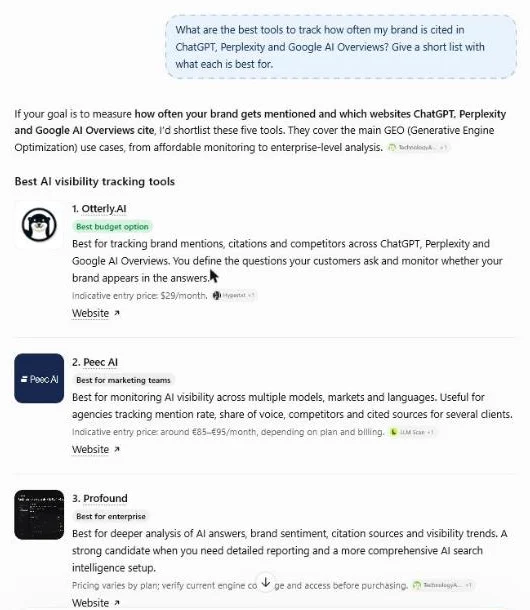 We asked ChatGPT on 17 October 2026 which tools track brand citations. Its top three: Otterly.AI, Peec AI and Profound.
You enter your key buying prompts in ChatGPT, Perplexity and Google AI Overviews and note whether and how your brand appears. We did exactly that for this article: on 17 October 2026 we asked ChatGPT for the best tools to track citations in ChatGPT, Perplexity and AI Overviews. It named Otterly.AI as the budget option, Peec AI for marketing teams and Profound for enterprise, the same order as ours. Its price estimates are indicative only; use the vendor pages above.
We run this kind of check on our own brand too: in our tracking, Perplexity named Customer Impact in 16 of 125 agency-choice prompts, up from 7. How to do it in a structured way is explained in measuring AI visibility without tools, and more free options are in free AI visibility tools.
| Pros | Cons |
|---|---|
| Free and immediate | Labor-intensive, not scalable |
| Sharpens your prompt list | Answers vary per session and location |
| Works on any engine | No history unless you log it yourself |
So which GEO tool do you choose?
Do not start with the tool but with your situation. For most B2B brands an expensive enterprise tool is overkill. Start small, measure the prompts that matter to your business, and scale only when the data justifies it.
| Your situation | Stack |
|---|---|
| One brand, no budget | Bing Webmaster Tools + Search Console + a monthly manual prompt test |
| One brand, small budget | The free base + Otterly.AI Lite |
| Agency or several brands | The free base + Peec AI |
| Already on Ahrefs or Semrush | The free base + Brand Radar or the AI Toolkit |
| Enterprise, many engines and markets | The free base + Profound or Scrunch |
Once the data comes in, turn it into a monthly AI visibility report and set up prompt monitoring for the questions that move deals. For the classic SEO side of your stack, see the best SEO tools.
The real work only begins after the measuring. A tool shows you where you stand, but not how you get cited. That is what GEO is about: building content and signals so that AI models present your brand correctly and prominently on questions with buying intent. To understand how that works, read our pillar what is GEO, and concretely getting found in ChatGPT and in Perplexity.
Frequently asked questions
What is a GEO tool?
A GEO tool is software that sends your buying prompts to AI engines like ChatGPT, Perplexity and Google AI Overviews on a schedule and records whether your brand is mentioned or cited, in what position and with what sentiment. Most also compare you with competitors and show which sources the engines cite.
Is there a free GEO tool?
Yes. Bing Webmaster Tools reports real Copilot citations for free, Search Console has a generative AI features report, and Semrush gives a free AI Visibility Score per domain. Profound, Scrunch and Otterly.AI offer free trials, and a manual prompt test costs only time.
Otterly.AI vs Peec AI: which is better?
Otterly.AI is better for one brand on a small budget: it starts at $29 a month with public prices. Peec AI is better for teams and agencies that track several brands and want sentiment and position per competitor. Peec showed no prices on its pricing page when we checked, so ask for a quote.
How many prompts should I track?
Start with 10 to 25 real buying prompts per market and language, the questions a buyer asks right before choosing a supplier. That fits Otterly.AI’s 15-prompt Lite plan or a manual test. Expand only when you know which prompts move.
Do I need a GEO tool if I already have Ahrefs or Semrush?
Not necessarily. Both now report AI visibility: Ahrefs counts AI responses in Site Explorer and sells Brand Radar, and Semrush sells the AI Toolkit. Start there, add Bing Webmaster Tools for free citation data, and only buy a pure tracker if you need prompt-level control.
Want help choosing?
We help you choose the right prompts, metrics and tool for your B2B context, connect the measurement to an approach that actually produces citations, and tell you honestly when a tool is not worth it. Contact us
Free website scan
Enter your website and get an automatic scan within minutes, with concrete technical and SEO improvements. No sales pitch.
We only use your details for your scan. No spam, unsubscribe anytime.