
Marketing automation
The 8 best marketing automation tools (2026)

Copy for AI
The best marketing automation tools in 2026 are HubSpot, ActiveCampaign, Salesforce Account Engagement, Marketo, Brevo, Klaviyo, Make and Zapier. There is no single winner: the best tool fits your process, your CRM and the length of your sales cycle. For most B2B SMEs, ActiveCampaign or HubSpot is the pragmatic start; Salesforce teams look at Account Engagement or Marketo.
Below you get a comparison table, one section per tool with the same decision lines, an example nurture flow and a table that matches each tool to a situation.
How we checked: prices come from each vendor’s own pricing page, checked on 17 October 2026, in the currency the page showed. The screenshots are the vendors’ public homepages; we did not run trials or build flows in these tools for this article, and we are not paid by any of these vendors.
Which marketing automation tools are best for B2B?
| Tool | Best for | Starting price (checked 17 Oct 2026) | CRM included | B2B fit |
|---|---|---|---|---|
| HubSpot | All-in-one marketing and sales | Free; Starter $7 per seat/mo (annual) | Yes, free CRM | Strong |
| ActiveCampaign | Serious flows on an SME budget | Not shown publicly, 14-day trial | Via Pipelines add-on | Strong |
| Salesforce Account Engagement | Teams already on Salesforce | Growth+ €1,250/mo, billed annually | Salesforce | Strong, enterprise |
| Marketo Engage | Complex enterprise programs | No public price we could load | Integrates with CRMs | Strong, enterprise |
| Brevo | Email and simple flows, low cost | Free; Starter $9/mo | Basic | Medium |
| Klaviyo | E-commerce and B2C | Free up to 250 active profiles | No | Weak |
| Make | Connecting tools visually | Free; Core $9/mo (annual) | No | Glue only |
| Zapier | Connecting tools fast | Free; Pro from $19.99/mo (annual) | No | Glue only |
Marketing automation is software that sends the right message to the right lead at the right moment based on rules: a form fill, a page visit or a score that crosses a threshold. To work this out in more depth, read what marketing automation is and how to set it up for B2B before you buy a tool.
How do you recognise a good marketing automation tool for B2B?
A tool automates what you already do. It does not invent a strategy for you. So choose your process first, then your platform. Pay attention to these five criteria:
- Lead scoring. Can the tool give leads a score based on behaviour and profile, so sales knows who is warm? Dig into lead scoring before you make a choice.
- CRM integration. Does the tool talk seamlessly to your CRM, or does it become a second, half-synced database? For B2B this is often the deciding factor. Our comparison of B2B CRMs helps if that choice is still open.
- Multichannel flows. Email alone is not enough. Can you also weave LinkedIn, forms, web pages and sometimes SMS into a flow?
- Reporting. Do you see revenue and leads per flow, or only vanity numbers like opened emails? Good reporting links automation to the pipeline.
- Scalability and price. Does the tool grow with you without the costs exploding? Calculate the price at your expected number of contacts, not at the entry level.
Which marketing automation tool fits your team?
1. HubSpot (all-in-one)
Best for: SMEs up to mid-market that want CRM, email, landing pages and reporting under one roof. Price: free plan for up to 2 users; Starter $7 per seat per month with an annual commitment ($20 monthly); Professional $800 per month annually ($890 monthly) with 3 seats and 2,000 marketing contacts, plus a $3,000 onboarding fee; Enterprise $3,600 per month (pricing page, checked 17 October 2026, USD). Biggest strength: everything works together on one contact record, in an accessible interface.
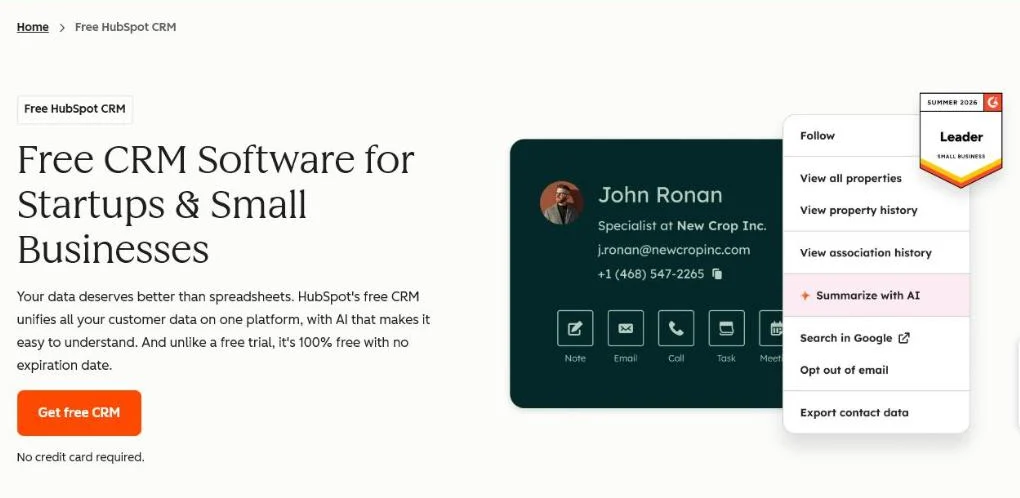 HubSpot’s Marketing Hub page, October 2026.
HubSpot is the best-known all-in-one platform: CRM, email, lead scoring, landing pages and reporting in one environment. Its great strength is that everything works together and the interface stays accessible, even for small teams. The pitfall: the entry level looks affordable, but as soon as your number of contacts grows or you need Marketing Hub Professional, the price climbs steeply. If your site is not built in HubSpot, check how the HubSpot website integration works, or for Webflow sites the Webflow and HubSpot integration.
| Pros | Cons |
|---|---|
| CRM, email and reporting in one place | Professional tier is a big price jump |
| Free plan to start | Onboarding fees on higher tiers |
| Accessible for small teams | Overkill if you only need automation |
2. ActiveCampaign (serious flows, SME budget)
Best for: SMEs that want powerful visual flows and lead scoring without an enterprise budget. Price: not shown publicly; the pricing page asks you to request pricing for your contact count and offers a 14-day free trial. Lead scoring and deal pipelines come with the Pipelines add-on (pricing page, checked 17 October 2026). Biggest strength: the visual automation builder, with branching on behaviour and score.
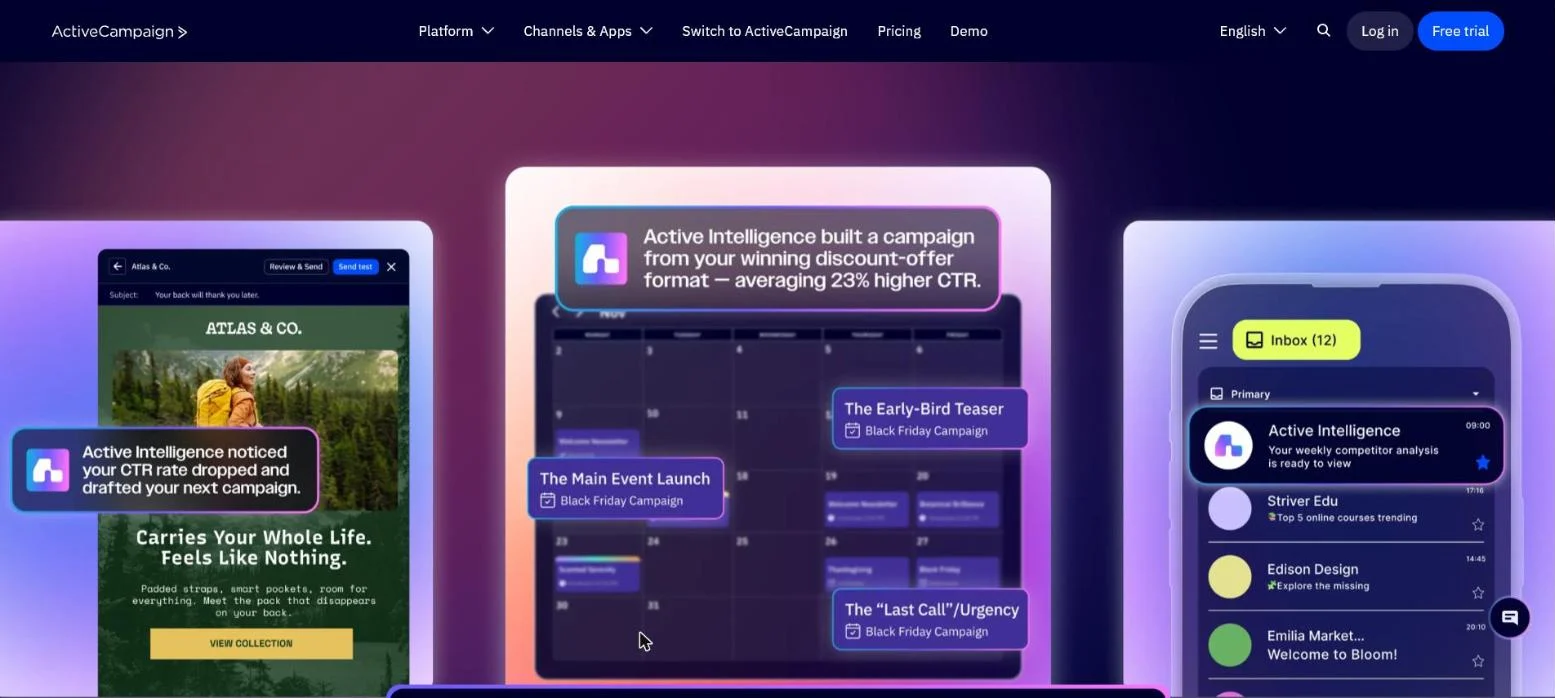 ActiveCampaign’s homepage, October 2026.
For many B2B SMEs, ActiveCampaign is the pragmatic starting point. You get powerful, visual automation flows and solid lead scoring without buying an all-in-one suite. Because the pricing page now shows a request form instead of prices, ask for a quote at your real contact count before you decide. The built-in CRM is lighter than HubSpot’s, but more than enough for most SME journeys.
| Pros | Cons |
|---|---|
| Strong visual flow builder | No public price list |
| Lead scoring tied to behaviour | CRM and scoring sit in an add-on |
| Good fit for long nurture sequences | Less suited to complex enterprise setups |
3. Salesforce Account Engagement (formerly Pardot)
Best for: larger B2B organisations that already run on Salesforce and have a dedicated team. Price: Growth+ €1,250, Plus+ €2,750, Advanced+ €4,400 and Premium+ €15,000 per org per month, billed annually; 10,000 contacts included (75,000 on Premium+) (pricing page, checked 17 October 2026, EUR). Biggest strength: the deepest link between marketing activity and the Salesforce pipeline.
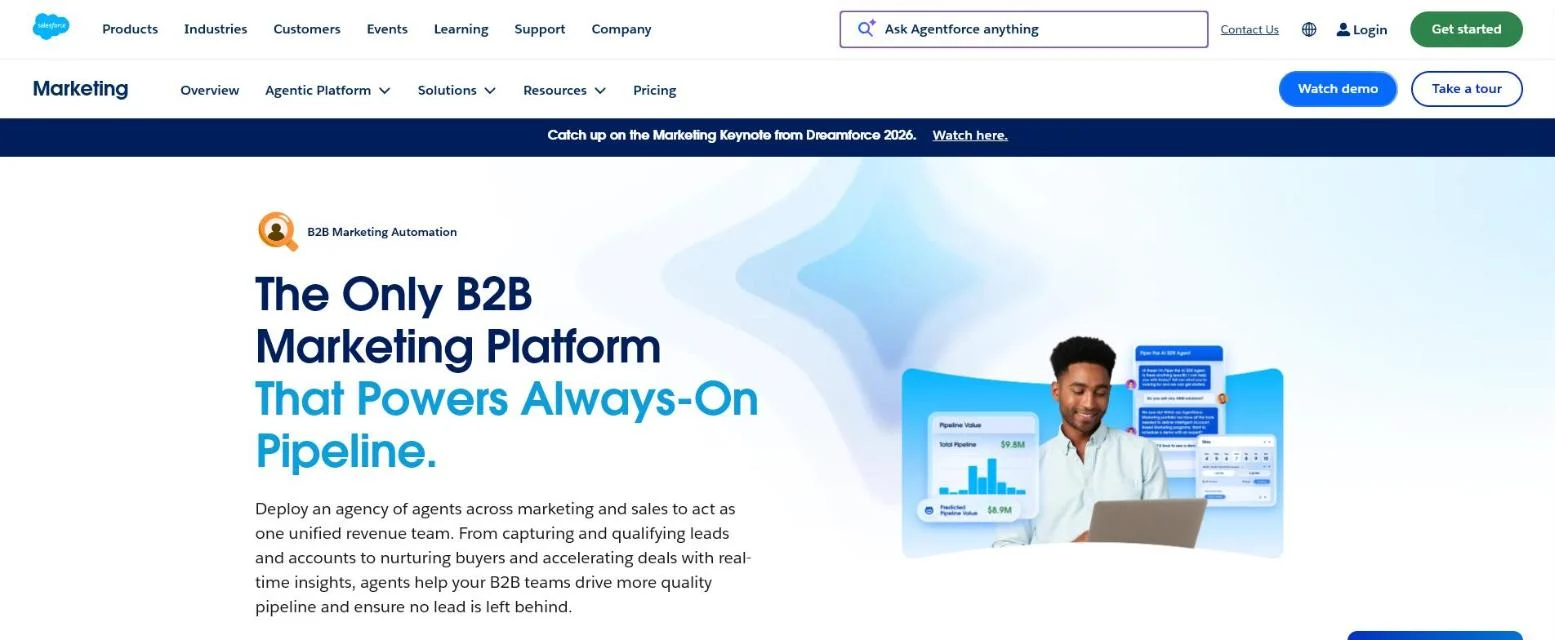 Salesforce’s Account Engagement page, October 2026.
Marketing Cloud Account Engagement, long known as Pardot, is the automation layer on top of Salesforce. The logical choice if you already run on Salesforce: the integration between marketing and sales is deep and the reporting links seamlessly to your pipeline. The downside is the price and the complexity: an annual contract from €1,250 a month and an implementation you rarely do alone.
| Pros | Cons |
|---|---|
| Native Salesforce integration | Annual contract required |
| Reporting tied to pipeline revenue | High entry price |
| Built for B2B account journeys | Needs Salesforce skills to run |
4. Marketo Engage (Adobe)
Best for: enterprise marketing teams with a lot of volume and the people to manage it. Price: we could not load a public price list for Marketo Engage on 17 October 2026; expect a quote from Adobe’s sales team. Biggest strength: depth for complex programs: advanced lead scoring, account-based marketing and extensive flows.
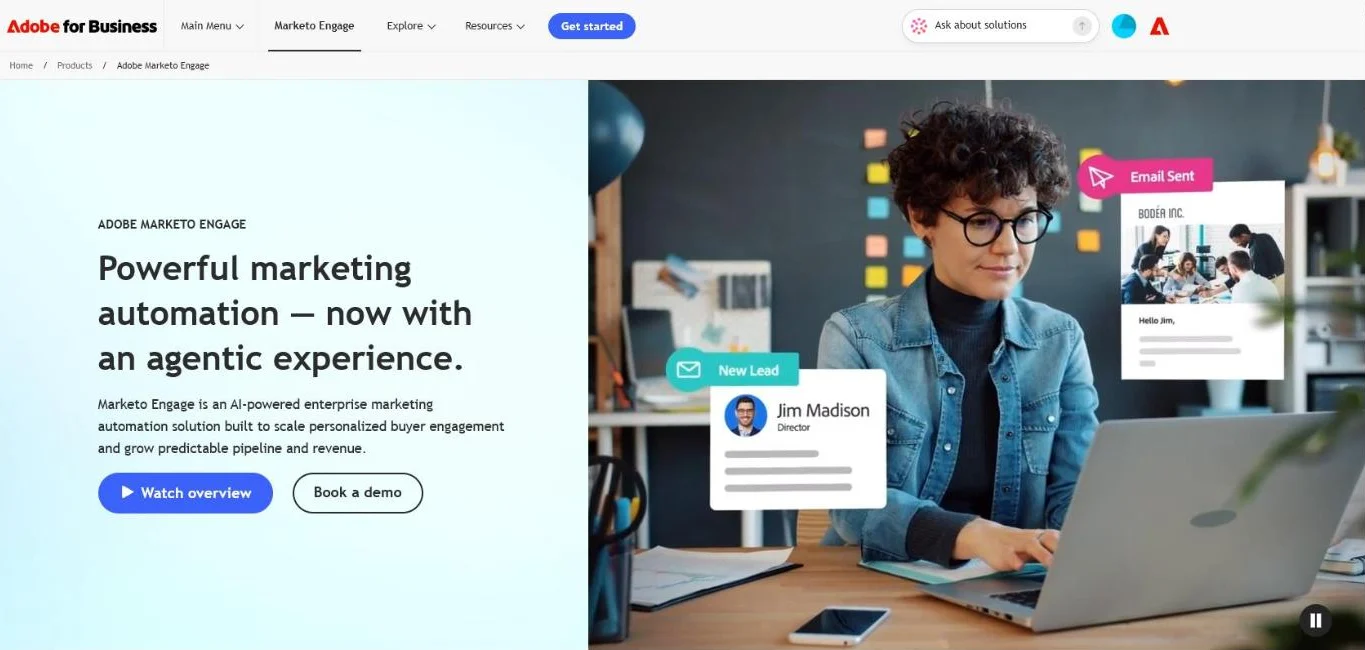 Adobe’s Marketo Engage page, October 2026.
Marketo Engage, part of Adobe, is a heavyweight for complex B2B automation: advanced lead scoring, account-based marketing and extensive flows. Its strength is depth and scalability; the price sits in the enterprise segment. The learning curve is steep, so count on onboarding time or external help.
| Pros | Cons |
|---|---|
| Very deep scoring and program logic | No public price |
| Strong for account-based marketing | Steep learning curve |
| Scales to large volumes | A size too big for most SMEs |
5. Brevo (affordable European email and automation)
Best for: smaller B2B teams that start pragmatically with email and simple flows. Price: Free plan; Starter $9, Standard $18 and Professional $499 per month; Enterprise on quote (pricing page, checked 17 October 2026, USD as shown). Biggest strength: a low entry price with email, automation and SMS in one European platform.
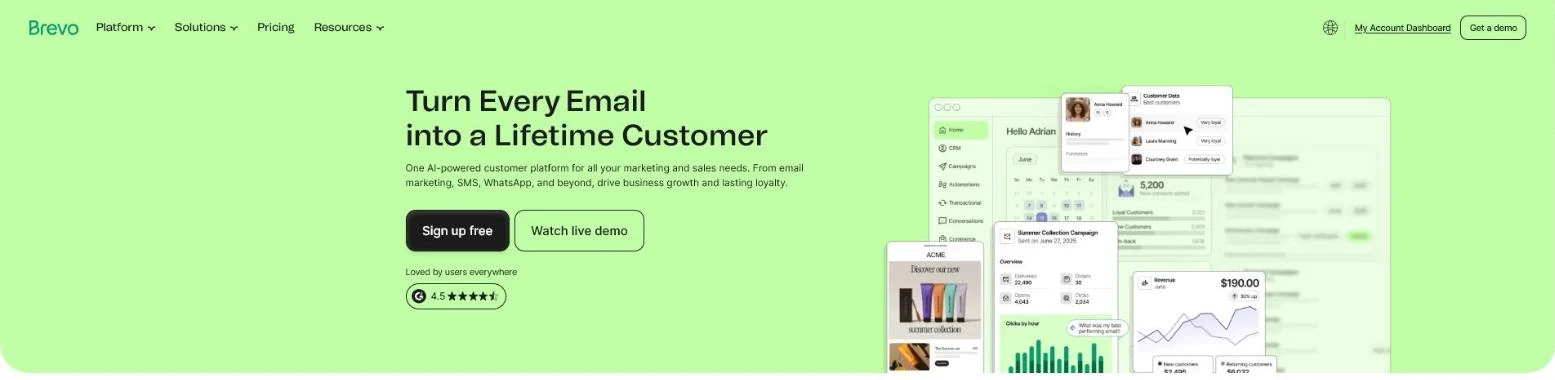 Brevo’s homepage, October 2026.
Brevo, formerly Sendinblue, is an affordable European platform with email, marketing automation and SMS. The automation is solid for welcome and follow-up flows, although the lead scoring reaches less far than at HubSpot or ActiveCampaign.
| Pros | Cons |
|---|---|
| Low entry price and a free plan | Lighter lead scoring |
| European platform | Less suited to account-based scenarios |
| Email, SMS and automation together | Professional tier jumps to $499/mo |
6. Klaviyo (e-commerce)
Best for: e-commerce and B2C brands on Shopify or WooCommerce. Price: free up to 250 active profiles and 500 email sends a month; paid plans are configured in a plan builder and were not listed on the page we read (checked 17 October 2026, USD). Biggest strength: flows built on product and purchase behaviour, with revenue per email.
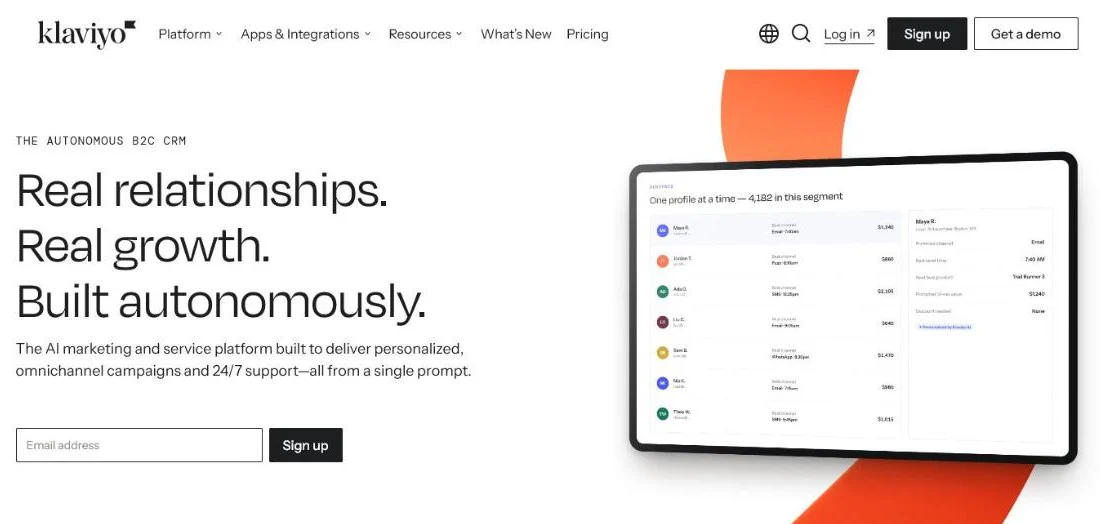 Klaviyo’s homepage, October 2026. Built for B2C commerce, not long B2B cycles.
Klaviyo is built around e-commerce and online stores. For a B2C brand with a store it is excellent: product behaviour, segmented flows and strong reporting on revenue per email. For classic B2B with long sales cycles and account-focused work it rarely fits.
| Pros | Cons |
|---|---|
| Excellent e-commerce flows | Weak fit for B2B lead generation |
| Revenue reporting per email | No real B2B lead scoring |
| Free plan for small lists | Price grows with profiles |
7. Make (visual glue between tools)
Best for: teams that want to connect separate tools with visual, multi-step scenarios. Price: Free with 1,000 credits a month; Core $9, Pro $16 and Teams $29 per month for 10,000 credits, billed annually (pricing page, checked 17 October 2026, USD). Biggest strength: complex branching scenarios for little money.
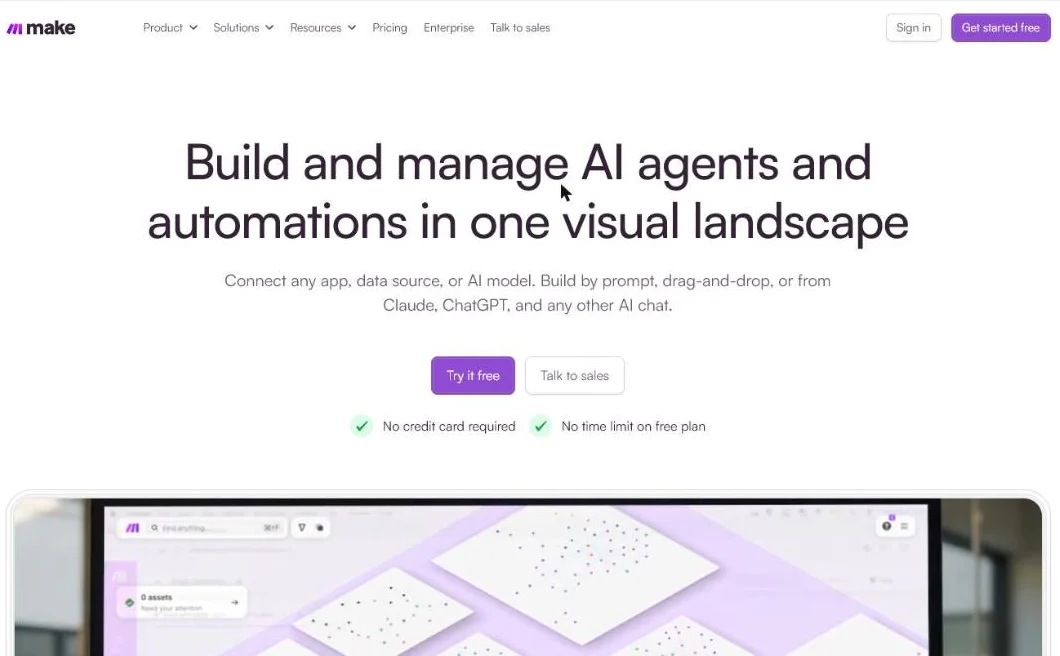 Make’s homepage, October 2026.
Make does not automate marketing as such, but connects your tools to each other: forwarding a form submission to your CRM, enriching a lead, a Slack notification on a warm lead. See it as the glue between platforms that otherwise do not talk. It does not replace a full automation platform, but plugs gaps no single suite covers. A typical case is connecting lead ads to your CRM.
| Pros | Cons |
|---|---|
| Very low price per run | Not a marketing platform on its own |
| Visual, branching scenarios | Scenarios need maintenance |
| Hundreds of app connectors | Credit use is hard to predict upfront |
8. Zapier (fast glue between tools)
Best for: teams that want to connect apps quickly without building complex logic. Price: Free with 100 tasks a month; Pro from $19.99 per month billed annually ($29.99 monthly) for 750 tasks; Team from $69 per month billed annually (pricing page, checked 17 October 2026, USD). Biggest strength: the widest app catalogue and the fastest setup.
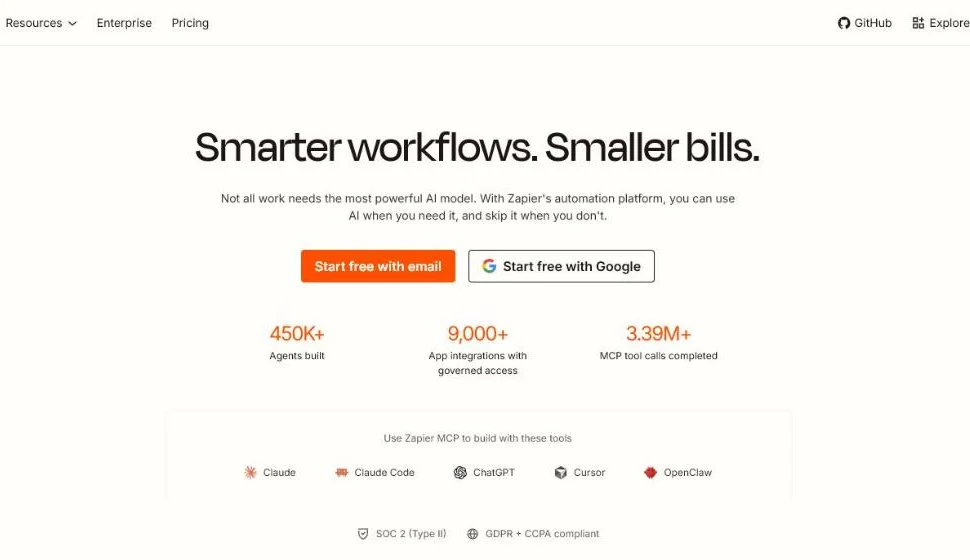 Zapier’s homepage, October 2026.
Zapier does the same job as Make with a simpler interface. It is the fastest way to get a form, a CRM and a chat tool talking, and the right pick when nobody on the team wants to maintain branching scenarios. At higher volumes it gets more expensive than Make.
| Pros | Cons |
|---|---|
| Fastest setup, huge app catalogue | Pricier than Make at volume |
| Simple for non-technical marketers | Less suited to complex branching |
| Free plan to test | Task limits add up quickly |
What does a 3-email B2B nurture flow look like?
The tool matters less than the flow you put in it. Below is an example 3-email nurture for a lead who downloads a guide. It works the same way in HubSpot, ActiveCampaign, Brevo or Account Engagement: a trigger, three emails with a wait step in between, and a score threshold that hands the lead to sales.
| Step | Trigger or wait | Message | Goal | Exit rule |
|---|---|---|---|---|
| 1 | Form: guide downloaded | Email 1: the guide plus one practical tip | Deliver value, set expectations | Books a call |
| 2 | Wait 3 days | Email 2: a relevant example or proof point | Build trust | Books a call |
| 3 | Wait 4 days | Email 3: a clear next step (audit, demo, call) | Ask for a reply | Books a call |
| 4 | Lead score passes your threshold | Internal task for sales | Personal follow-up | Deal created |
How long to wait between emails and what to put in them is covered step by step in how to build an email nurture flow, with more examples in our article on nurturing email flows and the broader guide to lead nurturing.
Which marketing automation tool do you choose?
| Your situation | Pick | Why |
|---|---|---|
| Already on Salesforce | Account Engagement | Native pipeline reporting |
| B2B SME, serious automation, modest budget | ActiveCampaign | Strong flows and scoring |
| Want CRM and marketing under one roof | HubSpot | One contact record, one interface |
| Large enterprise programs, ABM | Marketo Engage | Depth and scale |
| Small team, mostly email | Brevo | Low price, free plan |
| Online store, B2C | Klaviyo | Commerce-native flows |
| Need to connect separate tools | Make or Zapier | Glue between platforms |
Choose from your situation, not from the longest feature list. If you already run on Salesforce, Account Engagement is the logical route. If you are a B2B SME that wants to automate seriously without an enterprise budget, ActiveCampaign is often the best value-for-money choice, with HubSpot as an alternative when you want everything under one roof. If you run an e-commerce, then look at Klaviyo. And almost every team also needs Make or Zapier to plug the final gaps.
Remember: the tool is at most 20 percent of the result. Your lead scoring, your nurturing email flows and the follow-up by sales determine the rest. AI now speeds up the writing and segmenting part, see AI in marketing automation. If you want to compare platforms more deeply side by side, read our detailed comparison of marketing automation tools for SMEs. If you are still in doubt about managing everything yourself, look into outsourcing marketing automation and how it connects to your lead generation.
HubSpot vs ActiveCampaign: which one for a B2B SME?
Choose HubSpot when you want CRM, website forms, email and reporting in one system and accept a steep price jump at the Professional tier. Choose ActiveCampaign when automation and lead scoring are the core and your CRM needs are light. HubSpot publishes its prices; ActiveCampaign now asks you to request a quote, so compare both at your real contact count.
What this means for your AI visibility
More and more B2B buyers ask their first question to ChatGPT, Copilot or Gemini instead of Google. Anyone who wants to be named in those AI answers as a recommendation for marketing automation must publish clear, honest and well-structured content that AI models can cite. That is exactly what a GEO approach does: making you visible at the moment the buyer is orienting themselves. Read how that works in our resources on GEO for B2B.
Frequently asked questions
What is the best marketing automation tool for a small B2B company?
ActiveCampaign or HubSpot. ActiveCampaign gives the strongest flows and scoring for an SME budget; HubSpot is the better pick when you also want a CRM and landing pages in the same system. Brevo is the cheapest serious start if you mainly send email.
Is there free marketing automation software?
Yes, with limits. HubSpot, Brevo and Klaviyo have free plans, and Make and Zapier have free tiers for connecting tools (checked 17 October 2026). Free plans rarely include lead scoring, which is what B2B teams need most.
What is the difference between Make and Zapier?
Both connect apps. Make is cheaper per run and better at visual, branching scenarios; Zapier is faster to set up and has the wider app catalogue. Neither replaces a marketing automation platform.
How much does marketing automation cost for B2B?
On 17 October 2026 it ranged from free plans to $800 a month for HubSpot Marketing Hub Professional (annual) and €1,250 a month for Salesforce Account Engagement Growth+. Add onboarding fees and the contact tier you will need in a year.
Ready to choose?
Tell us your process, your CRM and your goal, and we will honestly tell you which tool fits and how we build your flows that deliver leads. Contact us and you will hear within 24 hours where your opportunities lie.
Free website scan
Enter your website and get an automatic scan within minutes, with concrete technical and SEO improvements. No sales pitch.
We only use your details for your scan. No spam, unsubscribe anytime.