
Leadgeneratie
Lead nurturing: how to turn cold leads hot

Copy for AI
Some links in this article are affiliate links. If you choose a tool through one of them, we may earn a commission. It costs you nothing extra and does not change our assessment.
Lead nurturing turns a random passer-by into a customer with the right content per stage.
You combine content and channels so a lead gets what it needs at each step of the sales funnel.
The verdict: match your content to the funnel stage, segment for relevance, and judge the result on new customers. Open rates don’t count.
Today’s customer is well informed and active across several channels. So sales and marketing need relevant information for every step of the buyer journey.
Which content and channels help you chase leads and win new customers? That’s what this guide answers, stage by stage.
Apply it right away: calculate what a lead is worth with our value-per-lead calculator.
Definition of lead nurturing: warm, cold, hot!
Lead nurturing is guiding a lead from first contact to buying intent with relevant content.
They sometimes say no two leads are alike.
Still, three types of leads interact with your brand: cold, warm and hot.
Cold leads
Cold leads are companies that don’t know your brand or have shown little interest.
They don’t know who you are, or that they need your product or service.
Don’t worry. The vast majority of your leads once started out cold.
Warm leads
Warm leads are potential customers who show interest in your product or service.
They’ve interacted with your brand several times. For example, they visited several pages, filled in a lead generation form or signed up for the newsletter.
They may not be ready to buy yet, but they know your company and trust you.
Hot leads
Hot leads are qualified and ready to buy.
All you have to do now is convince them to buy from you instead of from your competitors.
Interest isn’t buying intent
That distinction is crucial.
Many leads show interest, but only a small share genuinely intend to buy at that moment.
Nurturing bridges exactly that gap.
How CRM stages map to cold, warm and hot
Most CRMs track this as lifecycle stages. HubSpot’s lifecycle stages run from subscriber and lead to MQL, SQL, opportunity and customer.
The default list has 7 stages, ending with evangelist:
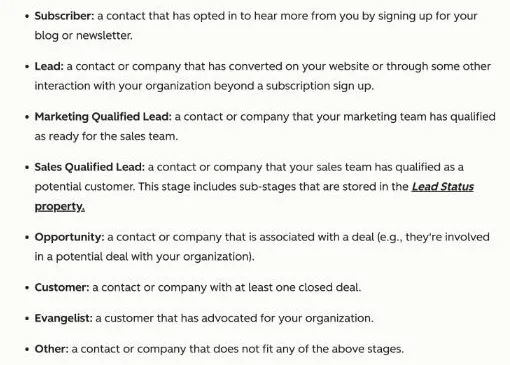 HubSpot’s lifecycle stage definitions, checked 18 October 2026.
HubSpot defines an MQL as a contact your marketing team has qualified as ready for sales.
Sales then decides whether it’s an SQL.
Roughly, cold maps to subscriber, warm to lead and MQL, and hot to SQL. Our guide to MQL versus SQL draws the line in detail.
How do you move potential customers from cold to warm to hot? By guiding them through the funnel:
How does Top of the Funnel (TOFU) nurturing work?
It reaches a broad audience with useful content and no sales pitch.
The top of the funnel is also called the awareness stage. The goal is to attract a large number of potential leads.
You want to reach a broad audience without actively filtering or discouraging conversions.
What TOFU content does
TOFU content makes your audience aware of a problem, need or challenge they want to solve.
It does that without sales arguments.
So forget your sales pitch and focus on genuine contact.
Tell a story, spark interest, and give leads useful information.
Examples of TOFU content
Here are a few formats that work at the top:
- Educational content: it makes your audience’s life easier, without promoting the product
- SEO articles: they match the search terms your audience uses
- Introduction videos: they show your brand personality and your offer
- Podcast episodes: they discuss trends or current topics in your industry
Where to promote TOFU content
Unfortunately, people rarely discover your content on their own.
To reach them, use these platforms:
- Organic posts on social media such as LinkedIn, X (formerly Twitter) or Instagram
- Paid ads on social media or through Google Ads
Rule of thumb: at the top, judge content on who it attracts, not on how many.
How does Middle of the Funnel (MOFU) nurturing work?
It shows why your offer solves the problem, and keeps building trust.
In the middle of the funnel, the consideration stage, prospects show more specific interest.
For example, an employee has read your blog or follows you on social media. But they aren’t very interested in buying anything yet.
What MOFU content does
The content here explains your product or service and why it solves their problem.
Keep building trust, too.
Don’t send only sales-focused content, and avoid coming across as overly enthusiastic.
Content that works in the middle
These formats do well in the consideration stage:
- Customer success stories and reviews: proof of how you’ve helped others
- Downloadable content: e-books or whitepapers in exchange for an email address
- Webinars or YouTube tutorials: depth without a sales call
- Personal or industry-specific landing pages: they speak to one pain point
Downloads make it easier to stay in touch, because you get an address to follow up on.
MOFU channels
Digital channels to promote your content include:
- Organic posts on social media
- LinkedIn InMails to leads you’ve interacted with before
- Email marketing or newsletters
- Paid campaigns on social media or Google
Why email deserves special attention
According to Ascend2 research, email marketing is the most effective lead generation tactic. Websites and landing pages come close behind.
It’s also one of the easiest channels to launch. You control your list, and you reach a prospect directly and repeatedly without paying per click.
For a B2B SME, that’s often the fastest path to qualified leads without a big budget.
Relevance beats personalisation
The engine behind good email nurturing isn’t personalisation, but relevance. Sending on behavior instead of the calendar gets you there fastest: see behavioral email marketing.
An automated “Dear [first name]” no longer convinces anyone. What counts is content that genuinely solves your prospect’s problem.
So segment by persona and funnel stage, for example based on your CRM data. Our guide to email list segmentation shows how to split a list.
Then, instead of a sales pitch, send content that helps first before it asks for anything.
Automate the flow, not the thinking
A marketing automation tool sends the right email when a lead takes an action. ActiveCampaign is one of the tools built for these flows:
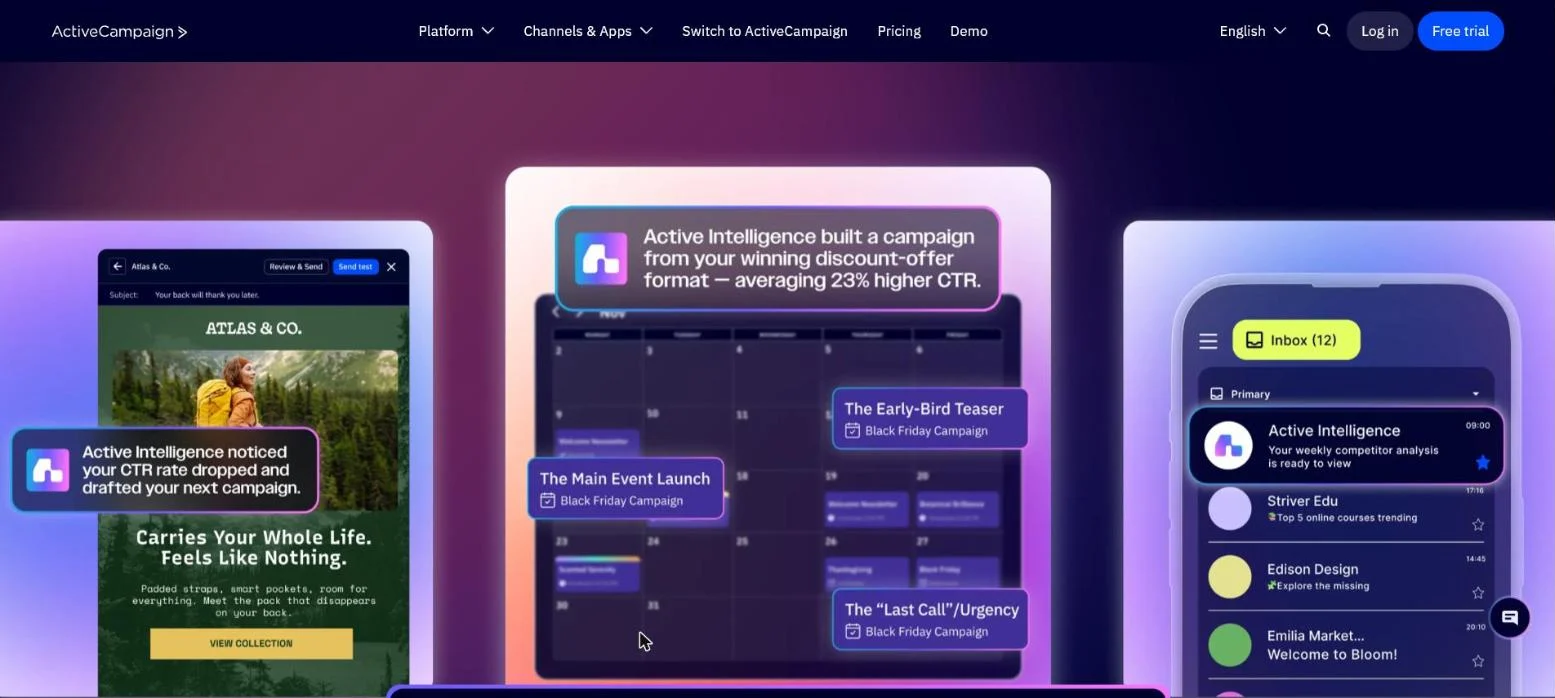 ActiveCampaign’s homepage, October 2026. Claims on the banner are the vendor’s own, not a test we ran.
Our experience: we’ve built these flows in HubSpot, ActiveCampaign and Brevo, from newsletter sign-up and active or inactive contacts to lead scoring and drip campaigns.
Where tools didn’t talk to each other, Make and Zapier closed the gaps.
Want the step-by-step build? Read how to build an email nurture flow, or compare tools in our list of the best marketing automation tools.
Ps. Do you also want to pay more attention to your prospects? Try our outbound sales automation and start collecting prospects automatically today.
How does Bottom of the Funnel (BOFU) nurturing work?
It gives a buyer who’s comparing options the final push.
The bottom of the funnel is the decision moment in your sales process. Potential customers have become potential buyers.
They’ve taken note of your offer and are ready to buy.
Just a final push is needed to close.
What BOFU leads are doing
These people are most likely comparing you with your competitors, to see who best meets their needs.
So enter into conversation with them, and don’t only focus on selling.
Build a relationship and share valuable information. That shows you’re the right partner for their challenges.
Content at the bottom of the funnel
These formats help a buyer decide:
| Content | What it does for the buyer |
|---|---|
| A clear pricing page | Removes the “can we afford this?” doubt |
| Customer references | Shows peers chose you |
| A free assessment or evaluation | Lets them see value before paying |
| A demo or consultation | Answers their specific questions |
| A discount code or free trial | Lowers the risk for e-commerce or SaaS buyers |
| An FAQ page | Clears up common objections |
| A feature comparison table | Shows your strengths against competitors |
Writing the proof pages? See our guides to a strong case study page and to showing pricing on a B2B website.
BOFU channels
Much of that content lives on your website.
You can also keep feeding buyers information through these platforms:
- Email marketing: follow-ups tied to what they viewed
- LinkedIn InMails: once you already have personal contact
- Paid retargeting: ads on social media or Google that keep you top of mind
- Peer review sites: G2 or the equivalent in your industry
Google calls its retargeting option your data segments.
It lets you re-engage people who already interacted with your brand or services.
LinkedIn offers the same through Matched Audiences, segmenting people by their actions with your brand.
Our guide to retargeting B2B leads covers the setup, and our piece on G2 and Capterra reviews the review side.
How do you measure lead nurturing on customers, not vanity metrics?
By counting requests and new customers, not opens and clicks.
How do you know whether your nurturing really works? Not on open and click rates.
Those look nice in a report, but they’re vanity metrics. They say nothing about who actually becomes a customer.
The one question that counts
How many of the leads you nurture eventually became a request or a customer?
For example, say one segment opens every email but never books a call, while another opens less and buys. The second segment is the one that pays.
What to track per segment
Track a short chain per segment and per content piece:
- Lead to MQL: does the content move people forward?
- MQL to SQL: does sales accept what marketing sends?
- SQL to customer: does the nurtured lead actually buy?
A lead scoring model helps you decide when a lead moves on.
Keep that sharp, and you’ll see immediately where to put more effort.
Frequently asked questions about lead nurturing
What is lead nurturing in simple terms?
It’s guiding a lead from first contact to buying intent by giving them relevant content at every stage. Cold leads get information, warm leads get proof, and hot leads get the final push.
Which channel works best for lead nurturing?
Email is often the strongest, because you control the list and can reach a prospect repeatedly without paying per click. Combine it with LinkedIn, retargeting and your website for the other stages.
How do I know if my lead nurturing works?
Count how many nurtured leads become a request or a customer. Open and click rates only show attention, not buying intent.
Ready to turn cold leads hot?
Want to take the lead on your digital future together? See what a lead nurturing programme can do for your company, or let us set up the flows through our marketing automation service.
Contact us right away and we’ll start by mapping which of your leads are cold, warm and hot today.
Further reading
Free website scan
Enter your website and get an automatic scan within minutes, with concrete technical and SEO improvements. No sales pitch.
We only use your details for your scan. No spam, unsubscribe anytime.