
SEO & GEO
How Software Review Platforms Like G2 and Capterra Boost B2B AI Visibility

Copy for AI
Do AI assistants favor G2 and Capterra over your own product pages? For comparison prompts, often yes: a model trusts independent, aggregated reviews more than a vendor describing itself. Your product pages still matter, but a complete, recent G2 and Capterra profile is what confirms you belong on the shortlist.
Below you learn how AI engines use these software review platforms, which profile fields matter, eight concrete steps, and the honest nuance about how often AI actually cites them.
How we checked: the profile and AI-answer screenshots in this article were taken in October 2026 on public pages, with United States and English settings, without logging in to any vendor account. Platform figures and rules come from G2’s own pages, read on 17 October 2026.
Why do G2 and Capterra weigh so heavily in AI comparisons?
A software review platform is a website where verified users rate and review business software, sorted into categories so buyers can compare products side by side. AI models rely on independent, aggregated sources, and review platforms are exactly that. G2 and Capterra (the latter part of Gartner) collect user reviews, structure products into categories and display them in a comparable format. G2 alone says it lists more than 180,000 products in over 2,000 categories and serves more than 200 million buyers a year. For a model that is gold: the data is built consistently, comes from third parties rather than the vendor itself, and covers an entire market in one standardized grid.
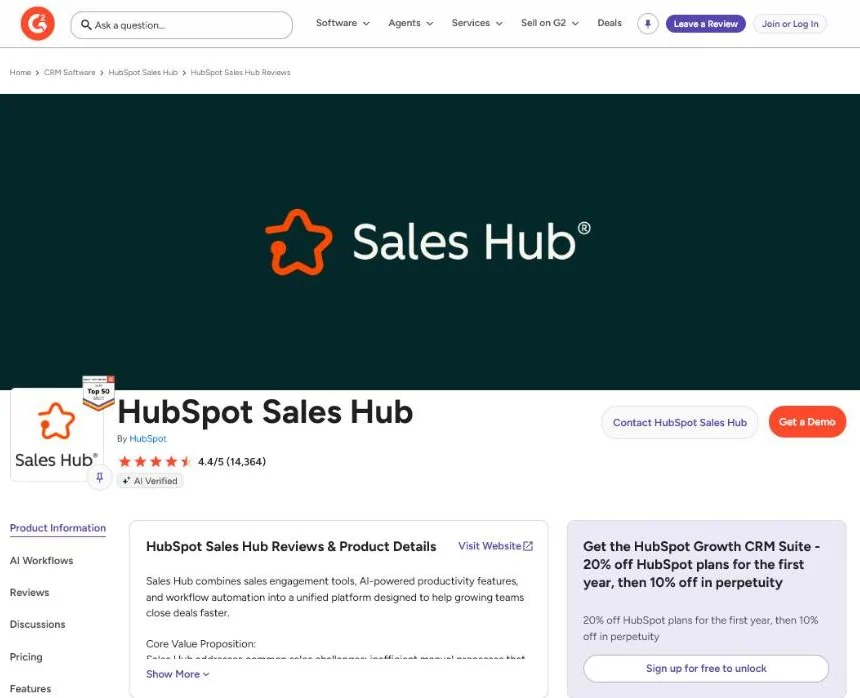 A public G2 profile: rating, review count and categories in one standardized grid that models can read.
That explains why these platforms weigh in disproportionately. A claim on your own website (“we are the best CRM for SMBs”) is suspect to a model, because every vendor says that. That same positioning, confirmed by hundreds of reviews and a category classification on an independent platform, is a far stronger signal. The model reads not only that you exist, but also in what context, for which type of buyer and with what sentiment you are mentioned. This ties into a broader principle in AI search: brand mentions often weigh more heavily than backlinks, and a review is a mention with sentiment and context baked in.
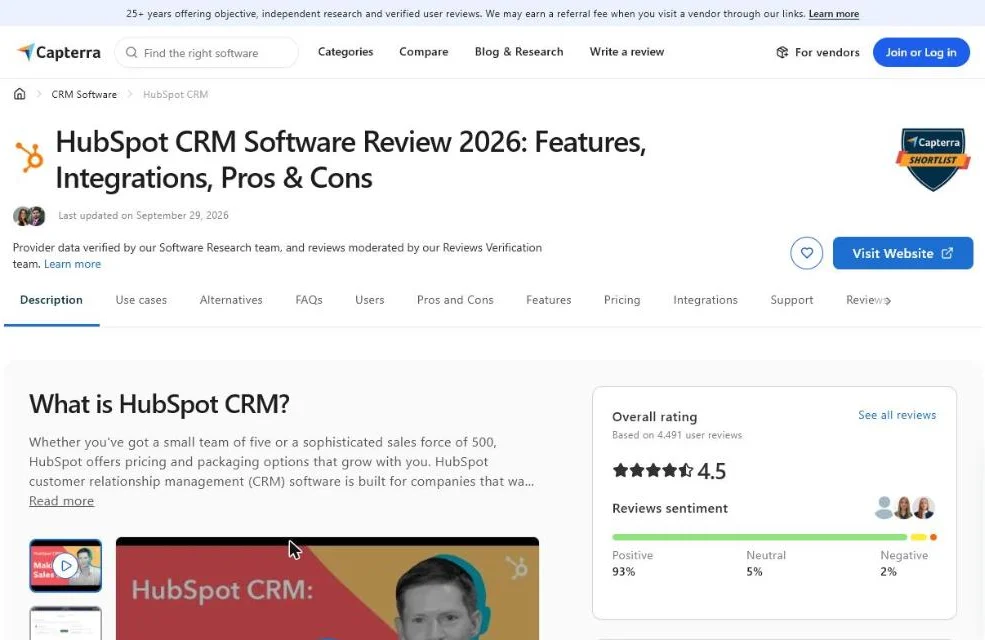 The same vendor on Capterra: the fields differ slightly from G2, but both structure the product the same way.
How exactly do AI engines use review platforms as a source?
AI engines mainly use review platforms as a validation layer while retrieving and weighing information, not always as the sentence you see in the answer. Broadly, they play a role at two moments.
First, during training. Models are trained on huge volumes of web text in which G2 and Capterra data, along with the countless articles that reference them, are heavily represented. As a result, a model already “knows” the association between your product and its category before any live query comes into play.
Second, during real-time source retrieval. Engines that search live fetch current pages to back up their answer; Perplexity, for example, says it searches the internet in real time and adds numbered citations to every answer. Review platforms rank strongly in classic search results for comparative queries, so they often end up in that source set. This whole process, in which a model checks what is true and reliable, is called grounding and it determines whether your product makes the cut. How this differs per engine is covered in our guide on ranking in Perplexity and in which sources ChatGPT cites.
You can see this for yourself with one prompt. Ask ChatGPT, Perplexity and Gemini “What is the best CRM software for small B2B teams?” and open the sources of each answer.
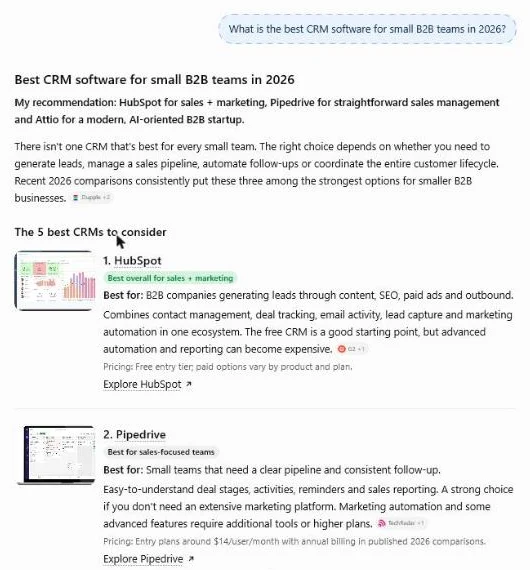 ChatGPT (free, 17 October 2026): G2 is cited as a source for its HubSpot recommendation. The only one of the three assistants that showed a review site.
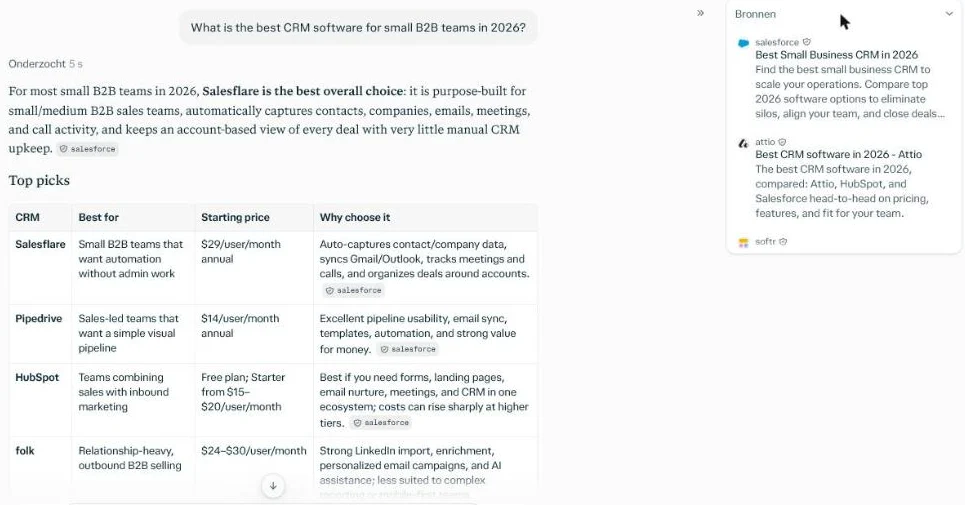 Perplexity (17 October 2026): 11 sources, led by vendor blogs from Salesforce, Attio and Softr. No G2 or Capterra in the visible sources.
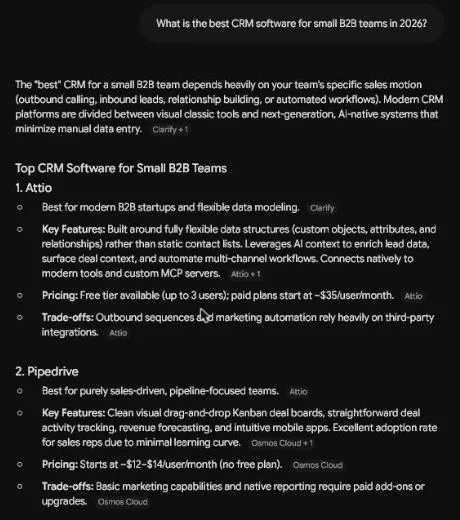 Gemini (17 October 2026): every visible citation points to a vendor page (Clarify, Attio, Osmos Cloud), not to a review site.
When we ran this test on 17 October 2026, only ChatGPT cited a review site (G2, next to its HubSpot pick). Perplexity and Gemini leaned on vendor blogs and comparison pages. So a strong G2 or Capterra profile helps, but it is one source among many: your own comparison pages and third-party write-ups carry at least as much weight.
Why is a complete and recent profile an inclusion gate?
A complete, up-to-date profile works as a gateway to the AI answer: without a profile you often stay out of view, with a half-empty profile you show up incompletely or incorrectly. This is the most important mechanism to understand, because it is a threshold, not a ranking.
Picture a profile the way a model “reads” it. If your product lacks a clear category, the model does not know which comparison you belong in. If your integrations, target audience and core features are missing or outdated, a model cannot place you correctly and would rather pick a competitor that is described clearly. If your reviews are old or scarce, the signal that you are still active and relevant today is missing. The consequence is not necessarily an error message, but silence: you simply are not mentioned.
At the same time, the honest nuance matters: a profile full of stars is an entry ticket, not a guaranteed first place. It brings you into consideration, but the final answer is also shaped by how often and how consistently you show up elsewhere in the market. Making the same name, category and positioning recur everywhere, your entity consistency, strengthens the effect of a strong review profile.
Which profile fields matter most for AI answers?
| Profile field | What to fill in | Why it matters for AI |
|---|---|---|
| Category | The one or two categories where your buyer actually searches | Decides which comparison prompts you can appear in |
| Product description | One plain sentence: what it is, for whom, which problem | Models reuse clear descriptions almost word for word |
| Target audience | Company size, industries, roles | Lets a model match you to “for small B2B teams” style prompts |
| Core features | Concrete features in the buyer’s words | Supports feature-specific prompts (“CRM with built-in invoicing”) |
| Integrations | The tools you connect with | Integration prompts are common in B2B shortlists |
| Pricing | Starting price or pricing model, kept current | Budget prompts filter on it; outdated prices get you dropped |
| Screenshots and video | Current product visuals | Signals an active, maintained profile |
| Reviews: count and recency | A steady flow of new reviews | Recency shows you are still relevant today |
| Review content | Use case, company type, result | Gives the model context to place you |
| Vendor responses | Short, factual replies to reviews | Shows an engaged vendor and adds context |
What are the 8 steps to make G2 and Capterra work for AI visibility?
The biggest win comes from systematically collecting reviews, completing your profile and sitting in the right categories, not from chasing isolated five-star ratings.
- Claim your profiles. Make sure you control your G2 and Capterra listings, so you can correct the name, logo and description.
- Choose the right categories. Pick categories where your buyer actually searches, not the broadest or most prestigious ones. Being mentioned in a specific, relevant category is more valuable than being invisible in a general one.
- Complete every field in the table above. Write in clear, concrete language rather than marketing jargon, because that makes you easier for a model to place correctly. Use the same name, category and one-line description as on your own site.
- Turn review collection into a fixed process. Ask for a review at a natural moment in the customer journey, for example after a successful onboarding or a milestone reached. A steady stream of recent reviews counts more heavily than an old peak.
- Play by the platform’s incentive rules. G2’s community guidelines allow incentives for honest reviews only within limits: never tied to positive sentiment, tagged as incentivized, and capped at $100 in total value. Breaking those rules risks removed reviews.
- Steer on content, not just numbers. Reviews that concretely describe who and what your product works for give a model context. Encourage customers to name their use case, so the association between your brand and the right problem becomes stronger.
- Respond to reviews. A short, factual reply to positive and negative reviews shows an active vendor and adds context a model can read. Our guide to online reviews covers tone and timing.
- Check the AI answers monthly. Run the same five to ten buyer prompts in ChatGPT, Perplexity and Gemini each month and note which sources appear. When G2 or Capterra show up without you, the profile is your first fix.
This is deliberately work outside your own site, and that is exactly the core of GEO for B2B: you do not win a spot by polishing your own pages, but by leaving a recognizable, consistent trail outside your site. In line with how we look at results: this is about being mentioned at the moment a buyer picks a vendor, not about racking up as many stars as possible as a vanity metric. For the wider picture, see how to get on the ChatGPT shortlist.
Does AI actually cite these review platforms in the answer?
Less directly than most people assume, and that is the most important nuance for staying realistic. In their answer, AI models do not always refer to the G2 or Capterra page itself. They use those platforms behind the scenes as confirmation that a product exists and is relevant, and often cite independent articles and “best tool for X” lists instead.
The reason is that a review page is a dynamic, interactive database, while an editorial list article offers a finished, citable stance that a model can easily summarize. Many of those listicles are in turn built on review data: they aggregate G2 and Capterra scores into a readable overview. That is how your review profile works indirectly: it feeds the sources that AI does cite. If you want to see this mechanism explored specifically for software companies, read GEO for SaaS, where we dig into comparison prompts and machine-readable product data, and brand mentions in SEO.
In practice, this means you want two things at once: a strong review profile as a validation layer, and a presence in the independent comparison articles that discuss your category. One reinforces the other.
G2 vs Capterra: which one should a B2B company prioritise?
Start where your buyers already read reviews: ask a few recent customers which platform they checked before they bought. If you can only do one well, pick the platform that already ranks for “best [your category] software” in Google for your market, because that is the page live-searching AI engines are most likely to pull in. Then keep the other complete as a second confirmation.
Frequently asked questions
Do AI assistants favor G2 and Capterra over my own product pages?
For comparison prompts, often yes. Independent, aggregated reviews are a stronger trust signal than a vendor describing itself. Your own pages still supply the facts; the review platforms confirm them.
Does a G2 or Capterra profile guarantee I am mentioned by ChatGPT?
No. A complete, recent profile is an entry ticket that brings you into consideration. Whether you are named also depends on how consistently you appear in comparison articles and other independent sources.
How many reviews do I need on G2 or Capterra?
There is no fixed number. Recency and relevance count more than a total: a steady flow of recent reviews in the right category, describing real use cases, is a stronger signal than a large but old pile.
Can I offer incentives for reviews?
On G2, yes, within strict rules: incentives can never depend on positive sentiment, incentivized reviews are tagged, and the total value is capped at $100. Check each platform’s current guidelines before you start a campaign.
The short summary
For AI models, G2 and Capterra are not a ranking but a reliability check: they confirm that your product exists, in which category and with what sentiment. A complete, recent profile in the right category works as an inclusion gate, while a half-empty or outdated profile quietly keeps you out of view. The honest nuance: AI does not always cite those pages directly, but it does cite the listicles built on them, so your review profile works indirectly but for real. Want to know where your B2B brand stands in AI answers today and which sources you are missing? Check out our approach for ranking in ChatGPT or contact us.
Free website scan
Enter your website and get an automatic scan within minutes, with concrete technical and SEO improvements. No sales pitch.
We only use your details for your scan. No spam, unsubscribe anytime.