
SEO & GEO
Your B2B buyer already has a shortlist (built by ChatGPT). Are you on it?

Copy for AI
Your B2B buyer often has a shortlist before they ever call you.
ChatGPT, Perplexity or Google’s AI Overviews built it. That list now decides who gets the first conversation.
The verdict: to get recommended by ChatGPT in B2B, you need content AI can read, trust and cite. More ads won’t put you on that shortlist.
You’ll notice it in your inbox first. A request comes in and the tone is different from before:
- They know you: the prospect already knows who you are
- They know your rivals: three competitors, by name
- They know the price: or at least the range they expect
The first call doesn’t feel like an introduction. It feels like a final exam whose questions are already set.
What happened is invisible: your buyer did their pre-purchase research through AI. They asked for a list, got three or four names, and that list decides who they call.
Do B2B customers really buy through ChatGPT?
They don’t buy in ChatGPT, but they do decide partly on what it tells them.
In 6sense’s buyer research among nearly 4,000 B2B buyers, 94% of buyers say they use LLMs during their purchase.
A growing share no longer starts on Google, but with an AI assistant. They type “best partner for X in Belgium” and get a balanced shortlist back in seconds.
From ten blue links to one verdict
That changes the rules of the game.
In the past, a buyer read ten blue links and formed their own opinion. Now they’re served a ready-made verdict, complete with reasons why.
Here’s what that looks like in practice. We asked ChatGPT for the best tools in a category we know well:
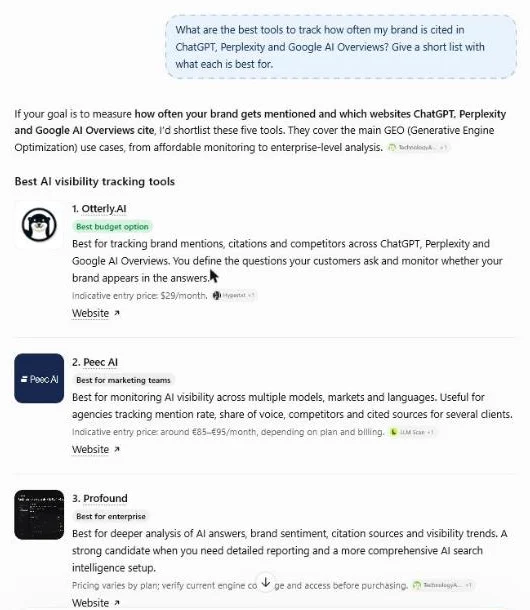 Our own ChatGPT test on 17 October 2026. Note who’s named, in which order and with which label.
Three names, a ranking and a one-line reason each. A buyer can stop reading there, and many do.
The names the AI mentions gain a head start you can barely close later in the sales conversation.
The pre-contact favourite usually wins
The same 6sense research shows why that head start matters.
94% of buying groups rank their shortlist by preference before engaging with sellers, and they buy from that preferred vendor in nearly 80% of cases.
Here are those three numbers side by side:
So the pre-contact favourite usually wins. Whoever is named first gets the benefit of the doubt.
The rest have to fight an opinion that’s already formed.
For how big that shift is in our region, read our figures on AI search adoption in the Benelux.
Which assistants your buyers actually open is in the AI tools B2B buyers use.
My prospects research in ChatGPT before calling us: how do I get recommended by ChatGPT in B2B?
You get recommended by being the clearest, most confirmed answer to your buyer’s question.
This is where many companies go wrong. They keep investing in the moment of contact, while the battle was decided before it.
You can sharpen your sales pitch all you want. If you’re not on the shortlist, you’ll never get to deliver it.
GEO: visibility for the answer, not the ranking
Getting mentioned in AI answers calls for a different kind of visibility. We call it GEO, or Generative Engine Optimization.
Classic SEO aims for positions in Google. GEO aims for AI models to trust, understand and cite your brand.
The foundation is still content, but content a language model can process:
- Clear, factual answers to the questions buyers ask, not vague prose
- Mentions in places AI trusts, such as trade media and review sites
- A consistent story about who you are and who you work for
To understand how this works in practice, our ultimate GEO guide is the best place to start.
For a quicker introduction, our guide: what is GEO explains the core in a few minutes.
Let the AI crawlers in first
None of this works if the assistants can’t read your site.
OpenAI says its crawler OAI-SearchBot “is used to surface websites in search results in ChatGPT’s search features”. Sites that block it won’t be shown in ChatGPT search answers.
Here’s what an open door looks like, in our own robots.txt:
 Our own robots.txt, October 2026: one rule for all crawlers, so every AI bot may read the site.
Watch out: OpenAI notes a robots.txt change can take about 24 hours to reach its systems.
Our guide to allowing AI crawlers shows which bots to let through.
How do I influence the supplier choice when buyers consult AI first?
You don’t shout louder. You become findable and citable at the moment the AI builds its answer.
Four levers do most of the work.
Make sure your answer exists somewhere
An AI model doesn’t invent suppliers. It draws on sources.
If nobody describes you as the party that solves problem X for sector Y, there’s nothing to cite.
So write content that answers your buyer’s question exactly, in their words.
For example: say you sell planning software to construction firms. A page titled “planning software for construction companies in Belgium” gives the model a sentence it can reuse. A homepage about “smarter workflows” doesn’t.
Build presence in places models read
AI systems lean heavily on sources like Reddit, trade forums and independent reviews.
Whoever is named and discussed there shows up more often in the answers.
Perplexity makes that visible, because it lists every page behind one answer:
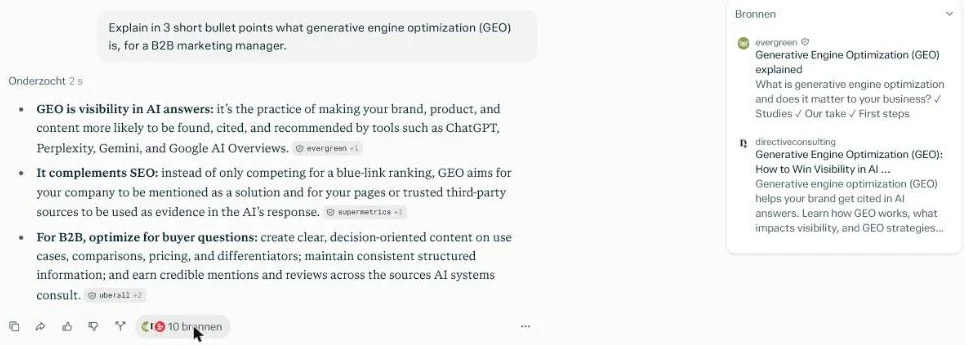 Perplexity’s sources panel for our own test prompt, 17 October 2026: 10 web pages behind one answer.
Most of those pages aren’t vendor websites. That’s why third-party mentions matter.
We wrote a concrete 90-day Reddit playbook about exactly this approach. And our breakdown of which sources ChatGPT cites shows where to look first.
Tell the same story everywhere
Models trust a brand whose facts agree across sources.
Same name, same description, same sector and location on your site, your profiles and in the trade press.
Contradictions make you harder to place, as our piece on entity consistency explains.
Measure what the AI says about you now
You can’t steer what you don’t measure.
An AI share of voice measurement shows how often you and your competitors are mentioned in AI answers. That tells you whether your problem is visibility or positioning.
Tools like Ahrefs Brand Radar put that number on a dashboard:
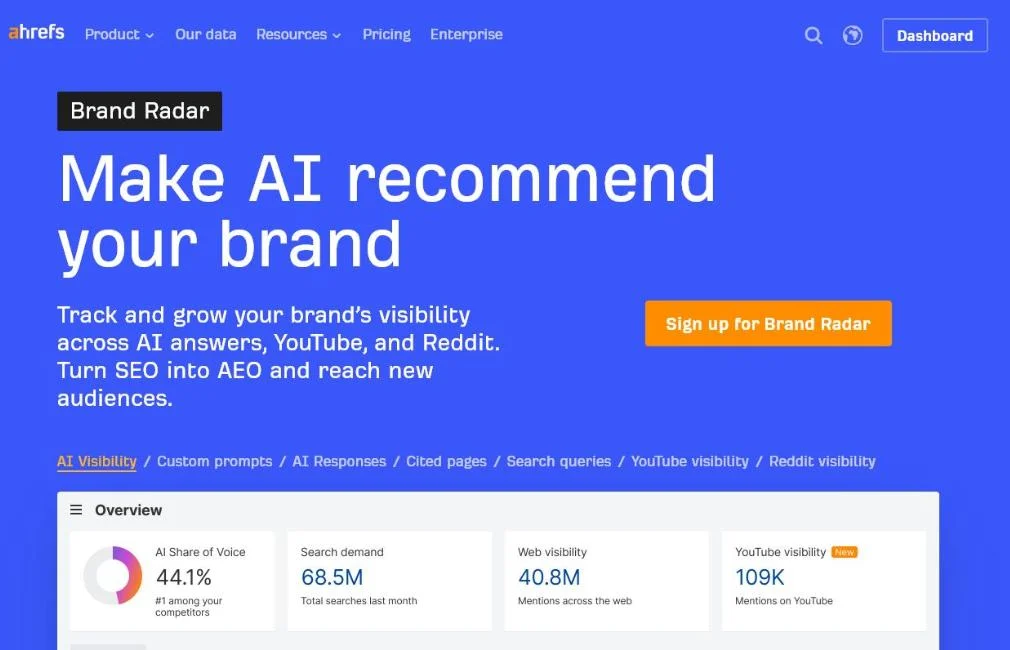 Ahrefs Brand Radar’s product page, October 2026. The figures are Ahrefs’ demo data, not ours.
Read how it works in measuring AI share of voice and benchmarking competitors in AI search results.
Our experience: one recent prospect found us through ChatGPT and AI Overviews. They were looking for a partner that ranks well in GEO itself.
So measure first, then fix the biggest gap.
What you can and cannot expect
Let’s keep it real, because exaggerated promises help no one.
GEO isn’t a button you press today to sit on top of every shortlist tomorrow. It’s construction work, just like trust in a sales conversation.
What you can expect
Three things are realistic:
- Step by step more visibility in ChatGPT, Perplexity and AI Overviews
- Insight into how AI talks about you and where the gaps are
- Warmer prospects, more often than cold ones
What you shouldn’t expect
Three things aren’t:
- A guaranteed top spot, because no AI is for sale that way
- Results in a week: count on months, not days
- A trick that replaces SEO, because the two strengthen each other
We explain that last point in GEO vs SEO.
Google says the same about its own AI features: there are “no additional requirements to appear in AI Overviews or AI Mode”, and SEO fundamentals still apply. Our Google AI Overviews guide covers that side.
Rule of thumb: judge GEO on mentions, warmer leads and pipeline, never on a single screenshot.
Frequently asked questions
Do B2B customers really buy through ChatGPT and how do I get on their shortlist?
They don’t buy directly through ChatGPT, but they do assemble their shortlist with it.
You get onto that list with content that describes your expertise factually, and by being mentioned on sources AI trusts. Think of it as building visibility before the conversation begins.
Our approach to customers finding you through ChatGPT goes deeper into this.
My prospects do their research in ChatGPT before they call us. How do I make sure we get mentioned?
Start by measuring what the AI says about you now, then fill the gaps.
Often there’s simply no clear, citable source linking your solution to the buyer’s problem. For your specific context, we have guides on GEO for B2B and GEO for small businesses.
How do I influence the supplier choice when buyers consult AI first?
By being visible and trustworthy in the places the model gets its answer from.
That means good content of your own, third-party mentions and a consistent story. You don’t steer the choice directly, but you greatly increase the chance you’re the first name mentioned.
Is ordinary SEO still worthwhile if everyone is shifting to AI?
Yes. AI models draw much of their knowledge from the same pages that rank in Google.
Strong SEO feeds your GEO. We wrote a level-headed piece about it in is SEO dead because of AI.
How do I know if it is working?
By tracking your AI visibility with the right tools.
Which ones, we summarise in AI visibility tools.
Ready to be on the shortlist?
Your best prospects form their opinion before they dial your number.
The sooner you know what AI tells them about you, the more often you start the conversation warm.
We help from strategy to execution: positioning, lead generation, ads, SEO and GEO, right down to the content AI models pick up. We’re a small team, so we move fast.
Contact us and we’ll show you whether you’re on the AI shortlist today, or just outside it.
Free website scan
Enter your website and get an automatic scan within minutes, with concrete technical and SEO improvements. No sales pitch.
We only use your details for your scan. No spam, unsubscribe anytime.