
SEO & GEO
The 6 best keyword research tools (2026)

Copy for AI
The best keyword research tool depends on the job you need done.
Most B2B teams combine free Google Search Console and Keyword Planner with Ahrefs or Semrush, then add AlsoAsked for questions.
The verdict: there’s no single best keyword research tool. Pick one per job: your own data, search volume, competitor keywords or the questions people ask.
How we tested: the screenshots come from our own accounts (customerimpact.be) or from each tool’s own site. Every price was checked on the vendor’s pricing page on 18 October 2026, in the currency the page showed.
No vendor pays us to be listed.
Which keyword research tools are best per job?
Here’s the shortlist, one row per tool:
| Tool | Best for | Free option | Paid from |
|---|---|---|---|
| Google Search Console | Your own real search queries | Fully free | Free |
| Google Keyword Planner | Search volume straight from Google | Free with an Ads account | Free |
| Ahrefs Keywords Explorer | Difficulty, SERP analysis, competitor keywords | Ahrefs Free (own site only) | Starter €27/mo, Lite €119/mo |
| Semrush | Large variant lists and keyword gap research | Free plan, 10 reports a day | €134/mo |
| A keyword data API | Bulk local data in your own sheets | Pay per query | Usage-based |
| AlsoAsked | How “People also ask” questions branch | Free monthly searches without an account | US$12/mo |
Most stacks need one tool per job. Here’s that logic in one picture:
Looking for the wider toolset, from audits to rank tracking? See the best SEO tools.
How do you recognise a good keyword research tool?
It gives consistent figures for your market and shows the search results behind each term.
Check these five things before you look at prices:
- Accurate search volume: consistent estimates you understand
- Intent and SERP analysis: who ranks, and which page type
- A difficulty score: how much authority you’ll need
- Local data: usable figures for your own market
- A fitting price: quarterly projects versus daily work
Volume is always an estimate
Every tool estimates, and the estimates differ. So learn what search volume means before you steer on it.
The SERP tells you the intent
A term says little without the results underneath it. Read the search intent from the SERP and check your page type belongs there.
Small markets need local data
Many tools are strongest for the US and thinner for smaller markets such as Belgium. For a B2B niche with small volumes, that makes a big difference.
Treat difficulty as a direction, not a law.
A tool doesn’t do the research for you. The process sits in our articles on keyword research and B2B keyword research.
Which free keyword research tools should you start with?
Search Console and Keyword Planner: one shows your own queries, the other Google’s demand data.
1. Google Search Console (your own real queries)
Best for: finding the queries you already appear for, including ones you never targeted.
Biggest strength: real queries, clicks and positions for your own site, measured by Google instead of estimated.
Price: free.
Watch out: it only covers your own site.
Start with the Performance report:
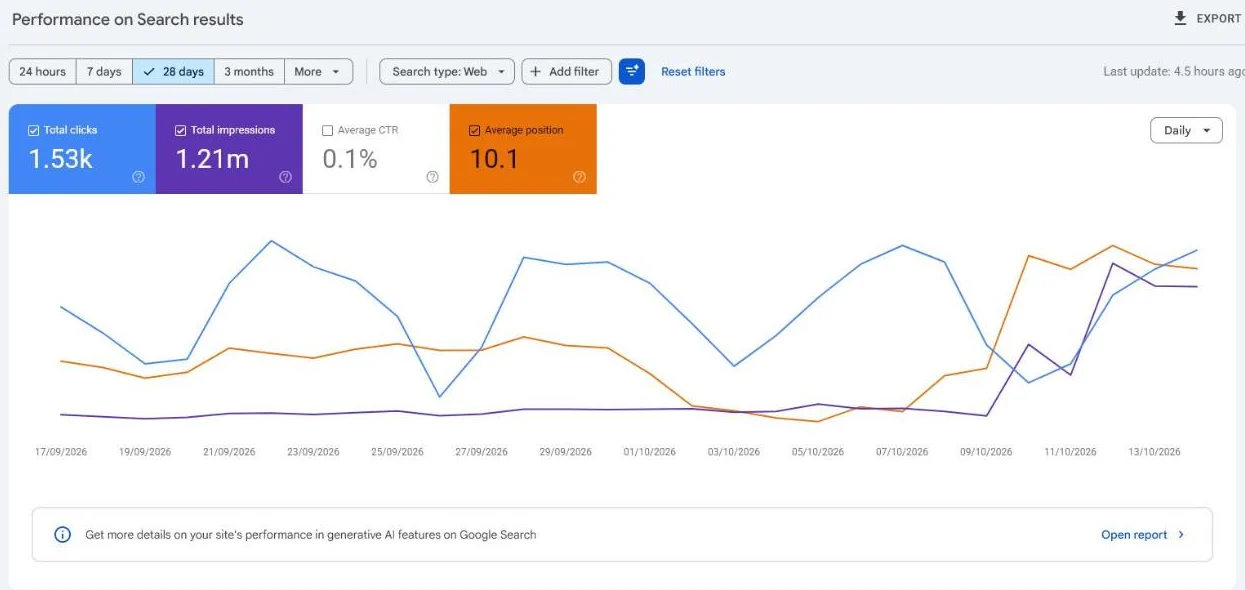 Our own Search Console, last 28 days. Switch the table to Queries to see the terms each page really ranks for.
Search Console shows something no external tool has: your own real search queries.
Our data: this very article collected 820 impressions in 28 days (17 September to 15 October 2026).
Its top query was “keyword research” at an average position of 10.3. We never put that term in the title.
That’s the kind of find that turns into a quick win. It’s a goldmine for striking distance keywords.
You can also split queries by brand. The filter sits above the queries table:
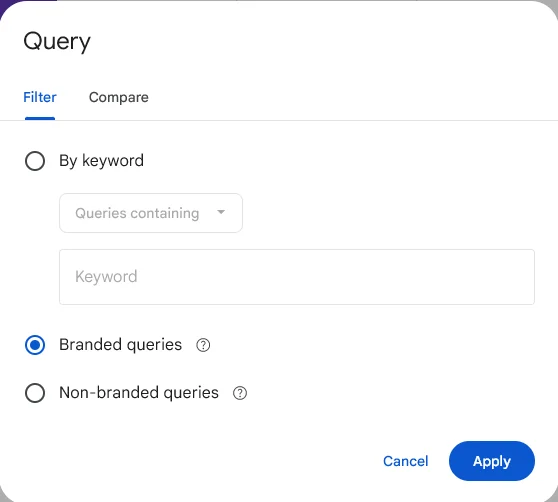 Performance > Add filter > Query in our own Search Console for customerimpact.be. Google splits branded and non-branded queries for you.
That keeps brand and non-brand keywords apart, so brand traffic doesn’t hide gaps.
| Pros | Cons |
|---|---|
| Free, first-party data from Google | Only queries you already appear for |
| Shows clicks, impressions and position per query | No competitor or volume data |
| Filters per page, country and device | Max 1,000 rows in the interface |
Verdict: open it first, but it’s no replacement for a research tool.
2. Google Keyword Planner (volume from the source)
Best for: search volume and related terms straight from Google.
Biggest strength: demand data from Google itself, with CPC as a signal of commercial value.
Price: free, you only need a Google Ads account.
Watch out: without ad spend you only get broad ranges.
Here’s what a search for “seo tools” returns:
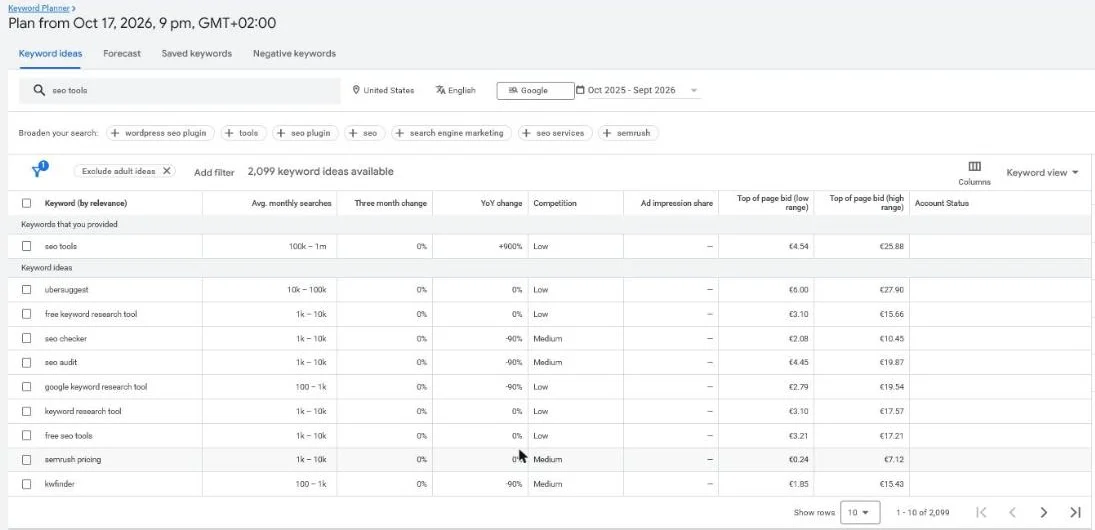 Keyword Planner for “seo tools”, United States. Without active campaigns you only get ranges like 100K to 1M.
It’s built for Google Ads but works for SEO too. The catch is visible above: broad ranges and no difficulty score.
As a free check next to a paid tool, it’s excellent. For in-depth SEO work it feels limited.
| Pros | Cons |
|---|---|
| Data from Google itself | Broad volume ranges without ad spend |
| CPC shows what a click is worth | Built for ads, not organic intent |
| Location and language targeting | No difficulty or SERP data |
Verdict: use it to sanity-check demand, not to plan content.
Which paid keyword research tool is best?
Ahrefs for SERP and link depth, Semrush for breadth, an API for bulk data.
3. Ahrefs Keywords Explorer (difficulty and SERP depth)
Best for: teams that need difficulty scores, SERP analysis and competitor keywords in one place.
Biggest strength: the SERP overview under every keyword, backed by one of the largest backlink indexes.
Price: Starter €27/mo, Lite €119/mo, Standard €229/mo, Advanced €419/mo (pricing page, checked 18 October 2026, EUR). Ahrefs Free covers your own verified site.
Watch out: credit and usage limits per plan.
Look below the metrics for the SERP overview:
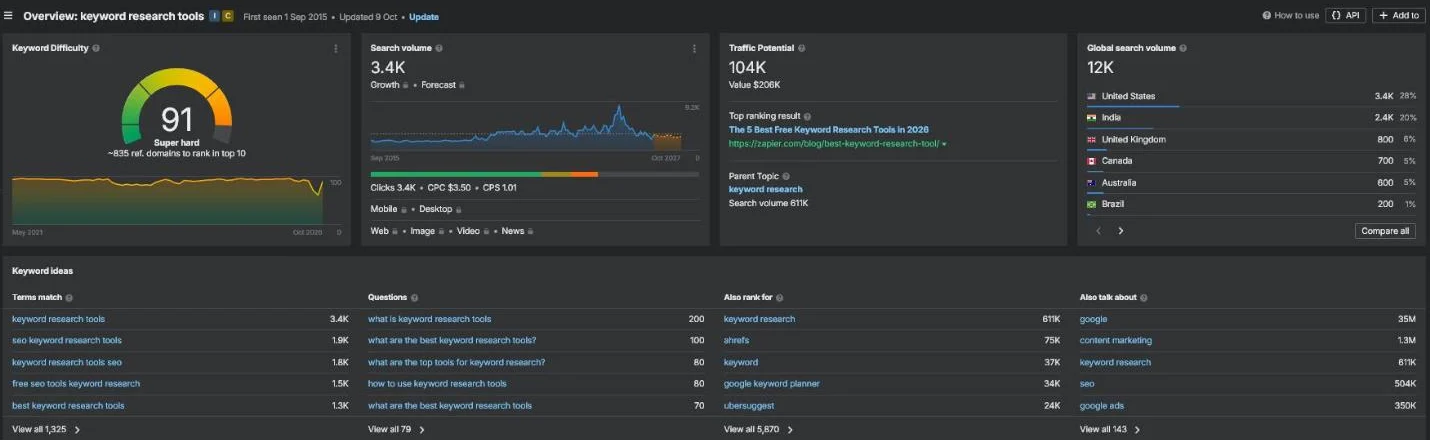 Ahrefs Keywords Explorer, United States. The SERP overview below the metrics shows who ranks and how many referring domains they have.
For many SEOs, Ahrefs is the standard. Because link data sits behind it, you see how much authority the top 10 has.
But small B2B volumes stay an estimate. So check them against Search Console once you rank.
| Pros | Cons |
|---|---|
| Strong SERP analysis per keyword | Price climbs with seats and add-ons |
| Difficulty backed by link data | Credit and usage limits per plan |
| Competitor keywords via Site Explorer | Small-market volumes stay estimates |
Alternative: Semrush, if you also research ads and content in the same tool.
4. Semrush (variant lists and keyword gaps)
Best for: mapping out a whole theme and comparing your keywords with competitors.
Biggest strength: the Keyword Magic Tool’s huge variant lists, plus Keyword Gap for competitor comparisons.
Price: SEO plan €134/mo, or €112.52/mo billed yearly; free plan with 10 reports a day (pricing page, checked 18 October 2026, EUR).
Watch out: it’s easy to pay for modules you never open.
Even without an account, the homepage shows a domain snapshot:
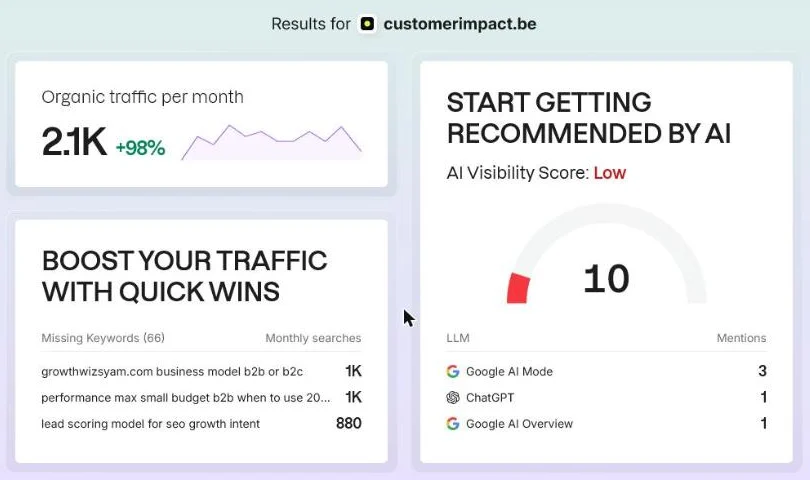 What Semrush shows for free when you enter a domain on its homepage, no account needed.
Semrush is the broader all-rounder: keywords, competitors, ads, content ideas and rank tracking in one package.
The variant lists are ideal when you cluster keywords into topics. Depth per feature is a little lower than Ahrefs, breadth higher.
| Pros | Cons |
|---|---|
| Very large variant and question lists | Easy to pay for modules you never open |
| Keyword Gap for competitor comparisons | Extra users add up fast |
| Useful free plan | Data depth varies per country |
Alternative: Ahrefs, if SERP and link depth matter more than breadth.
5. A keyword data API (bulk data in your own sheets)
Best for: data-driven teams that pull large keyword sets for their own reporting.
Biggest strength: local volumes, SERP data and difficulty in bulk, without a per-seat subscription.
Price: pay per query, so costs scale with usage instead of seats. Rates differ per provider.
Watch out: it needs scripts or a technical colleague.
A keyword data API isn’t a dashboard. You pull search volumes, SERP data and difficulty scores into sheets or scripts.
It pays off when you collect thousands of keywords for one market. For example, to find long-tail B2B keywords that fixed interfaces cut off.
Our experience: we combine several of the main keyword data vendors with our own data, collected over the years. It saves a lot of time.
How many keywords per run? It depends on the topic. A lawyer focused on traffic law has a clear, limited set of bottom-of-funnel terms.
For smaller companies, those terms drive revenue. Once they grow, supporting articles widen the set into the middle and top of the funnel.
| Pros | Cons |
|---|---|
| Costs scale with usage, not seats | Needs scripts or a technical colleague |
| Full control over markets and filters | No ready-made interface |
| Fits straight into your own reporting | You build the analysis yourself |
Verdict: the most economical route to reliable local data, if you build your own reporting.
Which tool finds the questions people ask?
AlsoAsked, because it shows how Google’s own questions connect.
6. AlsoAsked (how Google’s questions branch)
Best for: covering a topic completely by following Google’s “People also ask” questions.
Biggest strength: it shows how the questions connect, not only which questions exist.
Price: Basic US$12/mo, Lite US$23/mo, Pro US$47/mo, 20% cheaper billed yearly; free monthly search credits without an account (pricing page, checked 18 October 2026, USD).
Watch out: it has no volume data.
The tree view is the point:
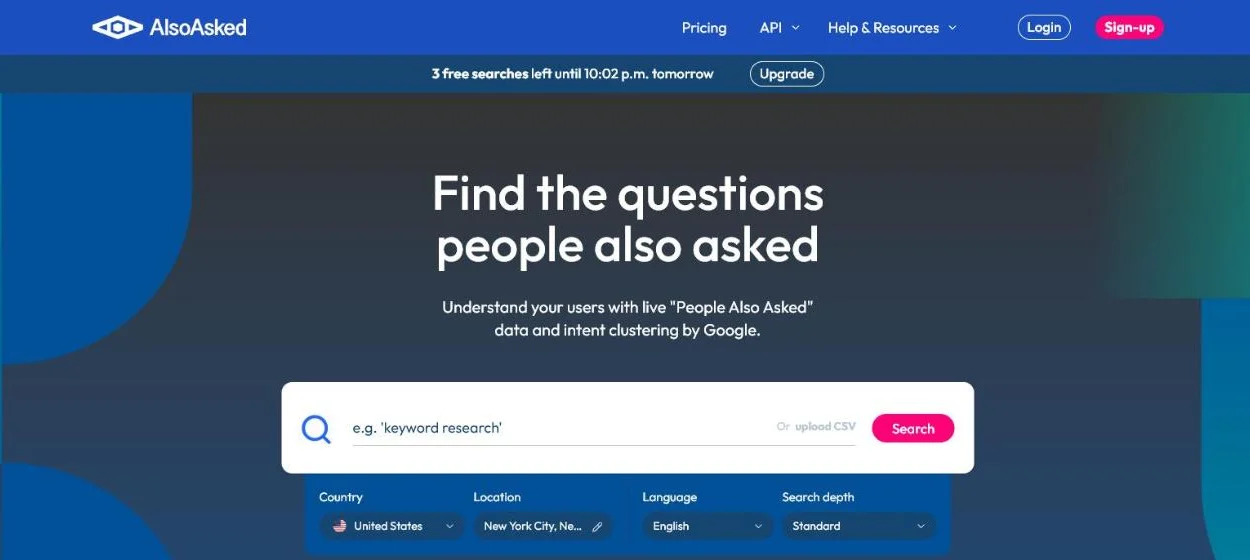 AlsoAsked maps Google’s People Also Ask questions as a tree, which makes subtopics for one article easy to spot.
It’s handy for seeing which sub-questions belong together on one page. Pair it with question keywords as a content strategy.
| Pros | Cons |
|---|---|
| Questions straight from Google’s SERP | No volume data |
| Shows how subtopics connect | Credits run out fast with heavy use |
| Low entry price | Fewer markets than the big suites |
Which keyword research tool should you choose?
A combination, matched to your budget and team. Our guide on choosing SEO tools builds that stack per task.
| Your situation | Stack |
|---|---|
| Starting out, no budget | Search Console + Keyword Planner + AlsoAsked free searches |
| Small B2B team | The free base + Semrush SEO plan or Ahrefs Lite |
| Serious SEO programme | The free base + Ahrefs or Semrush + a question tool |
| Data-driven team, many markets | The free base + a keyword data API + your own sheets |
| Content-heavy team | Any of the above + AlsoAsked |
Why intent beats volume in B2B
Say a term has forty searches a month and clear buying intent. It often earns more than a popular term where nobody wants your product.
Once you have your list, check for content gaps against what you already publish.
What does this mean for AI visibility?
Questions matter more, because people type whole questions into AI assistants instead of loose keywords.
AI engines such as ChatGPT and Google’s AI Overviews reason in question form. So question tools like AlsoAsked gain weight.
Content that clearly answers a question is easier to cite. That links classic SEO to GEO, being found in generative engines.
Frequently asked questions
What is the best free keyword research tool?
Google Search Console for the queries you already rank for, and Google Keyword Planner for search volume. Both are free and both come from Google itself. Add AlsoAsked’s free searches for question ideas.
Is Ahrefs or Semrush better for keyword research?
Ahrefs is stronger on SERP analysis and difficulty backed by link data. Semrush gives bigger variant lists and a handy Keyword Gap tool, plus ads research. Trial both on your own domain and pick on your main task.
How accurate are keyword research tools?
Every third-party tool estimates search volume, and figures can differ a lot between tools, especially for small B2B terms. Treat volumes as a direction and confirm with Search Console impressions once a page ranks.
Do I need a paid keyword tool?
Not to start. Once you research competitors and difficulty every month, one paid tool pays for itself. Before that, the free base covers most of the work.
Want to know which keywords are worth it for you?
Start with the terms your buyers already type.
Contact us and we’ll map the bottom-of-funnel keywords and questions that can bring you leads first.
Free website scan
Enter your website and get an automatic scan within minutes, with concrete technical and SEO improvements. No sales pitch.
We only use your details for your scan. No spam, unsubscribe anytime.