
Advertising
Brand vs non-brand keywords in Google Ads: how do you split your budget?

Copy for AI
Brand keywords contain your own company name; non-brand keywords are generic terms in which your brand does not appear. In Google Ads, branded terms are usually cheaper and convert better, because whoever types your name already knows you. Non-brand terms cost more per click and convert lower, but they bring in new buyers you would otherwise never have reached. The art is in the split: brand protects what you already have, non-brand lets you grow.
Planning your budget: calculate clicks, leads and cost per lead with the free Google Ads budget calculator.
What is the difference between brand and non-brand keywords?
The distinction comes down to intent and awareness.
- Brand keywords contain your company or product name, possibly with an addition: “[your company]”, “[your company] pricing”, “[your company] review”. Anyone searching that way already knows you and is close to a decision.
- Non-brand keywords are generic: “crm software”, “office cleaning company”, “accountant for small business”. The searcher has a problem but does not know you yet.
That difference between branded and non-branded keywords explains almost everything that follows. Brand traffic is low in volume but high in qualification. Non-brand traffic is high in volume but far broader and far looser. Both belong in a well-considered PPC approach, but they play a completely different role.
A quick boundary: this article is about the paid side, so about Google Ads and how you divide your advertising budget. If you want to know how to claim your brand name organically in the search results, read our guide on branded search. That is about SEO and your brand SERP; this is about euros and bids.
Why are brand keywords cheaper and why do they convert better?
It comes down to relevance. Google rewards ads that closely match the search query with a higher quality score, and a higher quality score means a lower cost per click. Nothing is more relevant than your ad on your own brand name: the search term, your ad copy and your landing page all revolve around the same thing. As a result, the CPC of branded terms is often considerably lower than that of non-brand terms.
Conversion follows the same logic. Someone who types your name picked you up somewhere: a recommendation, an earlier visit, a LinkedIn post. That person is further along in the decision process than someone searching for “compare accounting software”. Branded terms therefore deliver higher conversion rates at lower cost, a combination that looks unbeatable on paper.
But that is exactly where the trap lies. That low CPC and that high conversion are partly an illusion: a large share of those people would have found you anyway, even without an ad, a pattern that also shows up in analyses of branded versus non-branded traffic. You are then paying for traffic that would have come to you for free. Which brings us to the eternal debate.
Should you bid on your own brand name?
This is the question where opinions clash hardest. The honest answer: it depends, and the standard advice does not hold for everyone.
The arguments for bidding on your brand name:
- Competitors hijack your traffic. In Google Ads a competitor is allowed to advertise on your brand name. If they do and you do not, their ad appears at the top while you sit below it organically. Your own bid defends that space.
- You control the message. With an ad you decide the copy, the extensions and the landing page yourself, instead of whatever Google shows organically.
The arguments against:
- You pay for free traffic. If you already rank firmly at number one organically and no competitor bids on your name, your ad simply cannibalises your own organic click. You are paying for a visitor who was coming anyway.
- In B2B the volume is often small. For a Belgian B2B brand it sometimes amounts to a handful of brand searches per month. The amount is negligible, but so is the point of a separate campaign.
Our advice: first check whether competitors are bidding on your name (the Auction Insights in Google Ads show this). If they are, a defensive brand campaign is usually worth it. If they are not and you already dominate organically, that budget is better spent on non-brand growth. This is not a matter of principle but of measurement: steer on what delivers customers and revenue, not on a nicely low CPC figure in your report.
How do you split your budget between brand and non-brand in B2B?
This is where B2B differs sharply from a webshop. An e-commerce player can work with large brand volumes and direct purchases. A B2B company with a small, targeted audience starts from a different place: few brand searches, longer sales cycles and leads instead of direct sales.
A few principles we apply:
- Non-brand is your growth engine. The lion’s share of your budget should go to non-brand terms that attract new buyers. That is more expensive and converts lower, but it is the only way to expand your market. Brand alone is a ceiling, not growth.
- Brand is a safety net, not a strategy. Reserve a small, fixed amount for your brand name as a defence against competitors. Keep it modest, because most of those people find you anyway.
- Always split into separate campaigns. Never throw brand and non-brand into the same campaign. If you do, the cheap, high-converting brand clicks pull your averages up and everything looks great, while you cannot see which budget actually delivers new customers. Separate campaigns give you clean figures per type.
- Protect your non-brand budget with negative keywords. Add your own brand name as a negative keyword in your non-brand campaign. That prevents brand searches from leaking in there and clouding your reporting. Our guide on negative keywords goes deeper into that technique.
- Measure on leads and revenue, not on clicks. A two-euro non-brand click that produces a qualified lead is worth more than ten cheap brand clicks from people who were already customers. Tie your conversion tracking to real sales value, not to forms alone.
If you want to know how to set this up structurally, read how to build a Google Ads campaign with the right structure from day one.
What is a healthy ratio between brand and non-brand?
There is no universal number, and anyone who promises you a fixed percentage is selling you an illusion. The right ratio depends on your brand awareness, your competition and your growth goal.
A few guidelines all the same. The better known your brand, the more brand searches you have and the greater the temptation to lean on them. Do not: a high share of brand conversions means you are mainly harvesting what your brand has already built, not that you are growing. A young B2B brand with little name recognition should instead put almost all of its budget into non-brand, because there is barely anything to defend yet.
How do you know how much brand demand you actually have? Check Search Console before you build a brand campaign. Since Google introduced the branded queries filter in November 2025, it splits the two for you with an AI-assisted classifier, so you no longer need a hand-written regex:
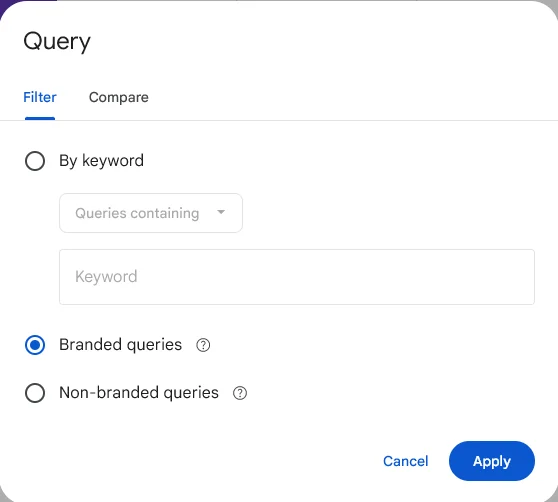 Performance > Add filter > Query: Search Console splits branded and non-branded queries for you.
We ran it on our own site for 10 July to 9 October 2026. Branded searches brought 54 of our 2,750 organic clicks, about 2%:
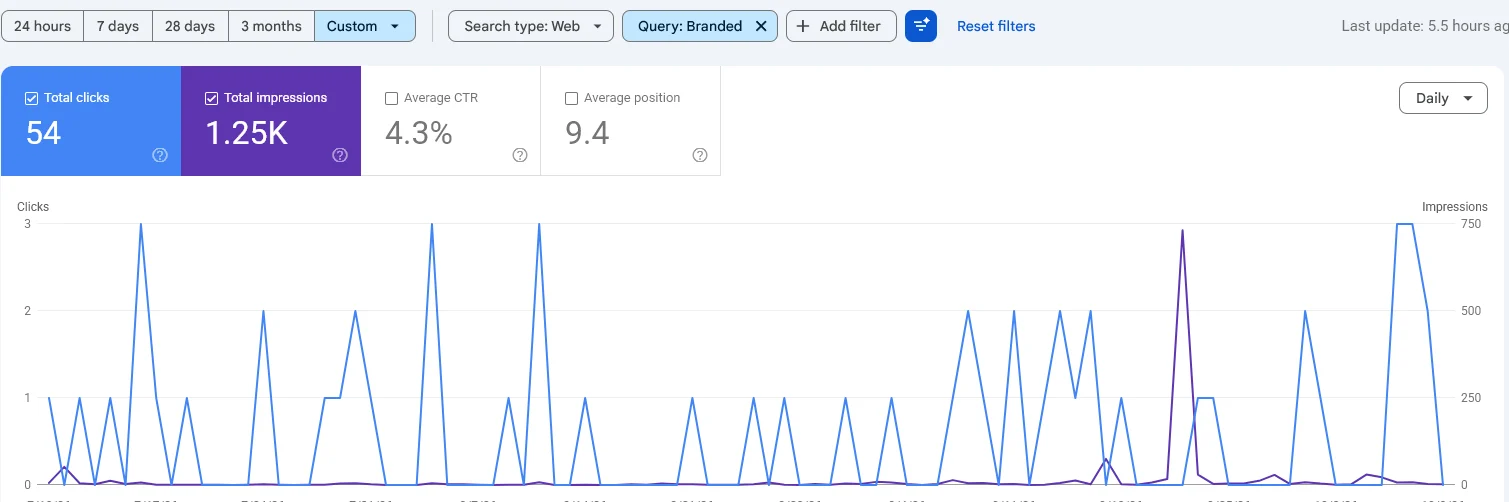 Our branded queries over three months: a 4.3% CTR, but only 54 clicks. For a brand this size, almost all growth has to come from non-brand.
That’s the situation for most young B2B brands. A brand campaign would defend a handful of clicks a week, so the budget belongs in non-brand.
The figure that counts is not the brand/non-brand ratio itself, but what each type delivers per euro in qualified leads. Analyse that monthly. If a non-brand keyword stands out on lead quality, scale it up. If your brand CPC suddenly shoots up, a competitor is probably bidding on your name and it is time to review your defence.
Frequently asked questions about brand vs non-brand keywords
Are brand keywords always cheaper in Google Ads?
Usually yes, thanks to the high relevance and quality score. But if competitors bid aggressively on your brand name, your CPC can rise. It is then they who drive up your cost, not Google.
Do I lose customers if I do not bid on my own brand name?
Only if a competitor does advertise on your name and you are not strong enough organically. If nobody bids on your name and you dominate the organic results, you lose little to nothing by deploying your budget elsewhere.
How much of my budget should go to non-brand?
In B2B usually the largest part, because non-brand is your only real growth channel. Brand you keep limited to a defensive amount. The exact percentage depends on your brand awareness and competition, so steer on lead quality and adjust monthly.
Why do I have to split brand and non-brand into separate campaigns?
Because mixed campaigns distort your figures. The cheap, high-converting brand clicks then mask how your non-brand campaigns are really performing, which makes you allocate your budget wrongly.
Want to split your Google Ads budget more intelligently?
Brand and non-brand keywords each have their place, but the gain is in the split: enough non-brand to grow, just enough brand to defend, and everything measured on real leads instead of cheap clicks. For a B2B company with a small team and a targeted audience, this is not about buying as many clicks as possible, but about leading every euro to customers. We build your campaigns so that you see per type what works and get honest advice about what you are better off not bidding on.
Free website scan
Enter your website and get an automatic scan within minutes, with concrete technical and SEO improvements. No sales pitch.
We only use your details for your scan. No spam, unsubscribe anytime.