
SEO & GEO
GEO Tools Comparison (2026): Profound vs Otterly vs Peec AI vs Trakkr

Copy for AI
There’s no single best GEO tool among Profound, Trakkr, Otterly.AI and Peec AI.
The verdict: Profound wins on breadth, Trakkr on all eight engines at one flat price, Otterly.AI on the cheapest entry, and Peec AI on multi-brand teams.
All four benchmark competitors and show cited sources.
The differences sit in engine coverage, how price scales, and whether you can see it before a sales call.
How we tested: we read each vendor’s pricing page and homepage on 18 October 2026 and took the screenshots then. We also asked ChatGPT which tools to use.
We follow this market closely for our own GEO work.
We don’t hold a paid seat in every tool, and no vendor pays us.
How do Profound, Trakkr and Otterly compare on competitor analysis, freshness and markets?
Here’s the side-by-side answer:
| Profound | Trakkr | Otterly.AI | Peec AI | |
|---|---|---|---|---|
| Best for | Enterprise brands | One flat price, all engines | Cheapest start, one brand | Teams and agencies, several brands |
| Competitor analysis | Benchmarks you against industry peers | Ranks you against competitors per AI model | ”Me + top 5 competitors” view | Visibility, sentiment and position per competitor |
| Sources and citations | Citation analytics across answers | Cited URLs and source types | Mentions and website citations | Domains and URLs cited, gap analysis |
| Data freshness | Prompts run daily | Every prompt across 8 models each day | Not stated on the homepage | You choose the frequency; it drives the price |
| Markets and languages | Not described on the pages we read | Not described on the pages we read | Country filter (US, UK, Germany, Netherlands and more) | Countries and languages listed as features |
| Engines | Up to 9 on Enterprise | 8, all plans | 4 included, 3 as add-ons | ChatGPT, Perplexity, Gemini, AI Mode named |
| Entry price (18 Oct 2026) | Custom | $100/mo (US page) | $29/mo | Not published |
| Free trial | 50 prompts for 7 days | 14 days, card required | Yes | Yes |
Competitor analysis is a given
All four do it, so pick on coverage and budget instead.
Selling in several countries, for example Belgium and France? Otterly.AI and Peec AI show that most clearly.
Ask Profound and Trakkr in a demo.
Nobody publishes an accuracy score
Every tool samples AI answers, and those answers change per session, location and model version.
So judge a tool on trends over weeks, not on one day’s number.
Want the full ranking with Scrunch, Ahrefs, Semrush and free options too? See our list of the best GEO tools.
What do these GEO tools really cost?
From $29 a month at Otterly.AI to custom enterprise contracts at Profound.
Here’s the entry price per month, as each pricing page showed it:
Trakkr sits in between with a public flat price for all engines.
Peec AI doesn’t show its amounts publicly.
What scales the price
Most plans charge on prompts, engines or brands, not on countries:
| Tool | Entry plan | What scales the price |
|---|---|---|
| Otterly.AI | $29/mo, 15 prompts, 4 engines | Prompts and engine add-ons |
| Trakkr | $100/mo, 50 prompts, 8 engines | Brands |
| Peec AI | Not published | Prompts x models x frequency |
| Profound | Custom (free 7-day trial) | Custom contract |
A cheap plan with too few prompts forces choices, for example dropping a product line.
So first decide which prompts to track.
What does each GEO tool do best?
One section per tool, with the same four labels each time.
1. Profound (enterprise breadth)
Best for: large brands that need the broadest engine coverage and deep analysis at scale.
Biggest strength: up to nine answer engines, prompt volumes and agent analytics in one platform.
Price: free trial with 50 prompts a day for 7 days on ChatGPT, Gemini and AI Overviews. Enterprise is custom (pricing page, checked 18 October 2026).
Watch out: beyond the trial, the pricing page steers you to sales.
Profound now leads with an agent, not with tracking. Look at the hero:
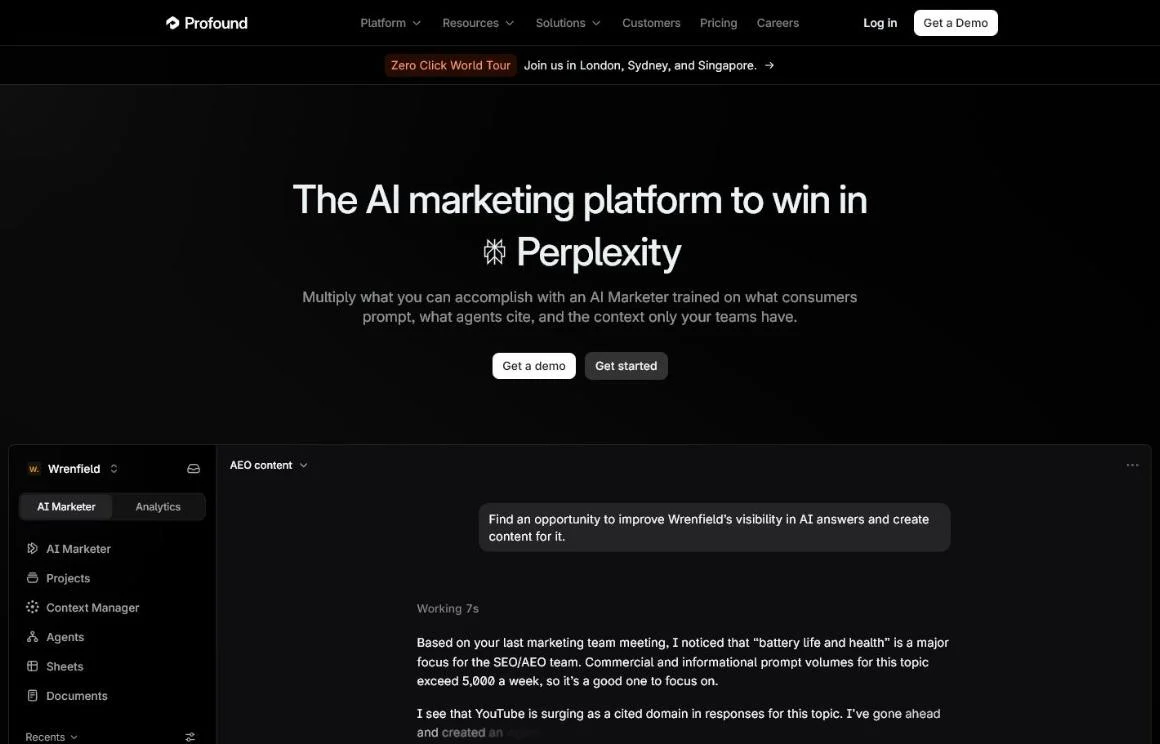 Profound’s homepage, October 2026. The AI Marketer agent sits on top of its tracking and analytics.
It’s the heaviest platform of the four. On Enterprise it tracks up to nine engines, with prompts run daily:
- ChatGPT, Perplexity and Microsoft Copilot
- Google AI Mode, AI Overviews and Gemini
- DeepSeek, Claude and Exa Search
It analyzes prompt volumes, meaning what large numbers of people actually ask AI.
It also benchmarks you against industry peers.
Agent analytics show how AI bots view, cite and refer to your pages.
For a small B2B brand with a few core prompts, that’s usually more tooling than needed.
Our Profound review goes deeper.
| Pros | Cons |
|---|---|
| Broadest engine coverage (up to 9) | No public price beyond the trial |
| Prompt volumes and citation analytics | The trial covers only three engines |
| Agent analytics for AI bot traffic | Built for enterprise budgets |
Alternative: Trakkr, if you want many engines at a public price.
2. Trakkr (all engines, one flat price)
Best for: brands and agencies that want every major engine tracked daily without per-engine add-ons.
Biggest strength: all eight engines on every plan, run every day.
Price: Growth $100 a month or $1,000 a year (1 brand, 50 prompts). Scale costs $500 a month (10 brands), Enterprise from $1,000 a month billed annually (pricing page, checked 18 October 2026).
Watch out: the page can also show GBP (£79 for Growth) or EUR, but billing is in USD. A card is required for the 14-day trial.
On US settings, the pricing page shows dollars. Check the Annual toggle top right:
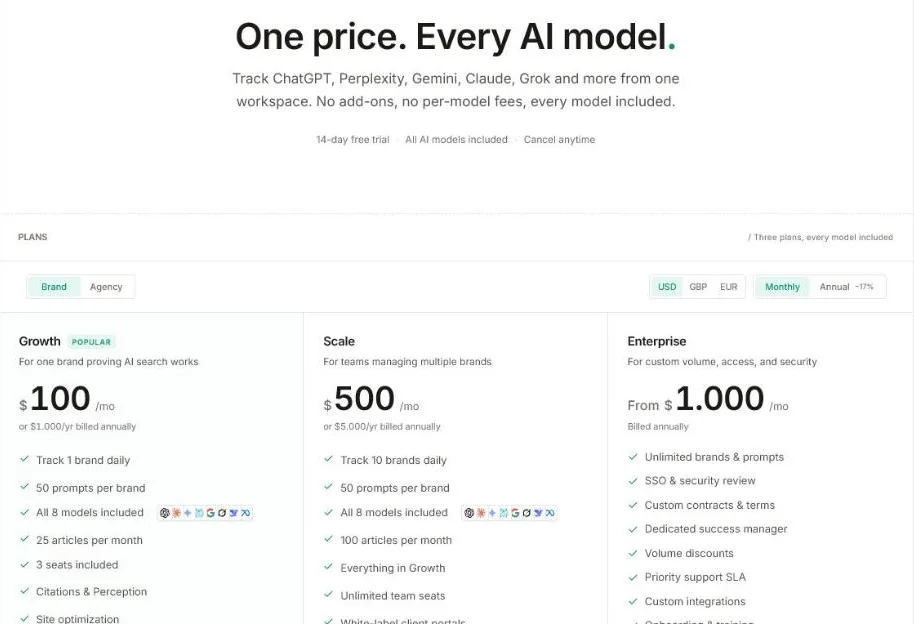 Trakkr’s pricing page, US settings, billed monthly, 18 October 2026. Annual billing saves about 17%.
That clears up the currency question: the GBP amounts are a display, the USD amounts are what you pay.
Trakkr runs every active prompt across eight AI models each day:
- ChatGPT, Claude and Gemini
- Perplexity and Google AI Overviews
- Grok, DeepSeek and Meta AI
Each answer is checked for mentions, position, cited URLs, competitors, sentiment and framing.
Its sample dashboard ranks a brand against competitors (“#2 of 9”).
It also logs AI crawler requests separately from citations and referral visits.
For competitor analysis, it’s the most direct of the four: it shows per AI model where rivals win on buyer questions.
| Pros | Cons |
|---|---|
| All 8 engines on every plan | 50 prompts per brand on Growth and Scale |
| Daily runs, competitor rank per model | Card required for the trial |
| White-label portals and API on Scale | Markets and languages not described |
Alternative: Otterly.AI, if four engines are enough and you want the lowest start.
3. Otterly.AI (cheapest public entry)
Best for: one brand that wants to start small and see whether GEO monitoring pays off.
Biggest strength: transparent pricing, a competitor view and a content audit from $29.
Price: Lite $29 a month (15 prompts), Standard $189 (100 prompts), Premium $489 (400 prompts), 15% off yearly (pricing page, checked 18 October 2026).
Watch out: Google AI Mode and Gemini cost $9 a month each on Lite, and Claude $29.
Otterly.AI’s homepage names six engines. Only four are in the base plans:
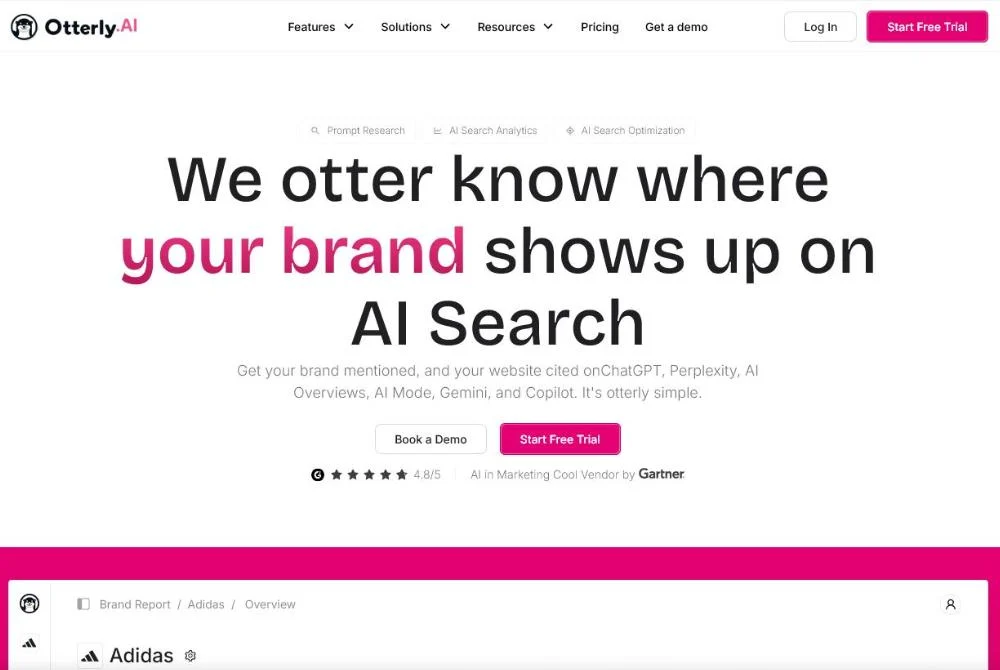 Otterly.AI’s homepage, October 2026. ChatGPT, AI Overviews, Perplexity and Copilot are in the base plans.
It focuses on prompt research and tracking mentions and citations.
Its brand report compares you with your top five competitors, or all of them.
A content audit checks pages for crawlability and citation potential. A country filter covers markets such as the US, the UK, Germany and the Netherlands.
Tip: count your prompts first. Fifteen run out fast with a broad product range, and extra prompts only start on Standard.
Read our Otterly.AI review for more.
| Pros | Cons |
|---|---|
| Lowest public price | Only 15 prompts on Lite |
| Competitor view and content audit | AI Mode, Gemini and Claude are add-ons |
| Country filter for several markets | Trial length differs across its own pages |
Alternative: Peec AI, if you manage several brands.
4. Peec AI (teams and agencies)
Best for: marketing teams and agencies that track several brands or projects.
Biggest strength: visibility, position and sentiment per competitor, plus source gap analysis.
Price: Starter, Pro and Advanced billed monthly, Enterprise custom and yearly. The pricing page showed no amounts on 18 October 2026.
Watch out: the price grows with prompts times active models times tracking frequency.
The demo dashboard tells you what Peec is built for. Look at the competitor columns:
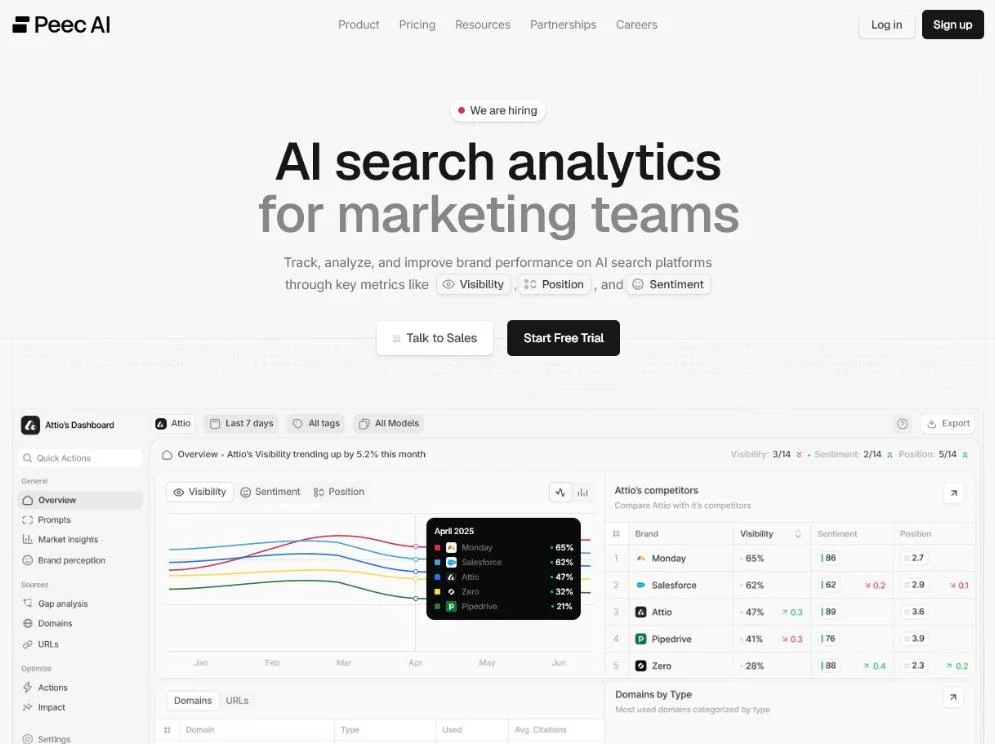 Peec AI’s homepage, October 2026. Visibility, sentiment and position sit next to each competitor.
It shows whether your brand is mentioned, in what position and with what sentiment. It also shows which domains and URLs the engines cite, with a gap analysis on top.
Countries, projects, languages and team users are plan features. That makes it a good fit for multi-market brands.
More in our Peec AI review.
| Pros | Cons |
|---|---|
| Sentiment and position per competitor | No public prices on the pricing page |
| Source gap analysis by domain and URL | More engines and frequency cost more |
| Countries and languages built in | Enterprise only on a yearly contract |
Alternative: Trakkr, if you want all engines at a public price.
What did ChatGPT recommend when we asked?
The same split as this comparison, minus Trakkr.
On 17 October 2026 we asked: “What are the best tools to track how often my brand is cited in ChatGPT, Perplexity and Google AI Overviews?” Here’s the answer:
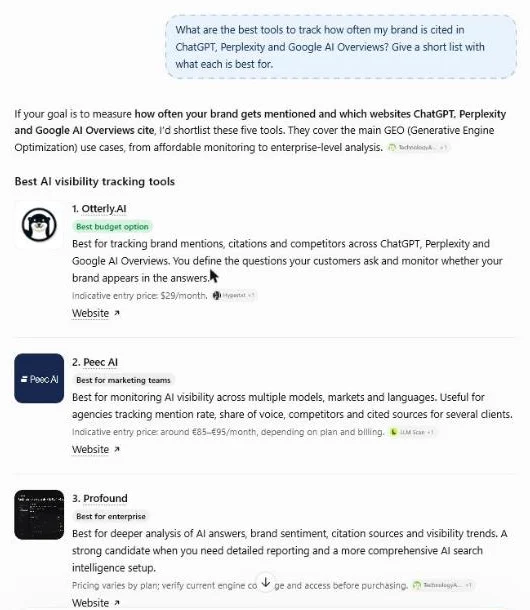 Our own test on 17 October 2026: ChatGPT’s top three for tracking brand citations.
Otterly.AI came first as the budget option, then Peec AI for marketing teams and Profound for enterprise. ChatGPT also gave indicative prices.
Watch out: treat those prices as guesses and use the vendor pages above.
The cheapest way to start
That test is also free: enter your own buying prompts in a few engines and log the answers.
Free first-party data helps too. Here’s Bing’s AI Performance report for our own site:
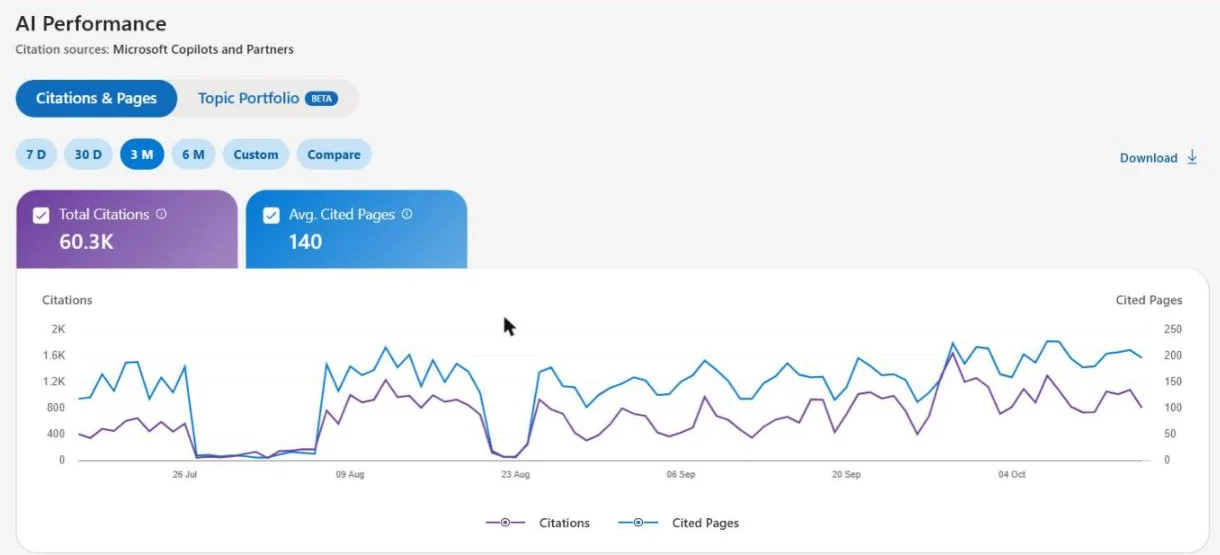 The AI Performance report in our own Bing Webmaster Tools: 60.3K citations in Copilot and partner answers over three months.
None of the four paid tools counts real Copilot citations like that. Our guide on measuring AI visibility without tools shows the method.
Free AI visibility tools lists more no-cost options.
Which GEO tool fits your B2B situation?
Start with your situation, not the tool. Three questions get you furthest.
How many platforms do you really need to track?
If your buyers mainly use ChatGPT and Perplexity, an entry tool is enough. Need many engines? Then Trakkr’s flat price or Profound’s breadth weigh more.
Work on each engine in a targeted way: ranking in ChatGPT, in Perplexity and in Microsoft Copilot.
One brand or several?
One brand fits Otterly.AI just fine. An agency or team with several clients gets more from Peec AI or Trakkr Scale.
What budget is defensible?
Start small, and only scale when the data justifies it. An enterprise tool is overkill for most Belgian B2B brands.
| Your situation | Pick |
|---|---|
| One brand, small budget | Otterly.AI Lite |
| One brand, every engine | Trakkr Growth |
| Agency or several brands | Peec AI or Trakkr Scale |
| Enterprise, many markets | Profound |
Look beyond the visibility score
A high score you can’t connect to buying intent is a vanity figure.
Track your AI share of voice on prompts that lead to deals. Then set up prompt monitoring to spot a competitor overtaking you.
For categories and methods, read measuring AI visibility. For the B2B angle, see GEO for B2B.
Frequently asked questions
Which is better, Profound or Otterly?
Profound is better for enterprise brands that need up to nine engines, prompt volumes and agent analytics, at a custom price. Otterly.AI is better for one brand on a budget: $29 a month, public pricing and four engines included. Most small B2B teams start with Otterly.AI.
Do Profound, Trakkr and Otterly track voice search?
Not as such. All three track the text answers of AI engines like ChatGPT, Perplexity and Google AI Overviews. None of the pages we read mentions voice assistants, so treat text answer tracking as the closest proxy and ask the vendor in a demo.
How accurate is the data in GEO tools?
None of these four publishes an accuracy score. Each sends your prompts to the engines and records the answers, which vary per session, location and model update. Profound and Trakkr run prompts daily. Judge a tool on trends over several weeks, not on one day.
Do these tools support several countries and languages?
Otterly.AI has a country filter, and Peec AI lists countries and languages as plan features. Profound’s and Trakkr’s pages we read do not describe this, so ask in a demo. Each language counts as separate prompts, which raises the price.
Is Trakkr cheaper than Peec AI?
We cannot say for sure: Trakkr shows $100 a month for Growth on its US pricing page, but Peec AI does not publish its prices. What we can say: Trakkr includes all eight engines at that price, while Peec’s price grows with the number of active models.
The short summary
Profound for enterprise breadth, Trakkr for all eight engines at one price, Otterly.AI for a low start, Peec AI for multi-brand teams.
Rule of thumb: your platforms, brands and budget pick the tool.
As GEO specialists, we’ll pick your prompts, metrics and tool, and say so when a tool isn’t worth it. Contact us.
Free website scan
Enter your website and get an automatic scan within minutes, with concrete technical and SEO improvements. No sales pitch.
We only use your details for your scan. No spam, unsubscribe anytime.