
Bureau kiezen
Why is my marketing agency not generating leads?

Copy for AI
Your marketing agency isn’t generating leads because it steers on activity, not on leads.
Every month you get a report full of visitors, rankings and likes.
Meanwhile your sales team sits on an empty calendar.
The verdict: a marketing agency not generating leads is almost always missing the conversion layer. Traffic, reach and rankings are means, not a result.
As long as nobody builds the bridge between visibility and a request, the report stays green.
Your pipeline stays empty.
Below are the 6 real reasons, how to recognise each one, and what good looks like.
Does this sound familiar?
Check how many of these you recognise:
- A monthly report full of rankings and engagement, but no line on qualified leads.
- Traffic rises, but requests don’t move with it.
- You talk to an account manager, rarely to whoever does the work.
- The leads that come in are students, competitors or bad fits.
- Sales and marketing blame each other.
- You hear about channels and tactics, never about cost per lead or payback time.
Nod yes several times? Then the problem isn’t your agency’s effort.
People are working hard.
The problem is what that work steers on.
What a ranking report hides
Here’s a typical ranking chart from our own Search Console:
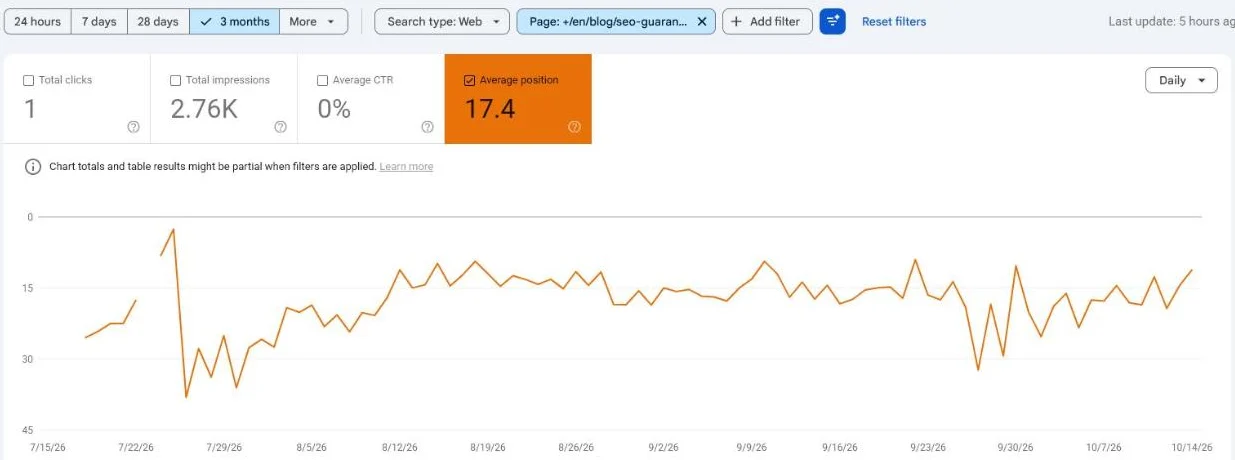 Our own Search Console: average position of one page over 3 months, October 2026. Rankings move daily; leads are what count.
It moves every day.
It doesn’t tell you whether a single buyer got in touch.
If that sounds like your reports, also read marketing agency, no results.
Why is your marketing agency not generating leads? The 6 real reasons
Each reason below comes with a way to spot it and what good looks like.
1. The wrong audience
Has your agency never asked about your ideal customer? Sector, job title, company size, problem?
Then it’s probably attracting traffic that never buys.
How to spot it: broad keywords, lots of visitors who leave at once, or leads that simply don’t fit.
What good looks like: a sharp ICP (ideal customer profile) that steers every campaign.
Every ad, article and form targets that 1 profile.
Tip: list your 10 best customers and what they have in common. That’s the first draft of your ICP.
Less traffic, but the right traffic.
Our guide to the ideal customer profile helps you write it.
Want to sharpen the whole plan yourself? Our piece on lead generation strategy helps you on your way.
2. A focus on traffic instead of conversion
This is the most common cause.
Many agencies sell visibility as the end goal: more visitors, higher rankings, more reach. But between a visitor and a lead sits a whole conversion layer:
- an offer that lands
- a landing page that convinces
- a form that doesn’t scare people off
If nobody builds that layer, your traffic stays traffic.
How to spot it: reports full of traffic charts, with not a word on conversion rate or cost per lead.
What good looks like: the agency steers on the whole funnel. It reports on lead generation KPIs such as conversion rate, cost per lead and share of qualified leads.
Here’s where the layer goes missing:
For example, say 2,000 visitors a month convert at 0.5%. That’s 10 enquiries. At 1.5% it’s 30, with the same traffic.
Run your own numbers with the conversion rate calculator. More on where it goes wrong in lead generation problems and website traffic but no leads.
3. No connection between sales and marketing
Marketing throws “leads” over the wall. Sales finds them worthless. Nobody closes the loop.
Without an agreement on what a lead is, your agency optimises blind.
It delivers what it thinks leads are, while sales needs something else.
How to spot it: the blame game. “We deliver.” “We get nothing usable.”
What good looks like: a shared definition of a qualified lead, laid down in a sales-marketing SLA.
HubSpot’s lifecycle stages show what that shared language looks like:
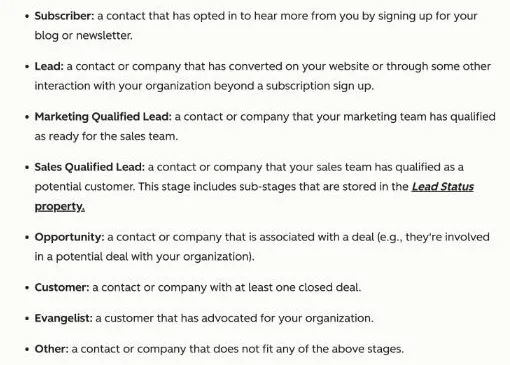 HubSpot’s lifecycle stage definitions, captured 18 October 2026.
HubSpot defines a marketing qualified lead as a contact “your marketing team has qualified as ready for the sales team”. Sales then decides whether it’s a real opportunity.
The handover is explained in MQL vs SQL.
With that split agreed, the agency improves on real sales feedback.
Tip: review 10 recent leads with sales and the agency every month. Mark which ones were worth a call, and why. That feedback is what the agency should optimise on.
4. A weak offer or unclear positioning
Sometimes the channels work fine.
But nobody gives the visitor a reason to react now.
If your offer isn’t clear, even the right visitor drops off. Why you, why now, what it costs.
Positioning isn’t a marketing luxury. It’s the engine behind conversion.
For example, “we help companies grow” gives nobody a reason to call. “We cut month-end close for finance teams” does, if you can prove it.
How to spot it: a website that says what you do, but not why a customer would choose you.
What good looks like: a sharp offer and a clear promise, backed by proof such as cases and figures.
A good agency challenges your positioning instead of blindly running campaigns on top of it.
5. No follow-up or nurturing
Most B2B buyers aren’t ready to buy yet.
The LinkedIn B2B Institute puts it bluntly: 95% of your potential buyers aren’t ready to buy today.
They’ll be in market later.
So if your only conversion point is a “request a quote” button, you leave behind everyone still orienting.
Without a soft entry and without nurturing afterwards, that traffic quietly evaporates.
How to spot it: 1 hard conversion point, no soft entry, and leads who never hear from you after the first email.
What good looks like: several entry moments and a follow-up flow that keeps the undecided warm. Soft entries can be:
- a practical guide or lead magnet
- a webinar
- a checklist
Then lead nurturing takes over. That way you also catch companies with a long sales cycle, and in B2B that’s most of them.
6. The wrong channels
Not every channel fits every audience.
Some agencies roll out the same recipe by default: always Google Ads, always LinkedIn, always content.
Without testing where your buyers are, they burn budget in the wrong place.
A channel that works for a web shop can be worthless for a niche B2B service.
How to spot it: an approach that looks identical for every client.
What good looks like: channel choice that starts from your buyer and your data, not from the agency’s habit.
Tip: ask why each channel was picked for you. A good answer starts with your buyer, not the channel.
Here’s how CTR and conversions can drift apart across ad accounts:
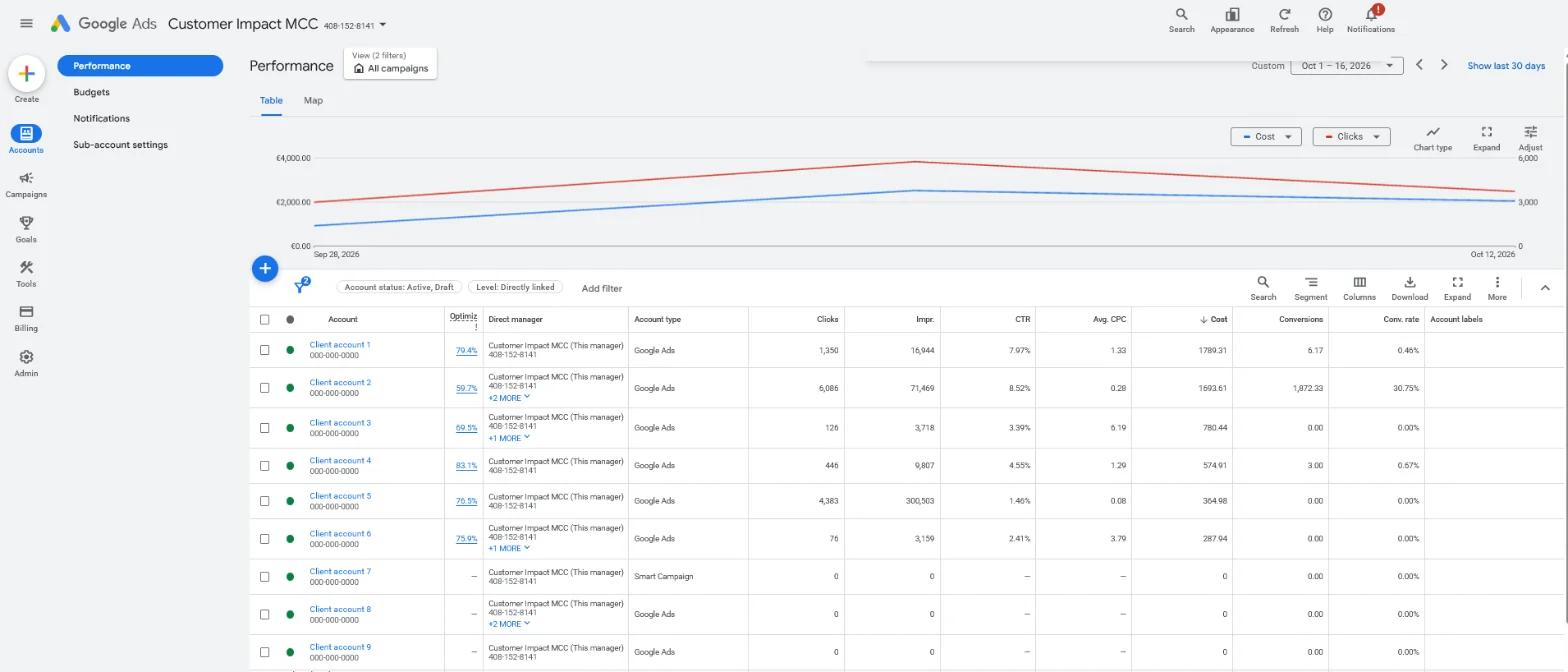 Our own manager account (MCC) in Google Ads, October 2026. Client names and IDs are replaced. Compare the CTR column with the conversions column.
A healthy click rate isn’t proof the channel works.
Which channels perform best in B2B is in the best B2B lead generation channels.
Is it you or the agency?
Sometimes part of it lies with the client.
A vague briefing, an unclear ICP or unrealistic expectations make the work harder.
If you don’t know who your ideal customer is, no agency can invent that for you.
But steering toward leads is the agency’s job.
A good agency keeps asking until your ICP is sharp.
It challenges your offer and refuses a campaign that only steers on traffic.
Rule of thumb: an agency that asks for input is fine. An agency that never mentions conversion isn’t.
Who should own what?
| Task | Your side | Agency side |
|---|---|---|
| Ideal customer profile | Input on best customers | Sharpen and test it |
| Offer and positioning | Decide the promise | Challenge and package it |
| Lead definition | Agree with sales | Report on it every month |
| Conversion layer | Approve pages and forms | Build and improve them |
| Follow-up | Sales calls within days | Nurture flows and handover |
How do you switch safely?
Start with 1 conversation, before you decide anything.
Ask your agency: “How many qualified leads did you deliver this quarter, and at what cost per lead?”
The answer tells you everything.
If you get explanations about rankings and reach instead of a number, you know enough.
Switching without chaos
Switching doesn’t have to be chaos. Take these 3 steps:
- Secure access to your own accounts: Google Ads, analytics, CRM and domain.
- Check your notice period before you sign with a new partner.
- Start with a short audit before the new agency touches the campaigns.
That way you lose no existing results in the handover.
Watch out: don’t pause everything on day 1. Campaigns that do bring enquiries keep running during the handover.
Who owns what is covered in Google Ads account ownership.
A step-by-step plan is in switching lead generation agency.
Use the checklist before firing your marketing agency first.
Want to pick the next one well? Read how to choose a lead generation agency.
How do we make sure an agency generates leads?
We’re a small, senior team that steers on 1 thing: qualified leads and revenue.
Not vanity rankings, not a pretty traffic report.
There’s no layer of juniors or account managers in between. You work directly with the people who do the work.
Our order of work:
- your ICP and your offer
- the conversion layer most agencies skip
- reporting in figures sales understands
For paid channels, that includes sending closed deals back to the ad platform. Google calls this measuring “what happens in the offline world after your ad results in a click”. Our guide to offline conversions in Google Ads shows how.
Proof, not promises
You don’t have to take our word for it.
For one client, our approach delivered 189% more MQLs at 22% lower monthly costs.
Same market, often with a smaller budget than a broad agency had.
That principle sits in our approach to lead generation: first the right audience and offer, only then traffic.
Is the leak on your website? Our conversion rate optimization team builds that missing layer.
Frequently asked questions
Why is my marketing agency not generating leads?
Usually because it steers on traffic, rankings and reach instead of qualified leads. The most common causes are the wrong audience, no conversion layer, no shared lead definition with sales, a weak offer, no nurturing and channels chosen out of habit.
How long should I give an agency before expecting leads?
That depends on the channel. Paid campaigns can bring enquiries within weeks, SEO takes months. Whatever the channel, the agency should report on conversion rate and cost per lead from the first month, not only on traffic.
Is it my fault if the agency delivers no leads?
Partly, sometimes. A vague briefing or unclear ideal customer makes the work harder. But a good agency keeps asking until the ICP is sharp and refuses to steer on traffic alone, so steering toward leads stays its job.
Getting traffic but no leads?
Months of traffic without leads is a fixable problem.
Contact us. We’ll look at what’s going wrong and what doing it differently would bring you. Want the price first? Ask us for a quote.
Free website scan
Enter your website and get an automatic scan within minutes, with concrete technical and SEO improvements. No sales pitch.
We only use your details for your scan. No spam, unsubscribe anytime.