
Growth & Strategie
What Does a Marketing Agency Really Do Each Month? An Honest Look Behind the Scenes

Copy for AI
A marketing agency mostly optimizes, tests, analyzes and reports each month.
Most of that work is invisible maintenance, not shiny new campaigns. That’s why so many clients feel they pay for nothing.
The verdict: not seeing the work is normal. Not getting an explanation of the work isn’t, and that’s the signal to act on.
Every month, money leaves your account heading toward your agency.
And yet a nagging feeling remains: what am I actually getting in return?
You see no new campaign, no report that adds up, no clear answer.
“I don’t know what my marketing agency actually does for my money” is one of the most frequently asked questions in B2B.
You’re far from the only one asking it.
So here’s an honest look behind the scenes: what a partner really does in an average month, what’s supposed to stay invisible, and when silence is a real warning sign. Understanding the marketing agency services you pay for is the first step.
Why do I pay my marketing agency every month?
You pay for maintenance and optimization, and that work doesn’t hang on the wall.
Many entrepreneurs think a marketing budget equals visible output: a new ad, a fresh blog post, a redesign.
But the largest part of the work is maintenance and optimization.
What a healthy month includes
A healthy month at a lead generation or SEO partner typically covers five kinds of work:
- Campaign management: adjusting bids, excluding poor search terms, redistributing budgets.
- Analysis: reading and interpreting data from Google Ads, GA4 and your CRM.
- Optimization: testing landing pages, tweaking copy, refining audiences.
- Content work: articles, technical SEO fixes, internal links, GEO optimization for AI search engines.
- Reporting and consultation: summarizing the numbers and proposing a next step.
Google lists a similar range for SEO alone.
Its guide Do you need an SEO? names services such as site reviews, technical advice, content development, keyword research and “optimizing for generative AI”.
That’s five services before a single ad runs.
Where most of that work happens
Much of it happens inside ad accounts you rarely open yourself.
Agencies often manage those through a Google Ads manager account, which lets them “create and manage campaigns for your client accounts” from one place. This is what that looks like on our side:
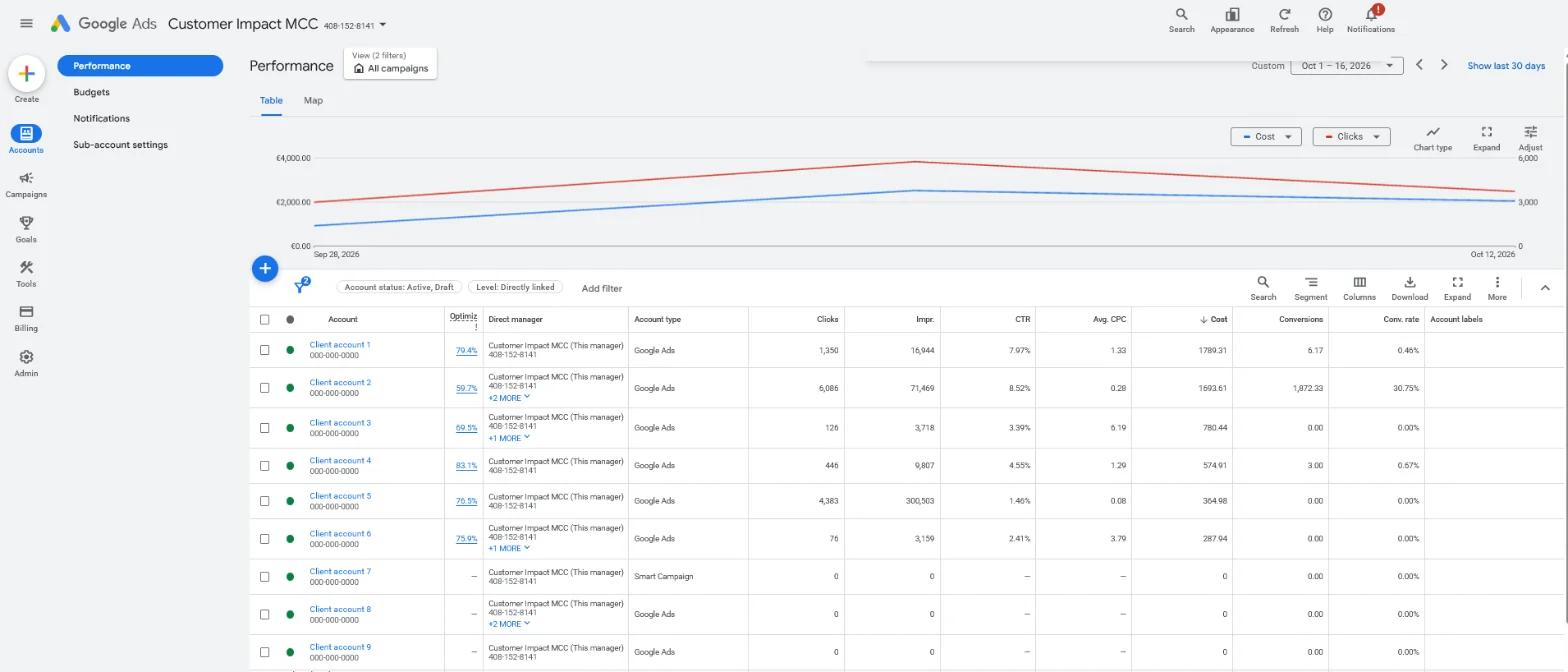 Our own manager account (MCC) in Google Ads, October 2026. Client names and IDs are replaced. Compare the CTR column with the conversions column.
Every row is a client account an agency checks and adjusts, often weekly.
You see none of it unless someone reports it.
Our guide to the Google Ads manager account explains how that link works.
The real problem is communication
The problem is rarely that nothing is happening. It’s that the agency communicates poorly about what it does.
Want to know which questions to ask?
Read which questions to ask your Google Ads agency and the questions your SEO agency should be able to answer without hesitation.
Good agencies answer them without blinking.
An honest monthly work log: this is what it really looks like
Transparency becomes concrete when an agency dares to write out its month.
Such a work log doesn’t need to be pretty, it needs to be honest. Here’s a realistic example for a B2B client with lead generation and SEO:
Week 1: measuring and adjusting
Gathering last month’s numbers and investigating notable drops or spikes.
Then redistributing bids and budgets based on what delivered leads.
That’s often an hour or two of really digging into the ad accounts.
Week 2: optimizing and testing
Setting up a new landing page variant, starting an A/B test, excluding keywords that swallowed budget without results.
This is where a lot of invisible but valuable work sits.
Week 3: building and publishing
Writing and optimizing a new article, applying technical SEO fixes, laying internal links.
This is the part that only bears fruit weeks or months later.
Week 4: reporting and looking ahead
Summarizing results in understandable language, drawing conclusions and setting the priorities for next month.
This is the moment you, as a client, should feel: ah, that’s where my money went.
For example, say week 2 excluded twenty search terms that ate budget without a single lead. In the report you should read which terms, what they cost and what happens with that budget now.
Watch out: is this logic completely missing? Do you never know which phase you’re in?
Then you’re probably dealing with one of the red flags at a lead generation agency.
My marketing agency cannot explain what they did this month
This is the real tipping point.
A partner is allowed to have a quiet month. A partner is allowed to do work that pays off slowly.
But “my marketing agency cannot explain what they did this month” isn’t a detail. It’s the core signal.
Three things a good partner can always tell you
In plain language, every month:
- What the three most important actions of the month were.
- Why they chose those actions.
- What the effect was, or when you can expect it.
Google expects the same openness from an SEO.
Its interview questions include “How do you measure your success?” and whether the SEO will share every change it makes to your site (Google Search Central).
Your agency should pass that test too.
Ghosting with words
Instead you get vague sentences like “we worked on visibility” or “the algorithms were restless”.
That’s a form of ghosting with words. It’s comparable to a web developer who becomes unreachable after delivery, or an agency that stops responding once the invoice is paid.
Recognize that pattern? Look at how to spot a bad SEO agency and what you can learn from common lead generation problems.
What you are entitled to expect, every month again
Instead of guessing what’s happening, you can simply demand four things, whatever your package or budget.
A clear work log
An overview of what was concretely done this month, in understandable language.
Numbers that mean something
Not just clicks and impressions, but leads, quality and cost per lead.
Which numbers really matter is in our guide on the right KPIs for marketing. For channel reports, see Google Ads reporting and SEO reporting.
Here’s what an honest SEO number looks like in our own Search Console. It shows clicks and impressions side by side:
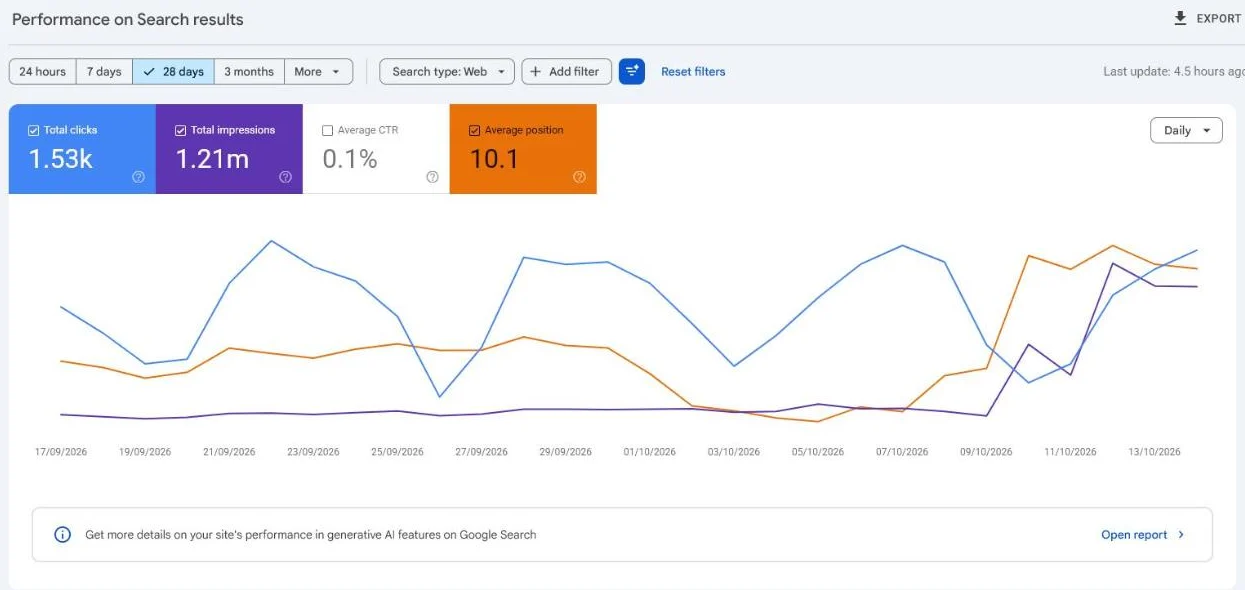 Our own Search Console for customerimpact.be, last 28 days, October 2026. 1.21M impressions against 1.53K clicks.
A report that only shows the impressions line tells you half the story.
A next step
A partner who looks ahead and proposes, unasked, what takes priority next month.
Our piece on the proactive marketing agency shows what that looks like.
Ownership of your accounts
You should always own your ad accounts and website.
In Google Ads, the highest level is Admin access. Google says an Admin “can give account access, change access levels, and cancel invitations from other users” (Google Ads access levels). That’s the level your own company should hold.
In doubt? Read about ownership of your Google Ads account.
Transparency is the minimum
It isn’t an extra service.
You may expect the same openness from your marketing partner that you give your own clients.
Tip: put these four expectations in your marketing agency contract, so nobody has to beg for them later.
Seeing no output need not be bad, getting no explanation is
The difference lies in the explanation.
Sometimes a month is deliberately calm. The strategy revolves around patience.
SEO and GEO pay off slowly, and constantly intervening often makes it worse.
That’s defensible, as long as your partner explains it to you.
When silence becomes the problem
It only becomes a problem when silence is the default answer:
- no report
- no consultation
- no reaction to your emails
Then you’re not paying for a strategy, you’re paying for absence.
At that point, switching isn’t a rash decision but a logical one. We describe it in our guides on switching to a different lead generation agency and changing SEO agencies.
Rule of thumb: a quiet month with an explanation is fine. Without one, it’s a warning.
Frequently asked questions
I don’t know what my marketing agency actually does for my money. Is that normal?
It’s unfortunately common, but it isn’t normal.
Not seeing the work usually means invisible maintenance is happening while your partner reports poorly. Explicitly ask for a monthly work log with the three most important actions and their result.
If you don’t get that, there’s a communication problem, possibly a bigger one.
My marketing agency cannot explain what they did this month. Should I switch?
Not immediately, but it’s the most important warning sign there is.
Give your partner one chance to explain in plain language what happened and why.
If it stays vague, you’re paying for absence and switching is defensible.
First look carefully at your contract and what to watch out for.
Why do I pay my marketing agency every month if I don’t see new campaigns?
For the invisible part: optimizing, testing, analyzing and adjusting.
New campaigns are only a fraction of the work.
The real return sits in the hundreds of small adjustments that lower your cost per lead.
An honest partner makes that visible in a report, so you don’t have to guess.
How do I know if my marketing partner simply had a quiet month or is ghosting me?
A quiet month comes with an explanation, beforehand or afterward.
Ghosting comes with silence: no report, no consultation, no answer to your emails.
The difference lies entirely in the communication, not in the amount of visible output.
Which marketing agency services should a monthly retainer cover?
Whatever you agreed, written out per channel.
Typically that’s campaign management, analysis, optimization, content work and a report with a next step.
Choosing a partner? Our guide on how to choose a marketing agency helps you compare.
Want to know where your money really goes?
You deserve a partner who explains every month what they did, why, and what it delivered, without you having to beg.
At Customer Impact that transparency is built in: a clear work log, honest numbers and a next step, for lead generation, ads, SEO, GEO and web.
We’re a small team, so we move fast and often do more than you expect. Contact us and we’ll show you what an honest month behind the scenes looks like for your account.
Free website scan
Enter your website and get an automatic scan within minutes, with concrete technical and SEO improvements. No sales pitch.
We only use your details for your scan. No spam, unsubscribe anytime.