
Growth & Strategie
Proactive Marketing Agency or Passive Order-Taker: What You Should Expect

Copy for AI
A proactive marketing agency brings ideas, warnings and plans without you asking.
A passive one waits for your brief. You send an email, you get a reply. You ask for a campaign, they set it up.
The verdict: passivity is rarely laziness. It’s a role nobody agreed on, and you fix it with check-ins, a roadmap and KPIs in the contract.
But the moment you go quiet, everything goes quiet.
Your marketing agency never brings ideas of its own, and you slowly start to wonder: do I really have to keep bringing everything myself?
Plenty of B2B owners know that feeling. Below: where the passivity comes from, and what you can expect from an agency that truly thinks along.
Why does your agency only act when you push?
Because most agencies are built as executors. You give an assignment, they deliver.
That model works fine for a one-off website or a standalone campaign. It cracks the moment you expect them to think about your growth.
Nobody agreed on thinking
An agency that only reacts is often doing exactly what it was hired to do.
No one ever agreed that strategic thinking was part of the job. So you’re the engine, and without your input the machine stalls.
That’s a role confusion, not a character flaw.
It only becomes a problem when you thought you’d bought a strategic sparring partner, but got an order-taker.
Executor versus thinking partner
The difference lies in the agreements, not in the people:
- Executor: waits for a brief and delivers exactly what’s in it
- Thinking partner: looks at your numbers, spots opportunities and proposes unprompted
- True partner: does both, advising proactively and then executing
A lot of frustration comes from never making this explicit at the start.
Here’s the same split in one picture:
Which of the three did you actually sign?
Do I have to bring everything myself, or should my agency be proactive?
A good agency should be proactive, but only when that’s been agreed.
Proactivity isn’t a free bonus that comes along by itself. It’s a service you can demand and anchor in your contract.
What buyers expect today
Many B2B buyers expect their partner to bring insights instead of just executing orders.
In our conversations with companies looking to switch agencies, the frustration often isn’t about poor execution. It’s about a lack of initiative and direction.
The three things you can expect
Here’s what a proactive marketing agency gives you:
- Scheduled strategic check-ins, not only when you call
- A shared roadmap with planned actions for the coming quarters
- Unprompted advice when your data reveals an opportunity or a risk
If none of these three are present, you’re paying for hands, not brains. That’s a fair moment to reconsider the collaboration.
Related warning signs
We wrote earlier about the red flags of a lead generation agency that often go hand in hand with this.
Feel stuck at the back of the queue as a smaller client? Read why you should never be a low priority as a small SME at your agency.
Why does my agency never warn me when something goes wrong?
Usually because nobody agreed on KPIs, reporting or ownership. Not out of ill will.
It’s perhaps the most painful variant. A campaign bleeds out and the cost per lead doubles.
You hear nothing about it until you open the numbers yourself.
The gap in the system
Three things are usually missing:
- No fixed reporting cycle: nobody keeps a structural eye on things
- No clear KPIs: nobody knows when an alarm should go off
- No ownership: the agency feels responsible for execution, not for the result
How a transparent partner turns it around
It sets up the right marketing KPIs with you in advance. Then it agrees at which deviation it calls you, not the other way around.
The tools for that already exist. In GA4, for example, custom insights can send email alerts when a condition triggers, such as a metric dropping by a set percentage. You can set up to 50 per property.
Rule of thumb: if your agency can’t name the number that would make it call you, nobody’s watching.
Not every dip is an alarm
A good partner also tells you when not to panic. Rankings and costs move day by day.
Look at how one page’s average position swings over three months:
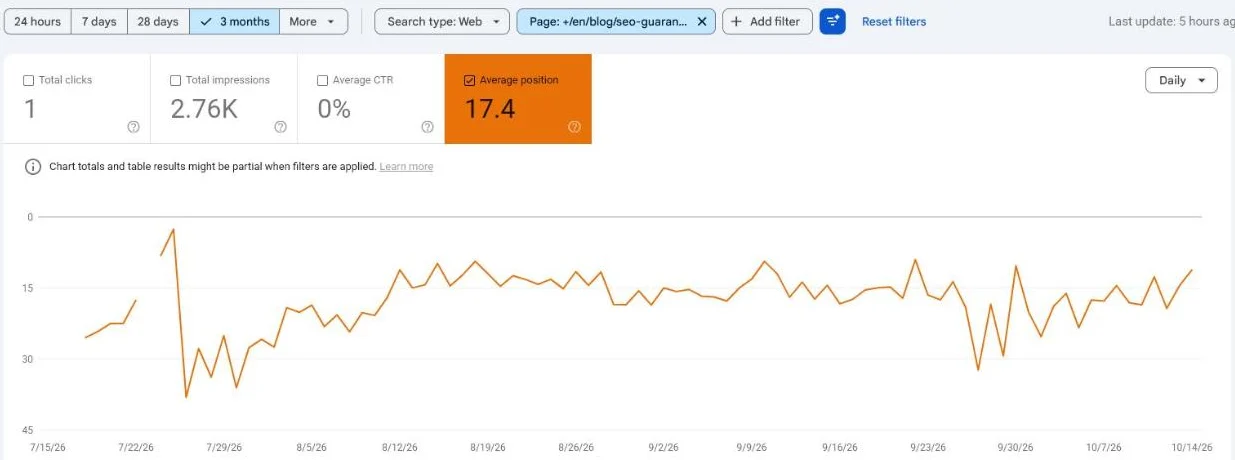 Our own Search Console: average position of one page over three months, 17.4 on average. Any single week could look like a drop.
A proactive partner separates that noise from a real drop, and calls you about the second one.
Bad news, fast
Bringing bad news quickly is a sign of a healthy relationship, not a weakness.
Problems that structurally disappear under the rug follow the same pattern as a bad SEO agency. The silence is the signal.
What can you expect from an agency that thinks along?
A few habits you’re simply allowed to demand. Let’s make it concrete.
Fixed strategic check-ins
Not a casual phone call, but a scheduled meeting every month or quarter.
You look at the numbers together, learn from what worked and plan the next steps. The agenda is fixed, even when you have no time to push.
How often that should happen is covered in our guide to a growth reporting cadence.
Unprompted, well-founded advice
A thinking partner sometimes sends a message that starts with “we spotted something in your data”.
For example:
- a new audience that converts above average
- an ad that’s burning out
- a page that suddenly scores better
The point: the initiative lies with them.
Here’s the kind of view where an agency should spot those things before you do:
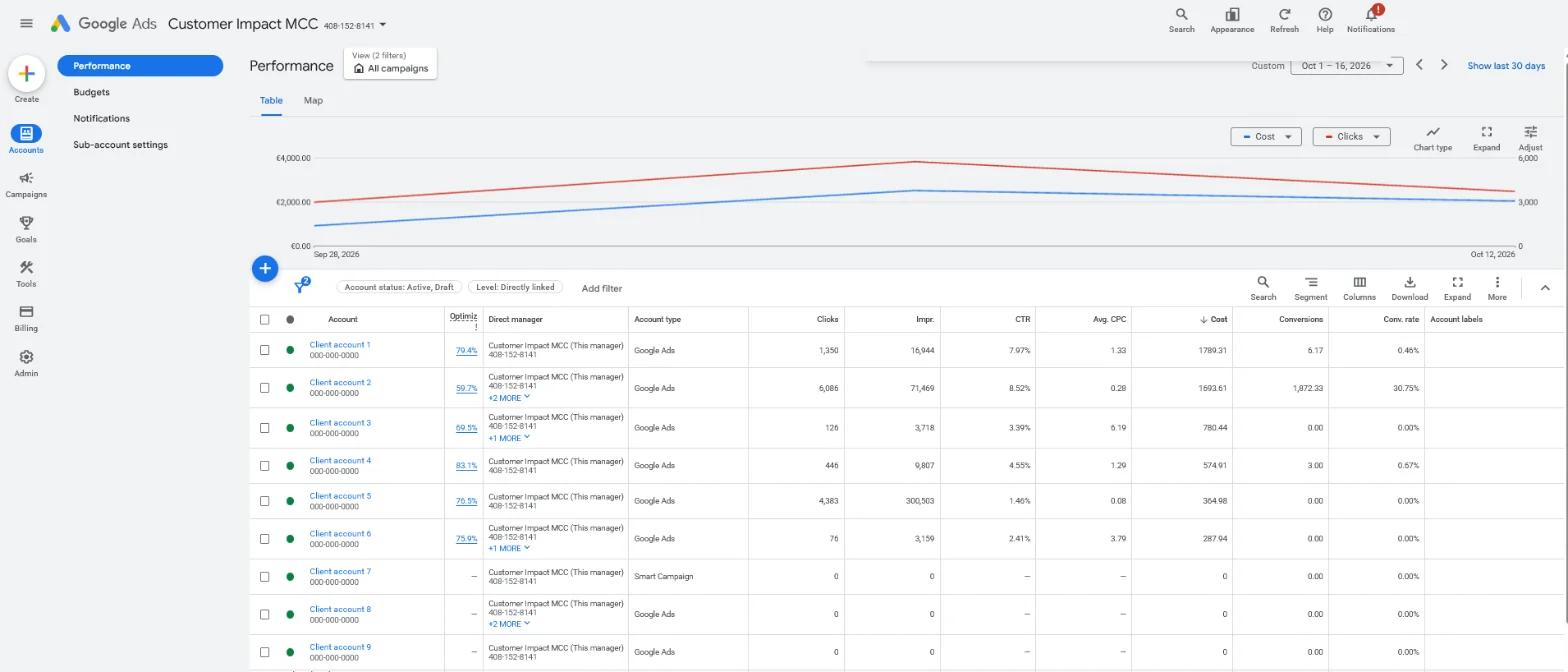 Our own manager account (MCC) in Google Ads, October 2026. Client names and IDs are replaced. Compare the CTR column with the conversions column.
A high click rate with no conversions is exactly the thing to flag.
Reporting that means something
Our experience: we report on cost of acquisition, revenue, impressions and traffic that fits your ideal customer. No vanity metrics.
A shared marketing dashboard keeps that visible between check-ins.
Clear agreements on ownership
Your access and ownership should be clearly arranged, from your Google Ads account to your website.
The platforms make that simple:
- Google Ads: has five access levels, and only Admin can manage other users’ access
- Search Console: owners can add and remove users, configure settings and use all tools
So you keep the Admin and Owner roles, and the agency works with its own login.
Our experience: the client owns everything: content, links and accounts.
A proactive partner doesn’t hide behind accounts you can’t view. See who owns your ad accounts for the checklist.
Test your current partner
Our list of questions to ask your SEO agency and the guide on what to look out for in a contract give you a concrete starting point.
How do you enforce proactivity instead of waiting for it?
Build it into the agreement. You don’t have to wait for an agency to change by itself.
Four steps make it stick:
- Make thinking along a KPI. Agree how many strategic proposals you expect per quarter, not just how many leads.
- Schedule the check-ins in advance. Put them in both calendars for a whole year, so they don’t depend on who calls first.
- Ask for a roadmap. A partner that can’t explain its plans for the next six months probably isn’t thinking ahead.
- Discuss the exit up front. Knowing how to switch to another agency keeps everyone sharp.
When it’s time to move on
Still bringing everything yourself after these steps? That’s not on you.
Then it may be time to outsource lead generation elsewhere, to a party that has initiative in its DNA.
Our checklist before firing your marketing agency helps you leave cleanly.
Frequently asked questions
My marketing agency never brings ideas or proposals of its own. Is that normal?
Unfortunately it’s common, but it doesn’t have to be that way. Many agencies are set up as executors and were never asked to think strategically. Make proactivity an explicit part of the agreement, or find a partner that offers it as standard.
Do I have to bring everything myself or should my agency be proactive?
You’re entitled to expect a full-fledged partner to come up with proposals itself. If you’re the only one bringing ideas, you’re paying for execution while you expect strategy. Fixed check-ins and a shared roadmap solve that.
Why does my agency never warn me when something goes wrong?
Usually because no fixed reporting, no clear KPIs and no clear ownership have been agreed. A transparent partner agrees in advance on the deviations for which it actively contacts you.
How do I recognize an agency that really thinks along?
By scheduled strategic check-ins, unprompted well-founded advice and clear agreements on access and results. Our guide on the best digital marketing agency helps you compare further.
Ready for a partner that picks up the phone itself?
A good marketing partner plans the check-ins, watches your numbers and calls you before something goes wrong.
We combine advice and execution under one roof: strategy, lead generation, ads, SEO, GEO and web, with lead generation as the engine.
We’re a small team, so we move fast and often do more than you expect.
Contact us and discover what a proactive partner feels like.
Free website scan
Enter your website and get an automatic scan within minutes, with concrete technical and SEO improvements. No sales pitch.
We only use your details for your scan. No spam, unsubscribe anytime.