
Growth & Strategie
AI in growth marketing: how AI is changing the discipline

Copy for AI
AI growth marketing means using AI to run your growth engine faster, not differently.
It speeds up experiments, personalization, analysis and content. The system underneath stays the same.
The verdict: AI is an accelerator, not a strategy. It makes a sound growth system faster and a broken one fail faster.
Growth marketing is still the system that forges SEO, CRO, content, paid and lead generation into one predictable engine.
If you want that bigger picture first, read what growth marketing is.
Weighing it against other disciplines? Compare growth marketing vs brand marketing and growth marketing vs traditional marketing.
How widespread is AI in growth marketing today?
It’s mainstream. Most companies already use AI somewhere in the business.
Stanford’s AI Index reports that 78% of organizations used AI in 2024, up from 55% the year before.
Here’s that jump in one picture:
The money follows.
The same report counts $33.9 billion in private investment in generative AI in 2024, 18.7% more than in 2023.
It also notes that research increasingly shows AI “boosts productivity and, in most cases, helps narrow skill gaps across the workforce.”
So access isn’t the edge anymore. Everyone has the tools.
The edge is where you point them: at the bottleneck that limits your leads and revenue.
AI touches the whole funnel, not one tactic
The biggest thinking mistake is treating AI as a trick for a single channel.
In growth marketing, the value sits in how the whole connects.
AI helps at every level of the funnel, and that sum makes the difference:
- Top of funnel: map search intents, draft ad variants, find new channel ideas.
- Middle of funnel: personalize emails, landing pages and nurturing by segment.
- Bottom of funnel: score leads, predict buying readiness, brief sales.
Our piece on the marketing funnel shows how these levels connect.
What it looks like at the bottom of the funnel
Take lead scoring. AI can weigh page visits, email clicks and company fit faster than a spreadsheet can.
Our guide to lead scoring explains which signals deserve weight.
The common thread: AI strengthens every stage, but only once your funnel itself is sound.
Experiments: learning faster, not just testing more
Growth marketing runs on an experimentation engine: hypothesis, test, learn, scale.
AI speeds up every step.
It helps you phrase a growth hypothesis, draft variants for an A/B test and spot why a test won or lost.
The pitfall: more noise
The trap is predictable. AI spits out variants in seconds, so you’re tempted to test everything at once.
But a hundred sloppy experiments teach you less than ten sharp ones.
The number of tests isn’t the goal.
Rule of thumb: what you learn, and what it yields in leads and revenue, is the goal.
Use AI to prioritize
Let AI help estimate which experiments promise the most impact.
Then keep the decision about what you roll out.
For example, say AI suggests twelve landing page tests.
You pick the two that touch your weakest conversion step.
Our growth experiment process lays out that rhythm.
Before you call a winner, check the numbers in our A/B test calculator.
Personalization: more relevant at scale
Personalization long meant little more than “Dear {first name}”.
AI lifts it a level.
Based on behavior, segment and context, you can tailor messages, offers and whole pages without building a hundred variants by hand.
Why it matters in B2B
You deal with several decision-makers, long journeys and different sectors.
AI helps you phrase the same core message differently for a financial profile than for a technical one.
It can also adapt nurturing to where someone is in the journey.
That fits how demand generation builds demand among the right people.
For a sector view, see growth marketing for recruitment agencies.
Email is often the easiest place to start, as our guide to AI in email marketing shows.
Watch the limit
Personalization that feels too precise scares people off.
Watch out: relevance without a strong offer stays empty. AI sharpens your message, but your positioning has to be right first.
Analysis: from reporting to understanding
This may be where the biggest gain lies.
Marketers drown in data and rarely get to interpretation.
AI helps you spot patterns faster: which channels truly contribute, where the funnel leaks, which segments are undervalued.
Let AI read the data, you ask the questions
Instead of digging through dashboards for hours, let AI summarize the raw data and propose hypotheses.
You ask the sharp questions and make the call.
Here’s the kind of raw report worth handing over, a GA4 acquisition view in our own property:
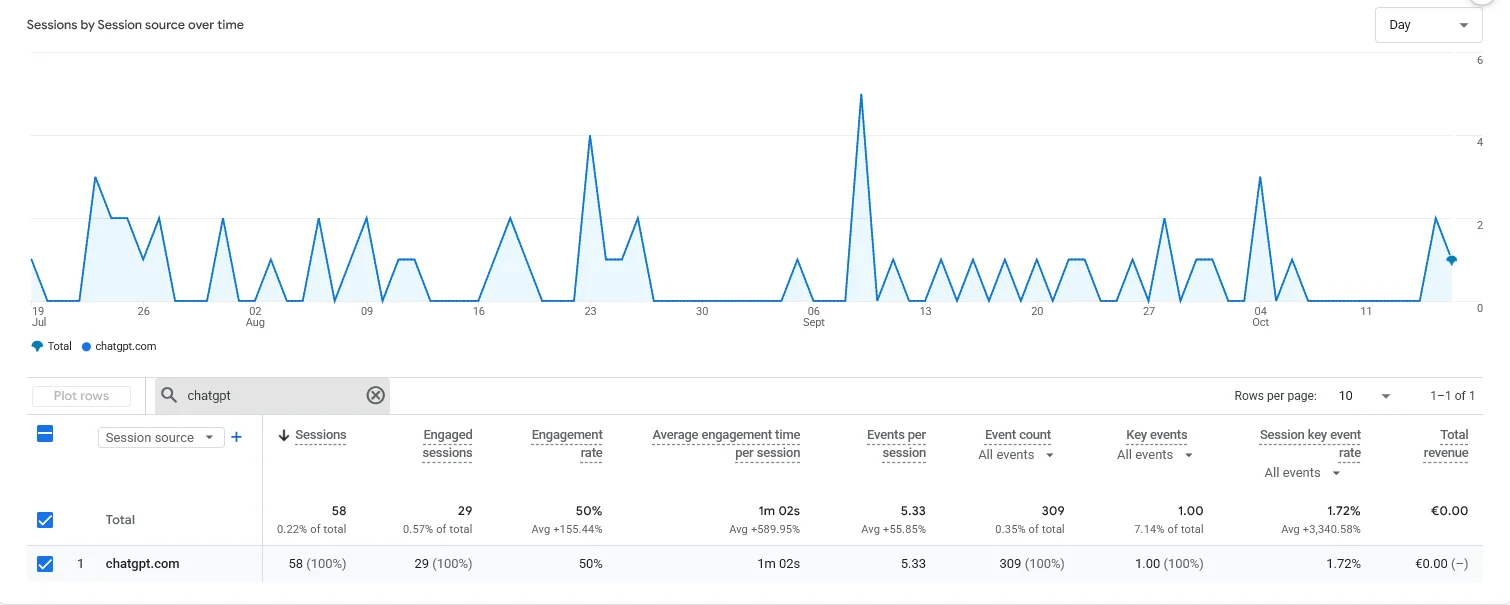 GA4 Traffic acquisition in our own property, last 90 days, October 2026: 58 sessions from chatgpt.com.
A table like this tells you what happened.
AI can help you ask why, and which page to test next.
Our guide on tracking ChatGPT traffic in GA4 shows how to set up that filter.
Steer on the numbers that matter
Not on clicks, likes or how many reports you run. Steer on leads, revenue and pipeline.
AI makes it tempting to polish every measurable number.
A good growth system keeps its eye on one north star metric tied to growth.
So use AI to understand faster, not to make prettier vanity charts.
The question stays: does this bring us closer to revenue?
Content: producing faster, humans keeping the bar high
Content is where AI is most visible.
Blog articles, ad copy, emails, product descriptions: AI delivers a first version in minutes.
For a growth team feeding many channels, that pace is valuable.
Here’s what a single AI turn looks like, a quick answer from Claude to a marketing prompt:
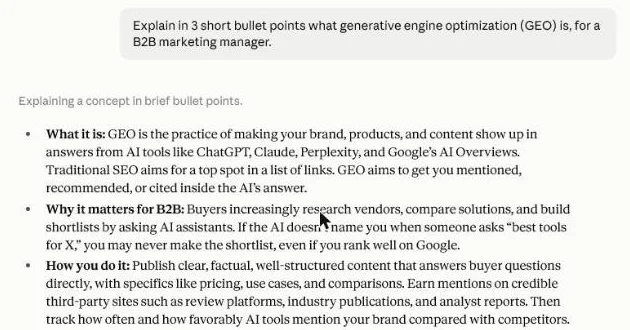 Claude, 17 October 2026, tested on a paid plan in an incognito chat: one turn, about 150 words, no actions taken.
It’s a decent sketch. It isn’t a finished, sourced page.
Speed without control is a risk
Generic AI content that adds nothing doesn’t help you in search, and it certainly won’t win a critical B2B buyer.
Google is explicit about it.
Its guidance on generative AI content warns that generating many pages without adding value may count as scaled content abuse.
It also asks you to fact-check AI output before publishing.
Google’s spam policies define that abuse as many pages generated “for the primary purpose of manipulating search rankings and not helping users.”
Our approach
You make the difference with your own point of view, examples and tone.
AI delivers the sketch, you deliver the sharpness and the truth.
Our experience: we use Claude and ChatGPT daily, plus Claude Code, also for design and dashboarding. The gain is speed to a first version.
We invest the time saved in what matters.
No content for content’s sake, only content that moves a prospect one step further.
Our AI content workflow shows how to set up that editing step.
Where are humans still indispensable?
AI is strong at patterns, speed and variation. It’s weak at judgment, context and strategy.
Those weak points are exactly the core of good growth work:
- What is the real problem? AI optimizes what you ask. Asking well is human work.
- What is the right goal? AI maximizes a number. Choosing that number takes strategy.
- What is true? AI sounds convincing, even when it’s off.
Google itself notes that generative models “don’t retrieve facts”, so someone has to guard them.
Our explainer on AI hallucination covers why.
That’s why AI works best inside a thoughtful system, not as a replacement for it.
A growth marketing agency uses AI as an accelerator within an engine that already steers on leads and revenue.
How do you start sensibly with AI in growth?
You don’t have to overhaul everything at once. Three steps get you started on solid ground:
1. Pick one bottleneck
Where does your funnel leak the most? Start there.
Choose one concrete problem where AI can save time or add insight.
For example, slow follow-up on inbound leads, or a nurturing flow nobody has time to personalize.
2. Measure the impact on growth
Don’t count how much content or how many experiments you now run.
Count what it yields in qualified leads and pipeline.
3. Only scale what works
If an application proves itself, roll it out more broadly. If it doesn’t, stop without regret.
That’s exactly how we work: start small, prove it works, then scale.
For automating the proven parts, see AI marketing automation.
Ready to put AI in your growth engine?
AI makes growth marketing faster and sharper, but only inside a system that steers on the right things.
The art isn’t using as many AI tools as possible.
It’s using AI where it brings you closer to leads, revenue and pipeline.
We’re a small, fast team, and we’ll help you pick that first bottleneck without hype.
Contact us and you’ll hear where AI pays off first.
Free website scan
Enter your website and get an automatic scan within minutes, with concrete technical and SEO improvements. No sales pitch.
We only use your details for your scan. No spam, unsubscribe anytime.