
Growth & Strategie
Marketing agency not responding? How to spot the real communication red flags

Copy for AI
A marketing agency that structurally doesn’t respond is a red flag, not a busy week.
The verdict: a short wait now and then is normal. Chasing every update yourself isn’t, and silence around bad numbers is the most serious warning sign.
You send an email, and it stays quiet.
You call, get voicemail, and only hear back days later. Meanwhile your campaigns keep running, and nobody seems to be at the wheel.
Sound familiar? Then your marketing agency is not responding and you have to take the initiative every time.
Below:
- what’s normal in communication with an agency
- when it tips over into a genuine red flag
- what you can concretely do
- what you’re entitled to expect from a partner
My marketing agency isn’t answering my emails anymore: what can I do?
Send one clear reminder, call your contact, and record everything.
Before you panic or cancel the contract, put the situation in order.
Not every delay is a disaster. But you don’t have to stay endlessly patient either.
A level-headed first response
Work through these four steps:
- Send a short, factual reminder. Summarise what you asked, when you asked it and by when you need an answer.
- Call your fixed point of contact. An email is easy to ignore; a phone call forces a response.
- Ask explicitly about the agreements. What’s the agreed response time? Who’s your contact when they’re away?
- Record everything. Note dates and promises, so you have a factual file if things really go wrong.
For example, a reminder can be three lines: your question, the date you sent it, and “I need an answer by Thursday”.
When it stops being a busy week
Still nothing after a clear reminder and a phone attempt?
Then it’s no longer a busy week, but a structural problem.
Next step: look more critically at the collaboration. Our checklist before firing a marketing agency helps you do that calmly.
How long is it normal for an advertising agency not to respond?
About one working day for a sign of life, two to three for a real answer.
This is the question most business owners ask: how long is it normal for an advertising agency not to respond before you may worry?
There’s no law, but there are reasonable guidelines.
What’s usually normal
Three response times you can reasonably expect:
- An acknowledgement within 1 working day: not necessarily a full answer, but a sign of life.
- A substantive answer within 2 to 3 working days to an ordinary question.
- A faster response for urgent matters, such as a campaign going off the rails or an error in an ad.
Here are those guidelines on one line:
What’s no longer normal
Three patterns cross the line:
- days of radio silence without any explanation
- having to send a reminder every time before you hear anything
- “I’ll get back to you next week” promises that structurally go unfulfilled
The difference is in being informed
A busy period or holiday is fine, as long as the agency communicates proactively that it might take longer.
So the difference isn’t the waiting time itself.
It’s whether you’re kept informed.
Why do I always have to chase my marketing agency myself for an update?
Usually because the collaboration was set up without a contact person or a rhythm.
If you’re wondering why you always have to chase your marketing agency yourself for an update, look at how things were set up.
Good reporting and communication are a choice, not a coincidence.
It often comes down to one of three causes.
No fixed point of contact
Your email lands at a general address, or with someone you didn’t know last month.
Without a clear point of contact, every question falls between two stools.
Our piece on a dedicated point of contact shows what that role should cover.
No agreed rhythm
No fixed reporting moments were agreed.
So the agency only sends something when you ask for it.
Our guide to a growth reporting cadence shows what a healthy rhythm looks like.
Too many clients, too few people
Some agencies take on more clients than they can serve.
You notice it in slower responses and uneven quality.
The key insight: you shouldn’t be the engine of the communication.
A partner that takes its role seriously informs you proactively about results, problems and next steps.
What are the real red flags in communication?
Silence around bad numbers, vague answers, changing contacts, no access and shifting promises.
Not every slow response is cause for concern.
But certain patterns point to a deeper problem in the collaboration.
Google’s own guide on hiring an SEO suggests asking up front: “How can I expect to communicate with you?”
Google’s warning: “Be careful if a company is secretive or won’t clearly explain what they intend to do.”
1. Silence around bad numbers
This is the most dangerous one.
An agency that communicates smoothly while things go well, but becomes unreachable the moment results disappoint? That’s no coincidence.
Transparent partners bring the news themselves precisely then.
An agency that guarantees no results but is honest about it is more reliable than one that suddenly ghosts you.
2. Vague answers without numbers
“It’s going well” without any backing is an excuse.
You have a right to clear KPIs and reporting that show what your money delivers.
3. Changing points of contact
A new name in your inbox every month?
Then there’s either a lot of turnover, or no real owner of your file.
4. No access to your own accounts
Whoever shuts you out of your Google Ads account or your website makes you dependent.
Watch out: that’s a structural red flag, not a detail.
Agencies usually manage client accounts from one manager account. Here’s what that view looks like from our side:
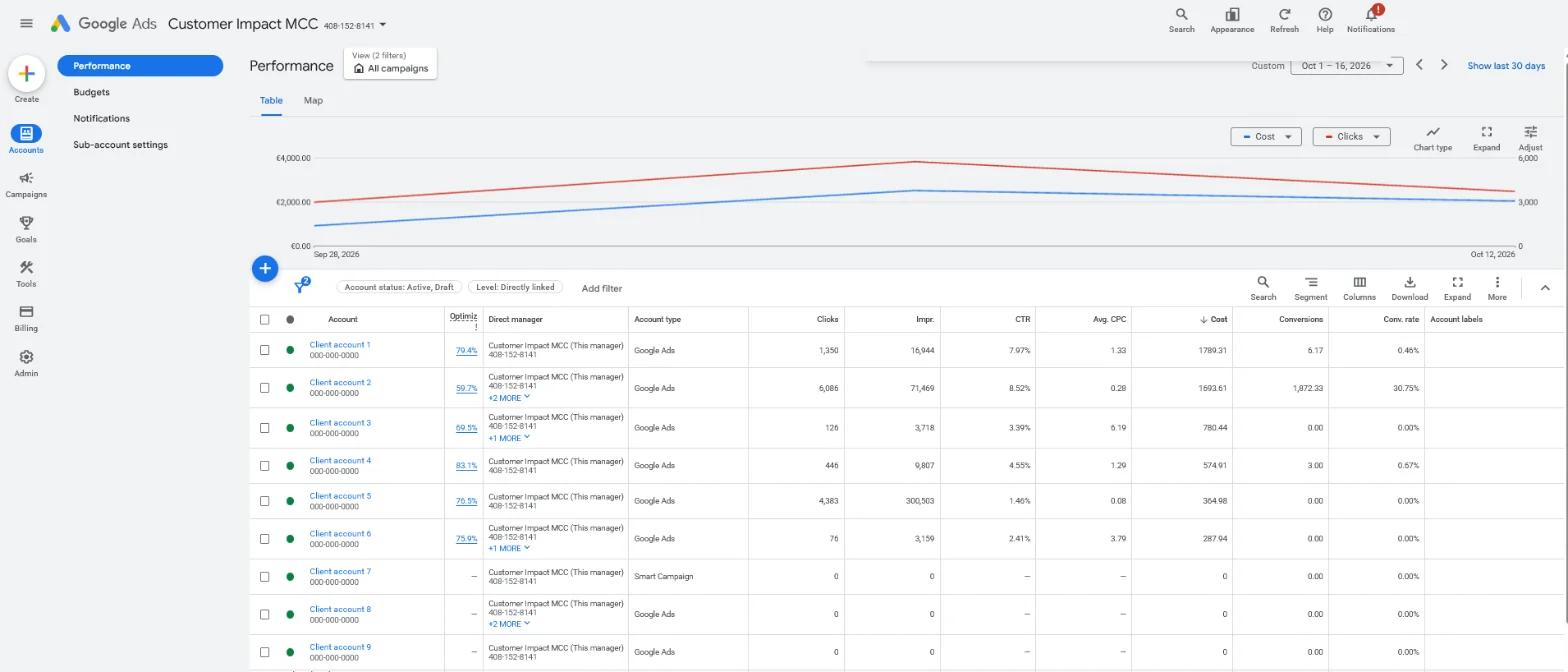 Our own manager account (MCC) in Google Ads, 1 to 16 October 2026. Client names and IDs are replaced.
Linking is fine. But the account itself should be yours, with you as admin.
Check who has access
Google Ads has five access levels, from email-only to admin.
Only an admin can give access, change access levels and unlink manager accounts.
You can check who has access in your own account:
The same goes for analytics. In GA4, only users with the Administrator role can add or change users.
Check it today: make sure at least one person in your company holds the admin or Administrator role in both.
5. Promises that keep shifting
Deadlines that slip without explanation undermine all trust.
And it costs agencies clients. In Setup’s Marketing Relationship Survey of more than 400 people on the brand and agency side, dissatisfaction with delivery is the top reason clients end a partnership, cited by 48%.
What are you entitled to expect from a good marketing partner?
A fixed contact, a written response time, proactive updates, fixed reporting moments and access to your own data.
Enough about what goes wrong. These are the basic agreements a professional partner simply keeps:
- A fixed point of contact who knows your file and who you can always turn to.
- A clear response SLA, for example a reply within one working day, agreed in writing.
- Proactive updates, even when the news is less good.
- Fixed reporting moments with clear numbers, not scattered little emails.
- Access to your own accounts and data, because it’s your property.
Want those agreements on paper? Our guide to the marketing agency contract lists the clauses to include.
How we handle it
At Customer Impact, communication isn’t a side issue. It’s the foundation of a good collaboration.
Our promise: a fixed point of contact and an agreed response time.
You never have to guess whether anyone is still thinking along with you.
Our experience: every delivery comes with full documentation, and we teach your team to make changes themselves.
No lock-in: no long contracts. If you’re not satisfied, you can stop.
Unsure about your current agency? Our guide on problems with lead generation pinpoints the sore spot.
Switch or adjust? How do you make the right choice?
Start with one honest conversation. Switch only when that doesn’t help or trust is gone.
Collaboration no longer fits? Then you have two options: adjust, or switch to a new partner.
Option 1: adjust
Always start with an honest conversation. Name concretely what you’re missing:
- the silence
- having to drive things yourself
- the lack of numbers
Sometimes an agency isn’t aware of the frustration.
A clear agreement can solve a lot.
Option 2: switch
Doesn’t that help, or is the trust gone? Then switching is legitimate. Prepare well:
- Check your contract and the cancellation terms before you cancel anything.
- Make sure you can transfer your website to another agency and that your accounts are in your name.
- Follow a structured plan to switch lead generation agencies without your running campaigns grinding to a halt.
Ending it cleanly? See our guide to cancelling a marketing agency.
Choose better the next time
Want to do it right this time? Ask your new partner the right questions to ask a Google Ads agency.
Pin down your communication expectations right away.
Our guide on how to choose a marketing agency covers the rest of the selection.
Rule of thumb: put response times in writing before you sign, not after the first silence.
That way you won’t be here again a year from now.
Frequently asked questions
My marketing agency isn’t answering my emails anymore, what can I do?
First send a short, factual reminder with a clear deadline and then call your fixed point of contact. Record every agreement and date. Still getting nothing after a reminder and a phone attempt? Then it’s a structural problem and you’re allowed to review the collaboration critically, possibly heading towards switching agencies.
How long is it normal for an advertising agency not to respond?
You may expect an acknowledgement of receipt within one working day and a substantive answer within two to three working days. Longer is only acceptable if the agency warns you proactively. Radio silence without explanation is never normal, no matter how busy things are.
Why do I always have to chase my marketing agency myself for an update?
Usually because there’s no fixed point of contact or no agreed reporting rhythm. A good partner informs you of its own accord about results and next steps. If you always have to pull, then the collaboration is set up wrong.
Is being unreachable a valid reason to switch?
Yes. Communication is a core part of the service, not an extra. If your marketing partner is structurally unreachable or goes quiet the moment the numbers disappoint, that’s a legitimate reason to look for another partner.
Ready for a partner that actually calls you back?
You deserve a partner that keeps you informed proactively, even when the news disappoints.
One with a fixed point of contact, clear response times and numbers that tell you something.
At Customer Impact, we combine strategy, lead generation, ads, SEO, GEO and web under one roof. You don’t juggle multiple parties. We’re a small team, so we move fast and often do more than you expect.
Contact us and discover what a transparent collaboration feels like.
Free website scan
Enter your website and get an automatic scan within minutes, with concrete technical and SEO improvements. No sales pitch.
We only use your details for your scan. No spam, unsubscribe anytime.