
SEO & GEO
GEO vs SEO vs AEO: the difference explained

Copy for AI
SEO wins the click, AEO wins the answer box, GEO wins the AI mention.
That’s the whole difference in GEO vs SEO vs AEO. The three terms get used interchangeably, but each one aims at a different destination.
The verdict: you don’t have to choose. Build a strong SEO base, sharpen it for answers, and add a GEO layer on top.
SEO makes you findable in Google’s blue links.
AEO, answer engine optimization, makes you the direct answer at the top of the results.
GEO, generative engine optimization, gets AI models such as ChatGPT and Gemini to mention your brand in their answer.
The difference in one sentence
Each discipline has one goal:
- SEO aims for a high position, so someone clicks your link.
- AEO aims for the short, direct answer shown at the top.
- GEO aims for a mention in the answer an AI model generates.
The difference lies in the destination.
With SEO, you want someone to come to your site.
With AEO, you want your answer to be the answer, often before the click.
With GEO, you want a model to cite your brand when it builds an answer from several sources.
Here’s that split in one picture:
Our experience: “what’s the difference between SEO and GEO?” came up in five of our recent sales calls.
Everyone had heard a different answer.
What is SEO?
SEO, search engine optimization, is the classic discipline.
The goal is a high position in Google, so you draw traffic to your site.
How SEO works
You optimise pages around keywords and search intent. You keep a solid technical foundation and build authority with relevant content and backlinks.
- Goal: rank as high as possible in the search results.
- Channel: classic search engines like Google and Bing.
- How you win: content around intent, internal links, fast tech, authority.
Why it’s still the base
SEO remains the biggest traffic source for most B2B companies.
It’s predictable and measurable, and it compounds.
Every page that ranks keeps bringing traffic for months, without you paying per click.
You measure it in Search Console. Here’s our own performance report:
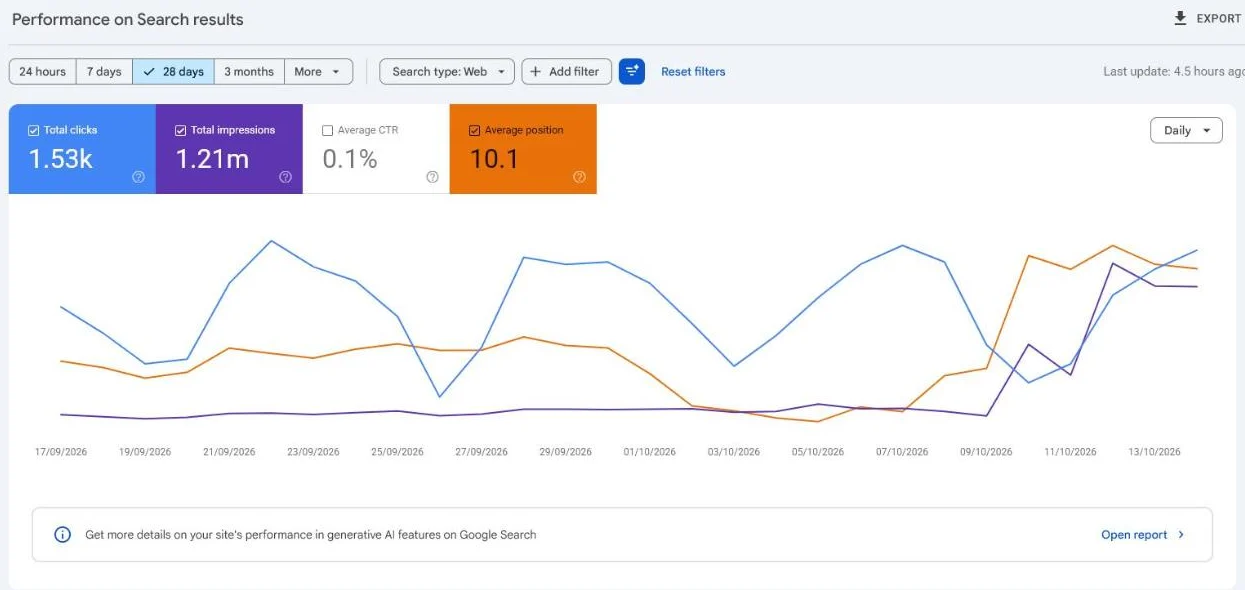 Our own Search Console for customerimpact.be, last 28 days, October 2026. 1.21M impressions against 1.53K clicks.
Clicks and positions: that’s the scoreboard SEO plays on.
Want to set the foundation firmly? Start with what is SEO and the SEO step-by-step plan.
Rule of thumb: a good SEO approach is the foundation the other two build on.
What is AEO?
AEO, answer engine optimization, is a refinement of SEO. You optimise to deliver the direct answer, not to get a click.
Where the answer shows up
Think of the featured snippet, the “People also ask” blocks and other answer formats at the top of the results.
Your content is built so a search engine can lift a clear, short answer straight out of it.
Our guide to answer engine optimization goes deeper.
No tag wins it for you
Google says you can’t mark up a page to become a featured snippet.
Its systems decide whether a page makes a good answer for the query.
- Goal: be the direct answer in the search results.
- Channel: answer formats such as featured snippets.
- How you win: literal answers, short paragraphs, a clear build-up.
How to win that box is in our featured snippet guide.
AEO is the bridge to GEO
AEO and GEO look alike because both revolve around “being the answer”.
The difference: AEO still plays out inside the search engine. GEO plays out in the generated answer of a standalone AI model.
So AEO is a logical intermediate step.
How Google’s own AI answers compare with the classic snippet is covered in AI Overviews vs featured snippets.
What is GEO?
GEO, generative engine optimization, is the newest discipline.
Everything revolves around “mention me as the answer” rather than “click my link”.
It’s also where we, as a pioneer, make the difference.
Where the term comes from
It comes from research. A Princeton-led team named it in the 2023 paper GEO: Generative Engine Optimization.
In that paper, optimization methods raised content visibility in generative engine answers by up to 40%.
How a model picks you
AI models build their answer from what they understand about your brand.
That’s your content, your authority and how often you’re mentioned elsewhere.
Look at how many sources sit behind a single Perplexity answer:
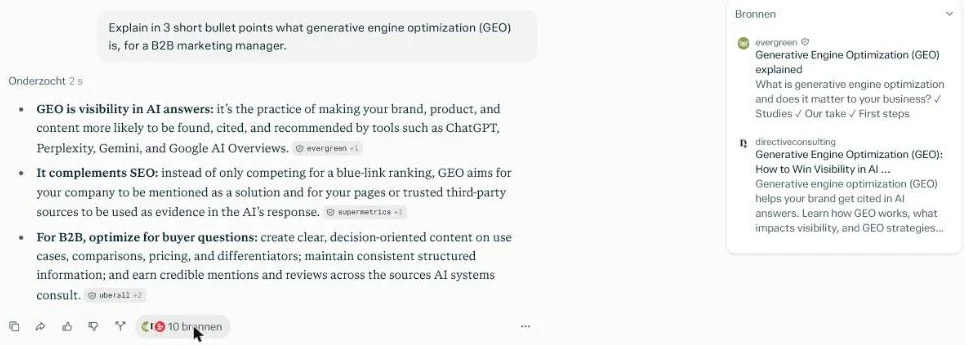 Perplexity’s sources panel for our own test prompt, 17 October 2026: 10 web pages behind one answer.
GEO is about being one of those sources, and being named.
- Goal: be mentioned in the answer of an AI model.
- Channel: ChatGPT, Gemini, Perplexity and Copilot.
- How you win: citable content, authority, consistent mentions everywhere.
Our experience: for LLMs it’s more of a citation play. How often and how consistently do other sites mention you?
Why it matters now
This isn’t a distant prospect.
More and more decision-makers ask their first question to an AI model instead of Google.
Our founder Tanguy De Keyzer wrote the book “The End of Search” about it.
Read the summary in the end of search.
The tricky part: less control
With GEO you have less direct control than with SEO. You don’t steer a position.
You raise the chance that a model sees you as a reliable source.
You do that in three ways:
- Tell the same, recognisable story everywhere.
- Write content that’s easy to cite.
- Build authority a model can verify.
Watch out: without a clear positioning, the model fills the gaps itself. That’s where it starts to hallucinate about you.
How to write that kind of content is in how to write content AI cites.
GEO vs SEO vs AEO compared
Side by side, the three disciplines differ on six points:
| SEO | AEO | GEO | |
|---|---|---|---|
| Goal | High position in Google | Being the direct answer | Being mentioned by AI |
| Channel | Classic search engines | Answer blocks in search engines | Generative AI models |
| Result | Click to your site | Answer at the top of the search results | Mention in the generated answer |
| Aims at | Keywords and pages | Concrete questions and intent | Meaning and authority |
| How you win | Relevance and authority | Clear, short answers | Citable, authoritative content |
| Measure | Positions, traffic, leads | Share in answer blocks | Whether and how you are mentioned |
How you measure GEO in practice
The measure column is where most teams get stuck. SEO has Search Console; GEO needs other reports.
Bing, for example, now reports how often AI answers cite your pages:
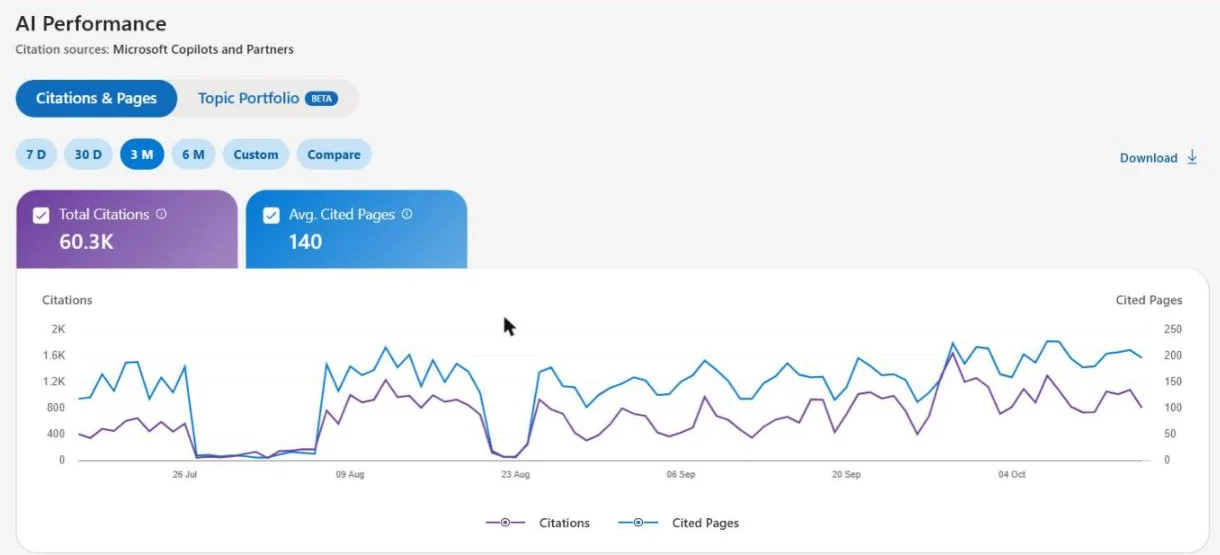 Our own Bing AI Performance report, October 2026: 60.3K citations and on average 140 cited pages over three months.
That’s a GEO scoreboard: citations, not clicks.
On our own site, those GEO numbers moved like this:
Our own GEO results for customerimpact.be in 2026. Perplexity mentions out of 125 agency-choice prompts, and Google AI Overview citations.
None of that shows up as a ranking. It only shows up when you measure mentions.
Where do SEO, AEO and GEO overlap?
Almost everywhere: the three share the same foundation. What works for one largely works for the others.
What all three reward
All three reward:
- Clear, valuable content that truly answers a question.
- A logical structure humans and machines can read.
- Authority: backlinks, mentions and a recognisable brand.
What Google says about its AI answers
Google says the same for its own AI features.
There are no additional requirements or special optimizations needed to appear in AI Overviews or AI Mode.
The page has to be indexed and eligible to show with a snippet. Standard SEO best practices apply.
Our guide to Google AI Overviews explains how those answers are built.
Why it isn’t a choice
So it isn’t a matter of choosing.
SEO is the base, AEO sharpens it at answer level, and GEO adds the layer AI models pick up.
Our experience: the two disciplines are merging. Search has shifted from keyword to intent.
ChatGPT and Claude split one question into many variations and search for each.
Ranking top 3 on those variations raises your chance to be in the AI answer, but it’s no guarantee.
Where GEO can move faster
There’s one twist. GEO can move faster than SEO in places.
A killer article on a niche expertise can be cited even without much domain authority.
Read more in cited in AI without ranking.
Where should B2B focus?
Start with SEO if it’s weak, then add GEO. For B2B the priority differs from a webshop chasing volume.
Why B2B is different
Your decision-makers search in a targeted way. They compare providers and do research before they get in touch.
It’s exactly that research that’s moving to AI models.
The order we recommend
Pick the line that fits you:
- No strong SEO yet? Start there: it already brings traffic and leads.
- SEO in good shape? Add the GEO layer while rivals wait.
- Don’t want to miss a click? Take AEO along in your content.
Whoever starts GEO early builds a lead that’s hard to catch later.
How to split the money is in the SEO and GEO budget split.
One article, three channels
In practice these tracks run into each other.
You write one strong article that answers a real question. You give it a clear structure, and you build authority around it.
That same article can rank in Google, grab the answer block and get cited by an AI model.
For example, say you sell payroll software and a buyer asks “how do I switch payroll provider mid-year?”.
- SEO: your guide ranks for that query in Google.
- AEO: its numbered steps become the featured snippet.
- GEO: ChatGPT cites the same guide when the buyer asks there.
One question, one page, three ways in.
Visibility is never the goal
The goal is more leads and revenue.
Visibility in Google, an answer block or ChatGPT is only the first step.
Whether a decision-maker finds you through a search or an AI conversation, your site has to convert that visitor.
That’s where our AI search optimization and SEO come together.
We optimise for mentions, leads and revenue, not vanity rankings.
Frequently asked questions
Is GEO replacing SEO?
No. GEO builds on SEO. Google says its AI features need no special optimization beyond standard SEO best practices, and the page has to be indexed first.
Is AEO the same as GEO?
Not quite. Both aim to be the answer, but AEO plays out in the search engine’s answer blocks, while GEO targets the generated answer of an AI model.
Which should a B2B company start with?
With SEO if your base is weak, because it already brings traffic and leads. Once that’s in shape, add the GEO layer.
How do you measure GEO?
By whether and how AI models mention you, not by positions. Reports such as Bing’s AI Performance show citations of your pages.
Ready for Google and AI?
Tell us your goal, and we’ll show you where you’re leaving opportunities on the table today, in the search results and in AI answers.
We are a small team, so we move fast and do more than you expect.
Contact us and you’ll hear within 24 hours where your lead lies.
Free website scan
Enter your website and get an automatic scan within minutes, with concrete technical and SEO improvements. No sales pitch.
We only use your details for your scan. No spam, unsubscribe anytime.