
SEO
SEO Competitor Analysis for B2B: Learn From Who Already Ranks

Copy for AI
An SEO competitor analysis maps which sites rank for your commercially relevant keywords, why they rank and where they are weak. You do it in six steps: list your keywords, find who ranks, check their rankings, run a keyword gap, compare their content with yours, and turn the gaps into a short action plan.
Build your business case: calculate your SEO ROI with our free organic-traffic calculator.
What exactly is an SEO competitor analysis?
An SEO competitor analysis answers three questions: who ranks for the keywords that are worth money to you, how they do it, and where they drop the ball in ways you can take over. It is a diagnosis, not a copy job.
An important distinction for B2B: your SEO competitors are not always your commercial competitors. A comparison site, a trade publication or a freelancer with a strong blog can rank for your keywords without ever stealing a client from you in a quote. Both groups count, because both stand between you and the click.
The honest caveat we always add at Customer Impact: a competitor analysis is only useful if it leads to action. A 40-page report that disappears into a drawer costs you money without returning anything. Steer by the keywords that generate clients and revenue, not by the prettiest dashboards.
The worked example we use below
To keep the steps concrete, we ran them on one of our own pages: our comparison of log file analysis tools, on the US English SERP (google.com, United States, English). We picked it because it is a neutral, tool-driven topic where we are clearly not on page 1 yet. In our own Search Console, the page collected 1,779 impressions in the 28 days from 17 September to 15 October 2026 at an average position of 18.1, and its top query “log file analysis” sat at position 23.7 with 537 impressions. Page 3: a real gap to close.
Step 1: Which keywords are worth analysing?
Start with your own keyword list, not with your competitors. Note 20 to 50 search terms with buying intent (“outsource [service]”, “[product] B2B”, “[solution] price”), following the principles of keyword research according to Ahrefs. Avoid broad informational terms where the search volume looks high but the intent is zero.
The fastest source is Search Console: filter on one page, switch the table to Queries and sort by impressions. Google defines average position there as the average position of the topmost result from your site (Performance report help), so a query at 15 to 25 is a page that Google already connects to the topic but does not rank high enough to get clicks.
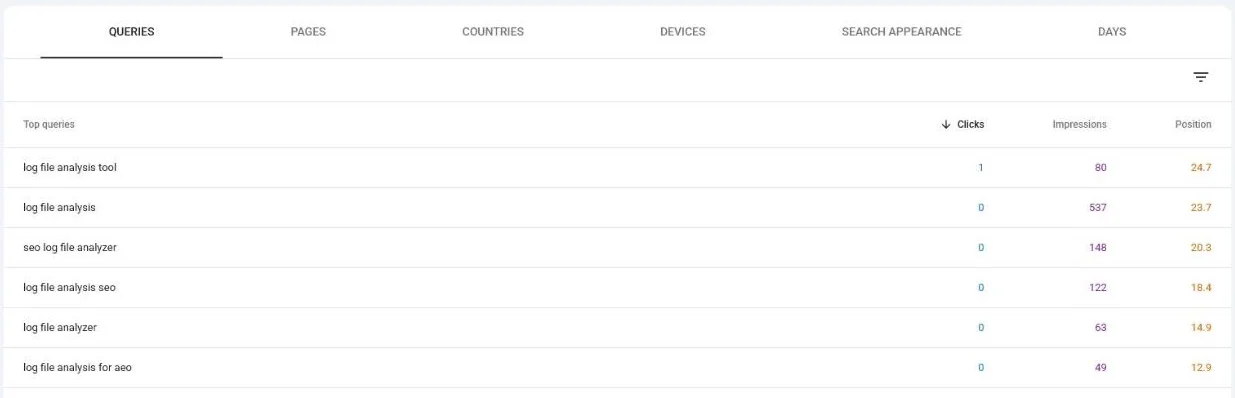 Step 1 in our own Search Console: the queries one page already gets impressions for, with their average position. Everything between position 11 and 30 is a candidate.
In the worked example, the list was short and clear: “log file analysis”, “seo log file analyzer”, “log file analysis seo” and “log file analysis tool”, all between position 18 and 25.
Step 2: How do you find your real SEO competitors?
Your real SEO competitors are the domains that show up above you most often for your target keywords. You do not pull those from your gut, but from the SERP.
- Search each keyword in the right market. For a US page, check google.com with the location set to the United States and the language to English; a result page from Belgium or the Netherlands shows different winners.
- Label every domain in the top 10. Tool vendor, publisher, agency, forum or encyclopedia. The label tells you what kind of page Google wants, which matters more than the brand.
- Build a shortlist of 3 to 5. The domains that keep coming back across your keywords are your real competitors. Depth on a handful is more valuable than a shallow overview of twenty.
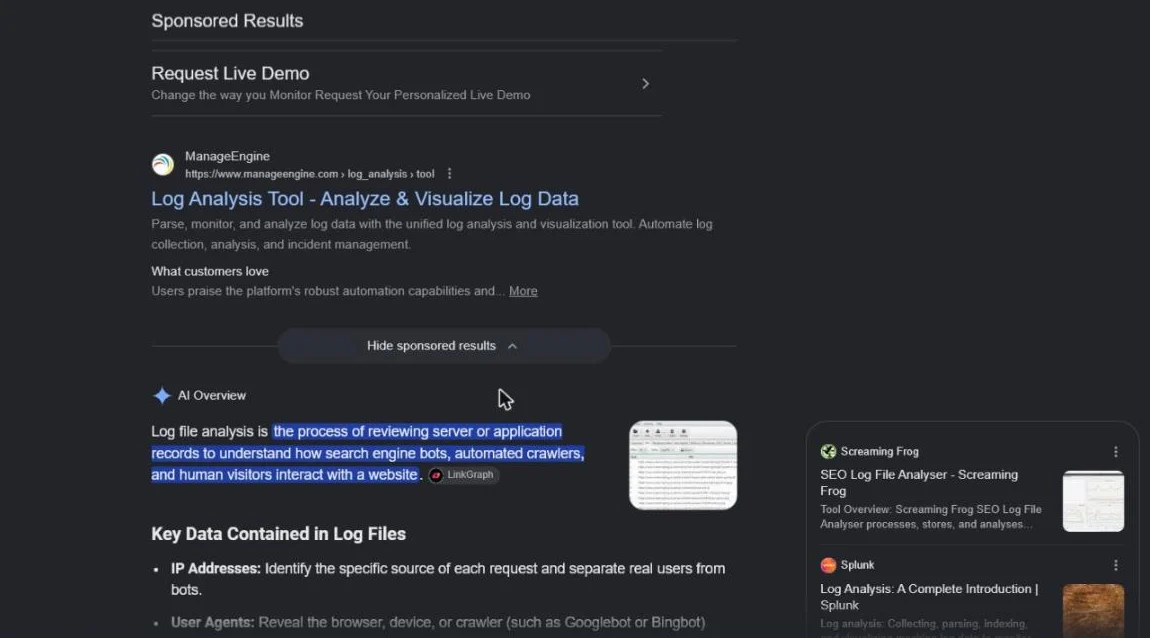 Step 2: the US SERP for “log file analysis”. Label each result by type before you look at any metric.
Step 3: How do you check your competitors’ rankings?
Once you have your shortlist, you want to know where each of them ranks, for which keywords, and whether that changes. There are three ways, from free to paid.
| Method | What you see | Cost | Watch out |
|---|---|---|---|
| Manual SERP checks | Who ranks today for one keyword in one market | Free | Personalisation and location skew results; use the right country and log out |
| Search Console | Your own positions per query, over 16 months | Free | Only your site, never your competitors |
| Rank tracker or SEO suite | Competitors’ positions per keyword, over time | Paid | Positions are sampled and estimated |
For one-off checks, manual searches are enough. For monthly follow-up, a rank tracking setup with your shortlist as competitors saves hours. Read positions together with CTR by Google position: moving from 12 to 8 is worth far more clicks than from 30 to 20.
Step 4: How do you do a keyword gap analysis?
A keyword gap analysis compares your ranking keywords with those of your competitors and shows where they score and you do not. In Semrush’s Keyword Gap you compare your domain with up to five competitors; its knowledge base defines “Missing” as keywords where all your competitors rank and you do not, and “Untapped” as keywords where at least one competitor ranks and you do not. Those are your direct opportunities.
The working process:
- Export the keywords your shortlist competitors rank for. Targeting the high-intent terms they already use is the core method of an ethical competitor analysis and delivers results faster than dreaming up keywords from scratch.
- Filter by intent. Throw out the informational leftovers and keep the terms where someone is ready to buy or make contact.
- Sort by feasibility. A keyword with lower volume but a weak number 1 is often more valuable than a popular term where three authoritative domains sit.
Want to compare links too? A backlink gap analysis does the same for referring domains. And for topics you have not covered at all, run a content gap analysis.
The trap here is chasing volume. A term with 2,000 searches per month that only attracts browsers returns less than a term with 70 searches from people who want a quote. In B2B, that difference is the whole game.
That difference is easier to see than to explain. Put a popular high-volume term next to a small term with real buying intent, and measure not the bar length but what counts on the bottom line: enquiries.
Step 5: What makes your competitor’s ranking content strong?
The pages that sit at the top are rarely there by accident. By dissecting them you see which signals Google rewards in your niche.
Pay attention to these elements:
- Content depth. Top 10 content is often more thorough and more comprehensive than the average blog post, which usually stays a good deal shorter. Depth is not a goal in itself, but in competitive B2B niches a thin page is rarely enough to cover a topic completely.
- Structure and intent. How is the page built? Does it answer the search query in the first paragraph? Are there clear headings and purchase-oriented sections?
- Proof. Screenshots, prices, dates, data from the author’s own accounts. Pages that show instead of tell are harder to beat.
- Internal and external links. How many other pages point to this piece? A strong internal link structure and relevant backlinks support rankings.
Do not copy word counts mindlessly. The question is not “how many words”, but “which questions does this page answer that mine skips”. In the worked example, we held our own page against that checklist. This is what it showed, and what we changed on 17 October 2026:
| What page 1 is judged on | Our page before | What we changed |
|---|---|---|
| Answer in the first paragraph | Two paragraphs of context first | A verdict opener that names the tools |
| Comparison table | None | Tool, best for, free option, paid from |
| Prices | ”Roughly one hundred euros” | Vendor prices, dated, with currency |
| Proof | No screenshots | Own Search Console Crawl Stats plus product pages |
| Coverage | Three tools | Four, including the free Crawl Stats report |
| FAQ | None | Four questions people ask |
Our guide to on-page SEO helps you turn that analysis into better pages.
Step 6: Where are your competitor’s weak spots, and what do you do first?
Besides what your competitor does well, what they do badly delivers the fastest wins. Look specifically for:
- Slow pages. A ranking page that loads slowly is vulnerable. A faster, better-optimized version of the same topic can push it out. Our technical SEO checklist helps you take advantage of this.
- Thin or outdated content. Pages that cover the topic halfway or have not been updated for years are vulnerable to a more thorough, more current piece.
- Missing intent. Sometimes an informational page ranks for a commercial term without a clear next step. That is where you win with a page that does have an offer and a call to action.
This is exactly where a small, fast team has the advantage. While a large competitor lets its content gather dust, you fix the gaps and take the positions. No black-hat tricks, just delivering better work.
Then turn the findings into a short, prioritized list. A filled example matrix (illustrative labels, not real competitors):
| Competitor A (tool vendor) | Competitor B (publisher) | Competitor C (forum thread) | Our move | |
|---|---|---|---|---|
| Ranks top 3 for the main term | Yes | Yes | No | Not a quick win, build depth first |
| Answers in the first paragraph | Yes | No | No | Match it |
| Shows prices or real screenshots | Own product only | No | No | Show all options, dated |
| Updated in the last 12 months | Yes | No | Yes | Add an updated date and recheck |
| Clear next step for a buyer | Free trial | None | None | Offer a concrete next step |
A workable action plan looks like this:
- Quick wins first. Keywords where you already sit on page two and can reach the top 10 with limited effort. Search Console finds them in minutes, see striking distance keywords. This generates leads fastest.
- Close content gaps. Write or improve pages for the high-intent keywords from your gap analysis, smarter and deeper than the current number 1.
- Technical fixes. Tackle the speed and structure issues your competitor leaves lying around.
- Targeted link building. Strengthen your most important pages with relevant backlinks, not with bought bulk packages. Read how in our guide to link building.
Prioritize by impact, not by ease. And dare to cut: if a keyword takes a lot of work and has little commercial value, let it lie. Honest advice also means saying when something is not worth it.
Which tools do you need for an SEO competitor analysis?
Search Console and manual SERP checks cover steps 1 to 3 for free. For the keyword gap in step 4 you need an SEO suite such as Semrush or Ahrefs. If you want to know which tools are worth it, read our comparison of SEO tools.
How often should you repeat an SEO competitor analysis?
For most B2B companies a thorough analysis per quarter is enough, with a quick check every month on your most important keywords. Rankings shift, competitors publish new content and Google adjusts its algorithm.
You do not need to reinvent the wheel every time. Keep your shortlist of competitors up to date, monitor your target keywords and watch what moves. A big shift (a competitor that suddenly rises or falls) is a signal to look deeper. Small noise is better ignored, otherwise you end up chasing dashboards instead of clients.
SEO is a long game anyway. If you want to know what you can realistically expect in terms of timeline, read how long SEO takes.
Should you outsource the competitor analysis or do it yourself?
An SEO competitor analysis can partly be done yourself, especially if you have the time and a tool. But the hard part is not collecting the data, it is drawing the right conclusions and prioritizing. That is where many companies go wrong: a pile of numbers, no plan.
At Customer Impact, we are a small B2B team that moves fast and steers by clients and revenue, not by vanity numbers. We do not do webshops or e-commerce, but B2B growth. In a free intake we look with you at your niche, your competitors and the keywords that are truly worth money. And if it turns out you can do it better yourself, we say so too.
See what an SEO engagement with us involves, or contact us right away.
Frequently asked questions about SEO competitor analysis
What is the difference between an SEO competitor and an ordinary competitor? An ordinary competitor serves the same clients as you. An SEO competitor ranks for the same keywords. That can be a trade publication, comparison site or freelancer who never steals a client from you, but who does stand between you and the search click. In a competitor analysis you count both groups.
Which tools do I need for a keyword gap analysis? A paid tool like Ahrefs or Semrush speeds up the work considerably, because you export competitors’ keywords in a few clicks. It can also be done manually by checking the top 10 for each keyword, but that takes more time. What matters is that you then filter by buying intent.
How do I check my competitors’ SEO rankings? Search your target keywords in the right country with personalisation off, and note who ranks. For ongoing follow-up, add your competitors to a rank tracker or use the organic keywords report in an SEO suite. Search Console only shows your own positions.
How many competitors should I analyze? Three to five is enough for most B2B companies. Depth on a handful of competitors returns more than a shallow overview of twenty. Choose the domains that come back most often for your target keywords.
Should I just copy what the number 1 does? No. Copying produces at best a copy that never becomes better than the original. The win sits in the gaps: keywords the number 1 misses, questions it does not answer and weak spots such as slow or thin pages that you do better.
How do I know if a keyword is worth it? Look at intent, not volume. A term with 70 searches from people who want a quote is often worth more in B2B than 2,000 searches from browsers. Weigh the expected work against the commercial value, and let go of keywords that cost a lot and return little.
Free website scan
Enter your website and get an automatic scan within minutes, with concrete technical and SEO improvements. No sales pitch.
We only use your details for your scan. No spam, unsubscribe anytime.