
SEO & GEO
Link Building: How to Build Authority That Lasts

Copy for AI
Link building is earning links from other websites to yours.
To Google, every strong link is a vote of confidence. And you need that confidence to rank.
The verdict: quality beats volume, every time. One link from a trustworthy, relevant site is worth more than a hundred weak ones.
What is SEO worth to you? Calculate the pipeline from your organic traffic with the free SEO ROI calculator.
What is link building?
It’s the active discipline of building your authority through inbound links.
Our guide to backlinks explains what those links are and why they count. Link building is about how you earn them.
One of three pillars
Link building is one of the three pillars of SEO:
- Content: covers the topic
- Links: earn the right to rank for it
- Brand: makes you the recognised choice
Without links, even strong content moves slowly.
Why is link building necessary?
Because good content on a young or rebuilt domain ranks slowly: the trust is missing.
Links are the proof that others take you seriously.
What the data says
A Backlinko analysis of 11.8 million search results found a clear gap. The number 1 result in Google has on average 3.8 times more backlinks than positions 2 through 10:
So links aren’t a detail. They’re often the difference between the top spot and the rest.
Google weighs links, it doesn’t count them
The Wikipedia entry on link building describes the same shift: since PageRank, the quality of each link matters more than the number.
One link from a respected site in your industry lifts you further than dozens from random, weak sites.
Which white-hat tactics work?
The ones where every link rests on a real reason: you made or said something worth pointing to.
You don’t buy good links. You earn them.
Here are the five methods that make the difference in practice:
| Method | How you approach it | Characteristic |
|---|---|---|
| Linkable assets | Publish original research, a tool or an in-depth guide that others use as a source | Delivers links passively and for years |
| Digital PR | Share data or a strong story with journalists and trade media | High authority, but labour intensive |
| Guest articles | Write substantive contributions for relevant trade blogs | Control over context and anchor |
| Resource pages | Ask to be included on curated link lists in your niche | Quick to scale, relevance is crucial |
| HARO / source requests | Respond as an expert to journalists’ questions | Unpredictable, but strong domains |
1. Build linkable assets
A linkable asset is content so useful or unique that people point to it on their own.
It can be, for example, original research, a benchmark, a calculator or a guide that goes deeper than the rest.
Best for: passive links that keep coming for years.
Watch out: an asset nobody knows about. Without promotion, even the best guide stays invisible.
In practice, one good data story earns more referring domains than months of scattered outreach.
2. Do digital PR
With digital PR you wrap your expertise or data in a story the press wants to run.
Concretely: tie a figure to a current theme and pitch it to the editors who cover your industry.
Best for: links from high-authority news and trade media.
Watch out: a thinly veiled ad. Journalists link to news and insight, not to a sales pitch.
3. Write guest articles
A substantive guest article on a relevant trade platform earns a link in the right context.
Pick media your audience actually reads, and write something that stands on its own.
Best for: control over context and anchor text.
Watch out: chasing volume on weak sites with forced anchors. One article on an authoritative platform beats 10 on link farms.
4. Get onto resource pages
Many sites keep curated lists of useful resources in a niche.
If your guide or tool belongs there, a short, personal email is often enough. Our guide to resource page link building shows the routine.
Best for: quick, scalable links in your niche.
Watch out: mass mailings to irrelevant lists. Relevance decides whether the link has value and stays put.
5. Be a source through HARO and roundups
Platforms such as HARO (Help A Reporter Out) and expert roundups bring journalists and experts together.
Give usable commentary and you earn a mention on strong domains.
Best for: links from domains you can’t reach any other way.
Watch out: it’s unpredictable. You can answer many requests and get picked for none.
Relationship-driven content is underrated, though. A roundup where you bring peers together can produce a stream of links, because the experts share it themselves.
Mentions where your audience is also feed your visibility in AI models, see SEO for AI.
How do you find and pitch prospects?
Earned links start with a good list of sites that already care about your topic.
Build the list
Look for three things:
- sites that already write about your topic
- sites that link to comparable content (check your competitors’ backlinks)
- a credible profile of their own
Filter ruthlessly on relevance. A link from your industry beats a stronger but random domain.
Write the pitch
Keep it short and personal. Say why their audience gains from your contribution, and refer to something concrete on their site.
Make it easy for the editor to say yes.
This is patient work. But earned links stay put and build a lead that’s hard to close.
Which link building shortcuts should you avoid?
Anything that creates links without a real reason. In the hunt for links, watch out for:
- packages that promise “100 links for 50 euros”
- links from sites about nothing, or in a foreign language
- networks that exist only to place links
- the same exact anchor text everywhere
Why cheap links are expensive
These black-hat tricks can help short term and land you a Google penalty long term.
The Google Search spam policies name buying links for ranking purposes and automated link-building services as link spam. Violating sites may rank lower or drop out of results.
Our experience: private blog networks (PBNs) are old domains with no traffic, kept only to send signals. Those links sell for about 150 euros, up to 500 to 600 euros per link.
We don’t support them. Our guide to buying backlinks explains the risk.
How many links do you need?
There’s no magic number: it depends on your industry and your competitors.
For a small B2B team, 5 to 10 relevant links from authoritative sites are often enough to see results.
Compare against who outranks you
The right question isn’t “how many links?”. It’s “how strong is my link profile against whoever sits above me?”.
An SEO audit maps that out. Profile strength is often expressed as domain authority.
Start with what you already have
Count your referring domains first. Here’s our own profile in Ahrefs, 401 domains, with two tagged as spam:
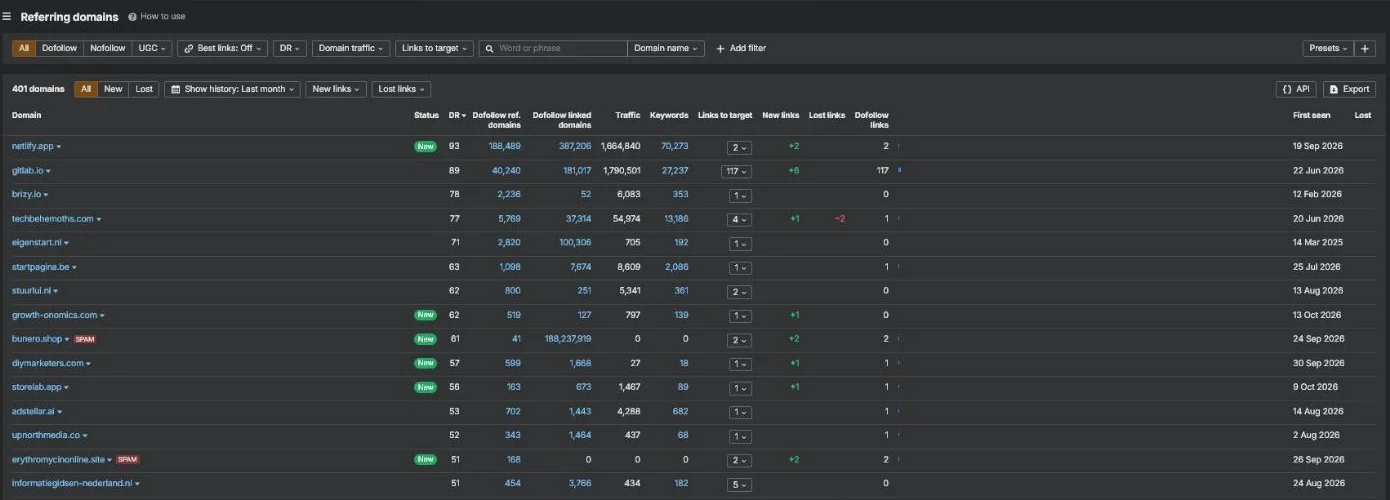 Referring domains for customerimpact.be in our own Ahrefs account, October 2026. A little noise is normal for any site that ranks.
Search Console gives a second view. Check the external total before you compare:
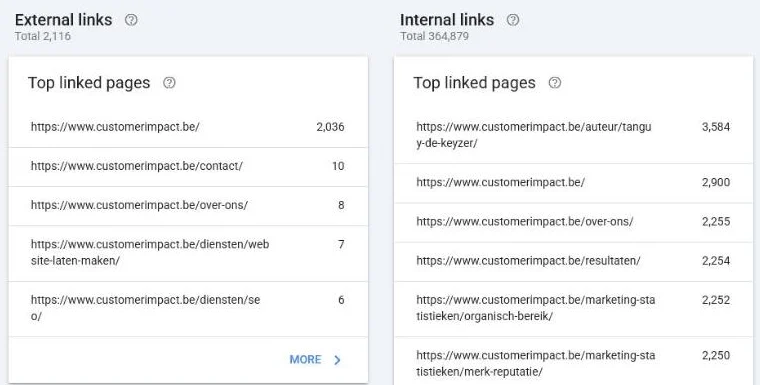 The Links report in our own Search Console for customerimpact.be, October 2026. It’s a sample, not every link Google knows.
Our experience: we don’t start with backlinks. We first fix internal linking, titles and the content on the site, then add links where a page is stuck.
Should you do it yourself or outsource it?
It depends on your time, your contacts and how well you know what’s safe.
Many companies outsource it. Then watch the approach closely, because outsourcing it badly can hurt you.
Read outsourcing link building before you sign, and check what link building costs per model.
How does authority turn into leads?
Through conversion: authority helps you rank, but traffic only becomes leads with a strong conversion rate.
Link building isn’t the goal. More leads are.
That’s how a strong SEO approach at Gom Nederland delivered 400% more daily visitors within 66 days.
Frequently asked questions
Is paid link building illegal?
Not illegal, but it goes against Google’s rules. Paid links meant to influence rankings fall under Google’s spam policies and can damage your visibility. That’s why we build only on earned links.
How long does it take for link building to work?
Count on months, not weeks. A link has to be found and weighed, and the gains stack up slowly. The upside: earned links stay put, so the effect lasts long after the work is done.
What is the difference between link building and backlinks?
Backlinks are the links themselves, and the value they pass on. Link building is the discipline you earn them with. Backlinks are the result, link building the process.
Want a stronger link profile?
Earned links last; bought ones don’t.
We build your authority the white-hat way, with contextual links from your own ecosystem. Contact us and within 24 hours you’ll hear where your opportunities are.
Free website scan
Enter your website and get an automatic scan within minutes, with concrete technical and SEO improvements. No sales pitch.
We only use your details for your scan. No spam, unsubscribe anytime.