
Marketing Automation
Choosing an Email Marketing Agency: What to Look For

Copy for AI
Some links in this article are affiliate links. If you choose a tool through one of them, we may earn a commission. It costs you nothing extra and does not change our assessment.
An email marketing agency turns your mailing list into revenue, not open rates.
The right one thinks along about your funnel, your offer and your follow-up. It also dares to tell you when email isn’t the smartest priority yet.
The verdict: choose the agency that reports on meetings and customers, owns nothing of yours, and says “not yet” when that’s the right answer.
Measure it yourself: put a euro value on your leads with our value-per-lead calculator.
What does an email marketing agency actually do?
It builds a system that guides contacts from first interest to customer and keeps running while you’re busy.
A good marketing automation and email agency does far more than send newsletters.
In concrete terms, it takes care of:
- Strategy and segmentation: who gets which message, and when in the funnel
- Automated flows: welcome sequences, lead nurturing and re-engagement
- Copy and design: emails that get read and prompt a click or an enquiry
- Tech and deliverability: landing in the inbox, not in spam
- Reporting on revenue: enquiries and customers, not opens
The last two points separate an agency from sending one-off emails yourself.
In practice, most of the value doesn’t come from prettier emails. It comes from the nurture flows running in the background and from a clean list that actually reaches the inbox.
Why should you choose on the numbers that matter?
Because you can’t pay a supplier with an open rate.
Plenty of agencies show off open rates and click-through rates. The marketing statistics from HubSpot show that revenue and pipeline are the metrics that truly matter.
The question that counts: how many meetings, quotes or customers does that email stream produce?
Choose an agency that steers on conversion and revenue, and puts those numbers first in its reporting.
If it only shows vanity metrics, you still know nothing about the value it delivers.
Which questions should you ask every agency?
Put these six on the table before you sign.
The answer matters less than how concrete and direct it is.
How do you handle deliverability?
It’s the most boring and the most important question at the same time. If your emails land in spam, the rest of the approach is wasted effort.
A good agency talks about SPF, DKIM and DMARC, about a clean list and about building reputation with a new sending domain.
Google spells out which authentication and sending hygiene inboxes expect in its sender guidelines.
Watch out: an agency that waves deliverability away with “the tool takes care of that”.
Ask exactly how they would improve email deliverability when your open rates suddenly collapse.
How do you set up automation and flows?
One-off campaigns are single shots. Flows keep working.
A strong agency thinks in sequences: a welcome flow, lead nurturing per funnel stage, and re-engagement for dormant contacts.
Ask for a flow they built before. Ask why it was set up that way.
For example, say a new subscriber doesn’t get a quote straight away. First come three emails that frame a problem, and only then does the offer follow.
Watch out: lots of standalone newsletters and zero automated follow-up.
How do you steer on revenue and leads?
The answer has to be about pipeline, not about opens.
Ask how they link an email stream to enquiries, quotes and closed deals. An agency that takes lead generation seriously knows which email produced which meeting.
If the conversation drifts to “we’re aiming for a 40% open rate”, the agency is measuring the wrong thing.
That’s how you connect email to real impact on your email marketing ROI.
Which tools do you use and who owns my data?
Your list and your flows are your property, not the agency’s.
Ask three things: is the account in your name, can you export all contacts, and can the flows move if you ever leave?
Also ask who pays the licence. On Brevo’s public pricing, for example, automation only starts on the $18 Standard plan, not the $9 Starter:
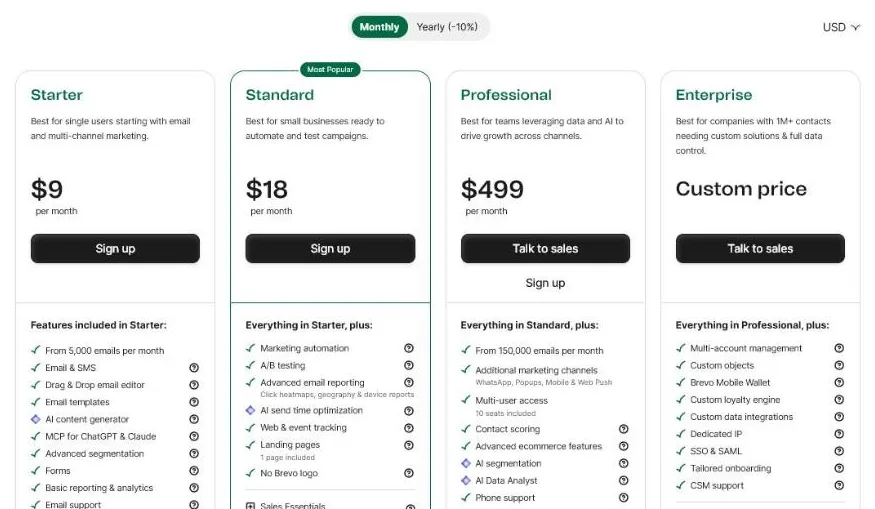 Brevo’s pricing page, US settings, billed monthly, 18 October 2026. Marketing automation only starts on Standard.
So the licence is a real line in the budget, and you should know whether it’s in the agency’s fee or on top.
Watch out: an agency that builds everything inside its own walled environment, so you walk away empty-handed.
Tooling ownership is your negotiating position for later.
What do you report, and how often?
Reporting should drive decisions, not decorate a slide.
Ask for a sample report. If you only see opens and clicks, the link with your revenue is missing.
If you see lead counts, meetings and cost per lead, you’re talking to an agency that steers on results.
For example, say the sample shows 12 meetings booked from one nurture flow last quarter. That’s a report you can steer on.
We steer on leads and revenue ourselves, and we put those metrics at the top of every report.
What do you do when email isn’t the best choice?
A straight agency tells you upfront when email is still too early.
It tells you to invest in your offer or your conversion rate first.
If every question gets an enthusiastic “yes, we can do that”, the agency is selling itself instead of your result.
Question versus answer: good sign or red flag?
Use this table as a mirror during the intro call:
| Your question | Good answer | Red flag |
|---|---|---|
| How do you measure success? | Leads, meetings and revenue per flow | ”Our open rates are above average” |
| Who owns the data? | Account and list are in your name, export is always possible | Everything runs in their walled environment |
| What about deliverability? | SPF, DKIM, DMARC and list hygiene actively managed | ”The tool sorts that out automatically” |
| Where does my list come from? | We build on your own opt-ins | ”We have lists we can put to work” |
| Can I see a sample report? | A transparent report with pipeline metrics | A vague promise or just a screenshot of opens |
If you get vague or polished answers, you know enough.
Which red flags should make you walk away immediately?
Four signals are reason enough to leave.
Good selling isn’t good work.
- Rented or purchased lists: an agency that offers to mail its own list in your name puts your reputation and your legal position at risk
- Spammy tactics: misleading subject lines, hidden unsubscribe buttons or floods of emails
- No access: if you can’t get to your own account, data or reports, you’ve been made dependent
- Only vanity metrics: opens and clicks with no word on pipeline often hide a thin contribution to revenue
Under GDPR and most sender rules you need explicit opt-in. Purchased lists burn your sending domain.
For example, say an agency offers 50,000 “verified” contacts for a flat fee. Walk away.
And spammy tactics chase short-term numbers and backfire the moment spam filters pick you up.
Access isn’t a favour. It’s your right.
Why does B2B need a different approach than a webshop?
Because the buying cycle is longer and a group of people decides together.
Many email agencies grew big on e-commerce: abandoned carts, discount codes, fast repeat purchases. That doesn’t work in B2B.
In your case it’s about building trust over weeks or months.
So choose a partner that understands B2B lead nurturing. The message has to match a rational, slow buying process, not impulse purchases.
An agency that only speaks webshop language misses the mark.
When does outsourcing pay off, and when doesn’t it?
It pays off when you have a list you aren’t using, when internal hands are missing, or when you want to scale faster than you can manage yourself.
An agency then brings structure and speed that are hard to build internally.
For example, say you hold 8,000 contacts and haven’t mailed them in a year. That list is an asset sitting idle.
It pays off less if you don’t yet have an audience or an offer. In that case, invest in lead generation and a strong proposition first.
Email amplifies what’s already there. It doesn’t conjure demand out of nothing.
Here’s the decision in one picture:
A straight agency tells you that upfront, so you don’t put money into a channel that’s still too early.
Large agency or small team?
A small, specialised team moves faster and knows your account personally.
Anyone comparing email marketing agencies notices the difference quickly.
Large agencies have volume and processes. But you easily disappear into the crowd and pay towards their overhead.
A small team steps in immediately when something needs adjusting.
With us you see that in the marketing automation we set up: fewer layers, more tempo, an approach tailored to your situation.
For Get Driven, that way of working delivered a fourfold conversion rate, from 1.8% to 7.3%:
We took the entire chain from message to follow-up into our own hands.
How do you make the final choice?
Weigh three things: proof, approach and fit.
Proof: concrete cases for companies like yours, not awards.
Approach: how straight an agency answers the questions above, especially on data ownership and deliverability.
Fit: tempo. Do you get a fixed point of contact who knows your account, or do you disappear into a queue?
In practice, fit weighs heaviest afterwards. An agency that knows your account adjusts faster when a flow underperforms.
Frequently asked questions
What does an email marketing agency cost?
That depends heavily on the scope. A one-off flow setup is something entirely different from ongoing strategy, copy and management.
Always ask whether the price is tied to what it delivers, and whether tooling and licence costs are separate or included.
Set the cost against the value of an extra lead. Our value-per-lead calculator works that out quickly.
Agency or in-house?
Doing it yourself works if you have a small volume and someone internally who picks it up.
Outsourcing pays off as soon as you leave a list unused, want to scale faster, or can’t get the flows and deliverability under control.
Still unsure? Read when outsourcing email marketing is and isn’t smart.
How quickly do you see results from email marketing?
Count on weeks, not days.
A welcome flow often produces the first enquiries within a few weeks.
Real lead nurturing in B2B follows the buying cycle, and that’s slow. An agency that promises results within a week is aiming at vanity metrics instead of pipeline.
Ready to choose the right agency?
Tell us what you’re doing with email today and where you want to go.
We’ll say plainly whether an email marketing agency is the smartest move for you, or whether you should invest elsewhere first.
We’re a small team, so we move fast. Contact us and you’ll hear within 24 hours where your opportunities lie.
Free website scan
Enter your website and get an automatic scan within minutes, with concrete technical and SEO improvements. No sales pitch.
We only use your details for your scan. No spam, unsubscribe anytime.