
Growth & Strategie
Choosing a SaaS marketing agency: what should you look for?

Copy for AI
Choose a SaaS marketing agency that steers on recurring revenue, not on clicks.
That’s a different exercise from finding an agency for a webshop or a local service provider. You aren’t selling a one-off purchase, but a subscription that has to prove its value month after month.
The verdict: pick the partner who can explain how a trial user becomes a paying customer and stays one. Ad skills alone won’t move your MRR.
Most classic agencies report on clicks and form fills, so they only half understand your story.
Not every agency with “growth” in its name can read a SaaS funnel.
The question isn’t whether they can run ads. It’s whether they understand activation, conversion to paid and retention.
That’s the test.
Why does SaaS put different demands on an agency?
Because in SaaS you only earn back your acquisition costs over several months.
That changes everything.
A lead who signs today is only profitable if they stick around long enough. That shifts the focus from “how many leads” to “what kind of customers, how quickly activated and how long retained”.
Cheap leads can cost you money
An agency that misses this will optimise your campaigns towards cheap leads.
Those leads never convert to paid usage. Or they cancel again within two months.
On paper the cost per lead looks great; in your MRR it shows up as churn.
The ratio between what a customer brings in and what it costs to win one is what counts. Our explainer on the LTV to CAC ratio shows how to calculate it.
Three differences that shape your choice
A few differences change what you need from a partner:
- The sales cycle is longer and more complex. There are often several decision-makers and a trial or demo period between interest and purchase.
- The product itself is a growth channel. At many SaaS companies, the product experience persuades more than a salesperson.
- Expansion counts. Existing customers who upgrade or add seats are often a bigger source of growth than new logos.
An agency that understands SaaS thinks along this entire chain. Others don’t.
Watch out: an agency that only works the top of the funnel gives you activity without your MRR moving.
Watch out: does the agency understand product-led growth?
It should, because more and more SaaS companies grow product-led.
Users try the product themselves through a free trial or freemium plan.
They upgrade once they feel the value.
Why onboarding beats the sales pitch
In that model your onboarding matters more than your sales pitch.
An ad that drives people to a sign-up is useless if those users get stuck before they reach their first moment of success.
For example, say a project tool gets 400 trial sign-ups a month, but most never create a first project. More ad budget only buys more people who get stuck at the same step.
Our piece on product-led growth explains the model in depth. If you’re unsure which model fits, read product-led vs sales-led first.
Three questions to ask about the product experience
Ask a prospective agency how it looks at the product experience. Good answers cover:
- Activation: which action predicts that a trial user will stay, and how do you get people there faster?
- Onboarding flows: where do new users drop off, and which emails or in-product messages keep them engaged?
- In-product signals: which behaviour shows who is ready for an upgrade or a sales conversation?
Our guides to customer activation and B2B customer onboarding show what good looks like on each point.
The red flag to listen for
If an agency looks away here and falls back on “we’ll run your ads more efficiently”, that’s a signal. A bad one.
With PLG the leverage often sits in the product and the funnel around it, not in a bigger ad budget.
New to the model? Read what growth marketing is first.
Funnel analytics: can the agency measure the right steps?
A good agency measures every transition in your SaaS funnel separately.
Broadly, that chain looks like this:
- Visitor to trial or demo. How much of your traffic actually starts a trial?
- Trial to paid. What share of trial users becomes a customer, and what speeds that up?
- Paid to expansion. How many customers upgrade, and how many churn?
Here’s the same chain as a picture, with the metric an agency should report at each step:
Ask how they tie marketing to MRR
If an agency only talks about traffic and cost per lead, it’s missing the two steps that determine your revenue.
So ask concretely: how do you measure the transition from trial to paid? And how does marketing move MRR?
A strong answer points to one measurement setup. Marketing, product and sales share the same numbers, rather than separate reports that contradict each other.
Tip: ask to see the lifecycle stages they’d set up in your CRM. In HubSpot, for example, the default stages run from Subscriber to Lead, MQL, SQL, Opportunity, Customer and Evangelist:
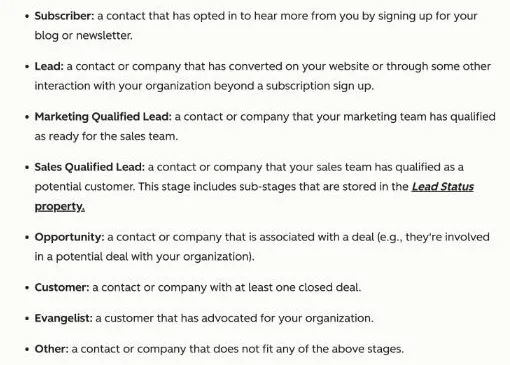 HubSpot’s lifecycle stage definitions, checked 18 October 2026. Marketing hands over the MQL, but only sales decides what counts as an SQL.
HubSpot defines an MQL as a contact “your marketing team has qualified as ready for the sales team” (HubSpot lifecycle stages). An agency that uses those stages can report on pipeline, not just on form fills.
Attribution across channels and weeks
Also pay attention to how the agency talks about attribution.
SaaS journeys are long. They often run across multiple channels and weeks. A partner who credits everything to the last-click channel oversimplifies your reality and pushes budget in the wrong direction.
GA4 itself offers data-driven attribution next to last-click models, and the older first-click and linear models were retired in November 2023 (Google Analytics attribution help).
You want someone who understands that content, SEO, paid and lead gen together form the path, not one heroic channel.
Does the agency steer on MRR or on vanity metrics?
It should steer on MRR, and this is perhaps the most important question.
Vanity metrics such as impressions, followers or even raw lead counts feel good.
But they say little about the health of a SaaS business.
What counts is recurring revenue, the quality of the customers coming in and how long they stay.
What MRR is made of
Stripe defines MRR as the predictable recurring revenue customers generate each month: the number of customers times the average monthly revenue per customer (Stripe on monthly recurring revenue).
It splits that into parts an agency can influence:
| MRR component | What it means | What the agency should work on |
|---|---|---|
| New MRR | Revenue from new subscribers | Acquisition of the right segments |
| Expansion MRR | Upgrades and extra seats | Upsell triggers and in-product signals |
| Churned MRR | Revenue lost to cancellations | Activation and onboarding |
| Contraction MRR | Revenue lost to downgrades | Value delivery after the first months |
| Net new MRR | New plus expansion, minus churned and contraction | The one number that sums up growth |
An agency that only talks about new MRR ignores three of the five levers.
Our explainer on net revenue retention shows why the existing base often matters more.
Questions an MRR-led agency asks
An agency that steers on MRR asks different questions:
- Value: what’s a customer worth on average over their lifetime?
- Budget: what can you afford to spend to win one?
- Segments: which segments pay off fastest and longest?
It then directs the effort towards the channels and messages that attract exactly those customers.
That turns marketing into an investment with a measurable return.
No more gut feeling.
The ninety-day test
A practical test during an intro meeting: ask what the agency would measure in the first ninety days.
- Traffic and clicks: it steers on activity
- Activation, conversion to paid, retention, revenue per segment: it steers on growth
That distinction runs deeper than MRR alone.
Read how input metrics and output metrics determine what you truly steer on in growth.
Rule of thumb: if the first report has no revenue column, keep looking.
One system, not one tactic
The biggest pitfall when choosing an agency is thinking in standalone tactics.
You don’t need an SEO agency, an ads agency and a content agency all working past each other. In SaaS, those channels only reinforce one another when they serve a single goal: moving more of the right users towards recurring revenue.
How the channels fit together
Growth marketing is exactly that orchestration system. It brings SEO, CRO, content, paid and lead gen together into one predictable growth engine.
Every channel plays a role. Same chain, same goal:
- SEO and content fill the top with users who are actively looking
- CRO and onboarding make sure those users activate
- Lead gen and paid accelerate where that pays off
- Funnel analytics show where the next win sits
Each channel has its own SaaS playbook. See SEO for SaaS and Google Ads for SaaS for the details.
Judge the system, not the prettiest ad
So when you assess a partner, ignore the prettiest ad.
Look at who can run the whole system and explain how the parts connect. A good growth marketing agency thinks about your growth model first and only then picks the channels.
Feel free to dig into related topics as well, such as demand generation and the difference between revenue figures and vanity metrics in marketing. Both bear directly on how an agency approaches your SaaS growth.
Checklist: how to choose a SaaS marketing agency before you sign
Run through these points with every agency you’re considering:
- Does it understand PLG and the role of the product in your growth?
- Does it measure the trial to paid and paid to expansion transitions?
- Does it steer on MRR, retention and activation rather than clicks?
- Does it work from one system that orchestrates channels?
- Does it share the same numbers with your sales and product teams?
Here’s how to score the answers:
| Answer you hear | What it tells you |
|---|---|
| Concrete metrics per funnel step | A partner who gets SaaS |
| ”We’ll lower your cost per lead” | Top-of-funnel thinking only |
| A channel plan before any question about your model | Tactics, not a system |
Our lists of marketing agency red flags and how to choose a growth marketing agency help with the follow-up questions.
Clear, concrete answers on most points? You’re dealing with a partner who truly gets SaaS.
Generic marketing talk? Keep digging.
Ready to choose the right partner?
Growing a SaaS business calls for an agency that treats your entire funnel as one whole.
Want to talk through your growth model, your funnel analytics or your MRR goals?
Get in touch and we’ll map where the biggest lever for your SaaS sits, from trial to expansion.
Free website scan
Enter your website and get an automatic scan within minutes, with concrete technical and SEO improvements. No sales pitch.
We only use your details for your scan. No spam, unsubscribe anytime.