
Content
How do you win leads from CBAM as a software company?

Copy for AI
You win CBAM leads by answering importers’ questions before they pick a tool.
Those questions are concrete:
- Do my imports fall under CBAM?
- How do I become an authorised declarant?
- What data do I ask my supplier for?
- Which software fits our setup?
The verdict: build pages on the regulation, not on “CBAM software”. That’s where the searches are, and the first annual declaration covering 2026 is due by 30 September 2027 at the latest.
Who is this CBAM playbook for?
It’s for vendors of CBAM software, customs software or an ERP. Your buyers import steel or aluminium.
The vendor with the answer gets the demo.
This piece is part of our guide to becoming less dependent on Google Ads. It shows how we approach content marketing around a single regulation.
How to keep this kind of content accurate and current is covered in regulation as a lead source.
What do software vendors need to know about CBAM?
CBAM puts a carbon price on imported goods with high emissions.
The full name is the Carbon Border Adjustment Mechanism. For your marketing you only need a handful of facts.
This is the situation as of 28 September 2026:
| Question | Answer | Source |
|---|---|---|
| Which goods? | Cement, iron and steel, aluminium, fertilisers, electricity and hydrogen | Commission CBAM Q&A |
| Mandatory since when? | The transitional period ran from October 2023 to the end of 2025. Since 1 January 2026 the definitive regime applies. | Commission CBAM Q&A |
| Who needs authorisation? | Importers bringing in more than 50 tonnes of CBAM goods per calendar year; anyone importing hydrogen or electricity, always | Commission CBAM Q&A |
| When to buy certificates? | Sales of CBAM certificates start on 1 February 2027 | Commission CBAM Q&A |
| First annual declaration? | By 30 September 2027 at the latest, covering 2026 imports | Commission CBAM Q&A |
| Who is competent in Belgium? | FPS Public Health, DG Environment (Climate Change Service) | klimaat.be |
Why the dates matter for your content plan
Every date in that table is a moment when importers start searching.
So each one deserves a page. Publish it well before the date.
Rule of thumb: publish at least a few months ahead, because new pages need time to rank.
What do importers search for and ask about CBAM?
They search for the regulation. Not for your product category.
These are monthly Google searches, averaged over the last 12 months (Google Ads data, September 2026):
| Search term | Belgium | Netherlands |
|---|---|---|
| cbam | 1,900 | 2,400 |
| cbam rapportage | 10 | 30 |
| cbam verordening | 10 | 40 |
| cbam software | 10 | 10 |
| koolstofgrenscorrectie | too low to report | too low to report |
The gap is easier to see in a chart:
Why “cbam software” is the wrong target
Anyone who picks “cbam software” as a target keyword is aiming at ten searches a month.
Answer the questions around “cbam” and you’re visible for 1,900 searches a month in Belgium and 2,400 in the Netherlands.
Watch out: a low tool volume doesn’t mean nobody buys. It means buyers start one step earlier.
A keyword tool shows you that spread per term. Here’s what the volume check looks like in Ahrefs:
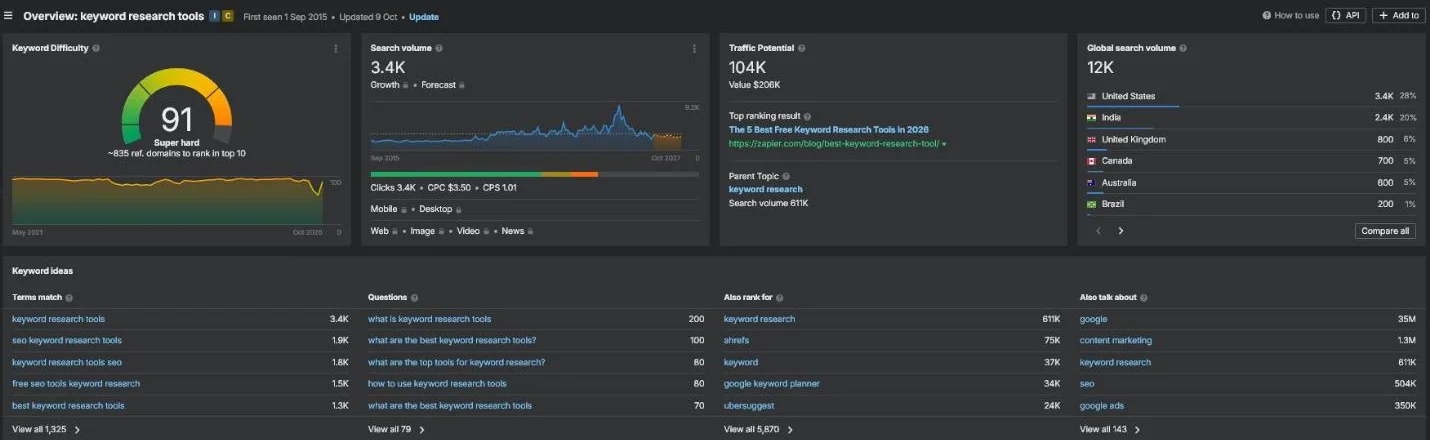 Ahrefs Keywords Explorer, United States settings, October 2026, shown for another term. Run the same check for “cbam” in your own market.
The questions behind the volume
In Google you can see those questions word for word:
- What are the CBAM rules?
- Which products are covered?
- Who pays, and what does it cost?
- How do you file a declaration?
Each of those is a page brief.
Our guide to B2B keyword research shows how to collect them systematically.
Which pages do you build around CBAM?
Follow the importer’s path from “does this apply to me?” to “which tool do I pick?”.
One page per question beats one long guide.
This is how you write about CBAM for importers who need your software:
| Page | The importer’s question | What’s on it | Where your software shows up |
|---|---|---|---|
| Explainer | What is CBAM and what changes in 2026? | Goods, phases, the role of customs and the competent authority | A diagram of the data flow your tool automates |
| Threshold test | Do my imports fall under CBAM? | The 50-tonne threshold per calendar year, explained with examples | An interactive tool as a lead magnet that runs the test |
| Supplier checklist | Which emissions data do I ask my non-EU supplier for? | A checklist per good, with the difference between actual data and default values | How your platform collects that data |
| Deadline page | What do I need to do, and when? | Authorisation application, certificates from February 2027, declaration by 30 September 2027 | A schedule your tool tracks |
| Comparison | Which CBAM software suits us? | Clear criteria: integration with your ERP and customs, supplier portal, audit trail | Your product next to the alternatives |
| Extension | Will our machines soon fall under CBAM too? | The status of the proposal for 2028, marked as a proposal | An alert or newsletter for those who want to follow it |
How the six pages connect
Connect those pages through a pillar page.
That way Google and AI systems see you as a source on the whole topic.
How to build that breadth is covered in building topical authority.
Is your customer also working on sustainability reporting? Then link to the CSRD and VSME page: the same CFO reads both.
One fixed URL for the deadline page
The declaration comes back every year by 30 September.
So put the deadline page on a fixed URL without a year. It then becomes an evergreen page you update every year.
For example: /cbam-declaration-deadline/ beats /cbam-deadline-2027/, because the links it earns keep working next year.
Where the comparison page fits
It’s your closest page to a demo.
Our guide to comparison pages for SEO covers the format.
Name the alternatives and the criteria. Say where another tool fits better.
What does an importer ask a CBAM software vendor?
An importer comparing tools asks very concrete questions.
Answer them on your comparison and product pages, and sales won’t have to explain them again every time.
Actual data or default values?
The Commission allows both for the embedded emissions in imported goods.
The mark-up on default values rises from 10% in 2026 to 30% from 2028, according to the CBAM Q&A. So show how your tool handles both.
How do I get verified data from my supplier?
Anyone using actual data needs verified emissions for 2026 for the first declaration.
Show: the supplier portal screen, and what a supplier sees when they log in.
Does it connect to customs and our ERP?
The import data already lives there.
So show the integrations by name, such as your customs declaration feed and the main ERP connectors.
Can it calculate my certificate cost in advance?
That’s the CFO’s question.
For each question, show the screen that answers it. A screenshot beats a feature list.
What is still moving in CBAM, and how do you write about it?
The biggest open question is the extension to products further down the value chain.
Where the extension stands
In December 2025 the Commission proposed extending CBAM from 1 January 2028.
It concerns 180 products with a lot of steel or aluminium, such as machinery and appliances.
On 12 June 2026 the Council reached an agreement on that extension.
The European Parliament adopted its position on 15 September 2026. Parliament and Council are now negotiating the final text and the product list.
Three rules for writing about it
For your content that means three things:
- A proposal is not a rule. Write up the extension as a proposal until the text is in the Official Journal.
- One block for the product list. Put the state of the negotiations in a single block you can update quickly.
- Follow klimaat.be. The Belgian competent authority updates its site with new implementing rules.
Why the extension is a lead source too
A manufacturer importing components may not search for CBAM today.
If the extension goes ahead, they will. Be findable by then.
Tip: an alert signup on the extension page turns that wait into a list of future buyers.
What does CBAM content cost compared to Google Ads?
A click on the regulation itself is still affordable.
“cbam” costs about 5 dollars in Belgium, “cbam rapportage” about 7 dollars in the Netherlands.
But someone clicking on “cbam” wants an explanation. Not a vendor.
The expensive clicks sit in software terms
A click on “carbon accounting software” costs about 72 dollars in the UK.
We know this from Hedgehog Company, which sells carbon accounting software. A month after the test, 77 of their 153 URLs ranked in the top 10 on average.
More sector prices are in our CPC benchmarks by industry.
What content costs with us
Content with us starts at 950 euros per month for 5 articles, with a three-month minimum and no setup fee.
Work out your own trade-off with our SEO ROI calculator.
Rule of thumb: compare one article’s cost with the clicks it replaces.
When we are not the right choice
Three situations where you should look elsewhere:
- You need your declaration filed: that’s a customs specialist’s job, not a marketing agency’s.
- Your software sells nothing to importers: CBAM content then brings traffic without buyers.
- You need pipeline within weeks: content isn’t the fastest channel.
None of those? Then start now.
Frequently asked questions
Does every importer fall under CBAM?
No. Anyone importing less than 50 tonnes of CBAM goods per calendar year doesn’t need authorisation as a declarant. For hydrogen and electricity that threshold doesn’t apply: those importers must always be authorised.
Who pays for CBAM?
The authorised CBAM declarant: the importer or their indirect customs representative. They buy certificates for the emissions embedded in the imported goods. Sales start on 1 February 2027, for imports from 2026 onwards.
When is the first CBAM declaration due?
By 30 September 2027 at the latest, covering 2026 imports. After that, a declaration follows every year by 30 September. You surrender the certificates by the same date.
Ready to turn CBAM into pipeline?
Start with the threshold test and the deadline page, then add one page per importer question.
Want us to map your CBAM keywords and draft the first two pages? Get in touch and we’ll go through the questions your buyers ask first.
Free website scan
Enter your website and get an automatic scan within minutes, with concrete technical and SEO improvements. No sales pitch.
We only use your details for your scan. No spam, unsubscribe anytime.