
Leadgeneratie
How do you become less dependent on Google Ads?

Copy for AI
Shift part of your budget each month to channels that keep paying off.
That’s how you become less dependent on Google Ads. Think SEO on your main services and industries, content that AI assistants cite, email to your own contacts and targeted LinkedIn outreach.
The verdict: none of these Google Ads alternatives works alone. Keep Google Ads on the keywords with the highest purchase intent and scale back the rest, one keyword at a time.
Your cost per click rises every quarter. The budget goes up, but sales says the inbound requests aren’t getting better.
And there’s the question nobody asks out loud: what happens to our pipeline if we switch off the ads tomorrow?
Looking for a pipeline you own instead of rent? That’s exactly what B2B lead generation is all about for us.
Why is depending on Google Ads a risk?
Because ads are rented reach: pause them for a month and that part of your pipeline disappears the same day.
Do almost all your demo requests come from Google Ads? That’s a risk, not a disaster.
Three risks we see in every B2B audit
They come back in almost every account we review:
- You don’t set the price. You bid in an auction; a bigger budget raises your click price.
- Volume isn’t pipeline. Browsers, students and suppliers fill forms too. Forms count, deals don’t.
- Nothing is left behind. An ad builds no position once you stop paying.
A page that ranks, or that ChatGPT cites, keeps working when the budget stops.
How big the gap can be: the Kaizo numbers
We saw the difference at B2B software company Kaizo.
In September 2025, 38,743 paid sessions produced 48 key events. That’s 0.12%.
Organic traffic produced 105 key events from 2,292 sessions. That’s 4.6%.
Here’s the same comparison as a chart:
So paid brought 94% of those sessions, but less than a third of the key events.
Rule of thumb: judge channels on deals, not on sessions.
What does a click cost for a B2B software company?
Often more than 20 dollars, and in some categories well over 100.
On 28 September 2026 we pulled Google Ads data for 106 search terms around software categories in Belgium and the Netherlands.
The median: about 22 dollars per click (Google reports in dollars). Some categories cost a multiple of that:
| Search term | Market | Cost per click |
|---|---|---|
| expense management software | NL | 181 dollars |
| helpdesk software | NL | 146 dollars |
| contract management software | NL | 59 dollars |
| hr software | NL | 58 dollars |
| crm software | NL / BE | 39 / 26 dollars |
| Median across 106 software terms | BE + NL | about 22 dollars |
The spread is easier to see in a chart:
What 100 clicks really cost
At 146 dollars per click, 100 visitors cost you 14,600 dollars before anyone requests a demo.
Is Google Ads still profitable for B2B software in 2026? On keywords that demonstrably produce deals, yes.
You’ll find other industries in our CPC benchmarks by industry. The click-or-article calculator puts your click price next to the price of an article.
Just saw a jump? Read how to lower your Google Ads CPC.
So should you stop Google Ads?
No. The goal is balance, not a radical stop.
Where Google Ads stays strong
Keep it running in four situations:
- Clear purchase intent, such as “[service] quote” or “[service] agency [city]”
- A new service, market or language, where you have no organic positions yet
- As a bridge, while your own channels are still growing
- To test which message and audience converts, before you build content on it
Make the account itself more efficient
What you do need to do is make Google Ads leaner.
At Facilicom we achieved 25% media savings by improving Quality Score and account structure.
Less budget, the same visibility. That freed-up money can go into an owned channel.
Also read how to improve your Quality Score and when you’re better off pausing or stopping campaigns.
Which Google Ads alternatives capture the demand you are buying now?
No single channel replaces Google Ads one for one. Together, though, they capture the same demand, and they keep working when you stop paying:
| Channel | What it replaces | Time to impact | Keeps paying off after you stop? |
|---|---|---|---|
| SEO on services and industries | Paid clicks on non-brand keywords | Weeks on long questions, 3 to 12 months on broad terms | Yes, as long as your pages stay up to date |
| Content that AI assistants cite | Research buyers now do in ChatGPT or Perplexity | A few months | Yes |
| Email to your own contacts | Remarketing to past visitors | Weeks | Yes, the list is yours |
| LinkedIn outreach and LinkedIn Ads | Reach among decision-makers who aren’t searching yet | Weeks | Outreach partly, Ads no |
| Referrals and partners | Brand demand you now capture with ads | Months | Yes |
1. SEO on your services and industries
For most B2B companies the most important channel is SEO.
It captures the same search demand as your ads, but you don’t pay per click.
Here’s what that owned demand looks like in our own Search Console:
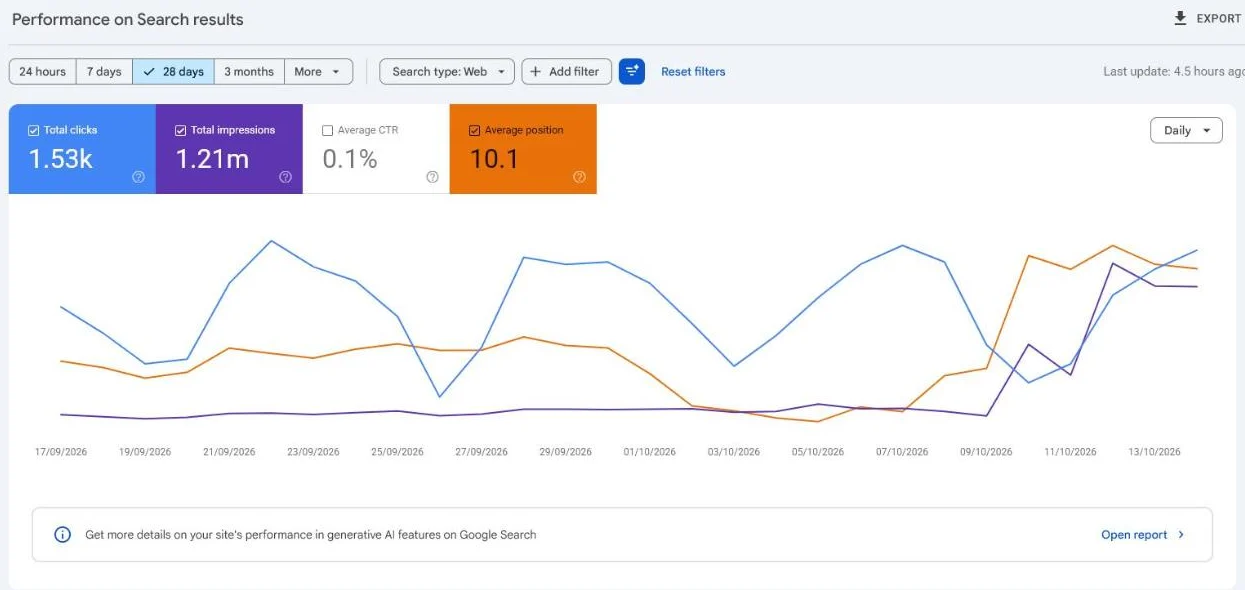 Our own Search Console for customerimpact.be, last 28 days, October 2026. None of these clicks is paid for per click.
Our experience: in our projects, organic traffic converts close to twice as well as paid clicks.
Want to make the trade-off per keyword? Read SEO vs Google Ads.
If you sell software, SEO for SaaS and lead generation for SaaS companies go deeper into your situation.
2. Content that AI assistants cite
Buyers now do part of their research in ChatGPT, Perplexity or Google’s AI Overviews.
At Hedgehog Company, Google showed an AI Overview for 31 of the 41 new articles on their own question. Hedgehog was cited as a source in 23 of them.
Those articles were less than two months old.
Bing now reports those citations too. This is our own report:
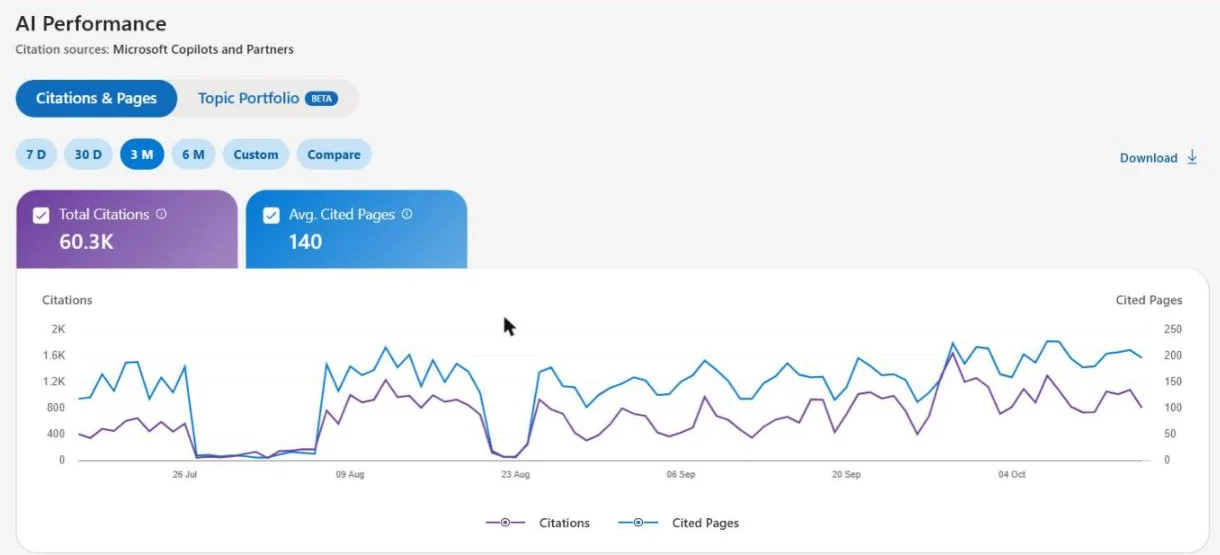 Our own Bing AI Performance report, October 2026: 60.3K citations and on average 140 cited pages over three months.
Are your clicks falling while your positions stay the same? Read what to do when AI Overviews cost you clicks.
3. Email, LinkedIn and referrals
For buyers who aren’t searching yet, other channels do the work.
- Email: your list is yours; see B2B email marketing
- LinkedIn: reach decision-makers early; check what LinkedIn Ads cost
- Referrals: they turn into branded search you no longer buy
For the full picture, our overview of the best B2B lead generation channels helps.
Most B2B companies combine two or three of these channels.
How do you shift budget without your leads collapsing?
Don’t switch off Google Ads in one go. Work in three phases, and only scale back what an owned channel demonstrably captures.
Does it need to go faster because the CFO is cutting the budget? Then read how to halve your ad spend without losing your pipeline.
Step 1: Measure all the way into your CRM
Don’t look at clicks or form fills. Look at opportunities and deals per keyword.
Google lets you import offline conversions for that. That way, according to Google, you can “measure what happens in the offline world after someone clicks on your ad”.
Start by checking which action your campaigns actually optimise on:
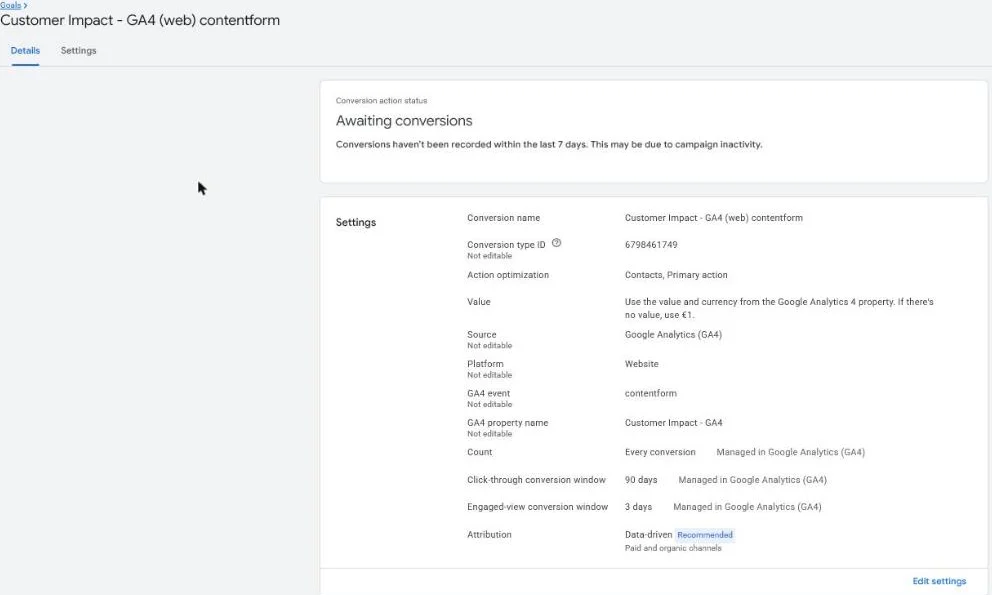 The contact form conversion action in our own Google Ads account, October 2026. Only primary actions steer the bidding.
Our experience: we usually run one primary goal, the booking, and secondary goals for the steps toward it.
Read how to feed lead quality back into Google Ads and how to connect leads to deals.
Step 2: Build owned channels on your best keywords
The keywords that produce deals get a strong service or industry page.
The keywords that produce nothing, you cut right away.
Step 3: Scale back per keyword
If a page ranks steadily in the top three and brings in requests, lower the bid on that keyword.
If requests stay level, scale back further. For example, say “crm software” ranks third and requests hold for a month: lower that bid another step.
Step 4: Redistribute your budget
There’s no fixed split, but there is a principle. Read how to split SEO and PPC budget.
Which moment are you in?
That shift usually starts at a specific moment. Recognise one? Then start with the playbook for that moment:
| What is happening this week | Read first |
|---|---|
| You are entering a new market (NL, UK or DE) | getting found in a new market without Google Ads |
| The founder can no longer sell everything alone | from founder-led sales to marketing |
| Your funding round has just closed | where to put the marketing money after a round |
| A competitor is bidding on your brand name | what to do when a competitor bids on your brand |
| You are starting as a new CMO or first marketer | your first 90 days as CMO |
| A new regulation affects your buyers (CSRD, NIS2, Peppol…) | regulation as a lead source |
Not sure yet where you stand?
The free search value scan shows which clicks you pay for today that you could also get organically.
What does less dependence deliver?
A pipeline that’s less vulnerable, not just lower ad costs.
Three examples from our own work
- Gom Nederland: +400% daily visitors in 66 days through SEO, with -12% in paid costs
- Kaizo: organic converted to intent signals 38 times better than paid
- Hedgehog Company: a new knowledge base that showed up in Google within weeks
At Kaizo, comparison pages scored strongest, at about 10%.
The Hedgehog numbers
Hedgehog Company, carbon accounting software, started with 18 test articles in English and Dutch.
They got 2,314 impressions and 24 clicks in 19 days.
A month later, 77 articles were live: 6,701 impressions, 42 clicks, and 77 of the 153 URLs with an average position in the top 10.
For comparison: a click on “carbon accounting software” costs about 72 dollars in the UK. Hedgehog ranks around position 14 there.
Know what a lead is worth first
Before you compare channels, work out what a lead may cost you with the value-per-lead calculator.
Then look at how fast a customer pays back its acquisition cost.
When we are not the right choice
We’re not a fit for every company. Four cases where you’re better off elsewhere:
- Webshop with thousands of products that steers on ROAS: a Google Shopping specialist fits better.
- Less than 3,750 euros per month for lead generation: start with your best service pages yourself.
- Only better Google Ads management: you don’t need a lead generation programme.
- Results within a few weeks: SEO isn’t the right channel.
Our Google Ads management starts from 950 euros per month, separate from your media budget.
Frequently asked questions
How do I get off Google Ads?
Pause your campaigns instead of cancelling your account. That way you keep your history and can restart later.
If you do cancel, Google automatically stops all your active ads, according to its own help page. Make sure the account is in your name: read who owns your Google Ads account.
How long does it take for organic traffic to make up for dropping Google Ads?
On long, specific questions you often see impressions within weeks. On broad keywords, count on three to twelve months, depending on your competition and your website.
The first weeks are erratic. In our Search Console data from six sites, a new page peaks in week 1, dips in weeks 2 to 8 and grows after that.
On customerimpact.be, the level from week 9 onwards was about three times higher than in weeks 2 to 8. At Kaizo, from week 10 there were about 90% more impressions than at the low point.
Not every site shows that: one of the six stayed flat. So judge new content after eight weeks, not after two. Keep Google Ads running until a page ranks steadily and brings in requests.
What is the best alternative to Google Ads in B2B?
For search demand, it’s SEO, because it captures the same demand without a cost per click.
For buyers who aren’t searching yet, LinkedIn and email are stronger. Most B2B companies combine two or three channels.
What does it cost to build your own pipeline?
Lead generation at Customer Impact costs 3,750, 5,950 or 9,500 euros per month. That includes management of 1 to 2 ad channels and landing pages.
Your media budget comes on top of that separately. The minimum is three months, with no setup fee.
Free website scan
Enter your website and get an automatic scan within minutes, with concrete technical and SEO improvements. No sales pitch.
We only use your details for your scan. No spam, unsubscribe anytime.