
Growth & Strategie
What should a new CMO do in the first 90 days?

Copy for AI
A new CMO spends the first 90 days on baseline, pruning and proof.
Month one: a baseline of leads, pipeline and channel costs, without changing anything. Month two: pruning Google Ads based on CRM data and starting content on your buyers’ questions. Month three: measuring, adjusting and showing first results to the CEO.
The verdict: in your CMO first 90 days, measure before you cut. Every decision after day 30 rests on the baseline you record now.
You started on Monday. The CEO is already asking when more leads will come in, and sales is counting on the inquiries from Google Ads.
This playbook is part of our guide to reducing your dependence on Google Ads. If you want a sharp marketing strategy that ends in pipeline, start here.
What does a new CMO do about the lead flow in the first 90 days?
You build the lead flow in three blocks of 30 days. Each block ends with a decision, not a presentation.
| Period | What you do | Decision at the end |
|---|---|---|
| Day 1 to 30 | Baseline, conversations with sales and your five most recent won customers, sharpening your ideal customer profile | Which channels actually produce deals? |
| Day 31 to 60 | Prune Google Ads based on CRM data, publish the first pages on buying questions | Where does the freed-up budget go? |
| Day 61 to 90 | Measure, adjust, report with fixed numbers | What do you scale up next quarter? |
Talk to sales first
In the first weeks, talk to sales above all. Ask which questions buyers ask before they book a demo.
Those questions become your content.
Turn the target into a number
Also work out how many leads you need to hit the revenue target. That way your goal is a number and not a feeling.
For example, say sales needs ten new customers this year. Work back from your close rate to the leads per month you need.
Further help: if you then need a rhythm for experiments, our 90-day growth roadmap helps.
This article is about the lead flow itself.
What baseline does a new CMO set before changing anything?
Record where things stand today, before you touch a single campaign.
Without a baseline, nobody can see after 90 days what you changed.
The five baseline numbers
Record these five, in this order:
- Leads and pipeline per channel, from your CRM, based on the deal’s first source. If deals aren’t recorded by source, read how to import offline conversions.
- Cost per won customer per channel, including management and production. That gives you your CAC payback.
- Organic clicks and impressions. Google recommends selecting the last 16 months in the Search Console performance report.
- The share of pipeline from paid channels. That’s your dependence, in one percentage.
- The GA4 data retention setting. That setting only affects explorations and funnel reports, not the standard reports.
Channel source in your CRM
The first number only works if your CRM records where a contact came from.
HubSpot, for example, stores the original traffic source of each contact, with values such as organic search, paid search and offline sources. Associated companies and deals mirror that value.
Lifecycle stages then show how far each lead got:
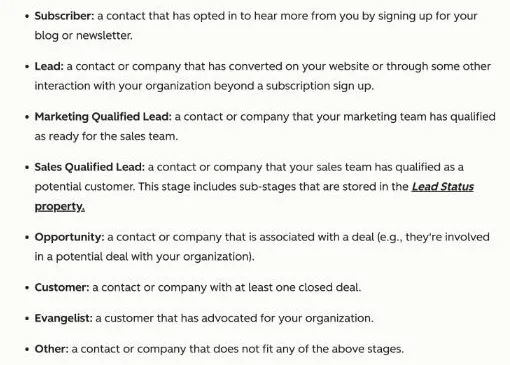 HubSpot’s lifecycle stage definitions, checked 18 October 2026. Count leads per stage and per source on day one.
Our guide to lead source tracking in your CRM shows how to set that up when it’s missing.
Organic traffic over 16 months
Sixteen months of Search Console data shows you seasonality. That way you don’t panic later over a normal dip.
Here’s what the performance report looks like for our own site:
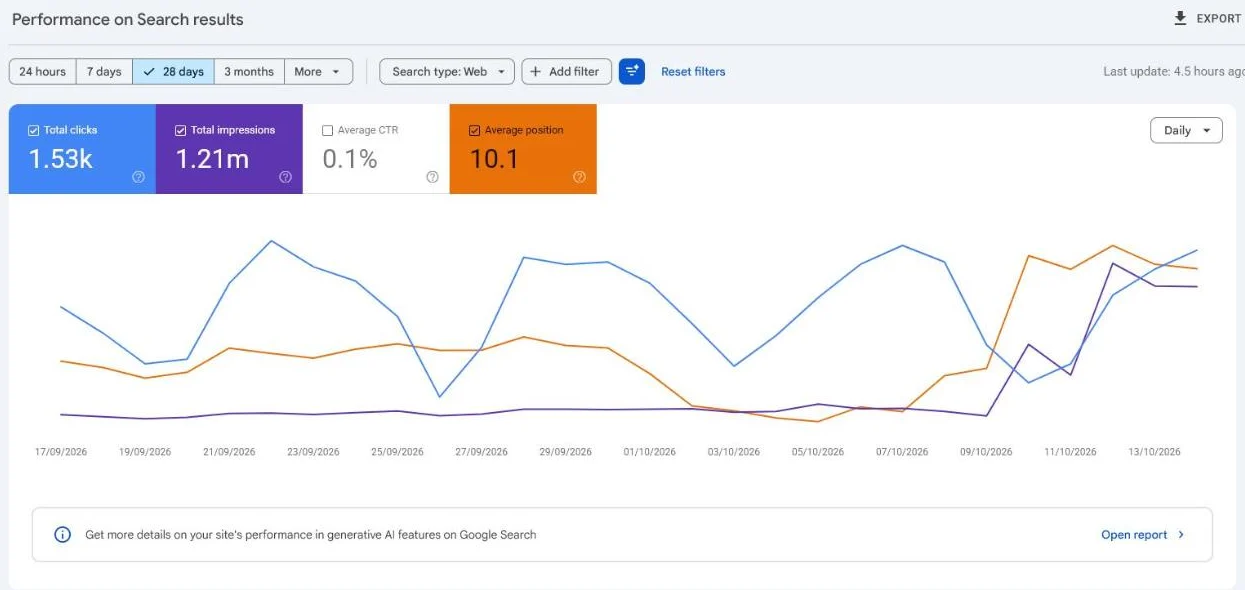 Our own Search Console for customerimpact.be, last 28 days, October 2026. For your baseline, switch the date filter to the last 16 months.
Also read how to analyze Search Console data.
GA4 retention: 2 months or 14
User-level and event data in GA4 can be kept for 2 or 14 months. If it’s set to 2 months, change it to 14.
Otherwise your explorations can’t look back far enough when you report on day 90.
Should a new marketing manager keep Google Ads or scale it back right away?
Keep it, but not unchanged. Scaling back before you have the baseline means losing leads without knowing which ones.
Prune in month two. Use your CRM.
Why pruning pays off in software
A median click costs about 22 dollars, across 106 Benelux software search terms we pulled from Google Ads data on 28 September 2026.
Here’s the spread for the terms we quote in this article:
Those amounts are in dollars, as the source reports them. For “HR software” in the Netherlands it’s 58 dollars, for “crm software” in Belgium 26 dollars.
At those prices, every click without a buyer behind it hurts.
What to keep and what to cut
Sort every campaign into one of four rows:
| Campaign | In month two |
|---|---|
| Brand campaigns on your own name | Keep, see brand vs non-brand and when a competitor bids on your brand name |
| Keywords that produce deals in your CRM | Keep and adjust |
| Broad, informational keywords | Cut and take over with content |
| Campaigns with lots of form fills and no opportunities | Pause |
Watch out: a high CTR doesn’t save a campaign. In our own manager account, some accounts with a solid CTR show few conversions:
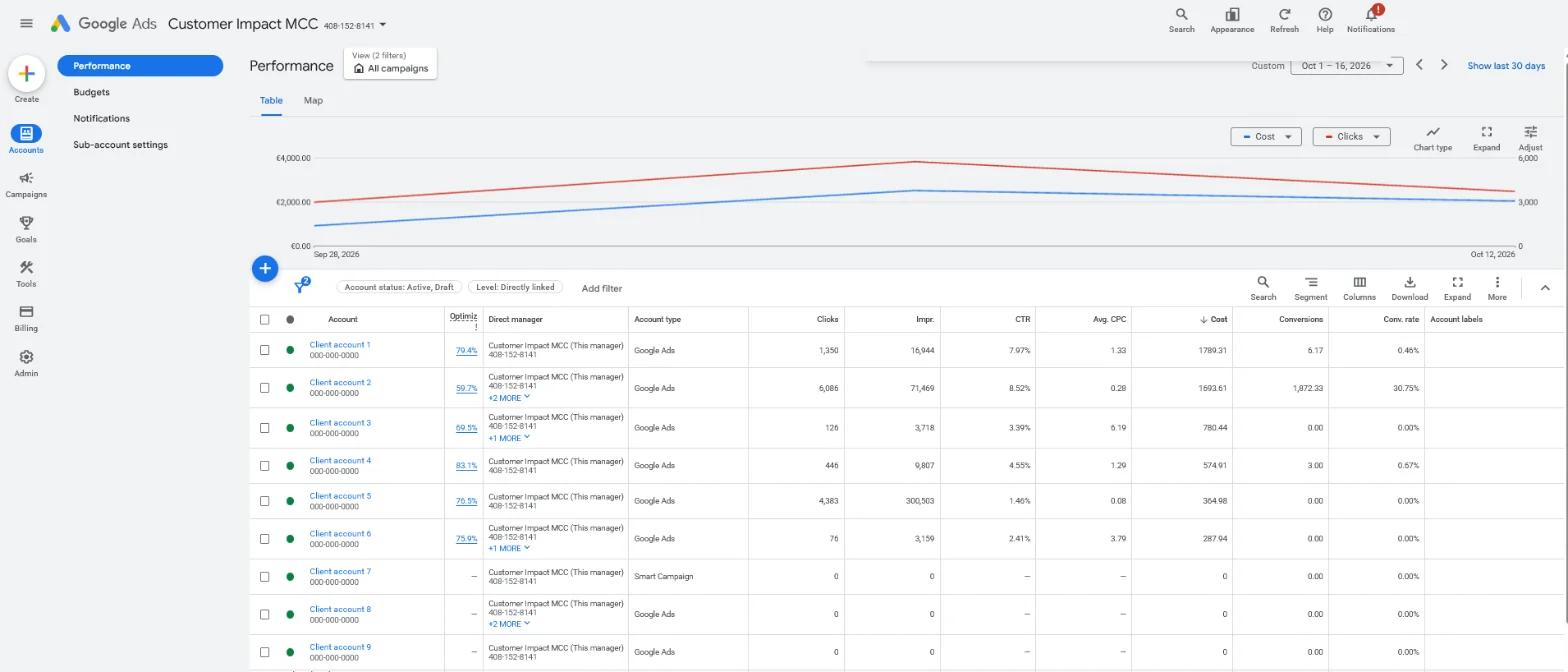 Our own manager account (MCC) in Google Ads, October 2026. Client names and IDs are replaced. Compare the CTR column with the conversions column.
Then go one step further than conversions: check which of them became opportunities in the CRM.
How big the paid vs owned gap can be
We saw it at Kaizo. In September 2025, organic traffic converted 38 times better to key events than paid: 4.6% versus 0.12%.
Key events are intent signals. They aren’t demo bookings.
If the budget really has to come down, follow the playbook for a halved ad budget.
What kind of agency should a new CMO bring in first?
The agency that fills the gap you can’t fill yourself.
Look at your baseline, not at the channel that sounds loudest on LinkedIn.
| What your baseline shows | Bring in first | Our price |
|---|---|---|
| Ads eat budget, few deals | Google Ads management to prune | From 950 euros per month for one channel |
| Little organic visibility on buying questions | SEO | 2,450, 4,500 or 8,500 euros per month |
| No time to write yourself | Content marketing | 950 (5 articles), 2,450 (15) or 4,500 (30, NL, FR and EN) per month |
| Leads come in, but not the right ones | Lead generation | 3,750, 5,950 or 9,500 euros per month |
All engagements run for at least three months, with no setup fee.
Rule of thumb: take one agency per gap, not three at once.
In your first quarter, you don’t have time for three partners.
As the first marketer: write yourself or hire an agency?
Write what only you know yourself, and outsource the volume.
You know the conversations with sales and customers. An agency delivers the consistency you won’t manage alongside everything else.
Why you start content in month two
The reason to start early is how new pages behave.
In our Search Console data from six sites, a new page peaks in week 1. It then drops in weeks 2 to 8, and then it breaks through.
On customerimpact.be, the level from week 9 onward was about three times higher than in weeks 2 to 8. One of the six sites did stay flat.
Volume makes the difference
Hedgehog Company started with 18 test articles in English and Dutch:
- First 19 days: 2,314 impressions and 24 clicks
- A month later: 77 articles live, 6,701 impressions and 42 clicks
- Rankings: 77 of the 153 URLs ranked in the top 10 on average
A click on “carbon accounting software” costs about 72 dollars in the UK. Run that trade-off for your own keywords with our content marketing ROI calculator.
Content and AI Overviews
At Hedgehog, on 28 September 2026, Google showed an AI Overview 31 times on the specific question of 41 new articles.
Hedgehog was cited as a source 23 times. The articles were under two months old.
On the broader head term, it was only 1 out of 18 times.
Read more about outsourcing content marketing.
When are we not the right choice for a new CMO?
When the problem isn’t execution. Four cases:
- No clear customer yet: if you don’t know who your ideal customer is, no agency will help. Work out your positioning with sales first.
- Pipeline needed in six weeks: content is too slow. First make your existing campaigns more efficient.
- You need a team lead: a fractional growth lead is a better fit.
- Consumer webshop: you’re better off with an e-commerce specialist.
If none of those apply, the baseline tells you where to start.
Frequently asked questions
I’m the first marketer at a software company. Where do I start?
With your five most recent won customers. Ask how they found you and which question they googled first. Then record your baseline and aim your first pages at exactly those questions. You only choose channels after that.
What does a new CMO do with a marketing agency that’s already in place?
Hold it to the same baseline as yourself for the first 30 days. Ask which campaigns produce deals in your CRM. If the agency can’t show that, you know where to start in month two.
When do you see the first results from new content?
A first peak in week 1, then a dip until about week 8. Only from week 9 do you see whether a page breaks through. Also read how long SEO takes.
What do you report to the CEO after 90 days?
Five numbers, next to your baseline. Pipeline per channel, cost per won customer and the share from paid channels. Plus organic clicks on buying questions and your CAC payback. Also show what you are deliberately not judging yet.
Free website scan
Enter your website and get an automatic scan within minutes, with concrete technical and SEO improvements. No sales pitch.
We only use your details for your scan. No spam, unsubscribe anytime.