
Content
How do you win leads from the EmpCo directive as a software company?

Copy for AI
The EmpCo directive has banned vague green claims to consumers since 27 September 2026.
You win leads from it with pages for brands that now have to prove their claims: what’s still allowed, does this apply to me, a claims checklist and a software comparison.
The verdict: EmpCo is a lead source for software that helps prove or check claims. It’s not a rule your own B2B marketing falls under.
Say you sell software for carbon measurement. Or product data, or labels.
Your clients are now reviewing every “climate neutral” on their packaging.
They ask Google or ChatGPT what’s still allowed. Your pages should answer.
We build that kind of knowledge base as a content marketing agency for software companies.
How to keep that content accurate and current is covered in regulation as a lead source.
What is the EmpCo directive, and who does it affect?
EmpCo is Directive (EU) 2024/825: Empowering Consumers for the Green Transition, also known as the empowering consumers directive.
You’ll also see the abbreviation ECGT.
It amends two existing consumer directives: the one on unfair commercial practices and the one on consumer rights.
The facts in one table
Here’s what a software vendor needs to know, according to the questions and answers of the European Commission from September 2026:
| Question | Answer |
|---|---|
| Since when? | The rules apply from 27 September 2026. According to the Commission, transposition in the member states is still ongoing. |
| Who? | Only commercial practices towards consumers (B2C). B2B falls outside the directive, although member states may extend the protection. |
| Generic claims | ”Green”, “eco” or “climate friendly” without demonstrable, recognised excellent environmental performance is banned. |
| Offsetting | Calling a product “climate neutral” based on carbon offsetting is banned. Only the real impact in your own value chain counts. |
| Labels | A sustainability label is only allowed if it’s based on a certification scheme or set up by a public authority. |
| Future claims | ”Climate neutral by 2030” requires a concrete, measurable plan that an independent expert checks regularly. |
Where it already applies
In the Netherlands the law has been passed, and the rules have applied since 27 September 2026.
That’s reported by Ondernemersplein, the Dutch government’s business portal.
Watch out: the Commission says transposition is still ongoing in other member states. Check the national status before you write a country page.
Which software companies sell into EmpCo?
Anyone whose product helps prove or check a claim.
Your buyer sells to consumers: food, fashion, personal care, energy or packaging.
Your product, your buyer, their question
| Your software | Your buyer | What that buyer is looking for now |
|---|---|---|
| Carbon accounting, product footprint | Sustainability manager at a brand | How do I prove a climate claim without offsetting? |
| Life cycle assessment (LCA) | Product development, R&D | What data do I need for a specific environmental claim? |
| Product information (PIM), packaging data | E-commerce, marketing | How do I remove banned claims from thousands of product sheets? |
| Certification and label management | Quality, compliance | Which labels may I still show? |
| Claim or advertising review | Marketing, legal department | How do I approve every green claim before publication? |
That last column is your content plan.
Every buyer question is one page. Or one FAQ answer.
Our method for pain-first content starts from exactly that column.
When CSRD and EmpCo meet
Some of those buyers also report under CSRD or VSME. Then both rules reinforce each other. That adds urgency.
Further reading: see CSRD and VSME as a lead source.
How does the EmpCo directive change your marketing as a sustainability company?
Your own B2B marketing doesn’t fall under EmpCo itself.
The Commission says so literally: B2B commercial practices fall outside the directive. Other EU rules on misleading advertising do apply to B2B.
Why your marketing still changes
You help clients prove claims. So your own claims must be spotless.
And your message shifts from “go greener” to “prove what you say”. That’s a stronger reason to buy, with a date attached.
Three changes to make this month
- Reread your own site. Remove “sustainable platform” without explanation, in B2B too.
- Rewrite your use cases. From “report your impact” to “back up every claim on your packaging”.
- Give your clients the words. A list of claims still allowed, with the data behind them, is your best lead magnet.
Rule of thumb: if a sentence on your site would fail your own claims checklist, rewrite it first.
Which pages do you build to win leads from EmpCo?
Follow your buyer’s path, from “what is it” to “which tool”. For EmpCo that means five pages:
| Page | Question it answers | What it must contain |
|---|---|---|
| Explainer | What is the EmpCo directive? | The facts above, with the official source |
| Application | Does EmpCo apply to my company? | B2C or B2B, which channels, which products |
| What is still allowed | Can I still say “climate neutral”? | Examples of claims that are and aren’t allowed |
| Checklist | How do I approve a claim? | Steps, evidence per claim, who signs off |
| Software choice | Which software helps prove claims? | An honest comparison page with yourself in it |
Add an FAQ under every page
Under each page, put four or five real buyer questions in an FAQ section.
Those short answers are the parts AI assistants tend to quote. Our guide to citable content for AI shows how to write them.
Link the five pages as one cluster
Link the explainer to the four deeper pages, and each of those back to it.
That turns five loose articles into one content hub that Google and AI tools read as a topic you cover end to end.
What does a brand ask a software supplier about EmpCo?
Anyone choosing a tool for claims asks questions that come straight from the directive.
Answer them on your product and comparison pages. That shows you know the rule, not just your own software.
Four questions from the directive
- Does the tool show emissions in your own value chain? A climate claim about a product may only rest on the real impact within that chain. Offsetting outside it doesn’t count.
- Does the tool find claims in brand and product names? According to the Commission, a name with “eco” or “green” can already be an environmental claim in itself.
- What about old stock? The rules also apply to products and packaging already made or distributed before 27 September 2026.
- Does the tool keep the evidence for a future claim? A target like “climate neutral by 2030” requires a plan that an independent expert checks regularly.
Point to the screen
Every answer points to a screen in your product. That’s your proof.
That’s the part no lawyer and no competitor writes for you.
How much search volume is there around EmpCo, and what does it cost in Google Ads?
Little on the name of the rule. According to Google Ads data (twelve-month average, 28 September 2026):
| Search term | Belgium | Netherlands |
|---|---|---|
| empco | 90 per month | 260 per month |
| empco richtlijn | 30 per month | 90 per month |
| green claims directive | 260 per month | 260 per month |
Here’s the same data as a chart:
Low volume, high intent
Someone typing “empco richtlijn” has a real problem. It’s on their packaging.
Long questions such as “can I still say climate neutral” often show zero volume in tools. In Search Console they do generate impressions.
Where to see those hidden questions
Zero-volume questions show up as impressions in your own Performance report, filtered on a query:
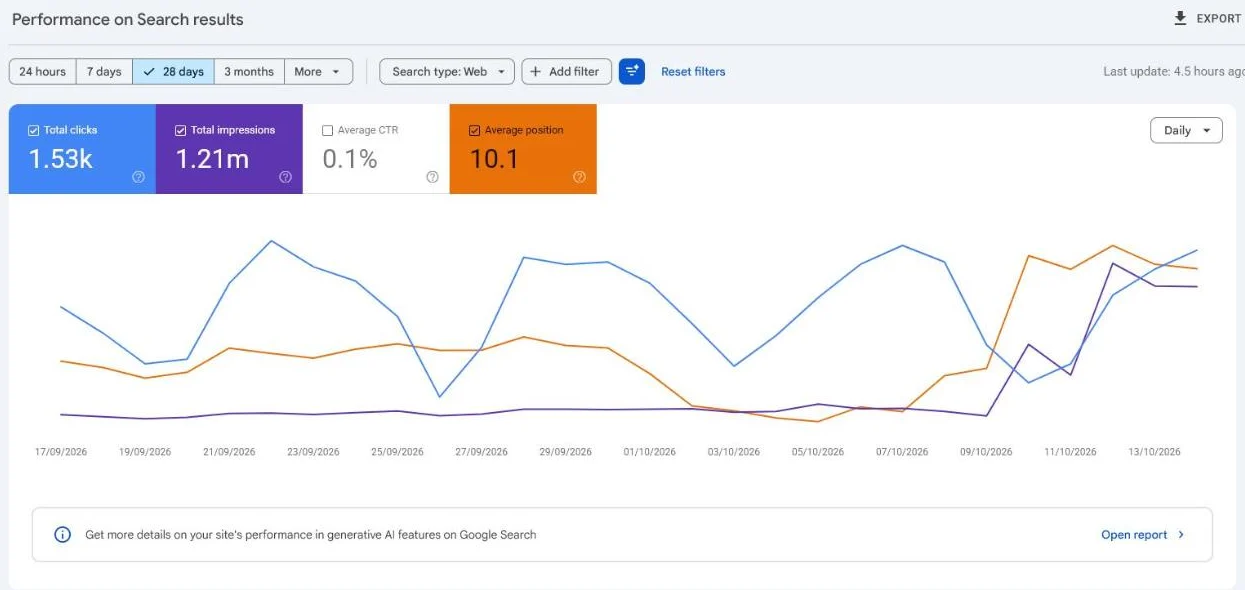 Our own Search Console for customerimpact.be, last 28 days, October 2026. Add a query filter to find long questions that keyword tools list as zero.
That’s why we never skip a page on low tool volume. Search Console is the demand signal.
Paid clicks cost far more
Advertising on the buying term in the same sustainability market is expensive.
“csrd software” costs about 41 dollars per click in the Netherlands, against a few dollars for “empco”. More figures per sector are in our CPC benchmarks.
Weigh one article against those clicks with our content marketing ROI calculator, or read how to reduce your dependence on Google Ads.
What is the status of the Green Claims directive?
EmpCo is settled. Green claims rules aren’t.
The separate Green Claims directive is a proposal that hasn’t been adopted yet.
Where the file stands
The file at the European Parliament stands at “awaiting Council’s first reading position”.
On 20 June 2025 the Commission announced that it intends to withdraw the proposal. The third trilogue, set for 23 June 2025, was cancelled.
The Parliament’s legislative train now marks the file as blocked by the Council, updated 25 October 2026. The file formally remains open (European Parliament).
What that means for your content
Two things:
- Describe Green Claims as a proposal, always with its current status.
- Build your pages on EmpCo, because those rules already apply and are enforced.
How do you know if ChatGPT mentions you?
Ask it the buyer’s question. Then log who it names, every month.
What an AI answer looks like
AI tools answer a buying question with a short list of suppliers and the sources behind them. Here’s one for a CRM question:
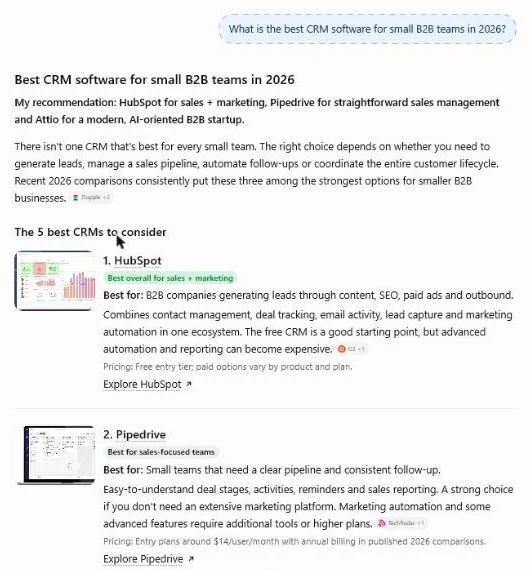 ChatGPT (free), 17 October 2026: three suppliers named in one answer, with a review platform cited as a source.
The same pattern applies to “which software helps prove green claims”. If your pages aren’t among the sources, you’re not in the answer.
Measure it monthly
Want a first read today? Run your domain through our AI visibility checker.
Which numbers to track over time is covered in AI visibility metrics.
When we are not the right choice
Three cases:
- Your buyers sell nothing to consumers. Then EmpCo doesn’t affect them; choose another rule.
- You want an opinion on a specific claim. You need a lawyer, not an agency.
- Your product doesn’t help prove or check claims. This content then brings traffic but few leads.
Price: content with us starts from 950 euros per month for 5 articles, with a minimum of three months.
Want to see which five EmpCo pages fit your product? Get in touch and we’ll map them against your buyers’ questions first.
Frequently asked questions
What is the EmpCo directive?
EmpCo is Directive (EU) 2024/825, also called ECGT. From 27 September 2026 it bans vague and unproven green claims to consumers. Climate claims about a product based on offsetting outside your own value chain are also banned, as are labels without certification or a public basis.
Does EmpCo also apply to B2B companies?
According to the European Commission, the directive is strictly limited to commercial practices towards consumers. B2B falls outside it, although member states may extend the protection. Other rules on misleading advertising do apply to B2B.
Is the Green Claims directive already in force?
No. It is a proposal that has not been adopted yet. Say so on your pages and reread them when there is news.
Free website scan
Enter your website and get an automatic scan within minutes, with concrete technical and SEO improvements. No sales pitch.
We only use your details for your scan. No spam, unsubscribe anytime.