
Advertising
Choosing a PPC agency: what you get and how to decide

Copy for AI
A PPC agency manages your paid search ads so they bring in enquiries.
That covers everything from campaign setup and keywords to bidding, landing pages and reporting.
The verdict: choose a PPC agency on what it steers on and who owns your account. Not on its tools or its pitch deck.
You outsource it when you want results faster than you can get on your own. Or when your ad budget is too large to steer on gut feeling.
But not every agency is the same, and not every company needs one. Below: what you get, how to recognise a good agency, and when outsourcing paid search really pays off.
Planning your budget: calculate clicks, leads and cost per lead with the free Google Ads budget calculator.
What exactly does a PPC agency do?
It builds and runs a machine that delivers enquiries predictably.
A paid advertising agency that runs paid search does more than “switch ads on”.
The five jobs it takes off your hands
In concrete terms, an agency handles this:
- Keyword strategy: which terms your audience types in, and which to avoid.
- Campaign structure: a setup that scales and doesn’t seize up after three months.
- Bidding and budget: steering on the right searches, not the highest volume.
- Landing pages: because clicks without conversion only cost money.
- Reporting: on customers and revenue, not on clicks and impressions.
Most agencies run many accounts from one manager account. Here’s ours:
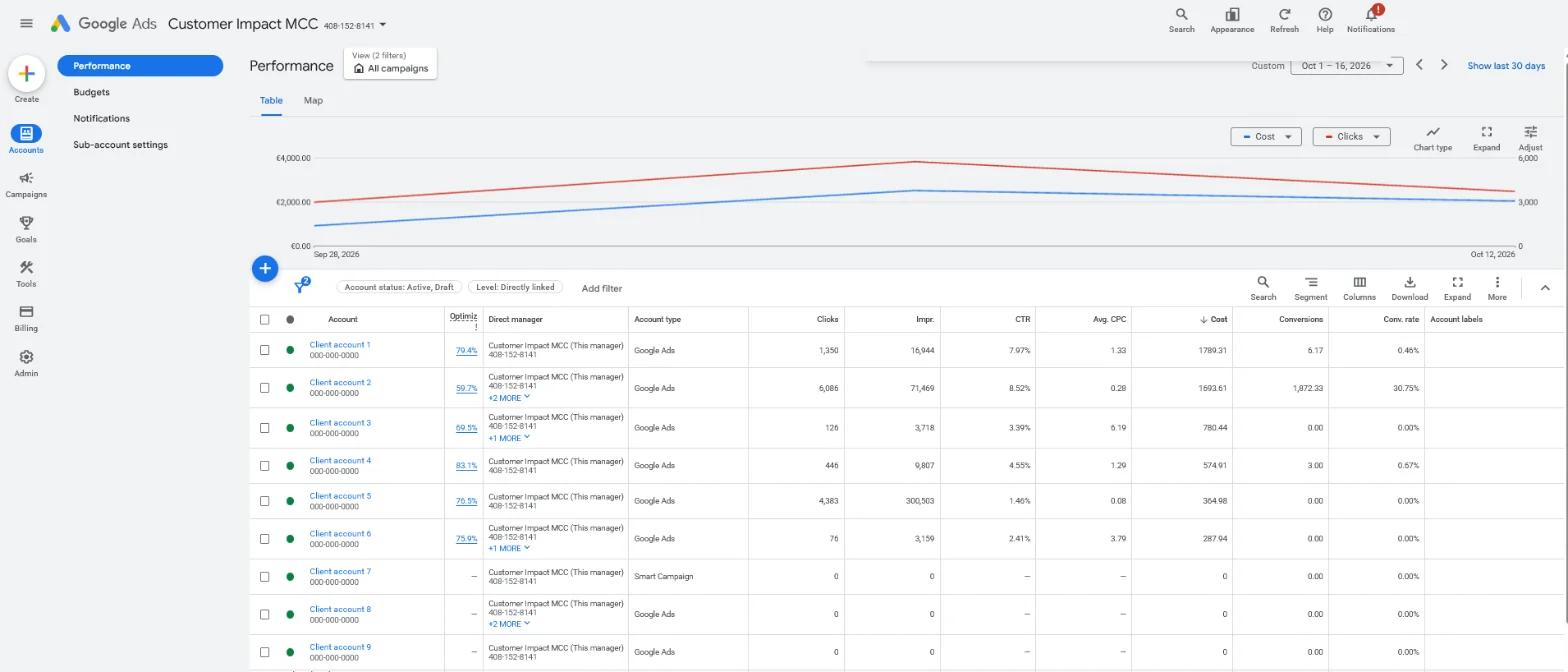 Our own manager account (MCC) in Google Ads, October 2026. Client names and IDs are replaced. Each client keeps its own account underneath.
How that structure works is explained in our guide to the Google Ads manager account.
Paid search is more than Google
Most agencies start with Google Ads, because that’s where the bulk of the search volume sits.
But paid search is broader. Microsoft Advertising (Bing) often delivers a cheaper click in B2B, as our piece on Microsoft Ads for B2B explains.
Depending on your audience, campaign types such as shopping, display or video count too.
Rule of thumb: a strong agency picks channels based on where your buyers are. Not on what it prefers to manage.
Working mainly with Google? Then also read how to choose a Google Ads agency.
What do you get in return?
A lower cost per enquiry and a return you can trace back to revenue.
The difference between an average and a strong agency isn’t in the tools, but in the focus.
Vanity numbers versus results
Plenty of agencies proudly report on impressions and clicks. Those are vanity numbers: nice to look at, but they say nothing about your revenue.
What you can expect from a good PPC agency:
- a measurable drop in your cost per enquiry
- a ROAS you can track monthly that matches your books
- clear choices about where the money goes
- someone who dares to say a campaign must stop
Reporting starts with the conversion setup
Good reporting starts with what counts as a conversion.
Our experience: we usually run one primary goal and one secondary goal. Primary is the booking; the secondary goals are the drivers towards it.
This is what a primary action looks like in our own account:
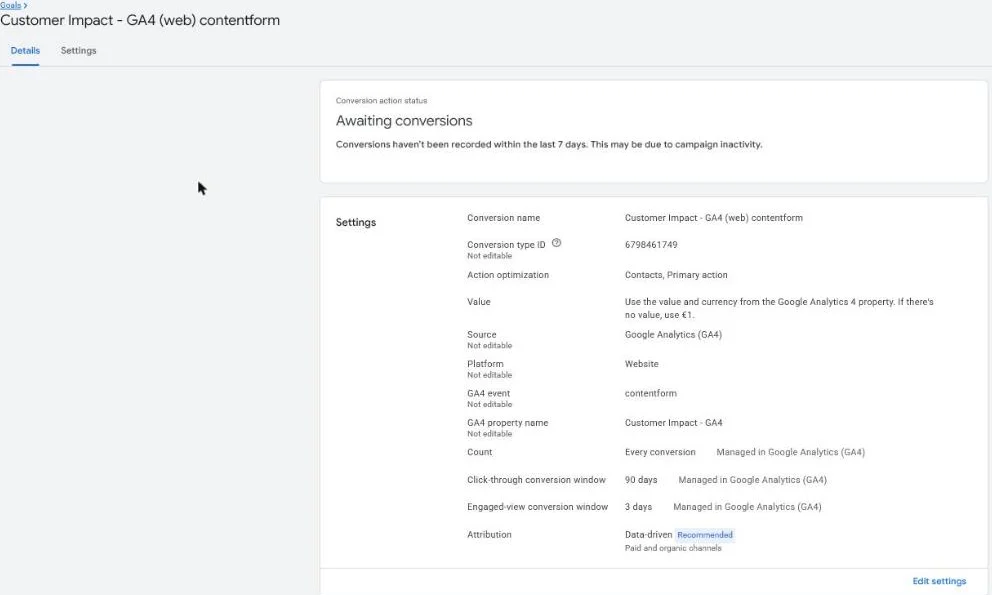 The contact form conversion action in our own Google Ads account, October 2026. An agency should steer on real enquiries like this one, not on clicks.
What a useful report then contains is in our piece on Google Ads reporting.
Someone who dares to say stop
That last point sounds obvious, but it isn’t.
An agency that gets paid per euro spent has no interest in spending less. We do, because we steer on your result.
How do you recognise a good PPC agency?
By its answers to four questions, asked before you sign.
The four questions to ask
- What do you steer on? If the answer is “clicks” or “impressions”, walk away. It has to be enquiries, customers and revenue.
- Who is working on my account? Sometimes a senior sells, but a junior does the work.
- Do I get access to my own account? The Google Ads account should be yours, not the agency’s.
- How often do you optimise? Paid search isn’t “set and forget”. It takes weekly work.
More questions are in our list of questions to ask a Google Ads agency.
Good answers and red flags
To make weighing those questions easier, we put a good answer next to the red flag you want to avoid:
| Question | Good answer | Red flag |
|---|---|---|
| What do you steer on? | On enquiries, customers and revenue | ”On clicks, impressions and visibility” |
| Who works on my account? | A dedicated specialist, named personally | An anonymous senior who quickly hands off to a junior |
| Who owns the account? | You do, you keep ownership | The agency opens it in its own name and keeps the key |
| How often do you optimise? | Weekly, with a log of changes | ”It runs by itself” or only at the quarterly meeting |
| How do you report? | Numbers you can trace back in your bookkeeping | A pretty dashboard with no link to revenue |
| Am I tied to a contract? | A reasonable notice period | Long lock-in with penalties if you leave |
In practice, the most dangerous red flag isn’t bad advice, but fog.
For example, an agency that stays vague about who does the work and what happens to your account. No straight answer to these four questions? Then you know enough.
What Google itself asks of agencies
Google sets rules for agencies too. Its third-party partner policy says partners should be “honest and transparent about your company, services, associated costs, and expected results.”
The same policy requires each end-advertiser to have its own Google Ads account.
Watch out: a Google Partner badge is a floor, not a guarantee. Google’s Partner requirements ask for three things (checked 20 October 2026):
- a 70% minimum optimization score
- 10,000 USD of ad spend over 90 days across managed accounts
- at least 50% of account strategists certified
What the badge does and doesn’t tell you is in choosing a Google Partner agency.
Also read our piece on Google Ads costs, so you know what budget is realistic and where your money goes.
How bidding and relevance hang together is explained clearly by Google on Quality Score.
What does handing it over cost?
A fee on top of your media budget, and that fee has to pay for itself.
A PPC agency usually charges a fixed monthly amount or a percentage of your ad budget.
Work it out simply
For example, say an agency lowers your cost per enquiry by 25 percent, and you spend thousands of euros a month on ads.
Then the fee pays for itself quickly. If it doesn’t add up, you’ll hear that from us plainly.
In our Facilicom case, optimising the Quality Score alone delivered 25 percent in media savings.
Tip: check your current return first with our ROAS calculator, then compare fee models in Google Ads agency costs.
When does outsourcing paid search pay off?
When you already have a working offer and a budget big enough to carry the fee.
Outsourcing paid search is a good move if:
- you already advertise, but results disappoint or stagnate
- a few percent of savings would cover a real fee
- you lack the time or knowledge to optimise weekly
- you want a channel that delivers enquiries predictably
Want to understand how the channel works first? Then read what is SEA for the basics.
If you work specifically with Google, read outsourcing Google Ads. Unsure where your account stands now? A Google Ads account audit shows it.
When had you better (not yet) do it?
When your budget, your offer or your website isn’t ready yet.
Sometimes an agency isn’t the smartest first move.
- Your budget is too small. Below a certain monthly budget, the fee eats your return. Start yourself, small.
- Your offer isn’t sharp yet. No campaign rescues a proposition that doesn’t land. Fix your message first.
- Your website doesn’t convert. Traffic to a leaking page is money thrown away. Start with your landing page.
What “too small” means in practice is in our guide to the minimum Google Ads budget.
A good agency tells you this upfront, instead of getting you to sign a contract that delivers no return.
PPC agency, freelancer or do it yourself?
It depends on your budget, your time and how much you want to keep in your own hands.
An agency isn’t the only route. Here’s the choice in one picture:
Doing it yourself
Doing it yourself suits a small budget and a simple campaign. You keep full control and pay no fee.
But you pay with your time, and beginner mistakes in bidding or keywords quickly cost more than a fee.
Working mainly within Google? Then our explainer on outsourcing Google Ads helps you work out where your limit lies.
A freelancer
A freelancer is flexible and usually cheaper than an agency. You often get a real specialist directly at the table.
Watch out: if they fall ill or get busy, your only point of contact disappears. The strategic view alongside the execution is sometimes missing too.
Our comparison of a Google Ads freelancer vs an agency goes deeper.
An agency
An agency brings a team, back-up and processes, plus experience across multiple accounts.
You pay a fee for that. And you have to watch out that you don’t end up with a junior when you’re expecting a senior.
Thinking about hiring in-house instead? Weigh it in Google Ads in-house vs agency.
What decides it
In practice, the best choice is rarely about the lowest price. It’s about who steers on your result instead of on their own invoicing.
We steer on leads and revenue, not on the hours we bill.
Frequently asked questions
Who owns my Google Ads account if I work with an agency?
You do. The account should be in your company’s name, with you as owner and the agency as manager. That way, if you leave, you keep your history, your campaigns and your data. If an agency opens the account in its own name, you are stuck and you start from scratch when you switch.
Google’s own help on manager accounts confirms that admins of a linked account can end the link with the manager account at any time.
How much budget do I need as a minimum for a PPC agency?
There is no hard figure, but the rule of thumb is that the fee has to pay for itself. If your media budget is so small that a few percent of savings does not cover the fee, the agency eats your return. In that case start small yourself, and bring in an agency as soon as the budget is large enough to carry the fee.
How quickly does a PPC agency deliver results?
The first clicks and enquiries can come in within days, but steering reliably on cost per enquiry and ROAS takes enough data. Count on several weeks before the campaign is stable enough to base real choices on. An agency that draws big conclusions after a week is gambling.
What if I want to switch agencies later?
Make sure the account is yours from day one. Then switching is a matter of unlinking the old manager account and linking the new one. Our guide to switching Google Ads agency lists the steps.
Ready to talk to a PPC agency?
Tell us your goal, your budget and your current results.
We’ll tell you straight whether a PPC agency is the right move for you, or whether you’re better off starting somewhere else.
We’re a small team, so we move fast and do more than you expect. Contact us and within 24 hours you’ll hear where your opportunities lie.
Free website scan
Enter your website and get an automatic scan within minutes, with concrete technical and SEO improvements. No sales pitch.
We only use your details for your scan. No spam, unsubscribe anytime.