
Advertising
Google Ads Cost: Budget, Management Fee and the Cost per Client

Copy for AI
Google Ads cost has three parts: media budget, click price and management fee.
The verdict: your monthly budget doesn’t tell you whether Google Ads pays off. Your cost per client does.
So “how much does Google Ads cost?” has no fixed answer. But you can estimate what it means for you in a few minutes.
Want the short version first? Read how much advertising with Google Ads costs.
Calculate it yourself: see how many leads your budget delivers with our free Google Ads budget calculator.
What does Google Ads cost consist of?
You pay Google per click, not per impression. With a Google Ads agency, you also pay for management on top of that media cost.
So your Google Ads cost is the number of clicks times the average cost per click, plus the fee.
The three cost items
Concretely, you pay for:
- Media budget: the money that goes straight to Google for clicks
- Management fee: strategy, setup, optimisation and reporting
- Tools: sometimes a tracking or bid licence, often not needed
You set the media budget yourself and can change it day by day.
That makes Google Ads one of the most controllable channels there is.
What your daily budget really means
Your daily budget is an average, not a hard cap per day.
Google says a campaign “might spend up to twice your average daily budget” on a given day. Over a month, though, you’ll spend no more than 30.4 times that average (Google Ads help on daily budgets).
For example, say you set 100 euros a day:
So budget per month, and don’t panic when one day runs high.
Changing the budget safely
Afraid of breaking something when you adjust it? First read whether you dare to change your live Google Ads.
Also read how a Google Ads campaign fits together, from setup to result.
The ad format matters too. From text ads to visual carousel ads, it shapes your click price and your return.
What does a click cost?
It depends on your sector and keywords. In B2B we often see anything between 1 and 8 euros per click.
Outliers reach 15 euros or more on competitive terms.
What benchmarks say
That range lines up with the well-known Google Ads benchmarks per industry. Their all-industry average was 2.69 dollars per search click.
But that’s an average across sectors and years. Our overview of CPC benchmarks by industry breaks it down further, and so does average CPC in B2B.
What we see in our own accounts
The spread inside one agency is just as wide.
Look at the Avg. CPC column in our own manager account:
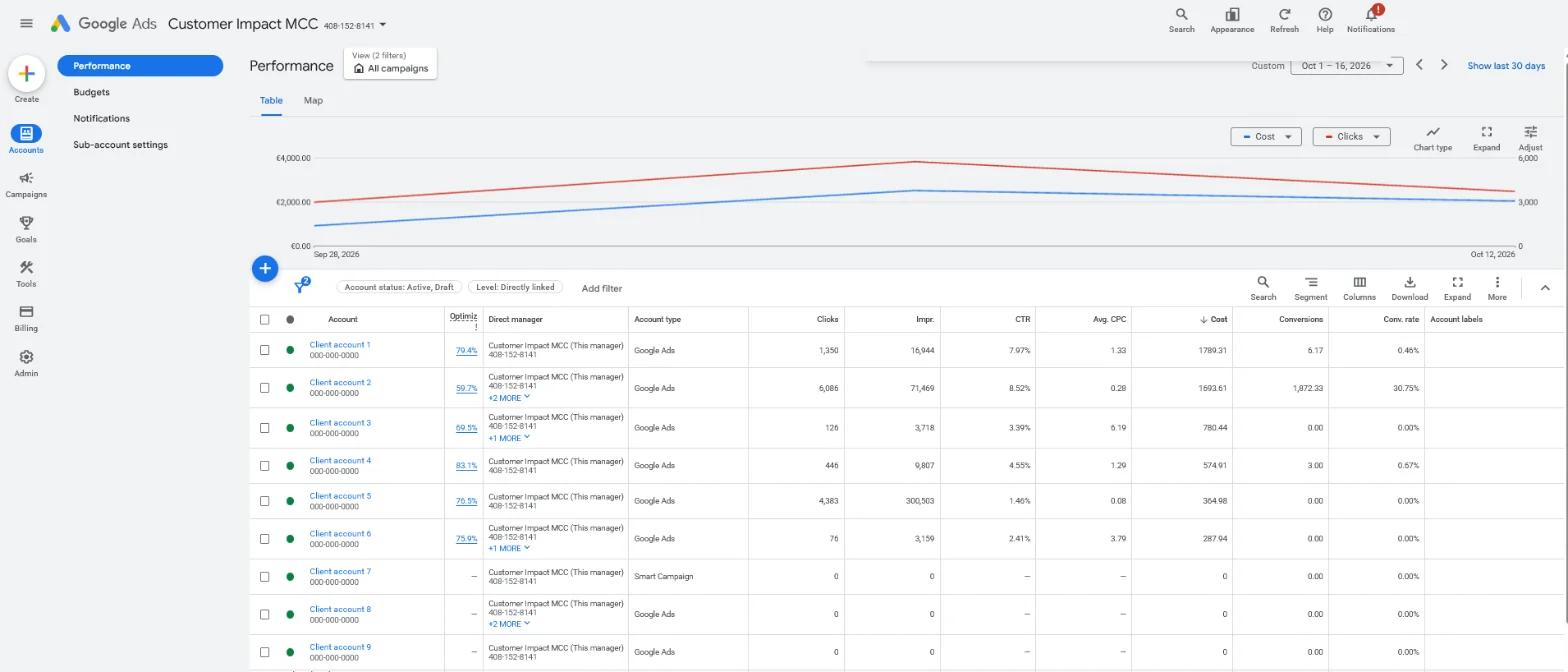 Our own manager account (MCC) in Google Ads, 1 to 16 October 2026. Client names and IDs are replaced.
Average CPC per account runs from 0.08 to 6.19 euros there. Same agency, same period, completely different click prices.
Our experience: never budget on someone else’s average. Check your own keywords.
What the planner shows before you spend
Keyword Planner gives you a bid range per keyword before you spend a cent:
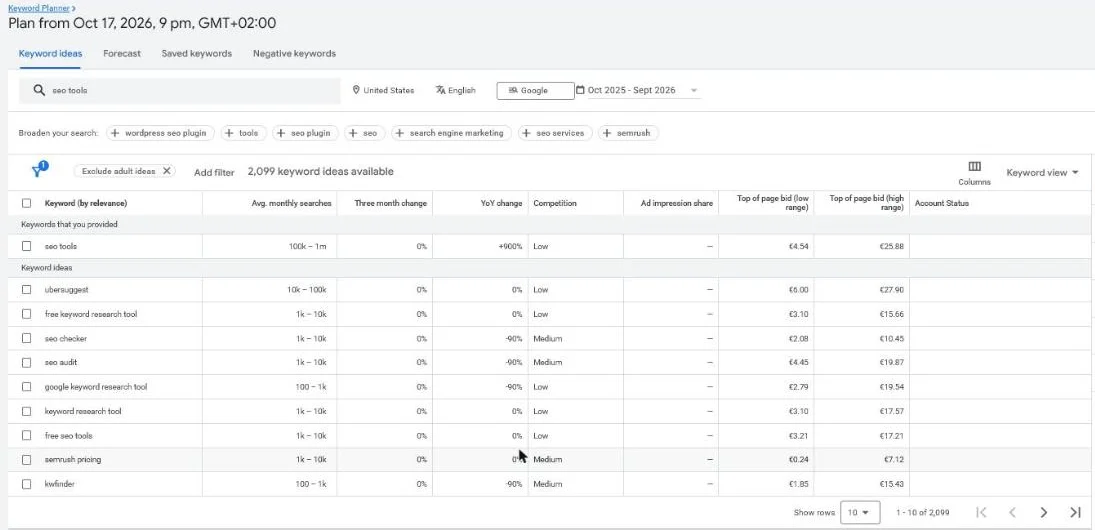 Keyword Planner for “seo tools”, United States, plan from 17 October 2026. Top-of-page bid: 4.54 euros (low range) to 25.88 euros (high range).
One keyword, a range of more than five times. That’s why you test before you set a monthly figure.
What sets the click price
Your actual CPC is “the final amount you’re charged for a click”, and it’s often less than your maximum bid (Google Ads help on actual CPC).
Three things drive it:
- Competition: more advertisers on a keyword, higher price
- Quality score: relevant ads and strong landing pages lower it
- Intent: “request a quote” costs more, but brings better leads
How quality score lowers your CPC
Google rates quality score from 1 to 10, per keyword (Google Ads help on quality score).
It looks at expected CTR, ad relevance and landing page experience.
You can’t always avoid a high click price, but you can improve your quality score.
For Facilicom, exactly that delivered a media saving of 25% without fewer enquiries.
What does management cost?
Roughly three models: a fixed monthly amount, a percentage of media spend, or an hourly rate.
For a serious B2B project you’re usually looking at a few hundred to a few thousand euros a month. It depends on complexity and the number of campaigns.
The catch with a percentage fee
A percentage sounds fair, but the more you spend, the more the agency earns.
That rewards a bigger budget, not sharper work. We prefer a fixed fee, so our interest runs parallel with yours.
Here’s how the three models compare:
| Model | How it’s billed | Watch out |
|---|---|---|
| Fixed fee | Same amount each month | Check what’s included |
| Percentage of spend | A share of your media budget | Rewards spending more |
| Hourly rate | Hours worked | Hard to forecast |
You can read more under outsourcing Google Ads and in our breakdown of Google Ads agency cost.
Is the management actually happening?
Not sure you’re getting what you pay for? Here’s how to check whether you’re paying for Google Ads management that isn’t being done.
Rule of thumb: an account nobody touches for weeks isn’t being managed.
How much budget do you need to start?
Enough to learn. With too small a budget you never gather enough data, and every euro stays a gamble.
For most B2B projects we advise a media budget that buys enough clicks and conversions per month to optimise.
Google explains how to set and spread it on its page about your campaign budget.
Work back from your goal
A rule of thumb we use:
- Start from enquiries: how many do you want, at what conversion rate?
- Count enough clicks: too few conversions and you can’t adjust reliably
- Leave room to test: the first weeks cost money before they pay off
For example, say clicks cost 4 euros and 3 in 100 visitors enquire. Ten enquiries then need about 333 clicks, or roughly 1,333 euros of media a month.
Plug your own numbers into the budget calculator, and read our take on the minimum Google Ads budget.
When the budget is too small
If your budget is too small to learn anything meaningful, we’ll say so.
Sometimes a different channel, or first improving your website, is the smarter move.
Our page on Google Ads with a small budget shows what’s still possible.
The reframe: steer on cost per client
Your monthly budget says nothing about whether Google Ads pays off. The figure that counts is your cost per client.
What does a new customer cost through Google Ads, and what is that customer worth? If they bring in more than they cost, your budget can go up.
The numbers we look at
So we don’t treat clicks or CTR as the final figure. We look at:
- Cost per lead: what you pay for a qualified enquiry
- ROAS or cost per client: what each euro of ads brings in
- Customer value over time: a one-off buyer weighs less than a loyal one
That only works if Google optimises on real enquiries. Here’s the contact form set as the primary action in our own account:
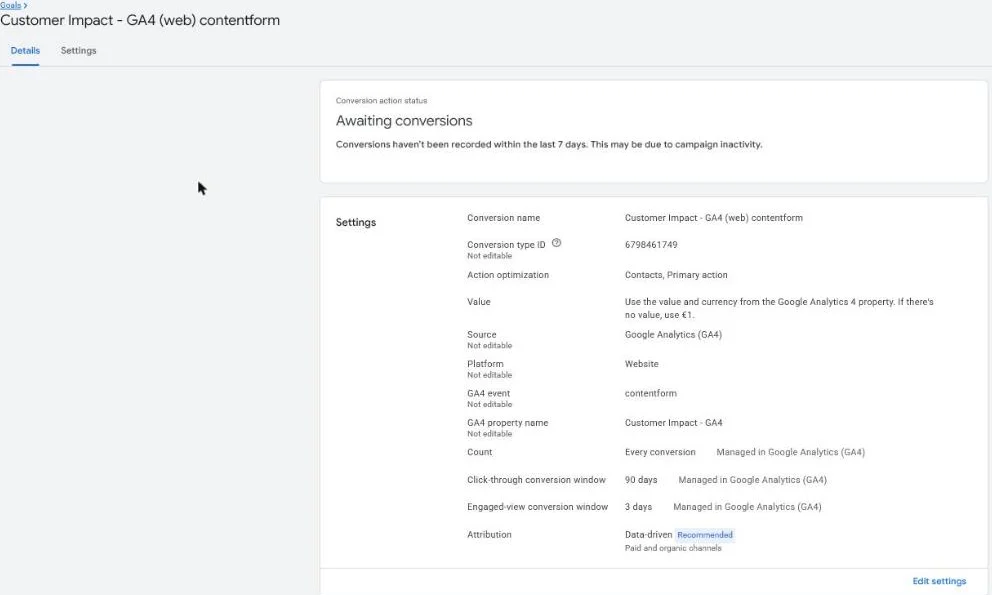 The contact form conversion action in our own Google Ads account, October 2026. It’s set as primary, so campaigns optimise on real enquiries.
Our experience: we usually run one primary goal and one secondary goal. The primary is the booking; the secondary goals are the steps toward it.
An expensive campaign can be the cheap one
Anyone who only looks at the monthly budget misses the point. Compare these two campaigns:
A campaign of 5,000 euros that brings in 50,000 euros of revenue is cheaper than one of 1,000 euros that brings in nothing.
Work out your own figure with the ROAS calculator, or follow our steps to calculate Google Ads ROI.
When Google Ads doesn’t pay off
Google Ads isn’t the right channel for everyone. With a tiny budget, an unclear offer or a site that doesn’t convert, you burn money.
Fixing those first delivers more than advertising.
Three signs to wait
It usually doesn’t pay off if:
- Nobody searches for it: no search volume, no search ads
- Your landing page doesn’t convince: expensive clicks that don’t convert
- You can’t follow up yet: leads left lying around only cost you
We’d rather say that up front than watch you burn three months of budget.
Frequently asked questions about Google Ads cost
How much does Google Ads cost per month?
There’s no fixed amount: you set the media budget yourself. Add the management fee, and work back from the enquiries you need and your click price.
Can Google spend more than my daily budget?
On a single day, yes: up to twice your average daily budget. Over a month, Google says you won’t spend more than 30.4 times that average.
What’s a normal cost per click in B2B?
We often see 1 to 8 euros per click, with outliers of 15 euros or more on competitive terms. Check your own keywords in Keyword Planner before you budget.
Is a percentage fee or a fixed fee better?
A fixed fee keeps the agency’s interest aligned with yours. A percentage fee rewards a bigger budget, even when that doesn’t bring more clients.
Ready to get your Google Ads cost sharp?
Tell us your goal, your sector and your budget.
We’ll calculate whether Google Ads pays off for you, or whether your money works harder elsewhere.
We’re a small team, so we move fast and steer on customers, not clicks. Contact us.
Free website scan
Enter your website and get an automatic scan within minutes, with concrete technical and SEO improvements. No sales pitch.
We only use your details for your scan. No spam, unsubscribe anytime.