
Advertising
Increase Google Ads Budget or Get Better Results? When 'Spend More' Backfires

Copy for AI
Increase your Google Ads budget only when the next euro still turns a profit.
Your agency is calling again, with the same message: raise the budget to grow.
You hesitate, because you don’t know whose interest that advice serves. That doubt is justified, and you’re far from the only business owner who feels it.
The verdict: more budget is real scaling when ROAS is stable and you’re losing impressions to budget. Otherwise it’s upsell.
So the job is to separate real scaling from lazy upsell. Start with the questions to ask before you increase your Google Ads budget.
My Google Ads agency always wants me to spend more: is that in my interest or theirs?
Yours, as long as every extra euro still turns a profit. Theirs, once growth stalls but the invoice keeps rising.
Let’s look at how many agencies make money. It’s simple.
A large share charge a percentage of your ad budget, or a management fee that grows with your spend. In that model, a higher budget is literally more revenue for them, whatever your result.
A structural incentive, not bad intent
That doesn’t make every such agency malicious. Far from it.
But it does create a structural incentive that doesn’t always run parallel to yours. It’s healthy to name that rather than wave it away.
Where the line sits
Rule of thumb: more budget is in your interest as long as every extra euro still turns a profit.
It tips toward their interest as soon as growth stalls but the invoice keeps rising.
How do you know where you stand?
Look at the right numbers, not the story around them.
When does more Google Ads budget make sense and when is it just upsell?
It makes sense when your campaigns prove they’re scalable. It’s upsell when the proposal has no numbers behind it.
Four signals that scaling up is right
Look for these hard signals:
- Your ROAS or cost-per-lead has been stable and healthy for months.
- Your budget runs out early in the day, so you lose volume.
- Your keywords are profitable, with room left in demand and audience.
- Your conversion value is measured correctly, so the numbers are reliable.
Google reports the second signal as Search lost IS (budget): “the percentage of time that your ads weren’t shown on the Search Network due to insufficient budget”.
Watch out: if you mainly lose impressions on rank instead, more budget won’t fix it. Better Ad Rank will.
The fourth signal depends on what you count as a conversion. Here’s how we set ours:
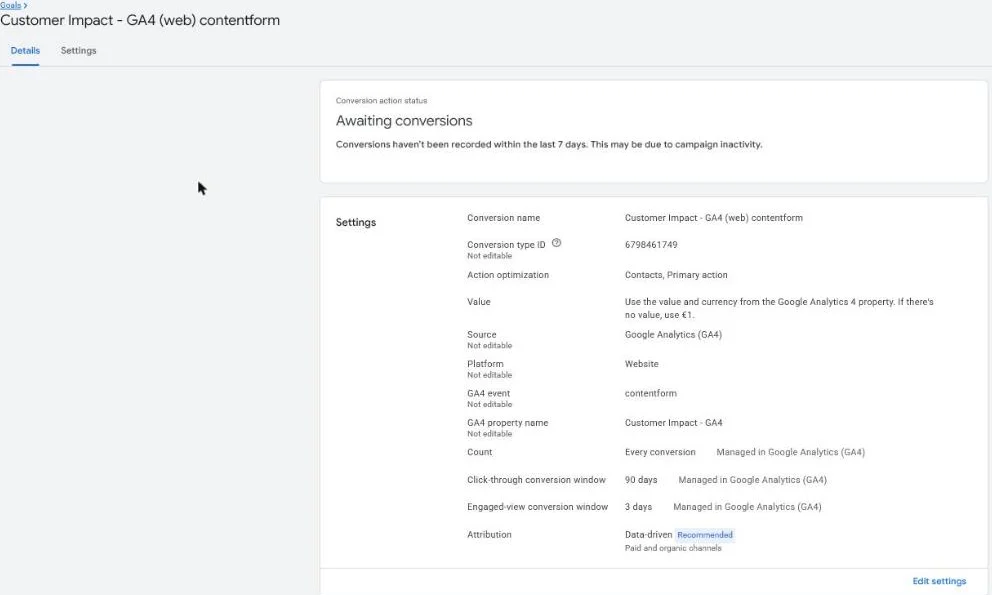 The contact form conversion action in our own Google Ads account, October 2026. It’s set as primary, so campaigns optimise on real enquiries.
Our experience: we usually run one primary goal and one secondary goal. The primary goal is the booking; secondary goals are the drivers toward it.
If the primary goal is a page view, your ROAS looks better than your bank account.
Four signs it’s probably upsell
It’s probably upsell when one of these is at play:
- The proposal comes without a scenario projecting extra revenue or leads.
- The account is still full of wasted ad spend that needs cleaning up first.
- The reasoning is generic, such as “the market is growing”, instead of specific to your account.
- Your reporting mainly shows clicks and impressions, not leads and revenue.
That last sign is easy to spot in an account overview:
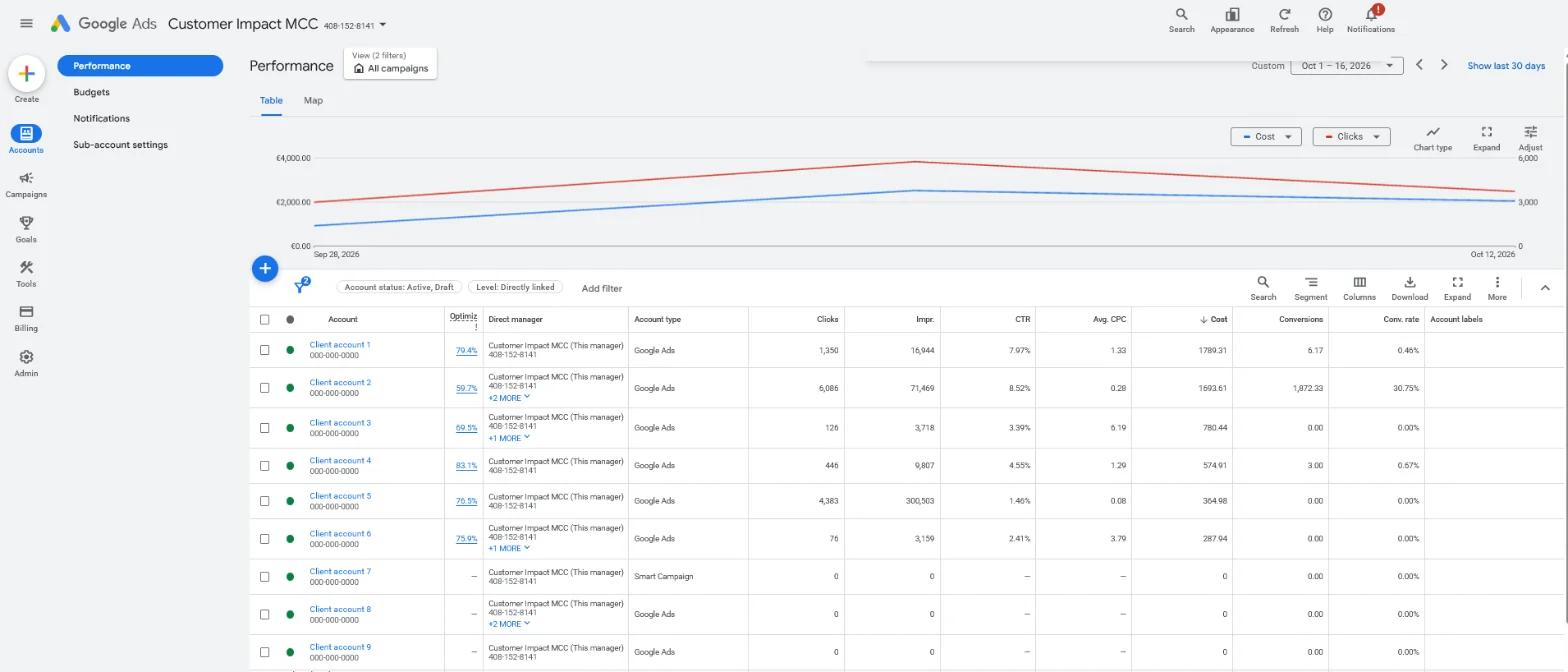 Our own manager account (MCC) in Google Ads, October 2026. Client names and IDs are replaced. Compare the CTR column with the conversions column.
A good CTR with few conversions is a reason to fix the account. Not to feed it.
Scaling versus upsell at a glance
Here are both sides next to each other:
| Real scaling | Lazy upsell |
|---|---|
| Stable ROAS or cost-per-lead for months | No scenario for extra leads or revenue |
| Lost impressions due to budget | Wasted spend not cleaned up |
| Profitable keywords with room left | Generic market arguments |
| Conversions measured correctly | Reports full of clicks and impressions |
A reliable agency puts that difference on the table itself. Here we can scale; here we’re wasting money we should spend better first.
See also when extra services from your marketing agency make sense and when it’s just a sale.
Do I really have to keep giving my advertising agency more budget?
No. Ever-growing budget isn’t a law of nature; it’s a choice you justify again each time.
Growth in advertising is not linear. The first euros capture your cheapest, most purchase-ready searches.
Every euro after that becomes, on average, a little more expensive.
A bigger budget shows up on the invoice first
Keep in mind how Google spends a budget. Your daily budget is an average.
On a single day Google may spend up to two times your average daily budget, capped at 30.4 times it per month.
So a bigger budget shows up in the invoice straight away. The result follows later.
Still at the start? Work out your floor first with our guide to the minimum Google Ads budget, or see how the daily budget works.
Diminishing returns
At some point you reach diminishing returns.
You then pay more per lead, because you target more broadly, bid on pricier keywords or reach a less purchase-ready audience.
Those pricier keywords add up fast in B2B. Here’s one example of a bid range:
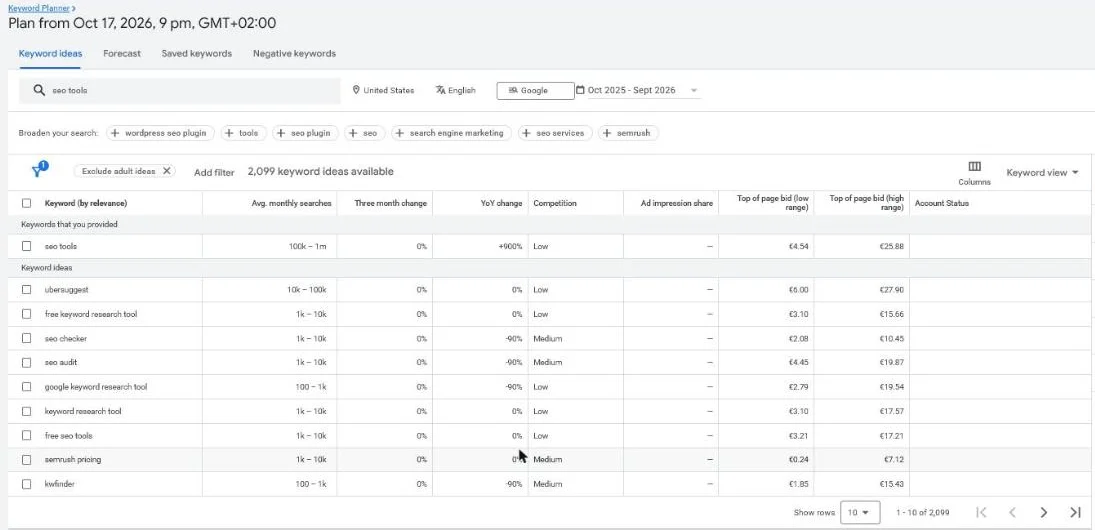 Keyword Planner for “seo tools”, United States, plan from 17 October 2026. Top-of-page bid: 4.54 euros (low range) to 25.88 euros (high range).
Moving from the low to the high end of that range means more than five times the price per click.
That doesn’t have to be wrong. But it must be a conscious trade-off, not an automatism:
In this example, the return drops from 5 x in the first tranche to 0.8 x in the fourth.
Ask for the marginal return
The question isn’t “what does my account return on average?”. It’s “what does the next euro return?”.
That’s the marginal return, and it’s the only number that matters in a decision to scale up.
For example, say your account averages 2.8 x across the four tranches above. Looks fine.
Yet the fourth tranche still loses money at 0.8 x.
Our guide to break-even ROAS shows where that line sits for your margins.
Better campaigns, same budget
Sometimes the best advice is that you don’t need more budget, but better campaigns within the one you have.
Three levers lower your cost per result without an extra euro:
- sharper bidding strategies
- a higher quality score
- tighter negative keywords
Our experience: when paid gets too expensive or the budget is too small, we let SEO take over part of the inflow.
The goal: less dependence on paid clicks.
Clean up first, then scale up
Raising the budget on a messy account is pouring money into a leaking bucket.
Before you scale, you want to know the basics are right. An independent Google Ads account audit exposes where your money leaks away.
Four leaks we see in audits
These come back again and again:
- search terms that never convert but do cost clicks
- campaigns that cannibalise each other’s budget and keywords
- conversion tracking that double-counts or measures the wrong thing
- bidding strategies that steer toward the wrong goal
Only once those leaks are sealed do you know what your campaigns can really handle.
Give bidding time to adjust
Plan changes calmly. Smart Bidding needs time.
That applies to any change in its settings, such as a new target.
Google says it can take a few conversion cycles (1 to 2 typically) for the strategy to adjust.
Scaling on a cleaned-up account is investing. Scaling on a leaky account is losing, just faster.
Our guide to scaling Google Ads campaigns covers the step-by-step pace.
Unsure about the state of your account? Request an audit and let a second pair of eyes take a look.
What you’re entitled to expect from an honest marketing partner
Advice backed by numbers, openness about how they earn, and the nerve to say “less”.
The role confusion is here: you expect an advisor, but sometimes get a salesperson.
The problem isn’t that an agency has ambition. It’s that advice and self-interest blur without transparency.
Four things you can expect
A partner who has your best interests at heart gives you:
- Substantiated proposals: every budget change comes with a projection of extra leads or revenue.
- Transparency about the revenue model: you know whether your partner earns from your spend.
- The willingness to say “less”: they advise against scaling if the numbers don’t support it.
- Ownership that stays with you: you’re always the owner of your Google Ads account.
That last point lets you check the numbers yourself, any day.
When it’s time for a sharper conversation
Does your partner only sell the growth story and never hit the brakes? That’s a signal.
It doesn’t automatically mean you have to switch to another agency. It does mean you need a sharper conversation.
A directional figure to keep in the back of your mind
B2B buyers do most of their research before they talk to you, so campaign quality often beats volume.
More and more buyers compare providers thoroughly before they get in touch.
In the 6sense 2025 Buyer Experience Report, buyers made first contact with sellers about 61% of the way into their journey.
Quality beats volume
That means the quality of your campaigns often yields more profit than the volume.
A growing part of the return lies in relevance and timing, not in a higher budget.
Whoever scales blindly, without fixing campaigns and landing pages, mainly pays more for the same thing.
The party that lays the foundations first gets more out of less.
That’s why Google Ads returns take time. A bigger wallet can’t buy them.
Frequently asked questions
My Google Ads agency always wants me to spend more, is that in my interest or theirs?
It depends on the substantiation and the revenue model. If your agency works on a percentage of your spend, their revenue grows automatically, regardless of your result. Always ask for the expected extra leads or revenue per extra euro.
If that doesn’t come, the proposal mainly serves their interest.
Do I really have to keep giving my advertising agency more budget?
No. Growth in advertising isn’t linear: every extra euro becomes on average a little more expensive because you target more broadly. At some point you reach diminishing returns.
Decide on the marginal return: what the next euro yields.
When does more Google Ads budget make sense and when is it just upsell?
It makes sense if your ROAS is stable and healthy, you’re demonstrably losing volume because of your budget cap and your keywords are profitable. It’s upsell if the proposal has no scenario, the account still wastes budget or the reasoning stays generic.
Then clean up first.
How do I know if my campaigns are ready to scale?
First have an independent audit carried out. It shows whether your conversion tracking is correct, whether no money is leaking away and whether your bidding strategy steers toward the right goal. Only on a cleaned-up account does a higher budget say anything reliable.
Scale after that.
Can an agency guarantee results with a higher budget?
Be careful with parties that promise this. A serious partner explains why guarantees on marketing results are misleading.
Expect realistic ranges instead.
Ready for advice that sometimes dares to say “less”?
Ask your partner for the marginal return before you approve the next increase.
We work advice-first, even if that means you’d better not scale up. We look at your numbers first and tell you plainly whether more budget moves you forward.
We build strategy, lead generation, ads, SEO, GEO and web, and we execute it too.
Want to know whether your budget is working or leaking? Contact us or first see how we work as a Google Ads agency. We’re a small team, so we move fast.
Free website scan
Enter your website and get an automatic scan within minutes, with concrete technical and SEO improvements. No sales pitch.
We only use your details for your scan. No spam, unsubscribe anytime.