
Growth & Strategie
Always Another Upsell? When Extra Services Make Sense and When It Is Just Selling

Copy for AI
A marketing agency upsell is only worth it when it fixes a real bottleneck.
Everything else is their revenue target talking.
The verdict: a good upsell starts from your data and names a result in pipeline or revenue. A sales upsell starts from their service menu.
Every conversation with your agency starts the same way:
- you call about one thing
- you hang up with a quote for three new services you never asked for
So you start to wonder: does my marketing agency constantly want to sell more instead of delivering results? Here’s how to tell a meaningful upsell from pure selling, and what to expect instead.
Why does every conversation with your agency feel like a pitch?
Because many agencies work with monthly revenue targets per client, and that colours every touchpoint.
That isn’t wrong in itself. But what starts as a status update ends as a proposal for extra budget, a new channel or a bigger package.
When the order flips
The problem isn’t that an agency sells services.
The problem starts when the order flips.
Your bottleneck no longer drives the advice; their service menu decides what they recommend.
Recognise the pattern
Here’s what it sounds like:
- You ask about your Google Ads results and get a plea for a new website.
- You ask about SEO, and suddenly social has to be added too.
- You ask why leads dropped, and the answer is a bigger retainer.
That’s the signal to look harder at the motive behind each proposal.
You’ll find comparable signals in lead generation agency red flags and in our broader list of marketing agency red flags.
Do I really have to keep buying more services from my advertising agency?
No, not automatically. An extra service only makes sense when it solves a demonstrable bottleneck in your growth engine.
It doesn’t make sense just because it happens to sit in the agency’s portfolio.
Three questions for every proposal
Ask yourself three questions:
- What concrete problem does this solve? Not “more visibility”, but for example “too few qualified leads from search traffic”.
- How do we measure whether it works? In pipeline and revenue, not in reach, clicks or “activity”.
- What happens if I say no? An honest partner can explain that calmly. A sales-driven one manufactures urgency.
When buying more is the right call
Sometimes buying more really is right.
For example, say your ads perform but your website doesn’t convert the visitors.
Then a conversion layer is a logical next step.
The difference lies in the evidence from your own data, not in the smoothness of the sales story.
A good rule of thumb
A meaningful expansion always builds on something that already works.
You scale what pays off. You don’t stack loose services on a hunch.
Anyone who wants to scale without proof is selling you motion instead of growth.
More on that in outsourced lead generation.
How do I know whether a marketing upsell is needed or just revenue for them?
Hold every proposal up against a simple split: does it start from your numbers, or from their menu?
This is the core question, and fortunately it’s testable.
Signs of an honest upsell
- It starts from a number that disappoints or an opportunity the data reveals.
- The agency also names what you can cut or stop.
- A measurable result is attached, with an agreed evaluation moment.
- The advice still stands even if you executed it yourself or bought it elsewhere.
Signs of a sales upsell
- Every conversation ends in “more”, never in “less” or “keep it as is”.
- The reasoning is vague: trends, “everyone is doing it now”, scarcity.
- The result is measured in vanity metrics, not in deals.
- Saying the budget could actually go down never happens.
See the gap in the numbers
Vanity metrics hide in plain sight.
Look at clicks and CTR next to conversions in a Google Ads overview like this one:
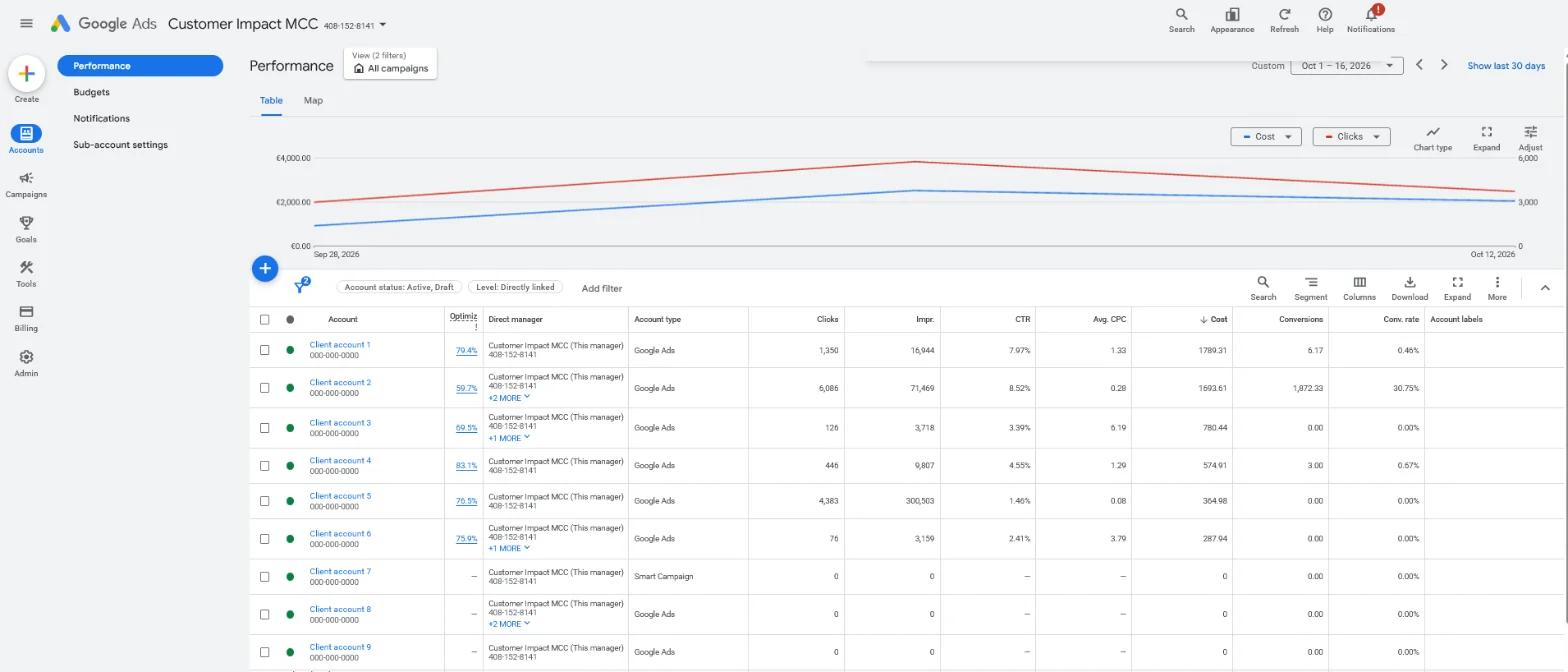 Our own manager account (MCC) in Google Ads, October 2026. Client names and IDs are replaced. A healthy CTR with few conversions is a reason to fix conversion, not to buy reach.
An upsell that adds more clicks to an account like that doesn’t touch the real problem.
The sharpest test
A trustworthy marketing partner dares to say: “You don’t need this.”
That may well be the sharpest test of all.
B2B buyers are also tired of being sold to.
In a Gartner survey of 646 B2B buyers, 67% said they prefer a rep-free experience (Gartner, March 2026).
Trust is built when someone occasionally advises against their own revenue.
What should you expect from a marketing partner?
Advice first, results counted in your unit, transparency and full ownership of your accounts.
Spotting too much selling is half the job.
Knowing what you’re entitled to is the other half.
Four things a good partner does
A good partner:
- Advises first, sells second. The advice leads, even when it means you spend less.
- Counts in your unit. Not in clicks or leads, but in customers and revenue. Do the maths with B2B marketing KPIs.
- Is transparent about source and result. You see which channel produces which pipeline, with no smokescreen.
- Lets you stay the owner. Your accounts, data and website are in your name, so you’re never held hostage. Read why in Google Ads account ownership.
Ownership in practice
Ownership has a concrete meaning in Google Ads.
Only Admin access “can give account access, change access levels, and cancel invitations from other users” (Google Ads Help).
Watch out: if your agency holds the only Admin login, you don’t fully own your account.
Counting in your unit
“Counting in your unit” means following every lead to revenue.
In a CRM, lifecycle stages do that: they “track how contacts or companies move forward in your process” (HubSpot Knowledge Base).
Ask your agency to report on these stages, not on clicks:
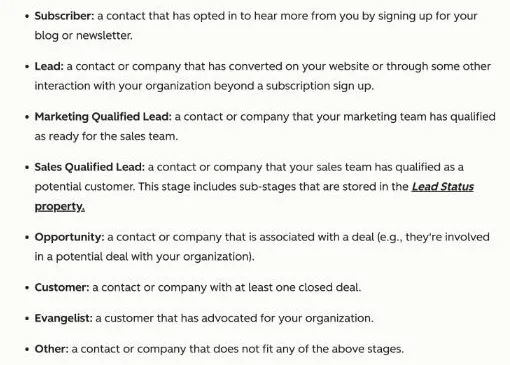 HubSpot’s lifecycle stage definitions, checked 18 October 2026. Ask which stage an upsell will move, and by how much.
What you don’t have to accept
You don’t have to accept an agency that becomes unreachable the moment the upsell is signed.
Nor one that bends every results conversation into a new sale.
Recognise that sudden silence? Learn how to spot the communication red flags when your marketing agency stops responding.
If that pattern sounds familiar, it’s time to review your partnership.
How to do that without losing your data is covered in switching lead generation agency.
Which questions should you ask before you say yes?
Four questions about the number, the risk, the budget and the measurement.
Before you agree to an extra service, put these to your agency:
- “Which number do you want to improve with this, and where does it stand now?”
- “What happens to my results if I don’t do this?”
- “How much of my current budget would you actually scale back?”
- “When and how do we measure whether this worked?”
The answers instantly reveal whether it’s advice or sales.
How a strong agency answers
A strong agency answers calmly and with numbers.
A sales-driven party gets uncomfortable or retreats into generalities.
That reaction is your answer.
Use the same test elsewhere
The same approach works for other disciplines.
See questions to ask your Google Ads agency and spotting a bad SEO agency.
Want the evaluation moment in writing?
Our guide to the marketing agency contract shows which clauses to add.
Frequently asked questions
My marketing agency constantly wants to sell more instead of delivering results. Is that a red flag?
It’s a signal, not a verdict. Test it against the reasoning: does every proposal start from your numbers and bottlenecks, or from their service package? If advice is structurally subordinate to selling, and you never hear that something could stop or go down, the balance is off.
Do I really have to keep buying more services from my advertising agency to see results?
No. More services don’t automatically lead to more results. An extra service is only worthwhile when it solves a proven bottleneck and you’re scaling something that already pays off. Stacking without proof is revenue for them, not growth for you.
How do I know whether a marketing upsell is needed or just revenue for them?
Ask for the concrete number that will improve and how it will be measured in pipeline or revenue. An honest upsell also names what you can cut and holds up even if you had it executed elsewhere. A sales upsell leans on vague trends, scarcity and vanity metrics.
Can a good agency recommend spending less?
Absolutely, and that’s exactly a strong sign. A partner who sometimes advises against their own revenue is thinking about your return. That builds more trust than any pitch ever will.
What if I doubt whether my current partner still advises honestly?
Put a recent proposal next to the questions in this article. Does the advice come from your data or from their menu? Still unsure? Read lead generation not working or ask for an independent view.
Would you rather have a partner that advises first?
You deserve a partner who tells you where your money works hardest, even when that means spending less.
At lead generation we look at your numbers and your bottleneck first.
Then at what’s actually needed: sometimes more, often different, sometimes simply less.
We’re a small team, so we move fast and often do more than you expect.
Contact us and you’ll hear honestly where your budget really belongs.
Free website scan
Enter your website and get an automatic scan within minutes, with concrete technical and SEO improvements. No sales pitch.
We only use your details for your scan. No spam, unsubscribe anytime.