
Growth & Strategie
My freelancer ghosted me: what to do when your marketer or developer disappears

Copy for AI
If your freelancer ghosted you, secure your access first and chase them second.
Your marketer hasn’t replied for two weeks. The website sits half-finished, the campaign runs with no one watching, and you don’t know where your files are.
The verdict: “my freelancer ghosted me” is rarely about the person. It’s about a dependency on one pair of hands. You fix it by getting every login, file and account back in your own name.
This is one of the most stressful situations for a business owner: your freelancer has disappeared and your project is at a standstill.
Below: what to do now, how to get to your files, and how to stop it from happening again.
Did your freelancer ghost you because of something you did?
Probably not: in most cases, the ghosting has nothing to do with you.
When a freelancer suddenly becomes unreachable, many business owners start doubting themselves.
Was I too demanding? Did I say something wrong?
Why solo providers go quiet
A solo provider who disappears usually does so for one of these reasons:
- overload
- illness or a personal crisis
- a bigger client getting priority
- lost overview, and no longer daring to reply
That doesn’t make it any less annoying for you.
Name the real problem
The issue isn’t one person. It’s the dependency on one person without a safety net.
Put everything in a single pair of hands and you automatically take on that risk.
My freelancer disappeared and my project is half-finished: what now?
Stay calm, then act in a fixed order.
Panic emails rarely help. Work through these three steps:
1. Document and give one last clear signal
Send a single clear, friendly but formal email with a concrete deadline.
For example: “I’d like to know before Friday whether and when you can continue. Otherwise I’ll take the project elsewhere.”
Keep all communication. It’s your evidence later if a dispute arises over payments or ownership.
2. Make a list of what you have in hand
Many business owners only now discover they don’t know who manages what.
Map it out per component:
| Component | Question to answer | Where to look first |
|---|---|---|
| Domain name | In whose name is the registration? | Your registrar’s confirmation emails |
| Hosting | Where does the site run, who has the logins? | Hosting invoices |
| CMS and website files | WordPress, Webflow or custom build? | Admin login emails |
| Ad accounts | Google Ads, Meta, LinkedIn | Billing emails from each platform |
| Analytics and tracking | Google Analytics, Search Console, tag manager | Invitation emails |
| Invoices and agreements | What was paid, what was delivered? | Your accounting tool |
Fill in every row before you contact anyone new. It’s your recovery point.
3. Determine what’s truly urgent
A half-finished website can wait a while.
Running ads that cost money without follow-up can’t. Pause the campaigns you can’t control until you regain a grip.
Rule of thumb: stop the spend first, recover the access second, fix the website third.
My marketing freelancer isn’t responding anymore: how do I get to my files?
Start with your inbox: more is in your name than you think, even without the logins.
Start with your email
Search for confirmation emails from your domain registrar, your hosting provider and your advertising platforms.
They tell you which party you need. Then you can restore access directly there.
Your domain name
One principle applies: whoever is registered as the holder is the owner.
Is the domain name in your freelancer’s name? For a .be domain, the current holder must request the transfer code (DNS Belgium, page in French). You can’t take it over on your own with your invoices.
If your freelancer won’t cooperate, DNS Belgium points to an amicable agreement, the CEPANI ADR procedure or the court. Your invoices and communication then serve as evidence.
ICANN’s registrants’ rights page says you’re entitled to know who your registrar is. You’re also entitled to clear instructions for managing and transferring your domain.
Watch out: ICANN also expects you to keep your registrar account data current and to answer registrar inquiries within 15 days.
Also read how to transfer a website to another agency, so you know exactly which components you need.
Your ad accounts
Ownership here is a well-known pain point.
If campaigns run in a freelancer’s account instead of your own, you lose everything when they leave. History, learning data and sometimes access itself.
In Google Ads, only an Admin “can give account access, change access levels, and cancel invitations from other users” (Google Ads access levels). So make sure someone in your company holds Admin access.
Our article on ownership of your Google Ads account shows how to fix this and avoid it next time.
How a healthy setup looks
A good partner works in your account, not the other way around.
Agencies link client accounts to their own manager account (MCC). Here’s ours, with client names hidden:
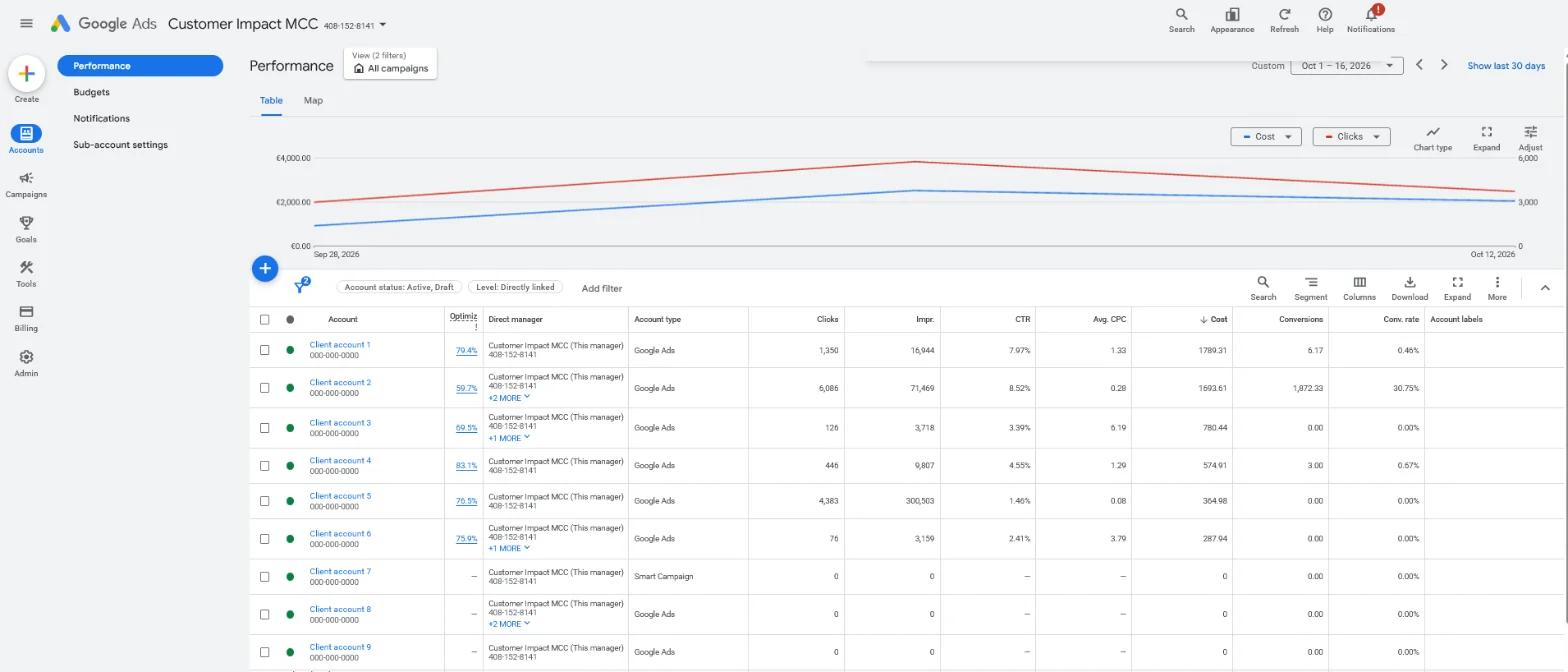 Our own manager account (MCC) in Google Ads, October 2026. Client names and IDs are replaced. Each linked account stays the client’s own.
If the link ends, the account and its history stay with the client.
More on that in who owns your ad accounts.
Search Console and analytics
Search Console has two kinds of owners, and both have the same permissions (Google’s owner help page).
You can verify the property yourself, without your freelancer. Then remove their access, and delete their verification tokens so they can’t re-verify.
Our guide to Google Search Console covers verification step by step.
Ask the other platforms’ support
Tip: ask each platform to add a new owner or administrator through its official support procedure.
Don’t count on guaranteed recovery, though. That’s exactly why you should always keep an admin account in your own name.
Freelancer from abroad disappeared with my project: what extra points need attention?
Focus on what you control yourself, because recovering what’s gone is rarely realistic.
Did you work with a freelancer from abroad via a platform or at a cheap rate?
Then the situation is unfortunately trickier.
The legal reality
Taking a freelancer in another country to court over a limited amount is almost never worth it.
The distance, the language and the costs make it unfeasible.
What to do instead
Concretely, that means:
- reset passwords and access
- disable payment cards linked to the freelancer
- recover your domain and accounts via the procedures above
- accept that part of the work gets redone
Then choose a partner you can actually reach.
It’s usually less bad than feared
A growing share of B2B owners who come to us after a disappearance abroad lost less than they feared. That was once their access was in order.
Redoing the work feels sour. But with a clean base, you’re back faster than you think.
What can you rightfully expect from a good partner?
Four things, and you can lock all of them down before you start.
A bad experience doesn’t mean outsourcing is wrong. It means you need the right agreements.
The four non-negotiables
Expect these from any partner:
- Ownership: domain, website, ad accounts and data are in your name.
- Reachability: a fixed point of contact and an agreed response time.
- Continuity: if someone drops out, a colleague takes over.
- Transparency: you know what happens, what it costs and what it delivers.
Put it in the contract
Our overview of what to watch for in a lead generation contract helps you put the right clauses on the table.
For a website, a website contract with an SLA sets the response time in writing.
Spot the warning signs early
Recognise the signals in advance and you avoid a repeat.
Check the well-known red flags at a lead generation agency and how to recognize a bad agency.
Our experience: we often see freelancers with messy ranking tactics. The client pays the bill at the next Google update.
We’re often the team companies call when it has gone wrong.
Why does a team make the difference?
Because it removes the single point of failure: everything hanging on one person.
With a team, knowledge is shared. Access is centralised and documented, for example in a shared password manager the whole team can open.
If someone drops out through illness or holiday, your website, campaign and follow-up simply carry on.
Continuity over the lowest hourly rate
More and more B2B companies deliberately choose continuity.
A stalled project turns out far more expensive than a slightly higher monthly amount.
When a freelancer still fits
A freelancer isn’t the wrong choice by default.
Our experience: a freelancer fits one-person or small businesses with a clear, simple delivery line. Several markets or products call for a team.
Our comparison of agency vs freelancer vs in-house helps you choose.
Strategy and execution in one place
Unsure whether to outsource to a party that combines strategy and execution?
Read what outsourcing lead generation involves. And see how to switch to another agency without getting stuck again.
Frequently asked questions
My freelancer disappeared and my project is half-finished, what now?
Send one formal email with a deadline, map out all your access and files, and pause running campaigns that cost money. Then continue with a party you can actually reach. Restarting is almost always easier than expected once your access is in order.
My marketing freelancer isn’t responding, how do I get to my files?
Search your email for confirmations from your domain registrar, hosting and advertising platforms. For some tools, such as Google Search Console, you can verify ownership yourself, even without your freelancer’s logins. For a domain registered in their name, you need their cooperation or a dispute procedure, with your invoices as evidence.
A freelancer from abroad disappeared with my project, can I still do anything?
Legal redress is usually not realistic because of distance and costs. Focus on what you control: reset passwords, disconnect payment methods and recover your domain and accounts. Accept that part of the work gets redone and choose a reachable partner.
How do I prevent an agency or marketing partner from ghosting me again?
Lock down ownership, reachability and continuity in the contract before you start. Keep the domain, website and ad accounts in your name. Preferably choose a team rather than one person, so you never depend on a single web developer or marketer.
Who owns my website and ad accounts?
That should be you. Read who owns my website for the details. If it’s in your former partner’s name, ask them for the transfer first. If they refuse, you can claim the domain through the dispute procedure (for a .be domain, CEPANI ADR) or in court, with your invoices as evidence. From now on, always agree this in advance.
Ready to regain control?
Stuck with a half-finished project and a partner who no longer replies?
We help you get everything back in order: recover access, get your lead generation moving again and put everything in your name. Strategy, leadgen, ads, SEO, GEO and web, honest and transparent.
We’re a small team that moves fast.
Contact us and we’ll map your access with you first, then plan the restart.
Free website scan
Enter your website and get an automatic scan within minutes, with concrete technical and SEO improvements. No sales pitch.
We only use your details for your scan. No spam, unsubscribe anytime.