
Website & Development
15 Questions to Ask a Web Designer Before You Sign

Copy for AI
The best questions to ask a web designer cover process, ownership and aftercare.
Not just how the design will look.
The verdict: the nicest portfolio says little about how a project runs. Or about what happens when you want to change something yourself a year from now.
Below are 15 concrete questions to ask a web designer, grouped by theme. For each one: the answer you want to hear, and the answer that should raise a flag.
This checklist is part of our broader B2B website development guide.
Use it during a quote conversation or intake. That way you compare apples with apples across agencies.
What are the 15 questions to ask a web designer?
They fall into four themes. Ownership has the fewest questions, but it’s the block that hurts most when you skip it.
Here’s the quick version of what a good answer sounds like per theme:
| Theme | Questions | Good sign | Red flag |
|---|---|---|---|
| Process and approach | 1 to 5 | Clear phases, named team, priced extra rounds | ”We’ll see as we go” |
| Platform and technology | 6 to 9 | A trade-off between platforms | The same platform for every client |
| Ownership and access | 10 to 12 | Everything in your name, admin rights | Domain or code in the agency’s name |
| Results, aftercare, price | 13 to 15 | Leads and conversion, itemized quote | Only visitors and “a nice site” |
Which questions should you ask about the process and approach?
Start with the process.
That’s where you see fastest whether an agency works in a structured way or improvises. A good agency explains in plain language how a project runs, from first conversation to go-live.
1. What does your process look like, from kick-off to go-live?
Good answer: a clear phasing: strategy, structure, design, build, testing, launch.
Red flag: a vague answer. That usually means a vague project.
2. Who is on my project team and who is my dedicated point of contact?
Ask whether you work with senior people.
Watch out: work handed off to juniors without supervision. Our piece on a dedicated point of contact explains why one name matters.
3. How do you determine the structure and navigation of the site?
Good agencies start with goals and audiences, not with colours.
Ask whether they work with wireframes before anything gets designed.
4. How many feedback rounds are included and what does an extra round cost?
You know the limits upfront.
And you avoid arguments afterwards.
5. How do you handle overruns in planning or scope?
The answer shows how they deal with expectations and with your budget.
For example, ask what happened on their last project that ran late.
What to watch in this block
In this block, pay attention above all to concreteness.
An agency that can’t describe its own way of working will struggle to steer your project.
Tip: ask for a sample planning of a comparable project.
That immediately shows whether their phasing is realistic. And whether they make room for strategy and testing, or jump straight to the build.
Which questions should you ask about the platform and technology?
Ask why an agency proposes a particular platform and which alternatives they considered.
The right answer depends on your situation: your team, your content, your budget and your growth plans.
Rule of thumb: an agency that always recommends the same platform is selling its habit, not your solution.
6. Which platform do you recommend for my situation, and why this one and not something else?
Webflow, WordPress and custom or headless each have real strengths and real limitations.
You want to hear the trade-off, not a dogma. Here are the two platforms you’ll hear most often:
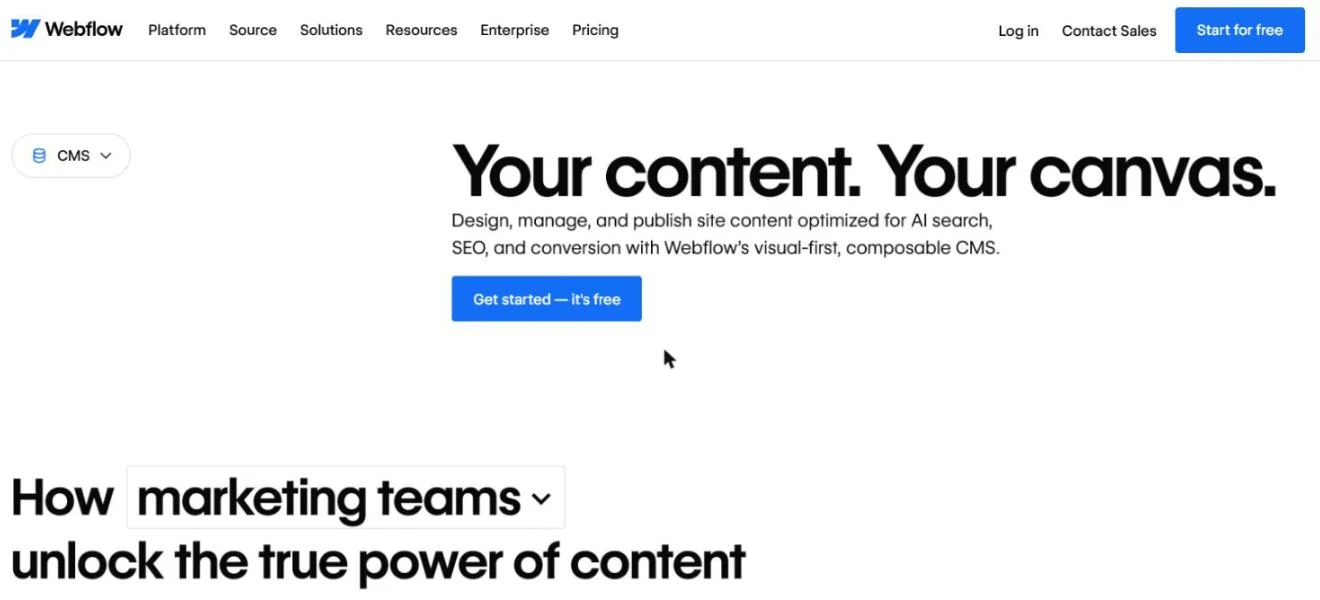 Webflow’s homepage, October 2026.
Webflow is a hosted visual builder. WordPress is open source, and you choose your own hosting:
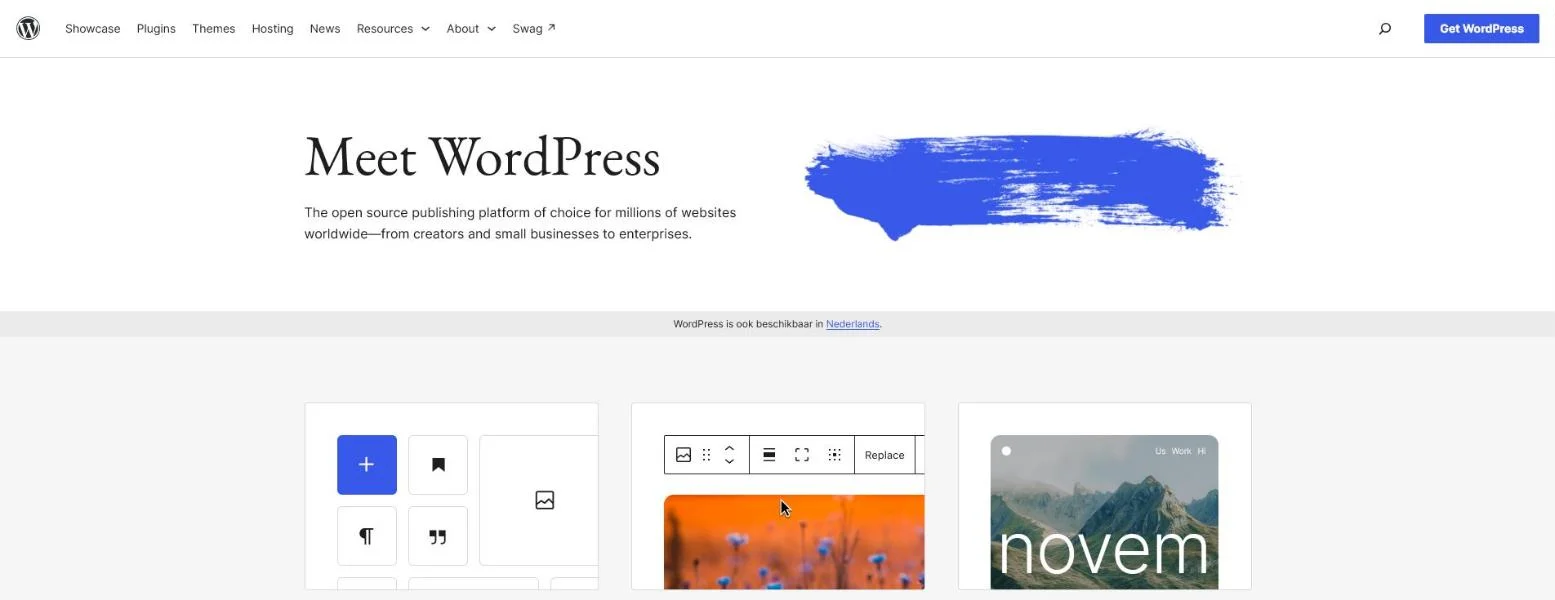 WordPress.org, October 2026.
Our experience: WordPress, Drupal, Webflow and Joomla all used to be strong defaults.
Today the right choice depends on the company. Our comparison of Webflow vs WordPress and our guide on which CMS to choose go deeper.
7. How easily can my team change content themselves later on?
If you have to pay for every text change, you’re dependent.
Ask for a short demo of the CMS. See what editing your website in a CMS should look like day to day.
8. How do you ensure speed and good Core Web Vitals?
Speed affects findability and conversion.
So Core Web Vitals should be part of the approach by default. Google’s web.dev guide to Web Vitals sets the “good” bar:
- LCP (loading): 2.5 seconds or less
- INP (responsiveness): 200 milliseconds or less
- CLS (layout stability): 0.1 or less
Those thresholds apply at the 75th percentile of page loads. Ask the agency to show field data for a site they built, like this check of our own site:
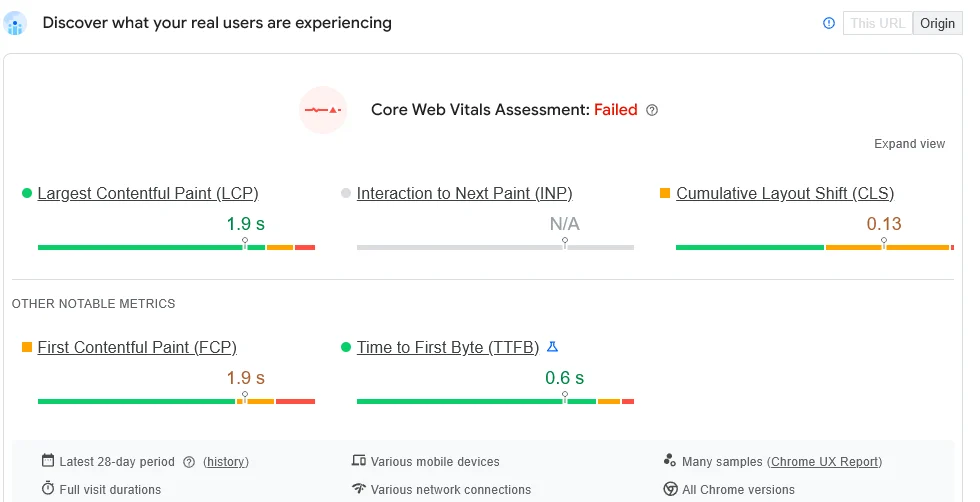 PageSpeed Insights field data for customerimpact.be on mobile, October 2026. LCP passes at 1.9 s; CLS at 0.13 still needs work.
Notice that even our own site has one metric to fix. An honest agency shows you the weak spot too.
You can run the same check on their portfolio with our website speed test.
9. How do you account for accessibility?
Accessible sites reach more people, and accessibility is legally becoming more important.
The European Accessibility Act covers services such as e-commerce. See our guide to website accessibility for what that means in practice.
A good agency takes this into account without you having to ask. A Lighthouse report gives a first, automated signal:
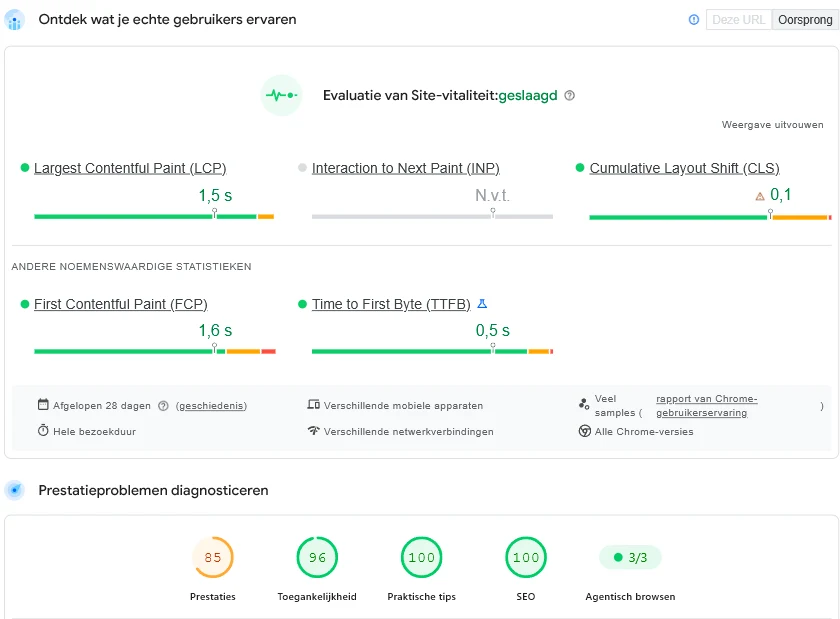 Lighthouse scores for our own site customerimpact.be in PageSpeed Insights, late September 2026: accessibility 96.
Watch out: an automated score doesn’t catch everything. Ask how they test with a keyboard and a screen reader, or try our WCAG checker.
The extra question for a redesign or migration
With a redesign there’s an extra concern: preserving your positions in Google.
Ask specifically how they approach a migration without losing rankings and whether there’s a redirect plan.
Google’s site move guidance asks for a map of old to new URLs and permanent 301 redirects. It also advises keeping those redirects for at least a year.
Test a sample of them yourself with our redirect checker.
Which questions should you ask about ownership and access?
This is the most important block, and the one most often forgotten.
Make sure you become the owner of everything related to your site. Then you’re never held hostage by your agency.
Too many companies only discover during a conflict that their domain or code isn’t in their own name.
10. In whose name are the domain, the hosting and all the accounts?
Good answer: in yours.
You should own your domain name and your hosting environment, even if the collaboration ends. More on that in choosing a domain name for your business.
11. Do I get full access to the CMS, the code and the analytics?
You want admin rights, not a restricted user role.
Also ask whether the source code is yours after payment. Proprietary systems can create CMS vendor lock-in.
12. What happens to the site if we end the collaboration?
An honest agency has a clear answer here.
It helps with a clean handover instead of locking you in. Our guide to transferring a website to a new agency shows what that handover includes.
Put it in the contract
Put the answers to these three questions in writing in the contract.
Ownership agreed only verbally isn’t ownership.
Our experience: with us, the client owns everything: content, links and accounts.
An honest partner has no problem with this. They want you to stay because the work is good, not because you’re technically stuck.
The more an agency hesitates here, the more you should keep digging.
Which questions should you ask about results, aftercare and price?
Finish with the questions that decide whether your site delivers anything long term.
Ask how the agency measures results and what happens after go-live. A site no one maintains or measures rarely generates leads.
13. How do you measure whether the site works, in leads and conversion and not just in visitors?
You want an agency that steers on revenue and enquiries, not on vanity metrics.
For inspiration, see how to build a B2B website that generates leads.
14. What is included in your aftercare: maintenance, updates, support and possibly optimisation?
Ask whether this is a fixed package or work by the hour.
And ask what the response time is when problems arise. Our guide to website maintenance lists what a package should cover.
15. How is the price built up and what falls explicitly outside the quote?
A transparent quote splits design, build, content and aftercare.
Our overview of website cost helps you judge whether a quote is in line.
Don’t count on the Flemish SME portfolio (kmo-portefeuille) for a web project: since 1 February 2026, VLAIO only subsidises advice on cybersecurity. Training remains eligible. More background in the kmo-portefeuille for your website.
Why these last three matter
A good answer here shows that the agency thinks beyond delivery.
The site isn’t an endpoint. It’s the start of your lead generation.
How do you compare the answers across agencies?
Score every agency on the same 15 questions.
A simple sheet works. Here’s how:
- Ask the questions in the same order. Same wording for each agency.
- Write down the answer word for word. Not your impression of it.
- Mark each answer good, vague or red flag. Use the table above.
- Ask for written confirmation of questions 10 to 12. Ownership goes in the contract.
For example, say two agencies tie on price. The one with a clear ownership answer and a named point of contact wins.
Google uses the same logic for hiring an SEO. Its guide to hiring an SEO suggests asking for past work, expected results and a timeframe, and whether they’ll share all changes made to your site.
Our step-by-step guide on how to choose a web design agency covers the full selection process.
The short summary
A web design agency’s value isn’t in the nicest mockup.
It’s in a clear process, ownership that lies with you and aftercare that keeps improving your site.
Ask all 15 questions to every party. Watch not only what they answer, but how openly they answer.
An agency that dodges tough questions about scope, ownership and price will probably do so again during the project.
An agency that answers concretely and puts its agreements on paper is the partner to sign with.
Want our own answers to these 15 questions? Explore our approach for web design or contact us.
Free website scan
Enter your website and get an automatic scan within minutes, with concrete technical and SEO improvements. No sales pitch.
We only use your details for your scan. No spam, unsubscribe anytime.