
Leadgeneratie
Lead generation agency vs marketing agency: what's the difference and which one do you need?

Copy for AI
A marketing agency builds attention; a lead generation agency turns attention into enquiries.
The verdict: in the lead generation agency vs marketing agency question, pick the layer that’s blocking you now, then make sure both layers end up in one engine.
Both kinds of partner promise more customers. They sound related, yet they do fundamentally different jobs.
So the real choice isn’t between two agency types. It’s between two problems: nobody knows you, or people know you but never call.
The short answer: lead generation agency vs marketing agency
A marketing agency works at the top of your funnel. Think awareness, positioning, brand, content and reach.
It makes sure the right people know you and trust you.
A lead generation agency works at the bottom. It turns that attention into concrete enquiries, completed forms and conversations with your sales team.
It steers on pipeline, not on reach.
Here’s where each one sits in a B2B funnel:
Both are needed. The question is which layer you’re missing right now.
What exactly does a marketing agency do?
A classic marketing agency thinks in terms of brand and message.
The typical assignments:
- Positioning and strategy: who are you, for whom, and why you?
- Branding and visual identity: logo, tone of voice, imagery.
- Content and visibility: blogs, social, campaigns that spread your name.
- Reach: how many people see and remember you?
Why the payoff is hard to see
The result is harder to measure directly in euros.
A strong brand makes everything cheaper later on.
Your ads work better, you close faster, and people already know you before they call.
But in the short term you mostly see reach, followers and name recognition, not a full calendar.
Why brand still pays in B2B
Timing explains it. LinkedIn’s B2B Institute estimates that 95% of your potential buyers aren’t ready to buy today.
Its examples are telling: 75% of companies buy computers only once every 4 years, and 80% change banking services once every 5 years.
So brand work is how you get remembered by the 95% before they enter the market. Our guide to brand building and demand generation works that out.
One signal of whether it’s working is branded search: people typing your name into Google.
Here’s what that looks like in our own Search Console:
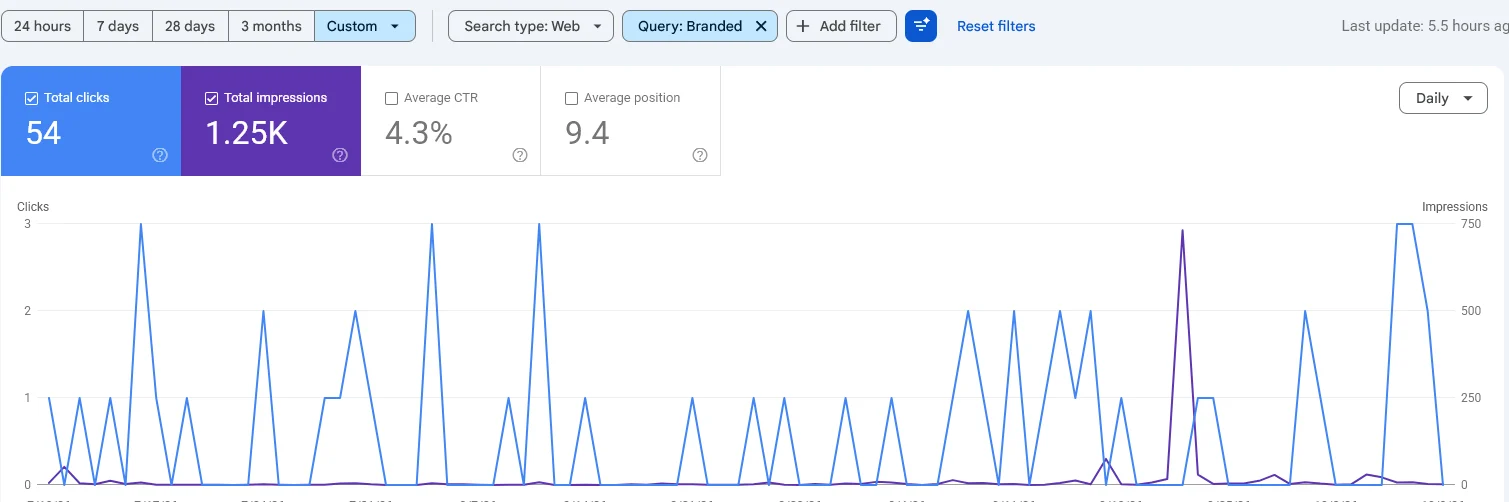 Branded queries for customerimpact.be in our own Search Console, 10 July to 9 October 2026: 54 clicks and 1.25K impressions.
Our own line shows 54 clicks from 1.25K branded impressions in three months.
If that line stays flat for months, the brand layer isn’t landing. More on reading it in our piece on branded search.
What exactly does a lead generation agency do?
A lead generation agency steers on one thing: qualified enquiries your sales team can follow up.
The typical assignments:
- Capture: landing pages, forms and offers that move a visitor to act.
- Channels that convert: such as search, ads and outreach aimed at buying intent.
- Qualification: filtering on your ideal customer, because not every lead is one.
- Follow-up and attribution: what became a conversation, a quote, a deal?
The unit you’re held to
The difference lies in the unit you’re held to. A marketing agency shows you reach and impressions.
A good lead generation agency shows you sales-ready pipeline and lead-to-deal attribution: from whose first click it came to who signed.
We call that qualified pipeline, not lead lists.
Rule of thumb: a list of names isn’t revenue; a conversation with a buyer who fits is.
What “qualified” means in practice
Most CRMs make the stages explicit. HubSpot’s default lifecycle stages run from subscriber to evangelist, seven stages in all.
Look at the difference between the third and fourth stage:
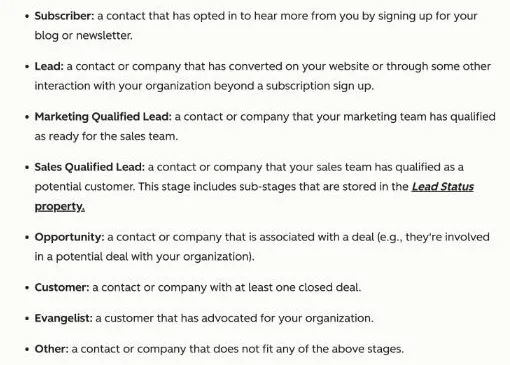 HubSpot’s lifecycle stage definitions, checked 18 October 2026. A good lead generation partner reports how many leads move from stage to stage, not only how many came in.
Marketing qualifies an MQL; only sales turns it into an SQL. That gap is explained in our guide to MQL vs SQL.
So ask any lead generation agency which stage it reports on. If the answer is “leads”, keep asking.
When do you choose what?
Ask yourself one question: do people already know you but never call? Or do they not know you yet?
Choose a marketing agency if:
- You’re new and nobody knows your name.
- Your brand is dated or doesn’t connect with your buyers.
- Trust and positioning make the difference in your market.
- You lack a foundation for campaigns to land on.
Choose a lead generation agency if:
- You already have awareness, but too few concrete enquiries.
- Your sales team has capacity but the pipeline is too thin.
- You advertise or create content without seeing what it returns.
- You want to be held to deals, not to clicks and reach.
A quick decision table
| Your situation | Missing layer | Start with |
|---|---|---|
| Nobody knows your name yet | Awareness | Marketing agency |
| Known, but few enquiries | Capture | Lead generation agency |
| Enquiries, but poor fit | Positioning and qualification | Both, in one plan |
| Spend, but no idea what works | Attribution | Lead generation agency |
For example, say a Belgian IT service company gets plenty of website visits from its trade show presence, but only two forms a month.
That’s not a brand problem. The capture layer is missing.
In practice you’re often somewhere in between. And that’s where the either-or question breaks down.
Why the split is a false choice
The split between brand and leads sounds logical. In the real world, one layer leaks into the other.
Lead generation without a brand dries up
People who don’t know you won’t fill in your form.
Or they come in as cold, hesitant leads that cost your sales team a lot of time.
Your ads get more expensive, because you have to build trust from zero every single time.
A brand without capture produces no revenue
You can have the most beautiful branding and the most followers.
But without a path from attention to enquiry, it stays at applause.
Many companies pay for years for awareness and wonder why the calendar isn’t filling up.
Research points the same way
Les Binet and Peter Field’s B2B work for the B2B Institute lists five principles of B2B growth.
One of them is to balance brand building with activation, the direct response work. Not one or the other.
One engine, not two executors
That’s why we see a lead generation agency not as a standalone executor. It’s the capture layer of one orchestrated growth engine.
Want to set that layer up yourself? Then read how to build a lead generation funnel from scratch with the five layers you need.
The engine works in four moves:
- Brand attracts the right buyers.
- Content builds trust before the first call.
- Capture turns that attention into pipeline.
- Attribution shows what works.
Cut that across two agencies that never talk to each other, and you lose exactly at the seams: the handover from attention to enquiry.
The practical pitfall of two separate agencies
Work with a marketing agency for the brand and a lead generation agency for the enquiries, and a grey zone appears.
The marketing agency points at weak follow-up.
The lead generation agency points at a weak brand and poor landing pages.
Nobody owns the whole path from first click to signed deal.
It costs you twice
That seam costs you money in two ways:
- Overhead: you pay two teams to coordinate, twice.
- The feedback loop: lead insights never correct your brand and content.
Which message, which segment, which objection? That knowledge stays stuck on one side.
A lead generation strategy that stands apart from your brand story stays half-hearted.
What alignment is worth
The same seam exists inside companies, between marketing and sales. Our own deck sums up the research finding:
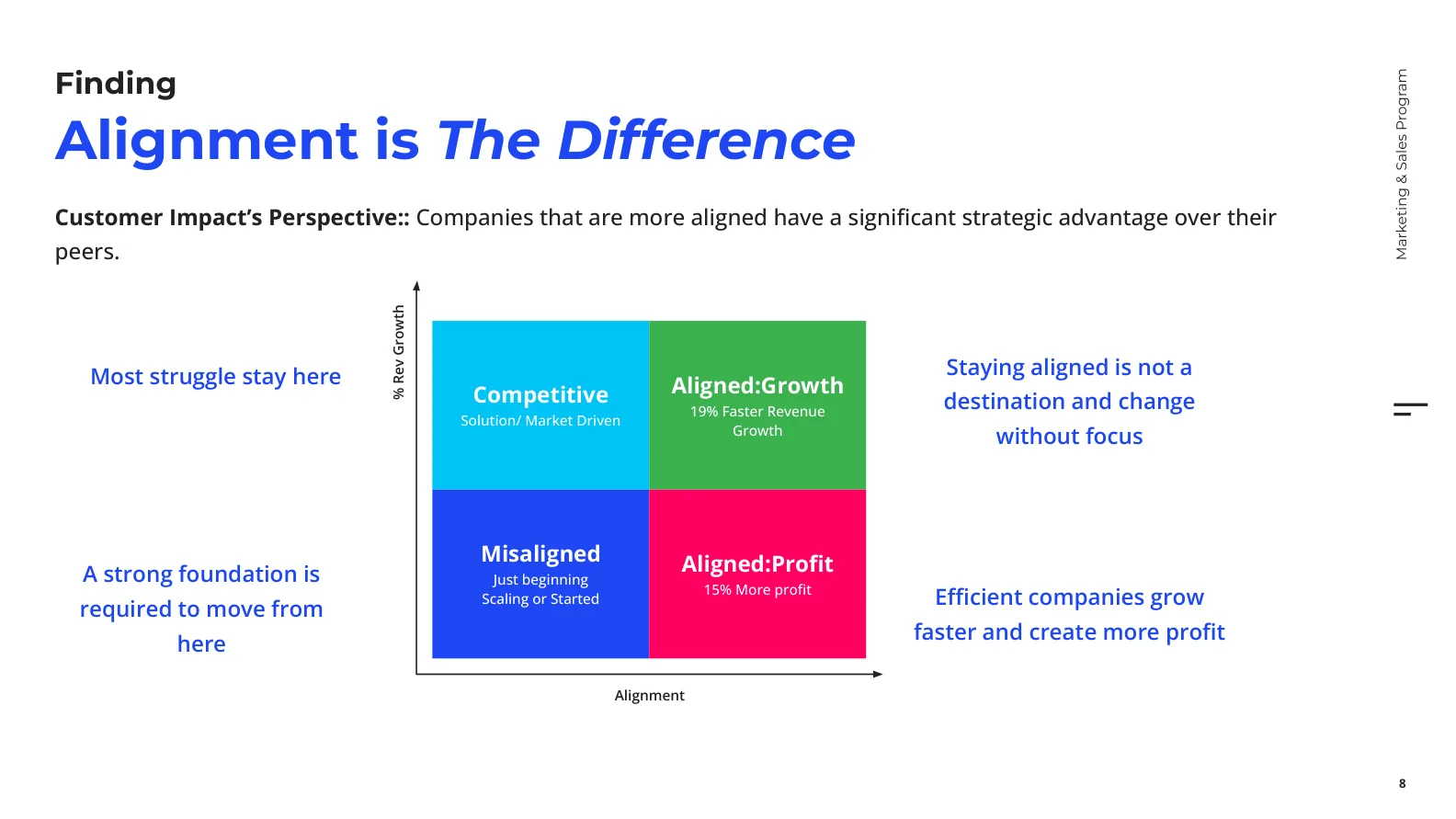 From our own Marketing and Sales Program deck, October 2026: aligned companies show 19% faster revenue growth and 15% more profit.
Two agencies that don’t share data behave like two misaligned departments. Our piece on sales and marketing alignment shows how to close that gap.
The alternative isn’t “pick one”. It’s: put both layers in one engine, with one definition of success.
Not reach next to leads next to revenue, but one line from attention to deal.
How do you recognise a partner that understands both?
Whether you talk to a marketing agency or a lead generation agency, the right partner asks these questions:
- Ideal customer first: do they start with who you want to reach, not with channels?
- Brand to pipeline: can they explain how awareness makes enquiries cheaper and warmer?
- The right target: are they held to qualified pipeline and deals?
- The whole path: do they cover first touch to follow-up and attribution?
Start with the ideal customer
A partner that skips your ideal customer profile will optimise for volume, for instance raw form fills.
Volume is the easiest number to deliver and the least useful.
Our experience: positioning is the most powerful first step to lower acquisition cost. When fewer non-fitting companies enter the funnel, the overhead on your website, process and sales team drops significantly.
Ask how they attribute
Ask which attribution model they use. Ask whether they can show a deal back to its first click.
If they can’t, you’ll be judging them on clicks.
Know what you’ll organise yourself
If a partner only says “we do branding”, or only “we deliver leads”, you’ll organise the other half yourself.
Sometimes that’s perfectly fine. But know what you’re missing.
Comparing types of partner more broadly? Our guide to agency vs freelancer vs in-house covers that choice.
Which one do you need right now?
It comes down to which layer is blocking your growth right now.
Three quick checks:
- Too few people know you? Start with the brand.
- Enough awareness, too few enquiries? Start with the capture layer.
- In doubt? Look at the result you want to be held to.
If that result is sales-ready pipeline and not reach, you know where to go.
Where to read next
For the broader context, first read what lead generation actually is.
Weighing doing it yourself, a freelancer or an agency? Then outsourcing lead generation will help you further.
Selling to a short list of named accounts? Then compare ABM vs lead generation first.
Frequently asked questions
Is a lead generation agency the same as a performance marketing agency?
Not quite. A performance agency often stops at clicks and conversions. A good lead generation agency follows the lead through qualification to the deal.
Can a marketing agency also do lead generation?
Some can. Check whether they report on sales qualified leads and deals, not only on reach and form fills.
Which one should a small B2B company hire first?
The one that fixes your current bottleneck. If nobody knows you, start with brand. If people know you but don’t call, start with capture.
Prefer one engine over two agencies?
We build brand and capture not as separate services, but as one engine we’re held to on pipeline and deals.
No lead lists, but qualified conversations with buyers who fit. That’s how a B2B lead generation agency should work, alongside brand positioning that makes those buyers warmer.
We’re a small team, so we move fast and do more than you expect.
Contact us and within 24 hours you’ll hear where your growth is stuck right now.
Free website scan
Enter your website and get an automatic scan within minutes, with concrete technical and SEO improvements. No sales pitch.
We only use your details for your scan. No spam, unsubscribe anytime.