
Advertising
Google Ads agency Leuven: SEA for tech companies, scale-ups and knowledge businesses

Copy for AI
A Leuven tech company needs a Google Ads agency that steers on deals, not clicks.
The verdict: pick a SEA partner that understands long sales cycles and offline conversions. Whether its office is in Leuven is a second filter, not the first.
Leuven has its own economic DNA.
Around the university, the imec spin-offs and the region’s tech companies, an ecosystem of scale-ups has grown.
KU Leuven alone says more than 200 spin-off companies were established there.
Think of SaaS businesses, knowledge-intensive services and B2B players that don’t sell what you buy in a shop.
If you’re looking for a PPC agency in that world, you hit a problem. Most agencies are built for webshops and local services, not for a complex product with a long sales cycle.
The right partner doesn’t necessarily have to be around the corner. Here’s what to look for instead.
Why does a Leuven tech company have different SEA requirements?
Because your value sits in a deal months later, not in the click today.
A classic agency optimises for the number it can see: clicks, cost per click, ROAS on a purchase that happens right away.
The webshop model doesn’t hold
That model works for an e-commerce store, where someone searches today and buys today.
For a SaaS company or a knowledge-intensive service, it breaks. A search query starts a journey of weeks or months.
That journey usually runs through:
- a first demo request or call
- an evaluation with several decision-makers
- a proposal and negotiation
- a deal that sometimes follows a quarter later
Our guide to Google Ads for a long sales cycle shows how that changes the setup.
Cheap clicks, wrong signal
A Leuven scale-up that steers on clicks is optimising for the wrong signal.
You get plenty of cheap clicks from students, curious colleagues and people who’ll never buy.
And you pay too little attention to the expensive click that brings in your ideal enterprise customer.
An agency that understands your market flips that logic.
It steers on the rare, valuable search query and accepts that it costs more, because the deal behind it is worth many times as much.
For example, say a generic click costs 4 euros and a click on “industrial IoT platform pricing” costs 40.
If 1 in 50 of those expensive clicks becomes a contract worth 100,000 euros, that click is still your cheapest source of revenue.
Small search volumes are normal
Search volumes in your niche are often small.
A niche offer, such as lab software or a specialised B2B service, doesn’t get thousands of searches per month in Belgium.
That isn’t a weakness of the channel. It’s a characteristic of your market.
But it does mean broad campaigns with hundreds of keywords waste your budget on noise.
Rule of thumb: a few sharp campaigns around real buying intent beat a sprawling structure that chases volume that isn’t there.
Does your Google Ads agency have to be based in Leuven?
No. Physical proximity is rarely the decisive factor in SEA.
Searching locally is natural. “Google Ads agency Leuven” feels safer: you can drop by, you share a region, you speak the same language.
The work happens inside the account
Google Ads is a data-driven discipline.
The work happens inside the account, not around a meeting table.
What counts is whether the agency understands your type of business.
Turn the question around
What would you rather have?
- an agency around the corner that mainly serves local plumbers and restaurants
- a partner that works with SaaS companies and scale-ups every day
The second one knows how a long sales cycle behaves inside an ad account.
It understands your buyer, your deal value and your challenge, even if it isn’t based on the Diestsestraat.
In complex B2B, domain knowledge weighs more heavily than a postcode. Our page on Google Ads for SaaS shows what that knowledge looks like.
Local presence is still a plus
That doesn’t make local presence worthless.
A partner that knows the Leuven market understands the ecosystem around the university.
It knows how a spin-off grows and recognises the talent and customers you’re after.
Use proximity as a plus, not as your first filter. The same logic applies when you look for an SEO agency in Leuven or a lead generation agency in Leuven.
Want a broader framework before your first calls?
Read our guide on how to choose a Google Ads agency.
How do you measure a deal? The question that decides everything
Ask any agency one question: how do you know which keywords actually produce deals?
That question, not “how many clicks do you deliver?”, is where the roads part for a Leuven tech company with high deal values.
A form isn’t the finish line
For you, a form submission isn’t an endpoint.
It’s the start of a journey through a demo and an evaluation.
That journey ends in a signed contract, or in a lead that never goes anywhere.
If your ads stop at counting forms, you’re optimising blind.
You don’t know whether the campaign with the most enquiries also brings your best customers.
Often the opposite is true:
- the cheap campaign generates plenty of lightweight leads
- the more expensive campaign lands the one enterprise deal that makes your quarter
For instance, say campaign A brings 30 forms and no deals, while campaign B brings 4 forms and 1 signed contract.
A form count alone tells you to scale A.
Without the link between lead and deal, you steer your budget towards volume instead of value. Here’s that journey in one picture:
Offline conversion closes the loop
The fix is called offline conversion.
Google’s help describes it plainly: an ad sometimes “starts a customer down a path” that ends offline. With offline conversion imports, “you can measure what happens in the offline world after your ad results in a click”.
The mechanism uses the Google Click ID (GCLID), a unique ID for every ad click.
When the deal closes, you send that GCLID back with the conversion.
Google then learns which keywords lead to actual revenue. Our guides on offline conversions in Google Ads and storing the GCLID in your CRM walk through the setup.
Watch out: Google’s same page now recommends enhanced conversions for leads as the newer option.
It also says offline conversion uploads move to the Data Manager API from 15 June 2026. Ask your agency which route it uses, and why.
Primary versus secondary goals
The second check is how the account decides what to optimise on.
Google splits conversion actions into two kinds. Primary actions are “used for bidding”; secondary actions “are for observation only”.
Here’s what that setting looks like in our own account:
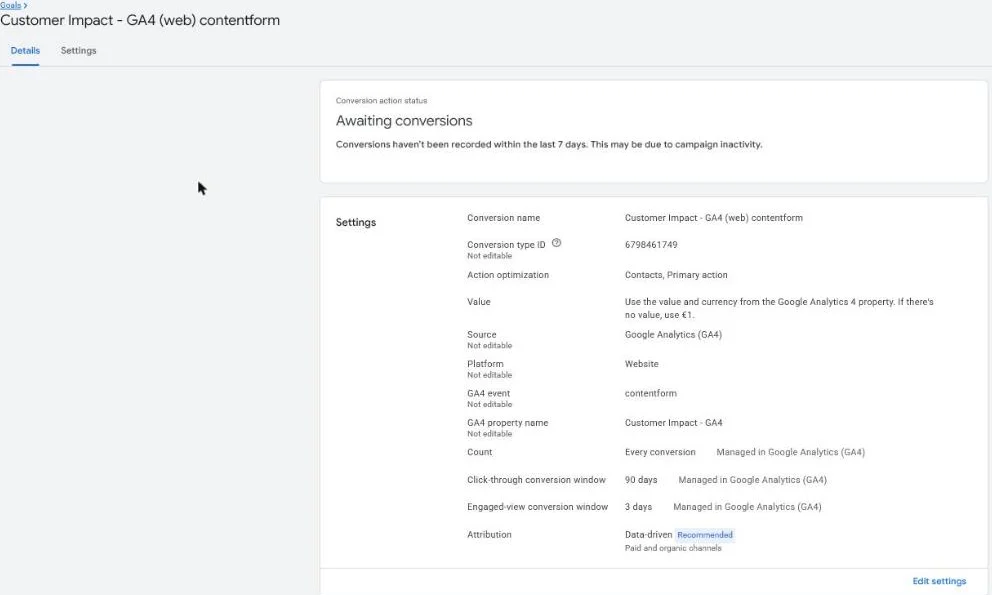 The contact form conversion action in our own Google Ads account, October 2026. It’s set as primary, so campaigns optimise on real enquiries.
Our experience: we usually run one primary goal and one secondary goal. The primary goal is the booking; the secondary goals are the steps that drive toward it.
So the overview should show a short list, not a dozen actions all fighting for the bidding:
 All conversions in our own Google Ads account, 1 to 16 October 2026. One primary action: the contact form.
More on that split in primary vs secondary conversions.
Listen to the answer
With high deal values, this isn’t a luxury.
It’s the only way to judge your budget fairly.
An agency that stays vague about it, or only talks about Google Ads costs and click prices, misses the very instrument you need.
Listen for technology and process, not for a pretty dashboard.
Why is SEA an acquisition layer, not a standalone switch?
Because ads alone don’t fill a pipeline that also converts.
At Customer Impact, we see Google Ads as the fast acquisition layer of a growth engine, not as an isolated service.
Ads buy speed
For a scale-up, that distinction is practical.
Ads bring in qualified traffic as early as tomorrow.
That’s exactly what a growing business needs. You can’t wait months for organic visibility to get going.
The rest of the engine anchors
The other parts do the other work:
- Content answers the questions your buyer asks during a long evaluation.
- Organic visibility captures searches you don’t want to pay for forever.
- Follow-up keeps a lead that comes in today warm two months later.
SEA accelerates; the rest anchors.
If those parts work separately, you pay for leads that sit unopened in an inbox.
If they work as a whole, you see per keyword what it ultimately delivered.
Clicks alone don’t tell you that. Our own manager account shows why:
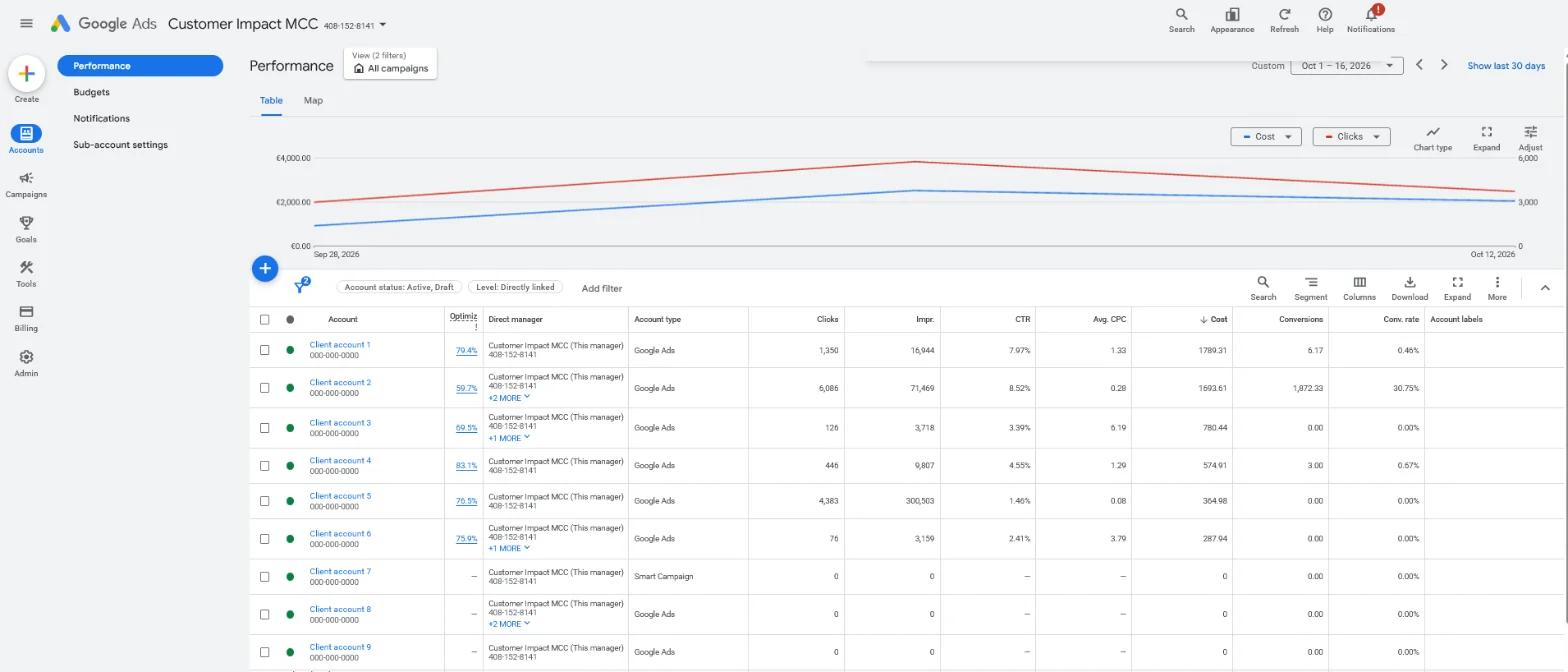 Our own manager account (MCC) in Google Ads, October 2026. Client names and IDs are replaced. Compare the CTR column with the conversions column.
A good CTR with few conversions is a click factory at work.
Know the channel
To understand that acquisition layer, it helps to know exactly what the channel is.
Read our explanation of what SEA is.
It shows how paid search relates to the rest of your growth engine.
The core for a Leuven tech company: use ads to buy speed when a buyer is actively searching.
Then build the structure that turns that speed into growth.
Which four questions should you ask a SEA partner?
Ask these four before you sign anything. They show quickly whether an agency suits your tech company or scale-up:
- How do you connect a submitted form to an actual deal in my CRM, not just to a conversion in Google Ads?
- How do you deal with my long sales cycle, when value only shows weeks later?
- How do you build campaigns for a market with low search volumes and high deal values?
- How does Google Ads fit alongside content and follow-up in my acquisition?
What the answers tell you
Pay particular attention to the first answer.
A partner that starts talking about offline conversions, deal value and your CRM understands where your value sits.
An agency that falls back on clicks, positions and ROAS percentages is treating you like a webshop.
Check ownership too
One more practical check: who owns the account? You should, from day one.
Our piece on Google Ads account ownership explains why, and our list of questions to ask a Google Ads agency goes further.
Our guide to a Google Ads agency for an SME in Belgium shows the partnership in practice.
Conclusion
Finding a Google Ads agency in Leuven isn’t about the distance to your office.
It’s about the distance to your business.
The partner you need understands long sales cycles, low search volumes and high deal values. It steers on pipeline instead of on clicks.
Decision rule: keep asking until you know how an agency connects a click to a customer. Then you’ll know whether it’s a growth partner or a click factory.
Want to know how Google Ads can get your Leuven scale-up to pipeline faster, without a sales pitch about clicks and positions? Get in touch and we’ll look at your numbers together.
Free website scan
Enter your website and get an automatic scan within minutes, with concrete technical and SEO improvements. No sales pitch.
We only use your details for your scan. No spam, unsubscribe anytime.