
Branding
What is a brand audit and why does your B2B company need one?

Copy for AI
A brand audit is a structured review of how your brand performs today.
It measures the gap between what you want to project and what the market actually sees.
The verdict: a brand audit isn’t a logo check. It’s the baseline you need before you change anything, so you keep what works and fix what doesn’t.
The trigger is usually a feeling. Your brand looks dated, your message no longer lands, or you sell something different from when you started.
Many B2B companies then jump straight to a new logo. But first you need to know what you have.
What is a brand audit?
A brand audit is a factual snapshot of your brand: how it looks, how it sounds, what it promises and how it comes across.
You measure it with the people who matter: customers, prospects, employees and sometimes the wider market.
It’s a baseline measurement. Not a judgment of taste.
The gap at the heart of the audit
The audit compares 2 things. On one side is what you want to project: your positioning, values and promise.
On the other is what the market experiences. Think of your website, your quote, or your name in a conversation.
The wider that gap, the more work your brand needs. The audit makes it visible, so you decide on facts, not instinct.
It isn’t a logo check
A brand audit isn’t a visual refresh. The logo is only a small part.
The real question is whether your whole brand tells one story, or falls apart in different places.
Think of it as a health check
A doctor doesn’t look at 1 symptom, but at the whole picture. A brand audit connects isolated signals the same way.
Here are 3 typical signals:
- your emails get fewer replies
- a prospect confuses you with a competitor
- an employee can’t explain your company in 1 sentence
Each seems small. Together, they often point to the same underlying problem.
What do you examine in a brand audit?
6 layers, looked at together rather than as separate pieces.
Here’s what each layer checks:
The lime layer is usually the most sobering one.
1. Positioning and strategy
Do you stand for something distinctive, or do you sound like every other player in your sector?
Here you test whether your brand positioning still matches who you are and the market you’re in.
Positioning is the foundation. If it isn’t sharp, everything else feels vague.
2. Message and brand language
What do you promise, and do you say it the same way everywhere?
Many B2B companies have a strong pitch in a sales conversation, but a weak, generic version on the website.
A brand audit exposes those inconsistencies.
3. Visual identity
Logo, colours, typography, imagery: are they recognisable and consistent? Or does every document drift its own way?
Visual coherence is what makes your brand stick, even when your name isn’t on screen.
Our guide to brand identity covers the building blocks.
4. Customer perception
What do customers and prospects really think about your brand?
You draw this from conversations, reviews, sales feedback and sometimes a short survey.
This is often the most sobering part. The outside world rarely sees you the way you see yourself.
Survey baseline: the Net Promoter Score asks 1 question on a 0 to 10 scale: “How likely are you to recommend us to a friend or colleague?”
Promoters score 9 or 10, detractors 0 to 6. NPS is the share of promoters minus the share of detractors.
Say 50% of respondents are promoters and 20% are detractors. Your NPS is then 30.
Repeat it after the changes and you have your second measuring point.
Search demand: a second signal is how many people look for you by name. Filter Search Console on branded queries:
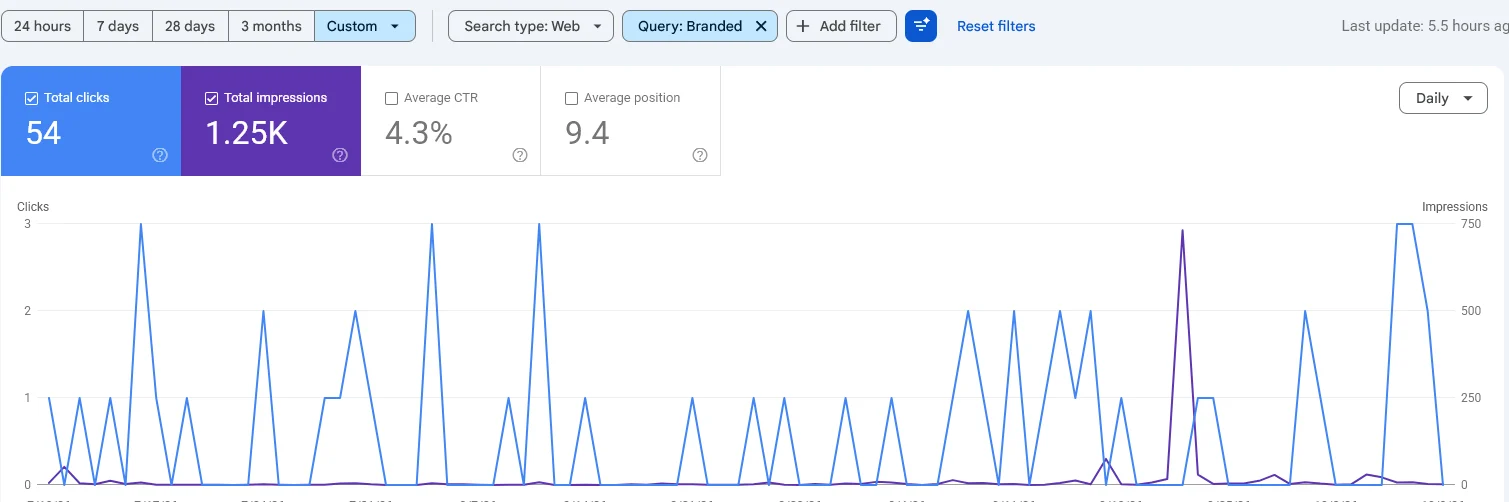 Our own branded queries in Search Console, 10 July to 9 October 2026: 1.25K impressions and 54 clicks.
That line becomes your baseline. If brand work pays off, branded searches should grow.
AI answers: also ask the AI assistants what they say about you.
Forrester’s 2026 State of Business Buying found that 94% of business buyers use AI during their buying process. So that answer is part of your perception now.
Ask a plain question, for example “What is [your company] known for?”:
If the answer doesn’t match your positioning, that’s a gap. Our guide to brand visibility in AI shows how to close it.
5. Internal experience
Do your own people tell the same story?
If sales, marketing and management each answer “what do we stand for” differently, your brand can’t come across as consistent.
6. Competition and context
How do you position yourself relative to others in your market? A brand never exists on its own.
Only next to the alternatives does it become clear whether you truly stand out.
Why does your B2B company need a brand audit?
Because in B2B, your brand carries trust before the first conversation, and most buyers aren’t even in market yet.
Buyers weigh risk, and they’re many
In B2B, the buying decision is rarely impulsive. Buyers weigh risk, compare suppliers and pick the party they trust most.
And it’s never 1 person. Forrester counts on average 13 internal and nine external stakeholders influencing a purchase.
Most buyers aren’t buying yet
Ehrenberg-Bass professor John Dawes estimates only about 5% of target buyers are in market at any time.
Here’s what that split looks like:
So your brand has to be remembered long before the purchase.
A weak or inconsistent brand creates doubt at the very moment you can least afford it.
When is a brand audit most valuable?
At 6 pivotal moments:
- Before a growth phase: your brand still projects the small player you were 5 years ago. Measure first, then grow.
- Before a rebranding: you know something must change, but not what. An audit stops you throwing away strong elements.
- In a new market: what works at home may not land elsewhere. The audit shows what transfers.
- After a merger or acquisition: bringing 2 brands together needs insight into what each is worth.
- When your leads stall: if the pipeline dries up while your offer is strong, perception is often the problem.
- Before a big marketing investment: check that your brand can convert the traffic. A strong brand makes every marketing euro work harder.
Ready to change things after the audit? Our step-by-step guide to a rebranding takes it from there.
The common thread
A brand audit makes you build change on facts rather than gut feeling.
That saves money: you only change what needs attention, and you keep the brand value you’ve already built.
What do you do after a brand audit?
You turn the findings into a strategy, and you measure again later.
Feed the findings into your strategy
The audit is the starting point, not the result. It shows what’s strong, what’s wobbling and where the biggest lever is.
Those insights feed into your brand strategy: the direction you steer your brand in over the coming years.
Without an audit, a strategy is too often a gamble. With one, it’s a well-founded choice.
Use it as a measuring point
An audit also gives you a baseline. Measure again later, and you see whether your brand investments pay off.
That way branding isn’t a cost centre run on feeling. You track it like any other growth investment.
Read how to measure the ROI of branding to make that result tangible.
Is a brand audit worth it?
Yes: it’s the most underrated first step in branding.
It costs little compared to what it prevents: expensive change in the wrong direction.
We approach brand from that goal: not pretty for the sake of pretty, but strong because it delivers leads, revenue and trust.
Our branding agency takes you from baseline measurement to a working brand.
Want to know where your brand stands today? Get in touch with us and we’ll start by mapping the gap between your intent and the market’s view.
Free website scan
Enter your website and get an automatic scan within minutes, with concrete technical and SEO improvements. No sales pitch.
We only use your details for your scan. No spam, unsubscribe anytime.