
Branding
Rebranding process: from trigger to launch in 8 phases

Copy for AI
A good rebranding process runs in 8 phases, from trigger to embedding.
A rebrand rarely fails because of a bad idea. It fails through a lack of structure: nobody knows who decides, and the timeline slips.
The verdict: treat your rebrand as a project plan, not a creative adventure. First the why, then strategy, language and visuals, and only then the rollout.
Halfway through, teams often still argue about a logo while the strategy was never settled. This roadmap gives you the goal, the duration and the owner of each of the rebranding steps.
Where the rebranding strategy covers when a rebrand pays off and how to limit the risk, this process focuses on execution: the order, the handover moments and who’s up.
Not sure a rebrand is needed at all? Check when to rebrand first.
What does the rebranding process look like at a glance?
It’s about 18 weeks of work, followed by an aftercare period that never really stops.
Here’s the full plan on one timeline:
The weeks are a planning frame, not a promise. A name change or a large carrier inventory stretches them.
Rule of thumb: every phase ends with a decision by the owner, and the next phase doesn’t start without it.
For realistic planning per company size, see the rebranding timeline. For the money side, read what a rebrand costs.
Phase 1: trigger and mandate (weeks 1 to 2)
Every rebrand starts with a trigger: a merger, a new market, a dated name, or a brand that no longer matches what you sell.
The first mistake is already made if you jump straight to design.
Name the why first
Start with the question of why the change is needed now. Then write down what it should concretely deliver.
For example, say you’ve merged two firms. The goal isn’t “a new logo” but “one brand that buyers in both markets recognise”.
Set the mandate
Who is the final decision maker? In most B2B companies that’s the owner or the board, not the marketing manager.
Agree on three roles:
- Leads: the project lead who runs the process
- Co-decides: a small group, ideally three people or fewer
- Informed: everyone else, kept up to date
That sounds formal. But it prevents the endless round of opinions later in the process.
Responsible: the board (mandate), the project lead (process).
Phase 2: research and baseline (weeks 2 to 4)
Before you change anything, record what you have today.
How is your brand seen right now by customers, prospects and employees? What works and deserves to stay?
Why a baseline matters
A rebrand without a baseline is guesswork. Afterwards you’ll never know whether perception actually shifted.
Gather input through three channels:
- customer conversations, a handful is enough
- one internal session with sales and service
- a look at your main competitors
Not to produce a thick report, but to extract the sharp insights that will steer your positioning. A structured brand audit gives you a ready-made frame.
Make the carrier inventory
Also record the practical inventory: every place your current brand lives.
That runs from your website to your email signature and your invoices. You’ll need that list in phase 7.
Watch out: include the URLs of your most-linked pages. Those links carry search value you’ll want to redirect later.
Responsible: the project lead, with input from sales and customer service.
Phase 3: strategy and positioning (weeks 4 to 7)
This is the foundation. Here you determine who you want to be for whom, and why a customer chooses you.
Only once the positioning is set may you touch the visible layer. Skip this phase and you get a beautiful logo on a shaky base.
Strategy before the designer
Work out your brand strategy before you bring in a designer. Brand strategy as the foundation of your rebrand defines your promise, your values and your differentiator.
That document is the touchstone for every creative choice that follows.
A design that doesn’t reinforce the strategy isn’t an option, however good it looks.
Write it down in one statement
Capture the result in a short positioning statement: for whom, what problem, why you.
If the board can’t agree on that one sentence, it won’t agree on a logo either.
Responsible: the board and the project lead decide, a strategic partner or branding agency facilitates.
Phase 4: verbal identity (weeks 7 to 9)
Language comes before visuals. Does this call for a new name, a new baseline or a sharpened tone of voice?
Handle a name change early
Name changes are the heaviest intervention, with legal and SEO consequences. So handle them separately and early.
Reversing a name later costs a fortune.
Before you fall in love with a name, run a brand name availability check on trademarks, domains and social handles.
Lock in the core message
In this phase you lock in the core message: the few sentences that explain who you are and why you’re relevant.
That message will steer your website, your sales team and your launch communication.
Then test it on a few customers.
Responsible: the project lead and copy, with a legal check in case of a name change.
Phase 5: visual identity (weeks 9 to 13)
Only now comes the work everyone thinks of immediately: logo, colours, typography and imagery.
Because the strategy and the message are already settled, this phase becomes execution rather than debate.
One direction, not five
The designer translates an agreed direction instead of filling a blank canvas.
Don’t ask for five completely different directions. That invites taste debates.
Ask for one considered direction that breathes the strategy, with variants within that direction.
Deliver a usable brand book
At the end, deliver a workable brand book: the rules that keep your brand consistent everywhere, even when you’re not in the room.
It should cover at least:
- logo use and clear space
- colour codes for screen and print
- type hierarchy and imagery style
- tone of voice with do’s and don’ts
Responsible: the designer delivers, the project lead and the board approve.
Phase 6: internal launch (weeks 13 to 15)
Your own team is your first audience, not the market.
If employees don’t grasp the new direction or don’t carry it, every external communication falls flat. Yet this is the phase most often skipped under time pressure.
Take the team through the why
Take your team through the why before you take anything outside. Explain what changes, what stays the same and what it asks of them.
Give sales the new message and the answers to the questions customers will ask.
For example, prepare a one-page sheet with the five questions sales will hear most in the first month.
A rebrand that doesn’t live internally feels hollow externally. More on that in internal branding.
Responsible: the board communicates, the project lead supplies the materials.
Phase 7: external rollout (weeks 15 to 18)
This is where the new identity becomes visible to the market.
Use the inventory from phase 2: website, social channels, email signatures, presentations, invoices, print and physical carriers.
Avoid the half rollout
A half rollout, where your website looks new but your quotes are still old, undermines the very trust you want to strengthen.
Choose deliberately between two options:
- Hard switch: everything changes at a single moment
- Phased transition: carriers change in waves
A hard switch sends a clear signal. It avoids a long interim period in which two identities live side by side.
Overcommunicate towards existing customers: they need to recognise you, even though everything looks different. Our brand rollout after rebranding checklist goes carrier by carrier.
Protect your search value with redirects
Set up redirects so your existing search value isn’t washed away.
Other sites keep linking to your old URLs. Here’s what that means for our own site:
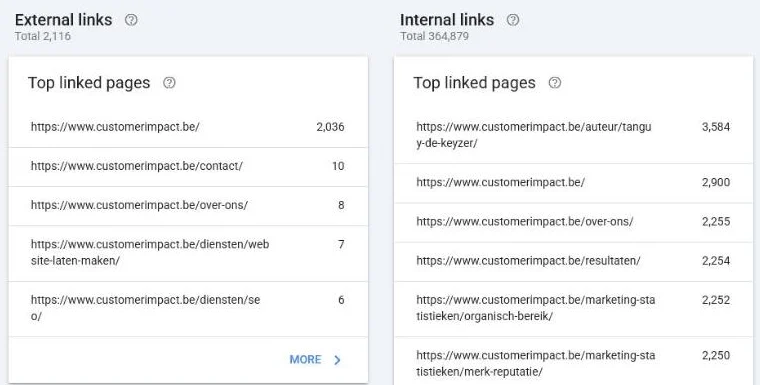 The Links report in our own Search Console for customerimpact.be, October 2026. Every one of those external links points at a URL a rebrand could break.
Google recommends permanent 301 or 308 redirects, kept for at least a year, and warns that even a small site can take a few weeks to move.
Permanent matters: Google uses a permanent redirect as a signal that the redirect target should be canonical. A temporary one keeps the old URL in results.
Map old to new URLs before launch with a 301 redirect plan.
Moving to a new domain too?
Moving to a new domain as well? Also run the Change of Address tool in Search Console, whose effects last 180 days.
You’ll find it in the settings of the old property:
The full playbook sits in website migration without losing rankings.
Responsible: the project lead coordinates, marketing and IT execute.
Phase 8: embed and measure (from week 18)
The launch is the beginning, not the end. A new identity fades if nobody guards it.
Plan an aftercare period in which you check consistency, handle questions and replace the last old carriers.
Steer on outcomes, not on fresh looks
Steer on concrete goals, not on the feeling that everything looks fresh.
Tie the rebrand to measurable outcomes:
- brand awareness, for example branded searches
- qualified leads from your target accounts
- revenue from new relationships
That way you’ll know in a few months whether the change shifted perception and growth, or only your house style.
Use branded search as an early signal
Branded searches are a free proxy for awareness. Filter them in Search Console and compare against your baseline from phase 2.
This is what that filter looks like for our own brand:
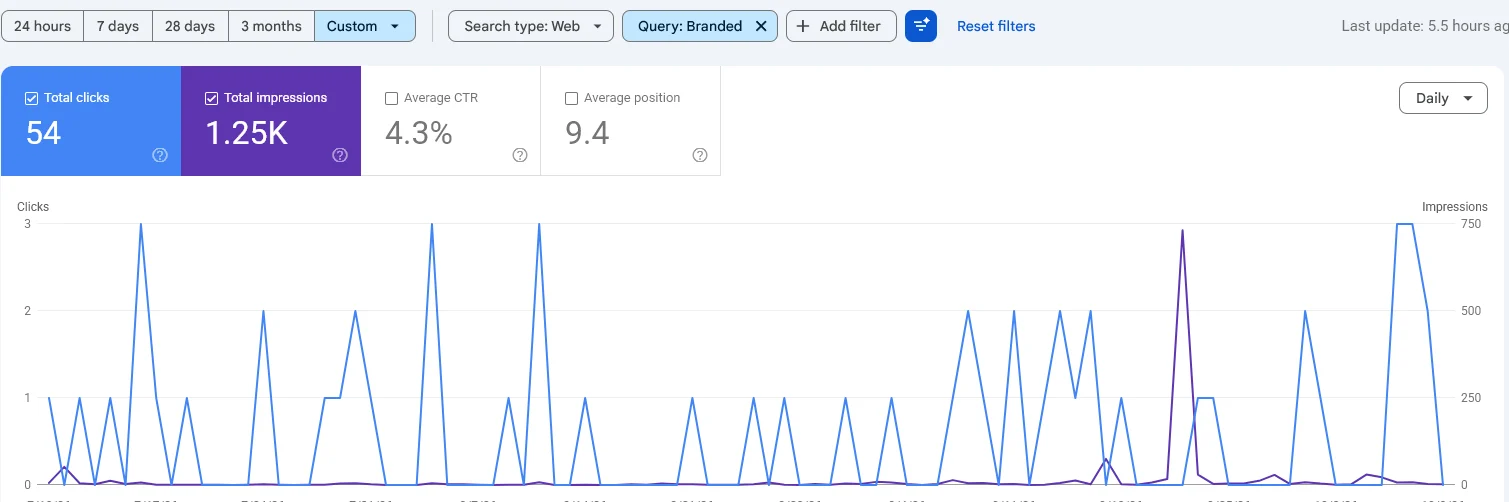 Our own branded queries in Search Console, 10 July to 9 October 2026: 1.25K impressions and 54 clicks.
After a name change, watch searches for the old and the new name side by side. The old name should fade. The new one should grow.
Responsible: the project lead guards, the board follows the results.
Who owns what in the rebranding steps?
One table, so nobody can claim they didn’t know:
| Phase | Decides | Delivers |
|---|---|---|
| 1 Trigger and mandate | Board | Project lead |
| 2 Research and baseline | Project lead | Sales, customer service |
| 3 Strategy and positioning | Board, project lead | Strategic partner |
| 4 Verbal identity | Project lead | Copy, legal check |
| 5 Visual identity | Board, project lead | Designer |
| 6 Internal launch | Board | Project lead |
| 7 External rollout | Project lead | Marketing, IT |
| 8 Embed and measure | Board | Project lead |
Put it in the kickoff deck.
Frequently asked questions
How long does a rebranding process take?
About 18 weeks of project work in this plan, from mandate to the end of the rollout. Aftercare continues after that. A name change or a domain move makes it longer.
What is the first step of a rebrand?
Naming the trigger and setting the mandate: why now, what it should deliver and who decides. Design comes much later.
Can you skip the internal launch?
You can, but it’s the most common reason a rebrand feels hollow. Your team has to carry the new message before customers hear it.
Will a rebrand hurt my SEO?
Not if you plan redirects. Use permanent 301 or 308 redirects from every old URL to its new one, and the Change of Address tool when the domain changes.
Turn your rebrand into a steered project
A successful rebrand isn’t a matter of luck or good taste. It follows a logic: why, strategy, language, visuals, and only then the rollout.
Respect that order and record per phase who decides and who delivers. Then you hold on to the value you already built.
Want your rebrand guided from start to finish, by a team that steers on leads and revenue instead of a fresh logo? Get in touch and we’ll map which phases you can handle yourself and where you need help.
Free website scan
Enter your website and get an automatic scan within minutes, with concrete technical and SEO improvements. No sales pitch.
We only use your details for your scan. No spam, unsubscribe anytime.