
SEO
How to run an AI visibility audit

Copy for AI
An AI visibility audit checks whether AI search engines can read, trust and cite you.
You can rank nicely in Google and still lose deals to players you barely know. More and more buyers start in ChatGPT or Perplexity, and that’s where the shortlist gets made.
The verdict: an AI visibility audit is a format of its own, not an extra tab in your SEO report. It answers one question: does AI see you?
It examines four layers separately: crawlability, entities, citations and schema.
Want the broader foundation first? Read what SEO exactly is and how it works.
Why do you need a separate AI visibility audit?
Because AI search engines do something different with your content than Google’s classic results do.
A classic SEO audit measures whether Google can find, index and rank your pages. That stays the basis.
An AI search engine reads, summarizes and combines sources. Then it writes an answer that names one or two brands.
Different signals, different metrics
You don’t need to be number one in the blue links for that. But your content does have to be:
- readable for machines
- understandable as a brand
- credible enough to cite
- easy to interpret technically
So the audit swaps positions and clicks for four checks, one per layer:
Work through them in this order, because each layer depends on the one before.
Layer 1: can AI bots reach your content?
Start here, because a blocked bot makes every other layer irrelevant.
Many teams only discover during an audit that they block AI crawlers by accident.
So open your robots.txt and check which user agents you allow or refuse.
Here’s the file to look at, on our own site:
 Our own robots.txt, October 2026: one rule for all crawlers, so every AI bot, training and search, may read the site. Add a separate user-agent line only for a bot you deliberately want to block.
Training bots and search bots are separate
The catch: they’re different user agents, and blocking one doesn’t block the other.
- OpenAI: GPTBot collects training data, OAI-SearchBot decides whether you show up in ChatGPT search. Blocking GPTBot alone doesn’t remove you from ChatGPT search.
- Anthropic: ClaudeBot is for model training, Claude-SearchBot for search quality and Claude-User for live user questions.
- Perplexity: PerplexityBot indexes for Perplexity’s search results, Perplexity-User fetches pages when someone asks a question.
- Google: Google-Extended isn’t a crawler at all. It’s a robots.txt token that controls Gemini training and grounding, and Google states it doesn’t affect inclusion or ranking in Google Search. AI Overviews and AI Mode follow your normal Googlebot rules.
So check each search bot separately. A block there means you can’t be cited in that platform’s answers.
Rendering, speed and orphans
Next, check whether your most important pages render server-side.
Content that only appears after heavy JavaScript is invisible or incomplete for many retrieval systems.
Also look at:
- loading speed
- redirect chains
- orphan pages without internal links
A handy cross-check sits in your crawl statistics in Search Console. If even Google struggles to fetch everything there, AI bots have it harder still.
Output: a list of pages that machines can’t reach or can’t read.
Layer 2: does AI understand who you are?
Not reliably, unless your brand is described the same way everywhere.
Being crawlable isn’t enough. A model also has to grasp what you do and why it should trust you.
Your brand is an entity
That revolves around entities: your brand, your people, your services and the topics you claim authority on.
Models build a knowledge picture from every source where you appear, not only from your own site.
Check three things:
- Do you describe your company the same way everywhere?
- Is it clear which problems you solve, for which audience?
- Do you have real depth around your core themes?
Also look at external signals, such as mentions, profiles and references in places models often consult.
The gap you’ll usually find
A strong entity comes from coherence between your site, your website architecture and how others talk about you.
The gap is almost always the same. The brand is active, but nowhere sharply defined.
So a model guesses, or simply skips you.
Layer 3: are you already cited in AI answers?
This layer tells you, and it’s your real baseline measurement.
Put together a set of realistic questions your ideal customer would ask. For each one, record which brands the AI names and which sources it cites.
Measure per platform
Do it per platform, because ChatGPT, Google AI and Perplexity behave differently. They draw on different sources.
The difference shows up in a single test. When we ran the same GEO prompt on 17 October 2026, the free ChatGPT answer listed no sources, while Perplexity showed 10 sources in a panel:
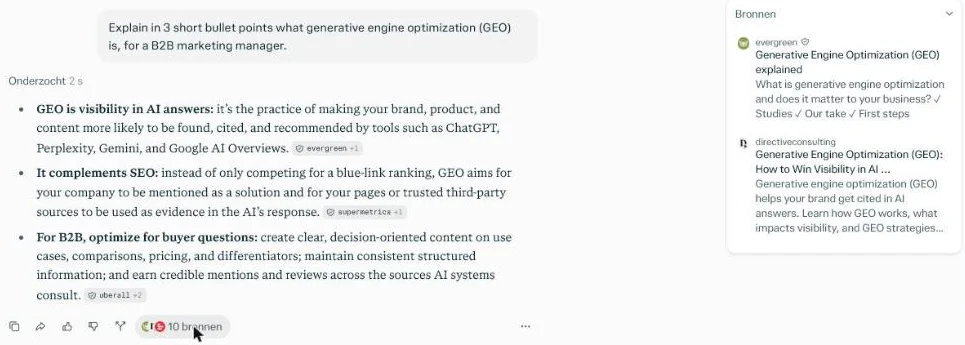 Perplexity’s sources panel for our own test prompt, 17 October 2026: 10 web pages behind one answer. These are the pages you’d want to be among.
So a brand can be visible in one assistant and absent in the next.
What to record per question
Note three things for each question:
- Presence: does your brand appear?
- Position: where in the answer?
- Type: cited directly, or only carried along as a source?
Look just as closely at the competitors who are mentioned.
Which of their pages get cited, and what do they have that you lack?
That shows whether the problem is missing content, a lack of authority, or a format that’s hard to cite.
For a deeper, structured version of this measurement, turn to the complete GEO audit, which develops the citation work further.
Use the tools you already have
You don’t have to start from zero. Two free or existing reports already count citations of your site.
Bing Webmaster Tools has an AI Performance report. It counts how often Copilot and Bing’s AI answers cite your pages.
Ours shows 60.3K citations over three months, with on average 140 cited pages:
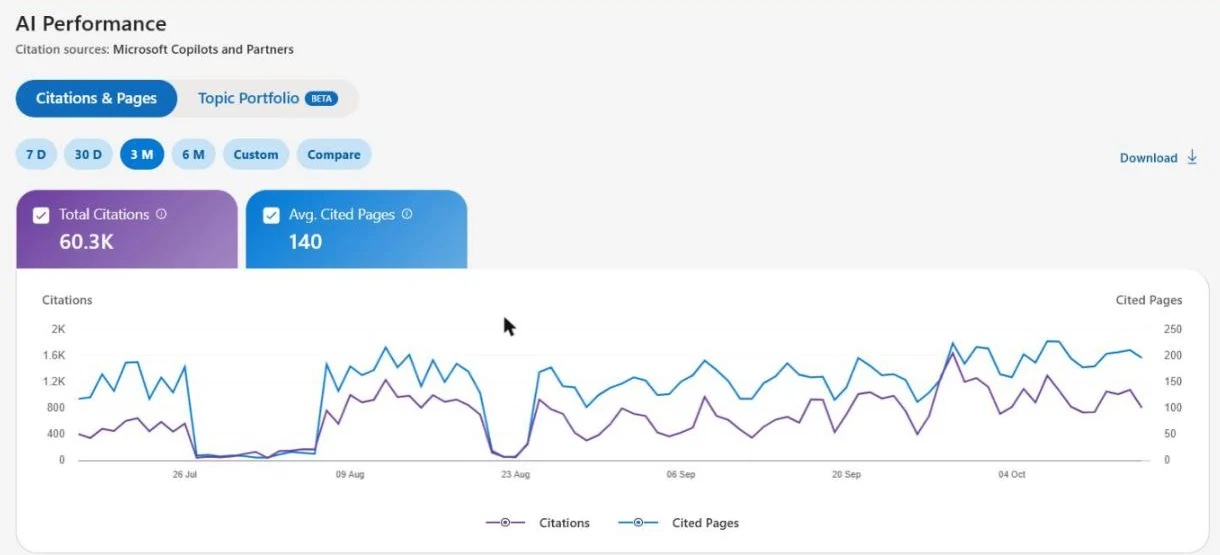 Our own Bing AI Performance report, October 2026: 60.3K citations and on average 140 cited pages over three months.
Ahrefs’ Site Explorer now counts AI responses next to backlinks. For our domain it found 463:
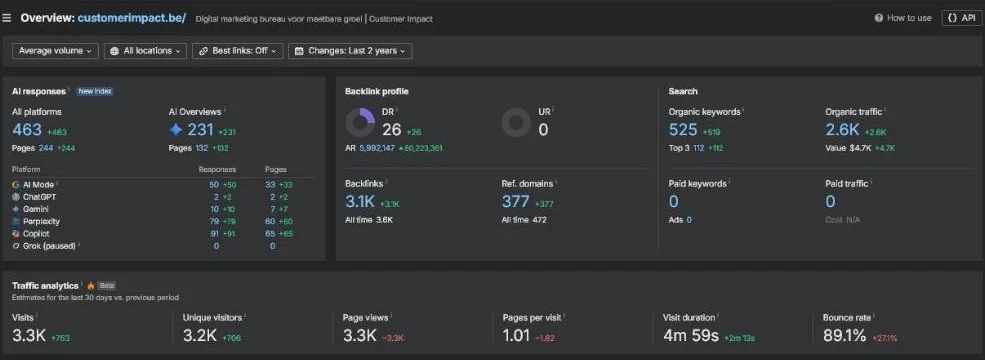 Ahrefs Site Explorer for our own domain, October 2026. The AI responses block sits next to backlinks and organic search.
Then check whether those citations bring visits. In GA4, filter traffic acquisition on chatgpt.com:
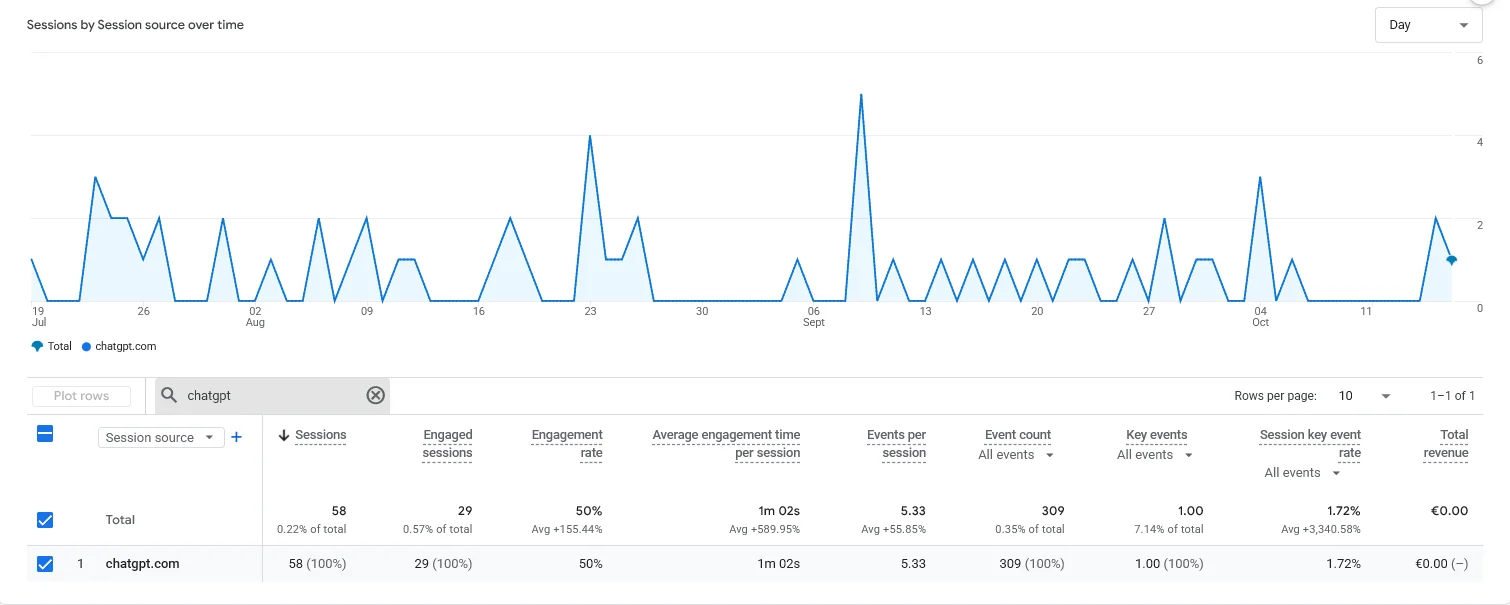 Our own GA4, October 2026: chatgpt.com brought 0.22% of sessions in 90 days, yet 7.14% of all key events.
That’s 58 sessions in 90 days. Small volume, high intent.
That’s why this layer belongs in the baseline.
Output: a selection rate and a citation share per platform, instead of a feeling.
Layer 4: do you give AI machine-readable context?
Partly, if your schema matches your visible text.
Structured data via schema.org tells machines what something is. For example, an organization, a product, an article, an author or a frequently asked question.
That reduces guesswork.
It raises the chance your content gets summarized and attributed correctly.
Schema helps, but isn’t an entry ticket
Keep expectations straight. Google says there’s no special schema needed to appear in AI Overviews or AI Mode.
It only asks that your structured data matches the visible text on the page.
Run your key pages through a validator to see what machines actually read:
 The Schema Markup Validator on our own English homepage, October 2026. Check that each detected type matches what the page visibly says.
The basics to check
Make sure these are in order:
- organization and website markup
- author data
- FAQ or product markup, where relevant
Check that your titles and summaries are unambiguous. A good title and meta helps every model that summarizes your page in one sentence.
Then the page itself: clear headings, short citable paragraphs, and facts that hold up out of context.
Output: usually technical gaps that close quickly. That makes this layer an ideal place to start.
How do you turn the audit into an action list?
Prioritize by impact and effort, and tie every gap to a commercial goal.
The pitfall is wanting to solve everything at once.
Quick fixes first, slow builds in parallel
A blocked crawler or missing basic schema is fixed in days. A strong entity and citable content take months.
| Gap | Effort | Typical layer |
|---|---|---|
| Blocked AI search bot | Quick | Crawlability |
| Missing basic schema | Quick | Schema |
| Vague brand description | Medium | Entities |
| No citable content on buyer questions | Slow | Citations |
Weigh each gap by purchase intent
A mention on a question without purchase intent weighs less than visibility on the questions your best leads ask.
That’s the difference between chasing visibility and building pipeline.
At Customer Impact we treat SEO and AI visibility as one acquisition layer of the same growth engine. We make sure you’re found and cited, always toward revenue.
Want an seo consultant to run this audit and tie it to your growth goals? We’re happy to help.
Where do you start?
With a baseline measurement: an honest snapshot of the four layers today.
It doesn’t have to be a months-long project. Translate the snapshot into a short action list, and you can prove progress later.
Want us to run the audit with you and tie it to your pipeline? Get in touch and we’ll make your AI visibility measurable.
Free website scan
Enter your website and get an automatic scan within minutes, with concrete technical and SEO improvements. No sales pitch.
We only use your details for your scan. No spam, unsubscribe anytime.