
Branding
How to Name a SaaS Product: Approach and Pitfalls

Copy for AI
To name a SaaS product, fix your positioning first, then test domain, trademark and sound.
The verdict: naming a product for software is a filter job, not a brainstorm. The name that survives all three checks beats the one that sounds best.
That’s because a SaaS name carries more than a good feeling.
It’s your brand, your web address and your product label at once.
And software sells across borders from day one, so the name has to hold up in every market you’ll reach.
Below, you’ll see how to name a SaaS product step by step, plus the pitfalls that sink software brands early.
Start here: naming ties into the wider work of what brand strategy is. Your name isn’t a standalone creative stunt: it’s the most visible expression of a positioning you need to get sharp first.
Why does a SaaS name weigh more heavily?
Because software has no local distance to hide behind.
No borders, so no room for overlap
A local service provider can share its name with a company in another city. Nobody minds.
Software doesn’t get that luxury.
Your product is findable everywhere at once. So your name competes with every SaaS brand that claims the same term.
For example, a name that feels free in Belgium may already be an established US tool with a strong trademark.
One name, many places
In software, your name lives in many places at the same time:
- your domain and your login link
- your email addresses
- your app store listing
- integrations with other tools
- perhaps an API subdomain later
Every place has its own demands. Some are strict.
Watch out: an odd spelling works poorly when people have to type it to log in. A name you have to spell out over the phone costs you conversion at every demo request.
App stores add hard rules. Apple says “App names must be limited to 30 characters” (App Store Review Guidelines, section 2.3.7).
The same section warns against packing a name with trademarked terms or popular app names just to game the system.
What this changes
A SaaS name must sound good, but it also has to work without friction, technically and legally, on the web.
That shifts the order in which you decide.
How to name a SaaS product: start with positioning, not the sound
Decide who you are and for whom before anyone pitches a name.
The temptation to brainstorm fun names right away is strong.
But without a frame, you judge names on taste. And taste isn’t something a team can agree on.
Let positioning set the tone
A usable name starts with the question of who you serve and why they’d pick you.
For example, a tool for finance teams may radiate authority and calm. A tool for creative makers can afford to be more playful.
Our experience: positioning is everything. Being very clear about who you’re built for and what value you bring is the most powerful first step to lower acquisition cost.
Our guide to B2B SaaS brand positioning shows how to get that frame on paper.
Then generate options
Pin down what your brand wants to stand for before you generate names.
If that foundation is missing, that’s the real work that has to come first.
A good branding agency helps you get that positioning sharp. The name then becomes a derivative rather than a gamble.
Doing it yourself? Put options on the table. Work systematically with the eight methods to come up with a company name. They apply just as well to a product name.
Which three checks count more for software?
Domain, trademark and international pronunciation, in that order.
Cut candidates early, because each check is cheaper than the step you’d otherwise take next. Here’s the filter in one picture:
1. The domain, and above all the .com
For software, the .com is still the standard. It inspires trust and sticks.
An alternative extension is possible, but you pay a price for it:
- people automatically type .com
- you lose traffic to its owner
- you compete with a brand that holds your name on the strongest extension
So check early whether the .com is free or affordable.
If it isn’t, that’s a serious argument to drop the name. However good it feels.
Readability check: merged words can turn out unfortunate once you stick them together in a URL. Read every candidate aloud as a web address and make sure no second, unwanted reading creeps in.
A registration lookup tells you in seconds whether the .com is taken:
Our guide to choosing a domain name for your business covers extensions and typo risks in more depth.
2. Trademark and international reach
A free domain isn’t permission to use the name.
What protects you legally is a trademark registration.
For SaaS, you think about that by markets, not by country.
Watch out: a name that’s free at the Benelux trademark office may already be claimed in the EU or the US in the same software class.
The scope differs a lot. The EUIPO explains that a national trade mark protects you only in the country where it’s registered.
An EU trade mark, on the other hand, covers all current and future EU member states.
Similar counts too: not just identical names. The USPTO says marks can clash when they’re “similar in sound, appearance, or meaning” and the goods or services are related (USPTO on likelihood of confusion).
So a near-miss spelling isn’t a safe workaround.
Test wide: because your product is findable worldwide from day one, you test more broadly than where you’re active now. A public register search is the first pass:
This step deserves its own thorough approach.
The step-by-step plan to check your brand name for availability shows how to test a name on the domain, the trade register and the trademark register.
For software, this isn’t an afterthought formality. It’s a filter you apply early.
3. International pronunciation and meaning
Your name travels into every language your customers work in.
So test whether it has an unfortunate meaning or an unpronounceable sound in your most important markets. A name that’s neutral in Dutch can call up something unwanted in French, German or English.
Tip: put a shortlist in front of native speakers from your target markets. It’s a cheap check that saves you from an expensive repositioning.
Ask each of them three questions:
- How would you say this name aloud?
- Does it mean or suggest anything in your language?
- Could you spell it after hearing it once?
The three checks side by side
Use this table to decide quickly when a candidate goes:
| Check | What you test | Drop the name if |
|---|---|---|
| Domain | .com free or affordable, clean URL reading | the .com is taken and not for sale at a sane price |
| Trademark | your markets and the software class | an identical or confusingly similar mark exists |
| Pronunciation | sound and meaning in key languages | native speakers stumble or flag a bad meaning |
Rule of thumb: one clear fail is enough. Don’t argue a name back onto the list.
Which pitfalls sink SaaS brands early?
Four mistakes come back time and again with software names.
1. Choosing too descriptively
A name that states the literal function of your tool feels logical.
But it becomes a cage the moment your roadmap grows.
For example, say you name the product after the one module you have now. The name pinches as soon as you add a second module or move into an adjacent market.
Rule of thumb: pick a name that leaves room for what you’ll be in three years.
Our piece on brand architecture explains how product names and the company brand relate once you run several modules.
2. A creative spelling that adds friction
It looks pretty on paper but creates friction in practice. Three common forms:
- missing vowels
- doubled letters
- a pun you have to explain
Each one costs you a little conversion. It happens every time someone has to type, remember or pass on the name.
3. Listening only to the founders
A name that’s funny or meaningful internally doesn’t have to say anything outside.
So test with real users, not just your team. Our guide on how to validate brand positioning uses the same kind of buyer test.
4. Decoupling the name from your brand
A strong name alone doesn’t stick. It needs a consistent look around it.
The name is the start, not the endpoint, of how you become recognizable. From there, brand identity and brand consistency take over.
How do you see whether the name sticks?
Watch how often people search for it.
People don’t google a name they can’t remember or spell. That’s why branded search is the most direct sign that a product name is landing.
Use the branded queries filter
Search Console can now split branded from non-branded queries for you. Google says the filter uses an AI-assisted system that also recognizes brand name variations and typos (Search Console branded queries filter).
You’ll find it under Performance, then Add filter, then Query:
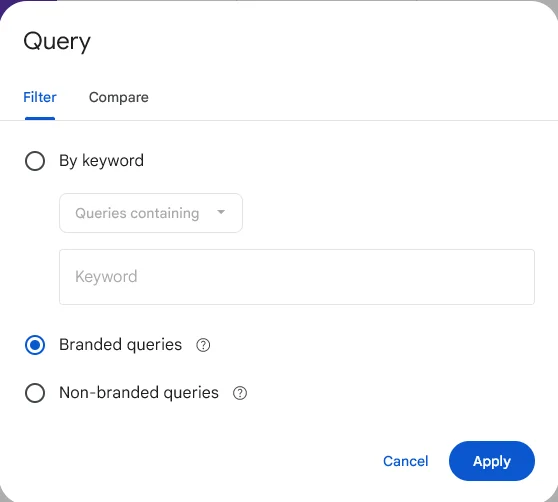 Performance > Add filter > Query in our own Search Console, October 2026: Google splits branded and non-branded queries for you.
Those typo variants are useful for naming too.
Lots of misspelled searches hint that the spelling causes friction.
Watch out: the filter only works on top-level properties with enough query volume. A brand-new product may not see it yet.
Our guide to brand vs non-brand keywords shows how to read that split over time.
Let the name carry what comes after
A brand name for SaaS is a decision with a long tail.
You print it on your domain, your invoices, your integrations and every mention online.
Changing it is possible, but it costs links, recognition and momentum, as any rebranding shows.
That’s why it pays to treat the choice as seriously as the product itself:
- positioning first
- then generating options
- then testing hard on domain, trademark and international reach
Skip a step and you’ll pay later.
Rather decide on a well-founded approach than on gut feeling? We tie the name directly into your positioning and your further brand building.
Get in touch and we’ll look at how your name can set up your SaaS product more strongly from the first impression.
Free website scan
Enter your website and get an automatic scan within minutes, with concrete technical and SEO improvements. No sales pitch.
We only use your details for your scan. No spam, unsubscribe anytime.