
Branding
Brand identity vs branding: what is the difference and what do you actually need?

Copy for AI
Your visual identity is how your brand looks; branding is how people think about you.
When you request a quote for “a new branding”, which one do you mean?
A logo and colours, or how clients think about you?
The question seems small. But it decides where your money goes and whether it returns anything.
The verdict: in the brand identity vs branding debate, the visual identity is one part of branding, not the other way around. Start with the strategy and let the look follow.
Branding and visual identity get used interchangeably all the time, including by agencies themselves.
That creates confusion at the moment it matters most: when you decide what to invest in.
Below: the real difference, why the confusion costs money, and how to work out what you need now.
What is a visual identity?
It’s the visible part of your brand: everything a designer can hand over in a file, such as a logo pack and a style guide.
What’s in it
A visual identity usually covers:
- Logo: the mark people recognise you by
- Colours and typefaces: your palette and fonts
- Imagery and icons: photo style, illustration and icon style
- Applications: how it all comes together on your website, cards and slides
The American Marketing Association describes brand identity in the same visual terms: “the visual and symbolic elements that represent a brand”, such as name, logo, colour scheme and typography.
Choosing those pieces well is its own craft.
See our guides on how to design a logo, how to choose brand colors and how to choose brand fonts.
The style guide holds it together
A brand style guide sets out how those elements must be used.
Everything then looks consistent, whether you’re writing a LinkedIn post or sending a quote.
How to design such a consistent icon style is covered in iconography in your visual identity.
What goes into the full guide is in our piece on the brand book.
Here’s what a visual identity looks like once it’s applied to a live site:
Tangible and easy to replace
A visual identity is tangible and clearly bounded.
You can see it, sign it off and replace it fairly easily.
That’s exactly why it’s the part people reach for first. “Our look is dated” is a recognisable feeling, and a new logo feels like a concrete fix.
But the look is only the outside. It says nothing yet about why someone would choose you.
What is branding?
Branding is everything that gives your name and logo meaning in someone’s head.
The definition
The American Marketing Association defines a brand as “any distinctive feature like a name, term, design, or symbol that identifies goods or services”.
Branding is everything that gives that identifier meaning: the sum of what people feel, expect and believe when they think of your brand.
Nielsen Norman Group puts it even more sharply: a brand “is not made of visuals or words alone”.
It’s not a logo or a slogan.
What branding covers
Branding is about your positioning:
- Who: who you’re there for
- What: which problem you solve
- Why you: why you’re more credible or relevant than the alternative
It also covers your brand promise, your tone, your values and the experience clients get at every touchpoint.
That runs from your first ad to the way you follow up on an invoice.
The visual identity sits inside branding
In other words, a visual identity is a component of your branding, not the reverse.
The colours and the logo are the visible expression of an underlying story.
If that story doesn’t hold up, a beautiful visual identity stays an empty wrapper.
Here’s how the layers fit together:
Want to dig into the strategic foundation beneath it? Read our explanation of what brand strategy is.
There you’ll see how positioning, target audience and brand promise together form the base your entire brand rests on.
A handy way to remember it
Your visual identity is what you say about yourself.
Your branding is what others say about you when you’re not in the room.
The first is entirely in your hands. The second you build, touchpoint after touchpoint.
One signal of that second part is how often people search for your name.
Here’s our own branded search data:
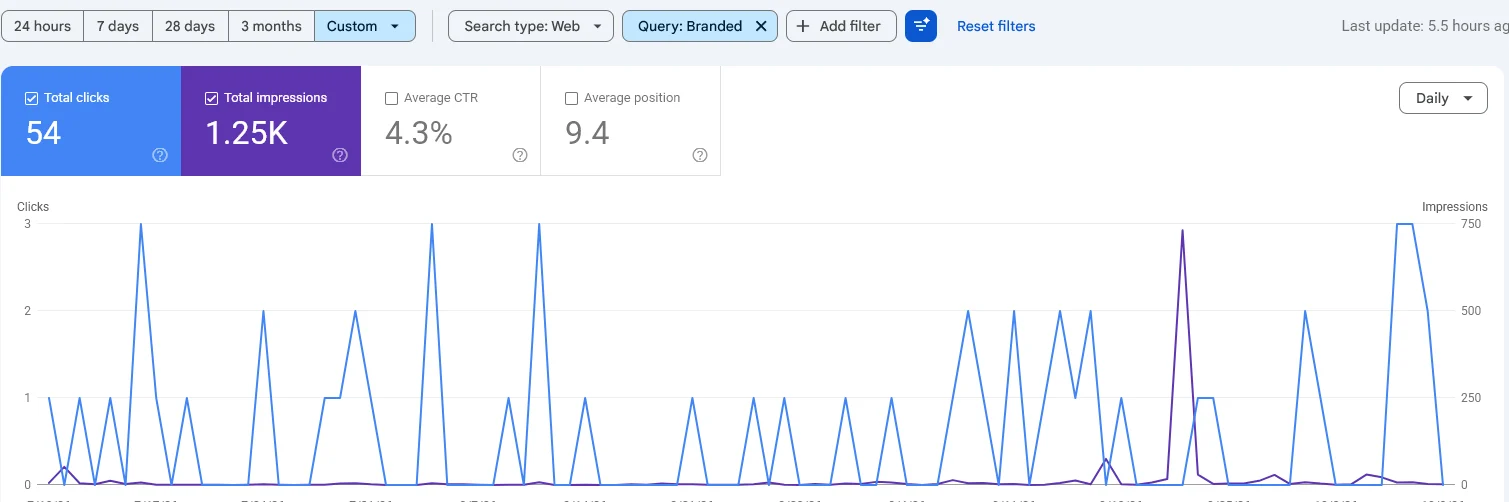 Our own branded queries in Search Console, 10 July to 9 October 2026: 1.25K impressions and 54 clicks.
No logo file creates those searches. They come from people who remember you. Our guide to branded search explains how to read that signal.
Brand identity vs branding: what’s the difference at a glance?
One is a deliverable, the other is a reputation. Side by side:
| Visual identity | Branding | |
|---|---|---|
| What it is | How your brand looks | How people think and feel about you |
| Contains | Logo, colours, type, imagery, style guide | Positioning, promise, tone, values, experience |
| Who controls it | You and your designer | You shape it, the market decides |
| Time frame | Bounded project | Ongoing, touchpoint after touchpoint |
| Solves | Dated or inconsistent look | Unclear choice, wrong clients |
The terms “brand identity” and “visual identity” overlap a lot in daily use.
Our piece on visual identity vs brand identity untangles those two.
Why does the confusion cost you money?
Because the budget lands on the wrong problem, and you end up paying twice.
The “new look” reflex
In quote requests we often see the same pattern. A company senses that something isn’t working:
- the leads don’t come in
- they attract the wrong clients
- they fade next to the competitor
For example, say a consultancy wins plenty of small, price-driven jobs but few of the large ones it wants.
The conclusion arrives quickly: “we need a new look”.
A request follows for a new logo and a website refresh.
When the real problem sits a layer deeper
Sometimes that’s justified. But just as often the real problem sits deeper.
An outdated logo doesn’t drive clients away. Unclear positioning does.
If nobody can explain in two sentences why they’d choose you, no colour palette will fix that.
You’re then paying for nicer packaging around a message that still doesn’t land.
The reverse mistake
The reverse happens too. A company invests for months in strategy, workshops and brand documents, but the look stays amateurish and inconsistent.
The story is strong, but the first impression undermines credibility before anyone hears it.
In both cases the cause is the same: branding and visual identity got mixed up, so the budget landed in the wrong place.
The cost gap
A visual identity project is bounded and relatively fast.
A branding project asks for more research, more conversations and more choices.
You’re making decisions that touch your entire company.
Watch out: whoever buys one while needing the other pays twice. First for the wrong solution, then for the right one anyway.
Our overviews of branding agency cost and logo design cost show how far apart the two budgets sit.
What do you actually need right now?
Ask three blunt questions before you request a quote, in this order.
1. Do people understand what you do and for whom?
Can an outsider, after one glance at your website, repeat which problem you solve and for which type of client?
If not, your work sits in branding and brand positioning, not in a logo.
A sharp positioning statement is the place to start.
2. Do you attract the right clients?
Do you get plenty of enquiries from people who are too small, haggle too much or don’t fit the work you like best?
That’s almost always a positioning problem.
You attract whoever you speak to, and if you speak to everyone, you truly reach nobody.
Our experience: positioning is everything. Make it very clear who you’re built for and what value you bring. That differentiates you, and it’s the most powerful first step to a lower acquisition cost.
Fewer non-fitting companies entering your website, process and sales team also means significantly lower overhead.
3. Does your look match your story?
Only then look at the appearance.
Does your brand look dated, inconsistent or unprofessional, while your story and positioning are sound?
In that case a visual identity refresh is a logical, targeted investment.
Our guide to brand consistency helps you spot where the look breaks down.
Most companies need both, in order
In practice most companies need both, but in a certain order.
You start with the strategy, because it drives the choices.
Then you translate that foundation into a visual identity that speaks to the right people.
Brand building pays off over a long horizon too. LinkedIn’s B2B Institute says “95% of your potential buyers aren’t ready to buy today”. They’ll remember a clear brand when they are; our explainer on the 95-5 rule unpacks why.
Pick the right partner
A strong branding agency therefore never starts with the logo.
It starts with the question of who you want to attract and why they’d choose you.
If you’re unsure which type of partner you need, compare branding agency, advertising agency or design studio.
The look follows from that answer, not the other way around.
Next steps for a full renewal
If you want to know what a full brand renewal looks like step by step, our approach to rebranding will help. Not sure it’s time? Check the signs in when to rebrand.
And if the friction is mainly in how you sound and communicate, read how to work on a recognisable brand voice in B2B.
Frequently asked questions about branding vs visual identity
Is a logo the same as branding?
No. A logo is one element of your visual identity, and the visual identity is one part of branding. Branding also covers your positioning, promise, tone and the experience clients have with you.
Should I start with branding or with the visual identity?
With the strategy behind your branding. Once you know who you serve and why they’d choose you, the visual identity can express that. The reverse order often means redesigning twice.
Is brand identity the same as visual identity?
In daily use they overlap. The American Marketing Association describes brand identity as the visual and symbolic elements of a brand, such as name, logo, colours and typography. Branding is the broader whole those elements serve.
When is a visual identity refresh enough?
When people already understand what you do, you attract the right clients, and only the look is dated or inconsistent. Then a targeted refresh is a sound investment.
So what’s the difference in one sentence?
A visual identity makes you recognisable. Branding gets you chosen.
You need the first to look professional, but the second to grow.
Whoever only tinkers with the outside rarely solves the problem that made them doubt in the first place.
Not sure whether your growth problem sits in the story or in the look? Get in touch and we’ll work out with you what your brand needs before you invest.
Free website scan
Enter your website and get an automatic scan within minutes, with concrete technical and SEO improvements. No sales pitch.
We only use your details for your scan. No spam, unsubscribe anytime.