
Branding
What does logo design cost? Prices and factors explained

Copy for AI
A logo costs anywhere from a few tens of euros to tens of thousands.
It depends on what you buy. A logo isn’t the same as a brand identity, and a brand identity isn’t the same as a brand.
The verdict: you don’t pay for drawing hours. You pay for the thinking and the breadth of use behind the logo.
Below: Benelux price ranges, what drives the cost, and where your money pays back.
We push no platform and no package.
Logo, brand identity or brand: what are you buying?
Three different things, and the price gap between quotes usually sits exactly there.
People use the words interchangeably:
- Logo: the visual mark, symbol plus wordmark
- Brand identity: the system of colours, fonts and rules around it
- Brand: how people think about you
A logo
A logo is the mark you recognise: the symbol and the wordmark.
On its own, it’s one component.
A brand identity
A brand identity is the system around that logo: colours, typography, imagery, icons, shape language and rules.
Those rules decide how it all works on a business card, a website, a quote and a LinkedIn post. So you look the same everywhere.
A brand
A brand goes one layer deeper. It’s your positioning, your promise and your tone; the visuals are the visible outside.
Why strategy always comes before design is explained in our pillar on brand strategy.
Rule of thumb: more layers worked out means a higher price, and more return.
How much does a logo cost?
From around €289 on a contest platform to tens of thousands for a full brand programme.
Prices vary strongly per supplier and assignment. See the ranges below as orientation, not as a rate card.
Here’s the ladder in one picture:
1. A standalone logo via a freelancer or platform
This is the lowest segment: a few tens to a few hundred euros.
Price: 99designs’ Belgian pricing page lists four logo contest packages, all in euro excluding VAT (checked 19 October 2026):
The top package (€1,299) already reaches into the next segment.
What you get: one visual mark, a few file formats, little to no strategy.
Best for: a hobby project or a quick start. You buy an image, not an identity.
2. A logo with basic guidelines via a small studio
In this mid segment you typically pay a few hundred to a couple of thousand euros.
What you get: a more considered logo, a colour palette, font choices and simple application rules.
Best for: small B2B companies just starting out. It’s a reasonable entry point.
3. A full brand identity via a studio or agency
Here you’re quickly in the thousands to tens of thousands of euros.
What you get: strategy upfront, a considered system, multiple applications and a brand book your team can hold on to.
Best for: companies that want to grow seriously or stand out in a crowded market. Here it pays for itself.
4. A brand programme with positioning and identity
At the top of the market you buy a strategic programme, not a brand identity.
Research, positioning, naming and the full visual execution come together. It’s a board-level investment, for companies where the brand has to become a growth engine.
So the price rises with the amount of thinking and the breadth, not with drawing hours.
How much does a logo cost per type of designer?
The same ladder, seen by who does the work. These are market ranges in the Belgian and Benelux market, not quotes:
| Type of designer | Typical logo design cost | Best for |
|---|---|---|
| Logo generator or AI tool | Free to a few dozen euros | A hobby project or short test |
| Microfreelance (Fiverr) | Roughly 20 to 150 euros | A placeholder with low stakes |
| Design contest (99designs) | €289 to €1,299 excl. VAT | Many concepts, little strategy |
| Freelance graphic designer | Roughly 500 to 2,000 euros | SMEs with clear positioning |
| Design studio or branding agency | Roughly 2,000 to 6,000 euros and up | A brand that drives growth |
Logo generators and microfreelance
You type your company name and get dozens of variants. Canva’s home screen is where many start:
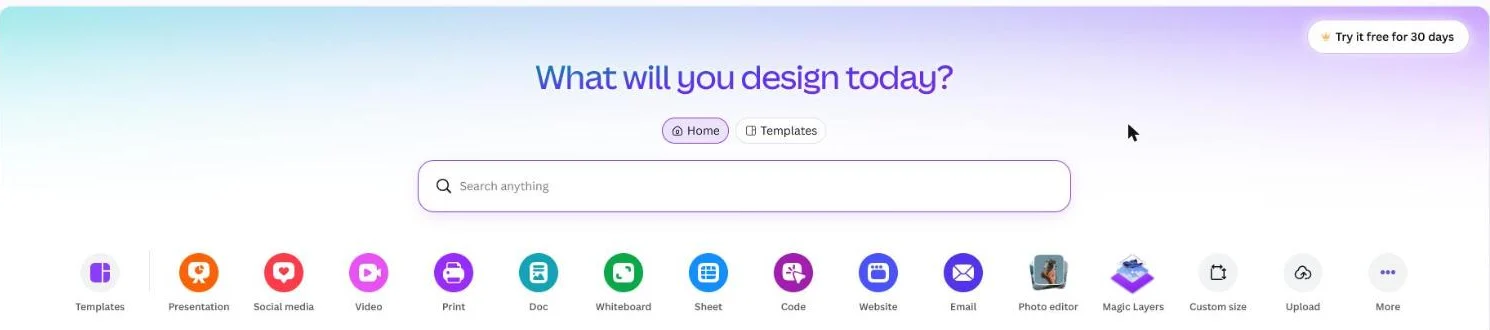 Canva’s home screen, 17 October 2026. Logo templates sit one search away, which is exactly why so many look alike.
Watch out: a template logo isn’t exclusive to you. Thousands of others can use the same shapes, which makes it hard to protect.
Cheap microfreelance packages are often reworked templates too. You rarely get the right file formats or a rationale.
Freelancer or studio
An experienced freelancer asks about your business and delivers variants, colour codes and working files. For many SMEs with clear positioning, that’s the sweet spot.
A studio or agency sells a process: strategy, positioning, then the logo and often a full identity around it.
Rule of thumb: the more your brand has to carry, the further up this table you belong.
Which factors determine the cost of a logo?
Six factors explain almost every gap between two quotes:
- Strategy upfront: research and positioning before any sketch
- Breadth of applications: how many carriers the identity must work on
- Concepts and rounds: how many directions and feedback rounds
- Experience: who makes it
- Deliverables: which files and guidelines you get
- Rights and originality: custom work or an adapted template
1. Strategy upfront
A design that starts from research, positioning and audience costs more than one that starts with a nice idea.
That strategy is what makes your identity sell instead of merely look good.
2. Breadth of applications
A logo for just your website is cheaper than an identity for packaging, company cars, trade fairs, social and print.
Every extra carrier, such as a trade fair stand or a van, calls for its own rules.
3. Number of concepts and rounds
The more directions and feedback rounds included, the higher the price.
Watch out: unlimited rounds sound attractive, but they often mean slower work without a better outcome.
4. Experience of whoever makes it
A seasoned designer or an established agency charges more. They often deliver a sharper result faster, because they know the pitfalls.
Weighing the two? Our comparison of a freelance designer vs a branding agency lays out the trade-off.
5. Deliverables and files
Do you get only a JPG, or vector files, light and dark variants and a brand book?
That difference is part of the price. A professional logo comes in three sets:
- Versions: full, compact, symbol only
- Colours: colour, black, and white for dark backgrounds
- File formats: vector files plus web and print versions
Vectors matter most. Adobe explains that vector files “can’t become fuzzy or pixelated”, however large you make them.
Which format serves which purpose is in logo file formats explained. A short set of logo usage guidelines is often worth the extra.
6. Usage rights and originality
A unique, custom-designed brand is worth more than an adapted template.
Cheap options, for example an adapted template, risk generic or even reused shapes, and those are hard to protect.
Paying for a logo does not make you the owner, either. Under Belgian law the copyright arises with the designer, and a transfer must be made in writing, according to FOD Economie. Have the transfer of rights written into your contract.
Price: budget separately for protection. An EU trade mark costs €850 online for one class, €50 for the second and €150 per class from the third. It lasts 10 years.
Is a quote suspiciously low? Then one of these six is usually missing.
Where does your logo budget pay back?
In strategy first, consistency second, and hardly at all in endless polishing.
Not every euro works equally hard.
Strategy and positioning
A sharp starting point makes every later choice easier. Your identity then serves a goal: more trust, more qualified leads, higher pricing.
A nice logo without direction is expensive decoration.
Consistency and applicability
An identity your team can apply correctly itself pays back for years. Everything you publish stays recognisable.
A brand book here isn’t a luxury but a working tool.
Endless aesthetic refinement
Beyond a certain point, another round adds little commercial value.
The work has to be right and consistent, not perfect to everyone’s personal taste.
The question we ask on every project
Does this identity contribute to revenue, leads and brand strength, or only to the feeling that everything looks fresh?
That question decides where your budget belongs.
A branding agency that works from growth beats the cheapest provider.
Which mistakes make a logo more expensive?
Most companies overpay or underpay for the same reason: they buy on the wrong criterion.
Four pitfalls come back again and again:
- Price alone: the cheapest option rarely stays cheap
- Logo instead of identity: you’re back at the table within a year
- Rebrand as logo swap: a bigger job than it looks
- No owner after delivery: an unguarded identity dilutes
Choosing on price alone
A weak identity costs you later, in missed recognition and a new round.
Our guide to cheap branding shows where the hidden costs sit.
Buying a logo when you need an identity
Within a year you’re back at the table, for example when your new website needs a colour palette. There are no colours, fonts or rules for your website and quotes.
Confusing a rebrand with a logo swap
A new name or a new positioning is a different, bigger programme.
How to do it without losing value is in our guide on tackling a rebrand.
Forgetting who manages it
A brand identity nobody guards dilutes.
Agree who manages the files and enforces the rules.
When does cheap end up costing you more?
When one of three hidden costs shows up:
- Wrong files: you still pay a designer to make the logo usable for print or large format
- A template look: your brand looks interchangeable and may not be protectable
- The wrong fit: nobody asked who you are, so within a year you pay for a rebrand
That last one costs most. Beyond the new design, you redo printed materials, website elements and the recognition you’d built. Our overview of rebranding cost shows how fast that adds up.
When cheap is fine: a temporary project, a test or an internal tool. Once the logo faces customers, a miss weighs more than the saving.
How do you read a logo design quote?
Ask three questions, because the price says little without the answers:
- What exactly is in the deliverables, down to file formats and usage rights?
- How much strategy comes before the design?
- What happens after delivery: do you get a brand book and support?
Example: a quote of a few thousand euros with strategy, a full system and a brand book is often better value. A cheap logo you come back to three times isn’t.
Frequently asked questions
How much does a simple logo cost?
On a platform, from a few tens to a few hundred euros. 99designs’ Belgian logo contests run from €289 to €1,299 excluding VAT (checked 19 October 2026).
Is a cheap logo worth it?
For a hobby project or a test, yes. For a B2B company that wants to grow, a mark without strategy or rules usually means paying twice.
Does a logo price include trade mark registration?
Usually not. An EU trade mark costs €850 online for one class, on top of the design.
How much does a professional logo cost in Belgium?
For a freelance graphic designer, roughly 500 to 2,000 euros. A studio or branding agency usually starts around 2,000 euros and can reach 6,000 euros and up, often with a wider identity included.
Which files should a logo designer deliver?
At least vector files, plus web and print versions, in colour, black and white. Also ask for a full, a compact and a symbol-only version.
So what should you spend on a logo?
As much as the layer you really need: start with strategy, buy the breadth you’ll use, and judge quotes on what you get back.
Not sure which layer fits your stage? Get in touch with us for a realistic estimate, without a sales pitch.
Free website scan
Enter your website and get an automatic scan within minutes, with concrete technical and SEO improvements. No sales pitch.
We only use your details for your scan. No spam, unsubscribe anytime.