
Branding
Outsourcing Brand Strategy: When, How and What It Costs

Copy for AI
Outsourcing brand strategy means a brand strategy agency defines your brand with you.
Together you decide what your brand stands for, who it’s for, and how you differ from everyone else.
The verdict: hire a brand strategy agency when you’re too close to your own story or the stakes are too high to gamble. Otherwise, invest in executing the brand you have.
A good outcome isn’t a pretty document destined for a drawer. It’s a compass that steers your choices in sales, recruitment, content and even product development.
Below: when outsourcing pays off, how a project runs and what drives the cost.
What exactly do you outsource (and what don’t you)?
You outsource the thinking behind your brand, not its look. Many people assume brand strategy is about how a brand appears.
That’s identity: logo, colours, typography. Strategy sits a layer deeper.
What you outsource is the thinking that decides why that identity later takes the shape it does. Our guide to brand identity covers the visible layer.
The decisions a partner works on
In concrete terms, a partner works on these decisions:
- Positioning: the place you claim in your buyer’s mind
- Audience and buyer insight: who you’re really there for
- Brand promise and proof: what you promise, and why buyers believe it
- Brand story and core messages: the common thread every team retells
- Tone of voice: how you sound when your logo is out of sight
Each one deserves a closer look.
Positioning rules things out
Positioning is the place you claim in your buyer’s mind, against which alternatives.
It’s the hardest and most valuable choice. Why? It rules things out. Our guide to B2B brand positioning shows how to make it.
Our experience: positioning is everything. Make it very clear who you’re built for and what value you bring; that’s the most powerful first step to a lower acquisition cost.
Audience, promise and proof
Who are you really there for, and what drives their decision? Appeal to everyone and you reach nobody.
Then the promise: what do you promise, and why should a buyer believe you?
Watch out: a promise without proof is a slogan. Our explainer on the brand promise shows how to back one up.
Story and tone of voice
The brand story is the common thread every team, from sales to recruitment, can retell in their own words.
Tone of voice is how you sound, so you stay recognisable even when your logo is nowhere in sight. Here’s how to define your tone of voice.
What you don’t outsource: the conviction
What you usually don’t outsource is the conviction itself.
A good partner draws the strategy up out of your organisation; they don’t invent it on top of your reality.
The substance comes from you and your customers. The structure, the sharpness and the outsider’s view come from the agency.
When does outsourcing brand strategy pay off?
Mainly in four recognisable situations. Not every company needs an external brand strategy project.
Your teams tell different stories
Ask three colleagues what makes your company unique and you get three answers.
For example, say sales pitches speed, marketing pitches quality and recruitment pitches culture.
That isn’t a detail. It leaks into every quote, every job posting and every sales call.
An external party brings those versions together into one story that holds up and that everyone can carry.
You’re too close to your own brand
Internal knowledge is both a blessing and a blind spot.
You know everything about your product. Because of that, you no longer see how a buyer experiences you for the first time.
An outsider asks the naive questions you long ago forgot to ask. A brand audit is often where those questions start.
The stakes are high or the market is new
For example, you’re entering a new segment, launching a second brand, or repositioning against a strong competitor.
The cost of a wrong bet is then greater than the cost of guidance.
You lack the time or the discipline
Strategy rarely dies from a shortage of ideas. It dies from a lack of time.
An external partner puts a deadline on something that would otherwise sit forever.
Already have a clear, shared and distinctive brand story? Then none of this applies.
Rule of thumb: skip outsourcing and invest in executing that story.
When are you better off doing it yourself or waiting?
When the basics aren’t in place yet. In those cases an expensive strategy project is wasted money.
Three situations call for patience:
- No customers yet: your strategy lacks its key raw material, real buying behaviour
- Visibility is the problem: positioning sessions won’t fix being unknown
- No will to follow through: you’ll write a document nobody uses
No customers yet
First work out what works in practice, then pour it into strategy.
Visibility, not direction
If your biggest problem is visibility rather than direction, start with channels. Positioning sessions won’t solve that.
No will to follow the outcome
A brand strategy that doesn’t carry through into decisions is an expensive summary of what you already thought.
For a side-by-side view, use this decision table:
| Your situation | Best move |
|---|---|
| Teams tell different stories | outsource |
| Entering a new market or repositioning | outsource |
| Clear, shared, distinctive story already | execute it yourself |
| No paying customers yet | wait and learn first |
| Main problem is visibility | invest in channels first |
Our comparison of outsourcing branding or doing it yourself makes the same call for the whole brand.
How does an outsourced brand strategy project run?
In four phases. The names differ per agency, the logic doesn’t.
1. Gathering insight
Interviews with your team, conversations with customers, a look at competitors and an analysis of what you project today.
For example, customers may describe your value in words your team never uses.
This is where most of the work happens and the least visible result is produced. Do not skip this phase.
2. Making choices
Positioning, audience and promise are sharpened in working sessions.
Friction comes with the territory: good strategy deliberately rules out attractive options. Our guide on how to run a brand workshop shows how those sessions work.
3. Capturing it
The story, the messages and the tone of voice come together in a workable foundation, not in a thick report.
Usable beats complete.
4. Activating
The strategy translates into identity, website, content and sales.
Without this step, strategy stays theory.
How do you choose the right partner?
Watch for one thing: do they involve your customers and your sales process, or do they start from taste and trends?
An agency that only talks aesthetics hands you nice packaging with no core.
A good branding agency starts with your buyer and your commercial reality, and only then with the form. More criteria are in how to choose a branding agency.
Rebranding instead of a first strategy?
If you face a complete brand overhaul rather than a first strategy, the project partly runs differently.
Our article on rebranding strategy explains how to reposition an existing brand without throwing away the recognition you’ve built.
What does outsourcing brand strategy cost?
It depends on the scope. Be wary of anyone who names a fixed amount without asking questions.
The biggest cost driver isn’t the number of working sessions. It’s the depth of the research and the breadth of the activation.
The three factors behind the brand strategy cost
Three factors decide the investment:
- Research depth: a few internal talks, or customer interviews and market research
- Scope of the outcome: positioning only, or through to identity and activation
- Involvement and seniority: juniors with a template, or strategists who know your sector
A handful of internal conversations costs less than a project with customer interviews, competitive analysis and market research. The second also produces sharper choices.
The further the scope runs, through a messaging house to activation on your website, the higher the investment and the impact.
Seniority shows up in both the price and the result. For real price ranges, read our breakdown of brand strategy cost.
Think in return, not in cost
Marketing professor Kevin Lane Keller’s Brand Report Card in Harvard Business Review frames strong brand equity as a driver of customer loyalty and profit, for companies of every size.
B2B buyers aren’t purely rational either. Bain partners argued in HBR that “the subjective, sometimes quite personal considerations of business customers are increasingly important in purchases”.
And most of that return lands later. LinkedIn’s B2B Institute estimates that 95% of your potential buyers aren’t ready to buy today.
So a sharp brand works on the buyers you’ll meet next year, not just this quarter. That’s the core of brand equity.
How you can see the return
One place the return shows up is branded search: queries such as your company name typed into Google. In Search Console you can split those queries out:
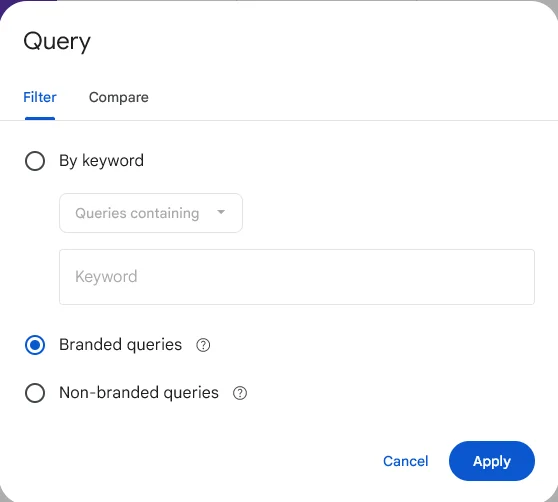 Performance > Add filter > Query in our own Search Console, October 2026: Google splits branded and non-branded queries for you.
Here’s what our own branded queries look like over three months:
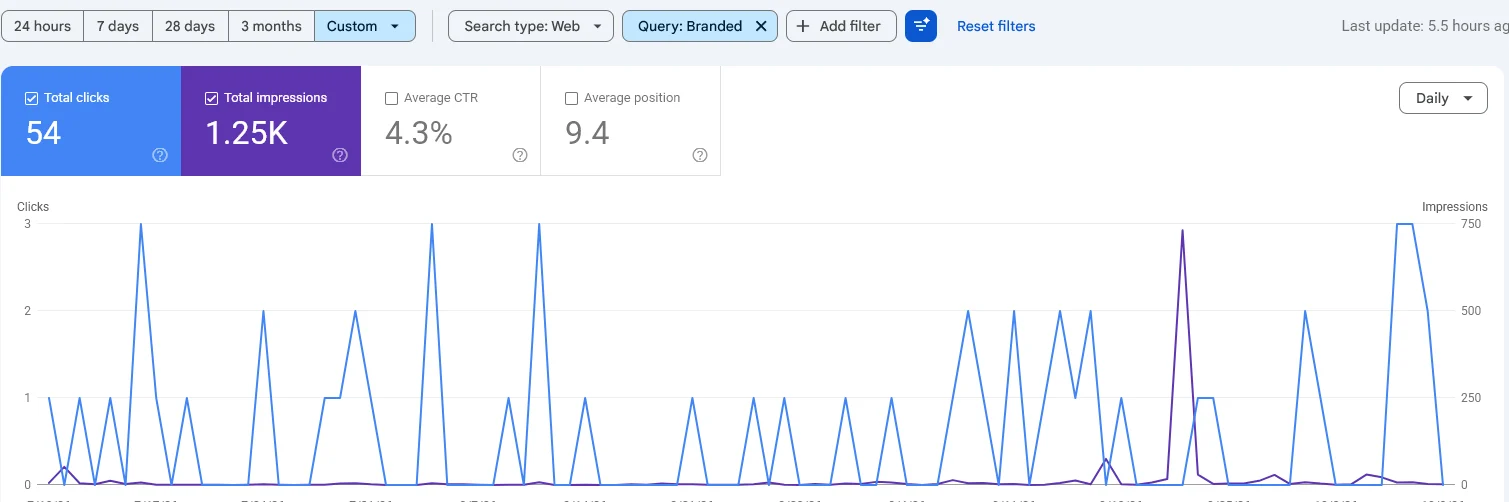 Our own branded queries in Search Console, 10 July to 9 October 2026: 1.25K impressions and 54 clicks.
People who search your name click far more readily. Our own CTR data shows the gap:
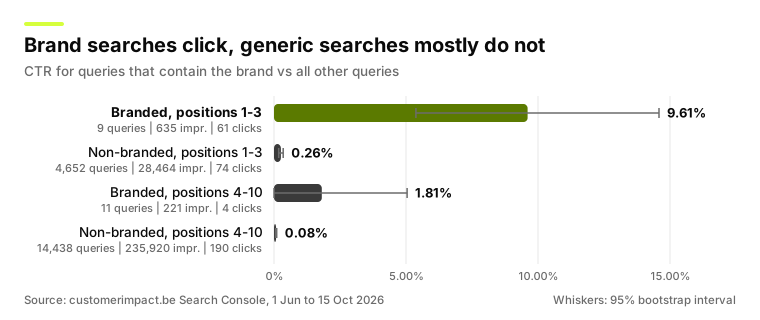 Branded vs non-branded CTR by position band, customerimpact.be Search Console, 1 June to 15 October 2026. Small branded sample.
Our guide to measuring brand awareness adds the other signals.
Where else it pays for itself
A brand strategy that helps your sales team close the right deals faster, and helps recruitment attract the right people, pays for itself in places you wouldn’t link to branding.
Our experience: fewer non-fitting companies entering your funnel means significantly lower overhead in your website, process and sales team.
Conversely, the cheapest option, a generic document nobody opens, is always too expensive.
The one question to ask with every quote
What concretely changes about our decisions after this project?
If an agency can’t answer that, they’re selling you a report, not a strategy. Our list of questions to ask before a branding quote adds more.
Frequently asked questions
When should I hire a brand strategy agency?
When your teams tell different stories, when you’re too close to your brand to see it clearly, when the stakes are high or the market is new, or when strategy keeps stalling for lack of time.
How long does an outsourced brand strategy take?
Expect weeks to a few months, depending on the research depth and how far the activation runs. Cheap and fast usually produces a document nobody uses.
What does a brand strategy agency deliver?
Decisions, not a logo: positioning, audience, brand promise and proof, a brand story with core messages, and a tone of voice. A good one also helps activate them.
Can I do brand strategy myself?
Yes, if you already have a clear, shared and distinctive story, or if you have no customers yet. Then executing or learning first is the better use of budget.
How do you make brand strategy a growth lever, not a document?
Let it carry through into how you sell, hire and build.
That’s exactly where most projects go wrong: the strategy gets delivered and after that it lives nowhere.
At Customer Impact we steer on leads, revenue and brand strength, not on a document that looks good in a meeting. With us, strategy and activation sit on one line.
Wondering whether your brand is ready for an external project?
Get in touch and we’ll tell you honestly whether outsourcing or a first step yourself moves you forward.
Free website scan
Enter your website and get an automatic scan within minutes, with concrete technical and SEO improvements. No sales pitch.
We only use your details for your scan. No spam, unsubscribe anytime.