
Branding
Company culture and brand: why culture is the core of your employer brand

Copy for AI
Your brand is what you promise; your culture is what you deliver.
The verdict: company culture and brand aren’t two worlds. Culture is the core of your brand identity and your employer brand.
You can have a beautiful logo, a sharp brand promise and a razor-sharp visual identity. Your brand can still feel hollow.
That happens when what you say outside doesn’t match how things work inside.
Culture is often filed under HR, brand under marketing. That split is exactly the thinking error that makes brands weak.
Below: why culture sits at the core, and how to align both so your brand rings true.
What is the difference between culture and brand?
Your brand is the promise you make outward. Your culture is how you deliver on it every day.
Your brand lives in the minds of customers, candidates and the wider market.
Your culture lives in the hallways and meetings. It shows in how people treat each other and their customers when no camera is running.
Why should they mirror each other?
Because a gap between them tells two contradictory stories.
For example, picture a brand that calls itself “human and approachable”. Inside, employees keep score against each other and customers disappear into a phone menu.
People sense that gap unerringly.
So your culture isn’t a side condition of your brand. It’s the foundation beneath it.
To see how promise and identity connect, first look at what a brand strategy actually involves. Culture is the layer where that strategy is proven true or false.
Why is your culture the core of your brand identity?
Because the visible brand is only the outside of something deeper.
Brand identity is often narrowed down to the visible: colours, typeface, tone, logo.
Beneath that visual layer sit your values, your way of working and the people who embody the brand every day.
That’s your culture. It decides whether your identity feels genuine or bolted on.
What happens when practice undermines identity?
For instance, think of a brand that claims to revolve around craftsmanship.
If the culture internally rewards speed and shortcuts, practice undermines identity. Three groups notice it, one after another:
- Customers: in the quality of the work
- Employees: in the daily decisions
- The market: over time, in your reputation
Developing a strong brand identity therefore doesn’t start with design. It starts with who you really are as an organisation, and how that shows in behaviour.
Why can’t competitors copy it?
Culture gives your identity something no competitor can copy: authenticity.
A logo can be imitated, and a colour palette too.
But the way your people solve problems, make decisions and talk to customers is unique. That’s the kind of difference that makes a brand defensible.
Anyone who builds their brand separately from their culture is building on sand.
See also how to sharpen that core by defining your brand essence: the heart of your brand in a single sentence.
Why is culture the foundation under your employer brand?
Because candidates judge the culture they find, not the careers page they read.
Nowhere is the bond between culture and brand as visible as in your employer brand.
Your employer branding is the promise you make to future and current employees: this is what it’s like to work with us.
That promise isn’t delivered by a careers page or a campaign. It’s delivered by the culture as it’s lived.
What do candidates check before they apply?
Culture and reviews, and most of them check both.
In Glassdoor’s survey of 5,113 adults in the US, UK, France and Germany, 77% said they’d consider a company’s culture before applying. 79% said the same about its mission (Glassdoor survey, July 2019).
Reviews weigh in too. In HireClix’s 2025 survey of 1,000 US job seekers, 57% said reviews on Glassdoor and Indeed influence whether they apply.
Here are those numbers side by side:
The lime bar is the problem. Candidates look hard at the culture, but fewer than half of employees can say what the company stands for.
What happens when the promise doesn’t exist inside?
It comes out fast, and it gets expensive.
New people leave again, your word-of-mouth reputation weakens, and recruitment costs more every time.
A credible employer brand always starts from what actually lives in the company. Not from what marketing would like.
That’s also why a well-run employer branding track starts by listening to your own people. Only then do you communicate outward.
Our guide to the employer value proposition shows how to put that into words.
Does it work both ways?
Yes, and that’s the good part.
A culture that rings true turns your best employees into ambassadors. They carry the story further, in their network and in their work.
Your employer brand then stops being something you broadcast. It becomes something you earn.
More on that in attracting talent with your employer brand.
Why are your employees the first expression of your brand?
Because a customer’s first real brand experience is usually a conversation, not an ad.
This is where company culture and brand meet most sharply.
For most customers, the first real contact isn’t your website or your ad. It’s one of your people:
- the account manager who calls
- the support colleague who solves a problem
- the consultant who thinks along
That moment is your brand in action.
Why can’t a guideline capture that moment?
Because you can’t script how someone reacts to a frustrated customer.
You can spell out the tone of your copy down to the last detail. But reactions in the moment come from culture: from values people have genuinely internalised.
Here’s how our own Marketing and Sales Program frames the payoff of teams pulling in one direction:
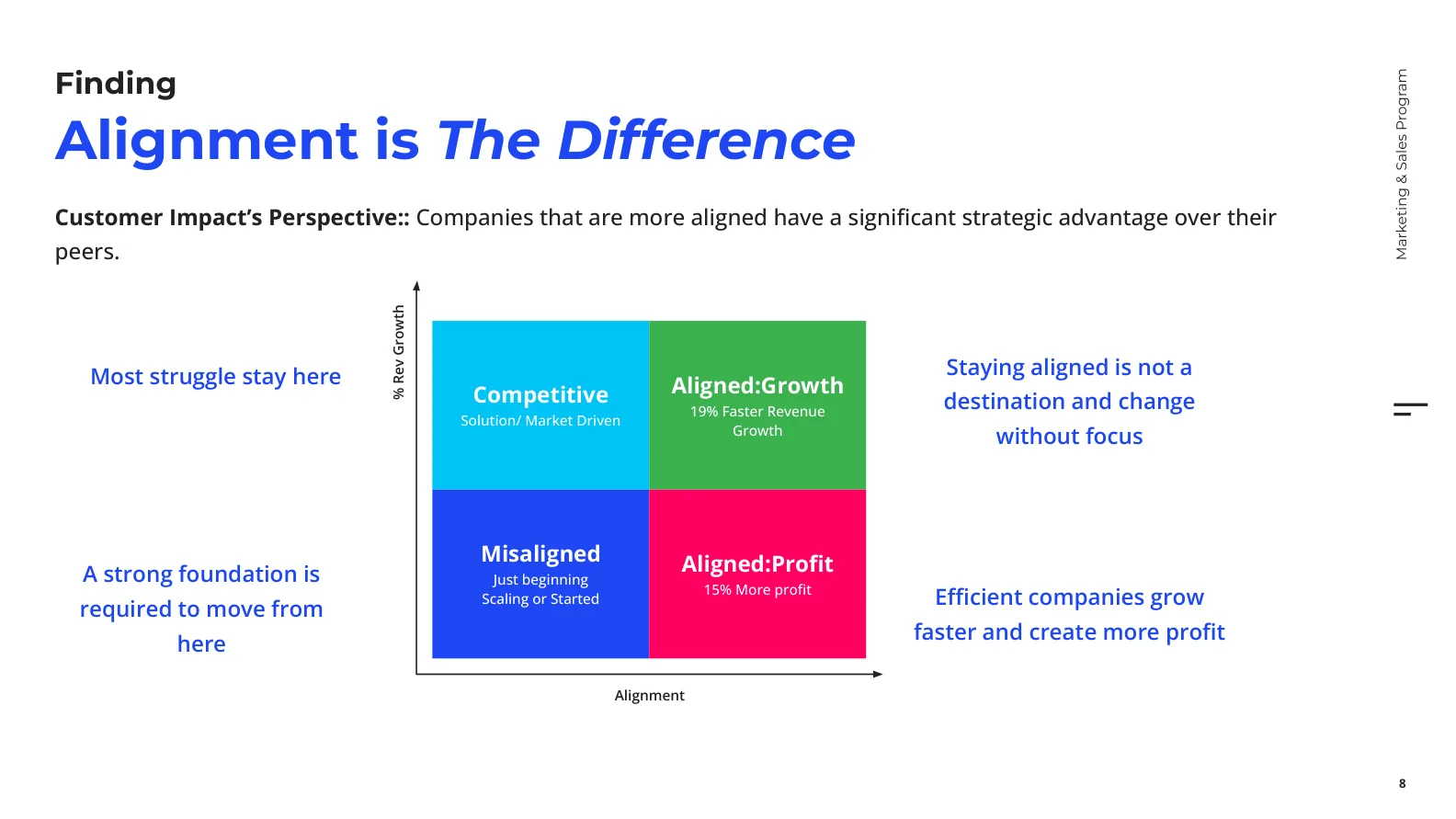 From our own Marketing and Sales Program deck, October 2026: aligned companies show 19% faster revenue growth and 15% more profit.
That’s why internal brand building matters at least as much as external brand building.
If your team doesn’t understand what the brand stands for, it can’t carry it either. Gallup found that only 41% of employees agree they know what their organisation stands for and what makes the brand different (Gallup, January 2019).
Should you hand everyone a script?
No. On the contrary.
Make your values so clear that people can apply them in situations you never anticipated.
Defining clear brand values is therefore not an abstract exercise. It’s a practical compass for daily behaviour.
Rule of thumb: a value that doesn’t show up in how people act isn’t a value. It’s a poster.
How do you align culture and brand?
Treat them as one project, and start from the inside.
The message is clear: don’t run culture and brand as separate projects. But how do you avoid drifting into vague talk?
Four concrete principles:
- Start from the inside, not the outside. Map who you really are before you build a brand story. A brand that denies the culture breaks later.
- Make your values behavioural. Not “we stand for quality”, but “we’d rather deliver late than sloppy”.
- Involve your people instead of informing them. A brand imposed top-down is rarely lived. A brand shaped by the team is carried.
- Hold promise and practice against each other. With every brand expression, ask whether you can deliver it daily. If not, adjust the promise, or the culture.
Where do you start in practice?
With a structured look at promise versus practice.
Running a brand audit gives you a concrete starting point to lay the two side by side.
A brand workshop with people from every team then turns those findings into shared values.
For example, say a 40-person engineering firm promises “partners, not suppliers”. The workshop asks one question per team: where did we act like a supplier last month?
The answers show exactly where culture and brand drift apart.
How do you know it’s working?
Measure both sides, inside and outside.
- Inside: do employees describe the brand in the same words as your promise?
- Outside: do candidates and customers describe you in those words too?
- Hiring: do new hires stay past their first year?
Our guide on measuring employer branding lists the metrics that matter.
Where do we come in?
This alignment is exactly the kind of work we steer on as a branding agency.
Not a pretty brand that stands apart from the organisation, but one that rings true from the inside and builds trust lead by lead.
Hiring is part of that. Our recruitment marketing puts the same story in front of candidates.
A brand that delivers on its promise has less convincing to do.
Frequently asked questions about company culture and brand
Is company culture not simply an HR topic?
No. Culture determines whether your brand promise is delivered or broken every day, in every customer contact and every decision. That makes it just as much a brand and leadership topic as an HR topic.
What if my culture does not match the brand I want?
Then you have a choice: adjust your brand promise so it rings true, or invest in cultural change so practice catches up with the promise. What you can’t do is take a promise to market that doesn’t exist internally. That gap always comes out.
How do you start aligning culture and brand?
Start by listening to your own people and your best customers. What do they say your brand is, separate from what you’d like it to be? From that honest picture you build a brand you can genuinely deliver.
Does company culture affect recruitment?
Yes. In Glassdoor’s 2019 survey, 77% of adults said they’d consider a company’s culture before applying. A culture that matches your employer brand makes every hire easier and cheaper.
A brand that rings true from the inside
Your brand promises, your culture delivers.
When they move together, you attract talent more easily and customers trust you faster. Your brand becomes defensible, because nobody can copy your culture.
When they drift apart, everyone feels it, first inside and then in the market.
Want a brand that rings true from the inside? We’ll start with a short call about where promise and practice drift apart.
Free website scan
Enter your website and get an automatic scan within minutes, with concrete technical and SEO improvements. No sales pitch.
We only use your details for your scan. No spam, unsubscribe anytime.