
Branding
Branding for law firms: standing out without losing authority

Copy for AI
Branding for law firms means standing out through substance, not volume.
A law firm lives on authority, discretion and reputation.
Marketing quickly sounds like something that undermines that seriousness.
The verdict: law firm branding works when it’s sharp about focus, proof and tone. It fails when it copies consumer marketing or hides in safe, grey sameness.
At the same time, firms look more and more alike: the same promises, the same tone, the same facades.
That’s where the real tension sits.
You want to stand out, but not at the expense of the trust your entire practice rests on.
Why does branding for lawyers create a different kind of friction?
Because your product is your judgement, and judgement isn’t sold with a catchy slogan.
For most companies, the branding question is simple: how do I become better known?
For a law firm, it’s more sensitive.
Your client isn’t shopping for a likeable brand
A client dealing with an acquisition file or a labour dispute isn’t looking for a fun logo.
They’re looking for someone they trust with something that genuinely matters.
Too much branding feels like selling.
And selling destroys exactly the signal you want to send: that you’re serious, capable and reliable.
Professional conduct rules set the limits
The legal world is conservative by nature, and professional conduct rules set the limits.
The CCBE Code of Conduct for European Lawyers (art. 2.6) allows publicity only when it’s accurate, not misleading and respects confidentiality and the profession’s core values.
Your local bar adds its own rules on top.
In England and Wales, for example, the SRA Code of Conduct for Solicitors (8.8) says any publicity about your practice must be “accurate and not misleading”.
Here’s the publicity paragraph in the SRA code itself:
Referral still dominates
In a summary of Clio’s 2019 Legal Trends Report, 59% of clients looked for a referral from someone they knew, while 17% used a search engine.
The same summary breaks the referral sources down further. Here’s how clients found a lawyer:
Friends and family were the biggest referral source at 32%. And of those who sought a referral first, only 16% also looked on their own.
Only 17% visited a lawyer’s website while looking for representation.
So every marketing expression quickly feels out of place.
Most firms opt for safe and neutral.
And that’s precisely the problem.
What’s the downside of safe? Everyone looks the same
If every firm chooses sober, professional and reliable, that eventually says nothing at all.
For example, say three firms in the same city all promise the same three things:
- a “personal approach”
- “short lines of communication”
- “years of expertise”
The websites show the same stock images. A handshake, or a classic balustrade. The tone is formal everywhere.
A prospect sees no difference
If they see no difference, they fall back on the only thing left.
That’s a tip from an acquaintance, the location, or the price.
Notice how a referral still needs a reason.
The person passing on your name has to be able to say why you, in one sentence.
Why lawyers stay in the grey zone
This is the same trap as with any knowledge-intensive service provider.
We worked it out more broadly in branding for professional services.
The difference with lawyers is that the fear of deviating is even greater.
Nobody wants to come across as the firm that needs marketing tricks.
So everyone stays stuck in the same grey zone.
Whoever steps out first, credibly, gains visible ground.
Does differentiation have to be loud?
No. For a law firm, louder even backfires.
Real differentiation doesn’t sit in a bold colour or a daring campaign.
It sits in sharpness: what you stand for, who you’re there for, and what you deliberately don’t do.
Here’s where that difference arises in practice:
Focus
A firm that says “all areas of law” says nothing.
A firm that positions itself as a specialist in real estate transactions, IT law or family wealth planning is immediately recognisable to anyone looking for exactly that.
Rule of thumb: choosing makes you stronger, not smaller. A short positioning statement forces that choice onto paper.
Point of view
Do you have an outspoken vision on how you treat clients?
On how you approach files, or on transparency about fees?
Those are choices that charge your brand without you having to be loud.
Client selection
Saying no is a message too. Which cases you don’t take on says as much as the ones you do.
A firm that chooses sharply radiates confidence and direction.
Substance over volume
This is the work of defining your distinctive edge: not shouting harder, but being clearer about who you are.
Standing apart in this sector is about substance, not volume. How to approach that concretely in a formal market is covered in brand differentiation for lawyers.
Pick one lever first. Focus is usually the easiest.
How is authority built: with proof or with big words?
With proof. The biggest mistake in legal branding is thinking that authority is something you claim.
“Leading”, “prominent”, “market leader”: every firm uses those words, so they ring hollow.
You don’t create authority with adjectives, you demonstrate it.
Three kinds of proof that work
You build authority with proof and consistency. Three signals carry most of the weight:
| Proof | What it shows | Where it lives |
|---|---|---|
| Substantive articles | how you think about a current legal question | blog, LinkedIn, newsletter |
| Client stories | what you concretely solved | case pages (with consent) |
| A clear way of working | what happens after the first call | service pages, intake |
Articles: a piece that shows how you think about a current legal question does more for your reputation than any self-declared superlative. That’s thought leadership in its plainest form.
Client stories: a story that makes concrete what you solved weighs more heavily than a list of practice areas. Our guide on writing a B2B case study shows how to structure one.
Way of working: a clear explanation of your process removes doubt for someone hiring a lawyer for the first time.
Each of those signals builds the same feeling. These people know what they’re talking about, and you’re in good hands with them.
Consistency is the second half
A brand inspires trust when everything rings true:
- the tone on your website
- the way the phone is answered
- how a first conversation goes
- what an invoice looks like
At a law firm, the stakes are high and the client’s judgement is sharp.
So every break in that experience stands out.
Watch out: a polished visual identity on a website that clashes with a messy reception does more harm than good.
The brand is the sum of those touchpoints, not the logo on top of them.
Our piece on brand consistency shows how to hold that line.
If you want to understand how those parts fit together, our piece on brand strategy will help you further.
How do you see whether it’s working?
One honest signal is how often people search for your firm by name.
Branded search grows when referrals and reputation do.
Here’s what that report looks like in Search Console, with a filter on branded queries:
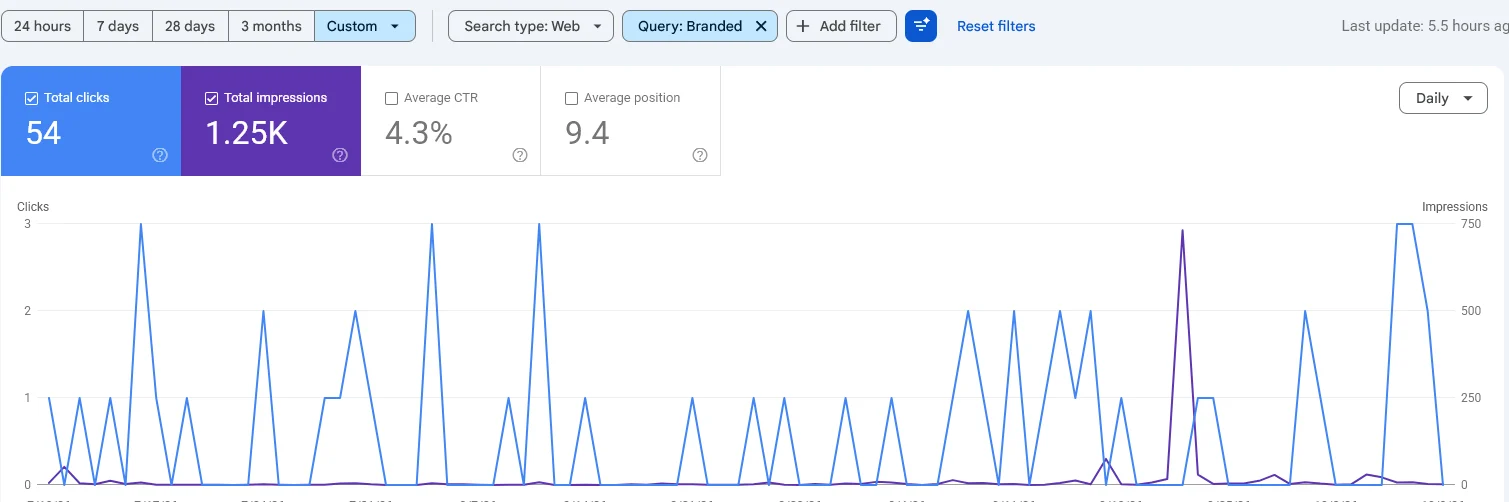 Branded queries in our own Search Console over a custom three-month range, October 2026. Name searches are one signal that a brand is being passed on.
Run the same filter on your firm’s name. You’ll see whether referrals turn into searches.
Our explainer on branded search covers the setup, and measuring brand awareness adds other signals.
If name searches stay flat, your brand isn’t being passed on yet.
Tone: how do you stay human without losing your authority?
By combining clarity and seriousness, because they aren’t opposites.
Many firms think they have to choose: formal and distant, or accessible and therefore less serious.
That’s a false opposition.
Clarity signals mastery
The strongest legal brands are clear and human precisely because that inspires trust.
A client dealing with a conflict longs for someone who explains in understandable language. Someone who listens and doesn’t make the complexity bigger than it is.
Clarity isn’t weakness. It’s a sign of mastery.
Whoever can explain something complicated simply has mastered the material.
Combine both, don’t choose
The art isn’t choosing between seriousness and humanity, but combining both.
You stay sharp on substance and correct on conduct.
But you talk as one human being to another.
For example, compare two lines on an employment law page:
- Distant: “Our firm renders counsel in all matters pertaining to employment law.”
- Clear: “Dismissed or about to dismiss someone? We tell you where you stand within one meeting.”
That second line only works if you can actually keep the promise, so write what you really do.
That alone sets you apart from firms hiding behind jargon.
How do you approach branding for a law firm?
It starts with sharp choices. Not with a logo.
Work through it in this order:
- Choose: what are you genuinely good at, and who do you want to work for?
- Differ: how do you differ from the three firms a prospect will compare you with?
- Translate: turn that into an identity, a tone and an experience.
- Hold the line: make every touchpoint ring true, from website to invoice.
Only once that foundation is in place does a brand identity make sense.
That requires honesty about who you are and the discipline to hold that line. A brand that only exists on the website convinces nobody.
Make sure you can be found, too
A sharp brand still needs to show up when a referral turns into a search.
That’s where SEO for lawyers and GEO for law firms come in, so AI answers name you as well.
Get an outside view
This isn’t an exercise you squeeze in between two files.
It requires an outside perspective and someone who understands the tension between distinction and authority.
For that, you’re best off with a branding agency that knows that in the legal sector trust is the end product. Differentiation may never cost credibility.
Frequently asked questions about branding for law firms
Are lawyers allowed to do branding at all?
Yes, within the conduct rules.
The CCBE code allows publicity that’s accurate, not misleading and respects confidentiality. Your local bar may add stricter rules, so check those first.
Does a law firm need a new logo to rebrand?
Not necessarily.
Most of the gain sits in focus, proof and tone. A new logo on top of unchanged choices changes very little for a prospect.
What’s the quickest branding win for a small firm?
Narrow your focus and say it plainly on your homepage.
One clear area is easier to recommend than everything.
Want a second opinion on your firm’s brand?
If your firm sounds like the three around it, start with focus and proof, not with a logo.
Book a call and we’ll look at where your firm can stand out without losing authority.
Free website scan
Enter your website and get an automatic scan within minutes, with concrete technical and SEO improvements. No sales pitch.
We only use your details for your scan. No spam, unsubscribe anytime.