
AI & GEO
What is agentic AI? Meaning and how it works explained

Copy for AI
Agentic AI is AI that plans, acts and adjusts on its own.
It takes a goal instead of a step-by-step instruction, and works out the steps itself.
The verdict: generative AI tells you something; agentic AI does something for you. That’s a bigger leap than it sounds, because a system that acts needs boundaries.
IBM’s definition is short: agentic AI is “an artificial intelligence system that can accomplish a specific goal with limited supervision” (IBM).
What does agentic AI mean exactly?
Agentic AI is AI with agency: the capacity to decide and act on its own toward a goal.
The word agentic refers to that capacity to act.
You no longer give a precise instruction per step.
You give the outcome you want, and the system reasons out which steps it needs.
An example: comparing suppliers
An example makes it concrete.
A classic AI application answers “which three suppliers match my requirements?” with a list.
An agentic system gets a bigger instruction: “compare these suppliers and set up a trial account with the best one.” It then works through the steps itself:
- gather information on each supplier
- weigh the options against your requirements
- make a choice
- complete the sign-up
Autonomy is the core distinction
Agentic AI doesn’t only generate text.
It intervenes:
- filling in a form
- querying a system
- scheduling an appointment
That independence often builds on an AI agent as a building block.
Agentic AI describes the behaviour more broadly: goal-directed, acting and self-steering.
Agents versus workflows
Anthropic draws a useful line here (Anthropic, Building effective agents):
- Workflows: “systems where LLMs and tools are orchestrated through predefined code paths”
- Agents: systems where the model directs its own process and tool usage
So not every AI automation is agentic.
If a developer fixed every step in advance, it’s a workflow.
Our comparison of AI agents vs RPA shows where fixed automation still wins.
How does agentic AI work? The plan-act-observe loop
It runs a loop: plan a step, act on it, observe the result, and repeat until the goal is reached.
An ordinary large language model responds turn by turn and then stops.
An agentic system keeps running until the goal is reached, or it gets stuck and escalates.
The three phases
The loop has three phases:
- Plan. The system breaks the goal into smaller, executable tasks and sets the order. A large instruction becomes a series of manageable steps.
- Act. It executes the next step, usually via a tool or integration such as a search query, an API call or a data operation. Without tools, agentic AI can’t do anything beyond text.
- Observe. It reviews the result, checks whether it’s closer to the goal and decides the next step. If something goes wrong, it corrects or tries another approach.
That cycle repeats until the task is done.
The ability to adjust on intermediate results is what sets agentic AI apart.
A plain model spits out one answer in one go.
What sits under the hood
An agentic system usually combines three parts:
- A language model that reasons and plans
- Memory that holds context across steps
- Integrations that talk to the outside world, often through a standard such as MCP
Agentic search: the loop applied to finding information
Increasingly, that interplay runs through agentic search, where the system searches and combines sources itself.
You can already see it in answer engines.
Look at how many pages sit behind one answer here:
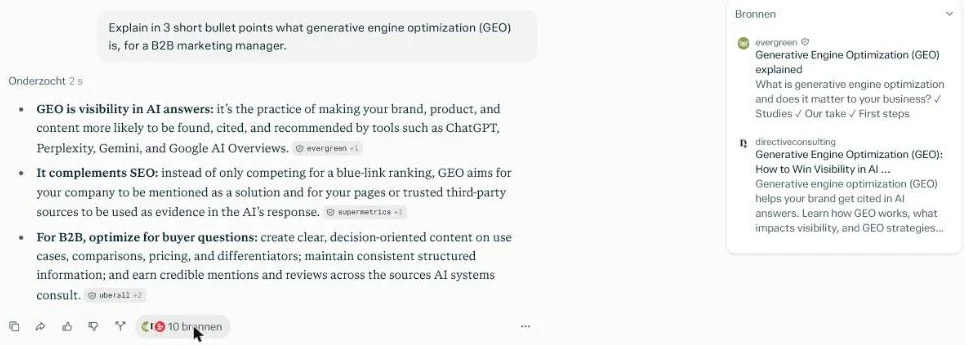 Perplexity’s sources panel for our own test prompt, 17 October 2026: 10 web pages behind one answer.
The system picked, read and combined those 10 pages without anyone choosing them.
Agentic AI versus generative AI and chatbots: what’s the difference?
Generative AI creates content, a chatbot holds a conversation, and agentic AI pursues a goal and acts.
The terms get confused easily, but they describe different things.
Generative AI and chatbots
Generative AI makes something new: text, an image or code, based on a prompt.
A chatbot is a conversational form of that, giving answers in a dialogue.
Agentic AI uses that generative layer as its engine and adds goal-directed action.
Here’s what a single generative turn looks like:
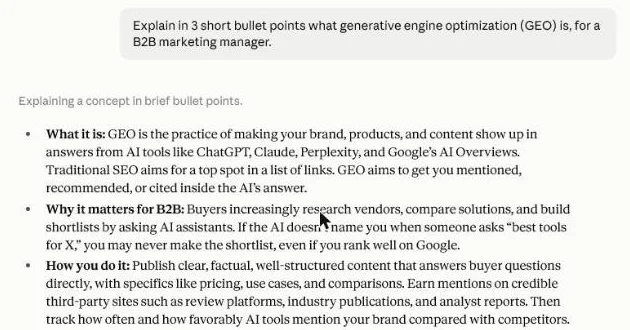 Claude, 17 October 2026, tested on a paid plan in an incognito chat: one turn, about 150 words, no actions taken.
A useful answer, but nothing happened in the world.
That’s the line agentic AI crosses.
Side by side
The table below places the three side by side on the points that matter in practice:
| Aspect | Generative AI | Chatbot | Agentic AI |
|---|---|---|---|
| Core action | Generate content | Answer in a dialogue | Pursue a goal and act |
| Way of working | One turn: prompt in, output out | Question-and-answer per turn | Loop: plan, act, observe |
| Autonomy | None, waits for a prompt | Low, reacts to input | High, determines the steps itself |
| Using tools | Rarely | Sometimes, limited | Central, core of how it works |
| Typical outcome | A text or image | An answer | A completed task |
| Role of the human | Give a prompt | Ask a question | Set the goal and boundaries |
The practical summary
Generative AI tells you something.
A chatbot discusses something with you.
Agentic AI does something on your behalf.
As soon as a system acts on its own, boundaries, oversight and reliability become decisive.
Why does agentic AI matter for B2B?
Because buyers will soon let systems compare and pick suppliers, so the question moves from being found to being selected.
For B2B, the significance lies less in the technology than in the shift that’s coming.
From being found to being selected
An agentic system is guided less by name recognition and more by demonstrable, machine-readable usefulness.
The companies chosen more often won’t necessarily be the biggest.
They’ll be the ones with clear, structured and current information about what they do, and don’t do.
That same principle drives your broader AI visibility: document concretely, back it up with results and keep it current.
Make your site readable for agents
A few checks for your own website:
- Facts: are services, sectors and prices described in plain text?
- Structure: do headings and tables make the page easy to parse?
- Freshness: is the information current and dated?
Our guide is your website readable for AI? goes through it step by step.
Or test your brand quickly with the AI visibility checker.
Operational gains: automating real work
On the operational side, agentic AI opens the door to AI automation of tasks that take a lot of manual work today.
For example, research, lead enrichment and follow-up. Our articles on AI agents for B2B and AI agents for sales show concrete use cases.
The same rule applies here: the gain lies in a concrete process that costs time or revenue, not in the technology.
Mind the trade-off
Agentic systems aren’t free. Anthropic notes that they “often trade latency and cost for better task performance”.
So calculate before you build.
Our guide to AI agent ROI shows how.
What are the common misconceptions about agentic AI?
Four misunderstandings keep coming back, and each one leads to wrong expectations:
- “Agentic AI is just a smarter chatbot.” No. The difference is acting, not talking. A chatbot gives an answer; an agentic system carries out a task with steps and tools.
- “More autonomy is always better.” Not necessarily. Autonomy is a spectrum. For decisions with consequences, you often want a human who approves.
- “It works flawlessly and independently.” An agentic system can reason wrongly or execute a step incorrectly. Without boundaries and oversight, small errors pile up over a long loop.
- “Every company needs one now.” Usually not right away. Your information and processes matter more. Your own agent only makes sense once it solves a concrete problem.
Autonomy is a dial, not a switch
Here’s the spectrum, from least to most autonomous:
What research and practice say
A 2024 survey of AI agent architectures on arXiv describes planning, execution and reflection as the phases behind robust agents. It also maps what current systems can and can’t do (Masterman et al., arXiv, 2024).
Anthropic is blunt about the risk. Autonomy means:
- “higher costs, and the potential for compounding errors”
- a need for “extensive testing in sandboxed environments, along with the appropriate guardrails”
- agents that “pause for human feedback at checkpoints or when encountering blockers”
So treat autonomy as something you expand in a controlled way, not as a switch you flip.
Our guide to AI agent governance and risks covers the guardrails in detail.
Want to try a small one first?
Read how to build an AI agent without code.
Frequently asked questions
What is the difference between agentic AI and an AI agent?
They are closely connected. An AI agent is the concrete building block: a single system that carries out a task independently. Agentic AI is the broader term for the behaviour, namely AI that plans, acts and adjusts in a goal-directed way. In practice you often realise agentic AI with one or several AI agents that work together, as in multi-agent systems.
Is agentic AI the same as generative AI?
No. Generative AI makes new content based on a prompt and stops there. Agentic AI uses that generative layer as its engine, but adds goal-directed action to it: it plans steps, uses tools and adjusts based on results. Generative AI tells you something, agentic AI does something.
Does my B2B company need agentic AI now?
Usually not right away. Start with a concrete problem that costs time or revenue and see whether agentic AI automation solves it. More important in the short term is that your information is clear, structured and current, so that you stay visible and selectable as soon as these kinds of systems play a bigger role.
Ready to see what agentic AI means for you?
Start with one question: which process costs your team the most time each week?
Tell us where you stand with your AI visibility, and we’ll tell you whether agentic AI already matters for you and where your biggest opportunities lie.
We’re a small team that moves fast, so you get concrete steps instead of hollow promises.
Free website scan
Enter your website and get an automatic scan within minutes, with concrete technical and SEO improvements. No sales pitch.
We only use your details for your scan. No spam, unsubscribe anytime.