
Growth & Strategie
New Website, Still No Customers? The Problem Isn't Your Design

Copy for AI
A new website with no customers is almost never a design problem.
It’s a strategy problem: nobody decided who the site is for, why they’d pick you and how they’d find it.
The verdict: if two rebuilds brought in no customers, don’t hire a third builder. Fix positioning and traffic first, then touch the design.
You’ve had your website built twice.
The first time you thought the design was outdated.
The second time you chose a different agency and a fresher look.
And yet your inbox stays quiet and your phone doesn’t ring.
That’s frustrating: you paid twice and hoped twice. The tempting conclusion is “the third builder is bound to be better”.
But if rebuilding twice yielded nothing, the problem probably isn’t in the pixels. It’s in the layer underneath.
Why won’t a third rebuild save your new website?
Because a third rebuild changes the same thing the first two changed: the look.
Ask yourself one question: what was fundamentally different about the second website? Often the answer is “it looks nicer”. That’s exactly where the reasoning goes wrong.
A website is a sales instrument
A website isn’t a work of art that attracts customers through beauty.
It’s a sales instrument that only works with a strategy behind it.
Without that strategy, you build a prettier version of the same problem.
Our piece on a nice website but no customers shows the same trap from another angle.
Builder or strategist?
Many owners confuse the role of a web builder with that of a digital strategist:
- Web builder: neatly translates what you ask for
- Digital strategist: tells you what you should be asking for
- Both in one: advises first, then builds
Who does exactly what is explained in web developer or digital strategist: which do you need.
Rule of thumb: if nobody asked about your customer before the first mock-up, you bought a builder.
Is the problem really your design?
Almost never. For example, a site can be sleek, fast and modern and still generate zero enquiries.
Design solves none of these three questions:
- Who exactly do you want to reach, and what keeps that person up at night?
- Why would someone choose you over three competitors on page one of Google?
- How does traffic end up on those beautiful pages at all?
Without clear answers, your website is a gorgeous brochure in a drawer that nobody opens.
Buyers decide before they talk to you
B2B buyers do most of their research before they ever contact you.
In the 6sense 2025 B2B Buyer Experience Report (almost 4,000 buyers), first contact with a seller came at 61% of the buying journey. Buyers started 79% of those conversations themselves.
So no visibility means no visitors, and no visitors means no leads. It doesn’t matter how beautiful the site is.
Google won’t hand you visitors by default
Publishing a site doesn’t put it in front of buyers. Google’s SEO starter guide says it “primarily finds pages through links from other pages it already crawled”.
It also says plainly that there’s “no guarantee that any particular site will be added to Google’s index”.
Is it a traffic problem or a conversion problem?
Your analytics tell you which one, in a few minutes. Two very different causes produce the same empty inbox.
A quick self-test
Look at your numbers:
- Visitors, but no enquiries: a conversion or positioning problem
- Barely any visitors: a traffic and visibility problem
- Both low: start with positioning, because it feeds the other two
Neither one is solved with a new colour palette.
Here’s what that check looks like in Search Console. Impressions count how often your site appeared in Search results; clicks count the visits that followed:
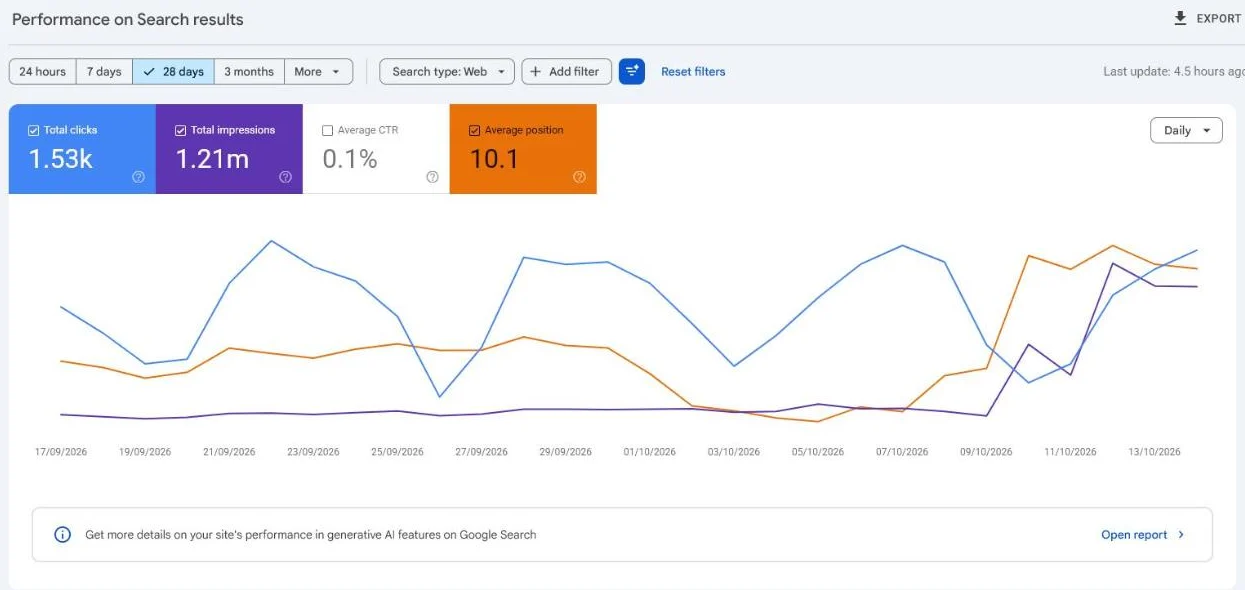 Our own Search Console for customerimpact.be, last 28 days, October 2026. 1.21M impressions against 1.53K clicks.
Plenty of impressions with few clicks points at your titles and message. Hardly any impressions points at visibility.
This diagram sums up where to look first:
Got visitors but no leads? Then website traffic but no leads goes deeper. Want a number on it? Use the conversion rate calculator.
Why does strategy come first and design second?
Because design only works once you know who it’s for and how they’ll arrive.
The right order is almost always the opposite of how it went for you. It isn’t “build a website first, then figure out how to fill it”.
The four steps, in order
Here’s the sequence that works:
- Positioning: who are we here for, and why us?
- Message: how do we say that in language the customer recognises?
- Traffic: channels such as SEO, GEO, advertising or email bring the right people in.
- Conversion: only then do we design pages that turn visitors into enquiries.
Design is step four, not step one.
Being known beats being pretty
The same 6sense report found buyers picked a vendor from their Day One shortlist 95% of the time.
So being known before the search starts counts for more than the look of your homepage.
That’s why a marketing strategy up front decides whether a website costs or earns. Our guide to a clear value proposition is a good place to start step 2.
What it looks like in practice
For example, say you sell planning software to construction firms. A designer asks which colours you like.
A strategist asks which jobs your buyers search for, what they compare you with, and what makes them pick up the phone.
Our experience: when a prospect asks us for SEO, we first ask why. You don’t walk into a doctor’s office and order a specific medicine before anyone knows the cause.
Sometimes the real answer is website optimisation or better keyword research, not a new site.
Want to understand how lead generation works as a whole? Read what does a lead generation agency do.
How do you avoid getting it wrong a third time?
Change the kind of partner you’re looking for, before you put money on the table again.
Don’t ask “who makes the nicest site?”. Ask “who dares to tell me why the previous two didn’t work?”.
Look for uncomfortable questions
A good partner asks uncomfortable questions before a single line of code is written.
Three resources help you test that:
- the questions in questions to ask a web design agency
- the warning signs in red flags at a web design agency
- the signs in signs you need a new website, so you know if a rebuild is justified at all
Pick the right type of partner
Torn between a freelancer, an agency or someone in-house?
Then freelancer vs agency vs in-house for your website helps you sharpen that trade-off.
The type of partner partly decides whether you buy strategy or only execution.
What can you expect from a good partner?
A sober diagnosis, a traffic plan and honest numbers. Not a promise of a full inbox tomorrow.
It works both ways: no partner can guarantee enquiries overnight. But here’s what you can expect:
- Analysis: why the previous sites brought in no customers, backed by your analytics
- Traffic plan: not just a delivery date, but how visitors will arrive
- Cost transparency: what it costs and what it realistically yields
- Ownership: responsibility for the result, not just the files
Traffic is part of the plan
A site without a visitor plan is half a solution.
Read SEO for lead generation to see how visibility and leads connect. Our website strategy guide shows how to plan both together.
Talk budget early
A realistic conversation about budget starts with what it costs to have a website built.
Watch out: a low build price with no traffic budget is often the most expensive option. You pay again when nothing comes in.
Strategy plus execution
A partner who combines strategy and execution can steer when something isn’t working.
An agency that only builds delivers and vanishes.
You only feel that difference months later, when the numbers disappoint.
Here’s what steering on the whole chain can do. In our Get Driven project, the new site came with a conversion plan:
 Case visual from our Get Driven website and branding project, Belgium: conversion rate from 1.8% to 7.3%.
The difference wasn’t the photos. It was what the site was built to do.
Frequently asked questions
I’ve had a new website built for the second time and still have no customers. What am I doing wrong?
You’re probably buying execution without strategy every time. The question isn’t “what does my site look like” but “who am I reaching, why do they choose me, and how do they find me”. Start with positioning and traffic, not design.
Website already rebuilt twice but still no enquiries, is it the design?
Almost never. A beautiful site without visibility gets no visitors, and a site with visitors but weak positioning gets no enquiries. Look first in your analytics at where it stalls: at the traffic or at the conversion.
New website and still no customers, what’s the cause?
One of three things: too little traffic, a message that doesn’t connect with the customer, or a page that doesn’t push visitors towards action. A good partner first measures which of the three it is, and doesn’t gamble on a rebuild.
Should I have my website rebuilt a third time?
Not right away. Often a strategic realignment is enough, with targeted changes to the existing site. Sometimes a new foundation is needed, but that’s a consequence of the strategy, not its starting point.
How do I pick the right agency?
Choose based on who asks the hard questions and takes ownership of your result. A partner who combines strategy and execution helps you sharpen the right criteria before you sign.
Ready to break the cycle?
You’ve invested in design twice. The third time can be different, if you start from why the first two failed.
We look at your strategy, your audience and your traffic first, and only then at pixels. We’re a small team, so we move fast and often do more than you expect. If a rebuild is needed, our website development team builds it on that plan.
Contact us and within 24 hours you’ll hear where it’s really going wrong.
Free website scan
Enter your website and get an automatic scan within minutes, with concrete technical and SEO improvements. No sales pitch.
We only use your details for your scan. No spam, unsubscribe anytime.