
Advertising
What is a campaign objective? Your campaign goal decides everything

Copy for AI
A campaign objective is the result you want from your advertising campaign.
It’s sometimes called your campaign goal. It’s the first choice you make in setup, and it steers everything after it.
The verdict: the platform optimises for exactly the objective you pick. Choose wrong, and it optimises towards the wrong result, very efficiently.
For B2B, that almost always means an objective aimed at leads or conversions.
What is a campaign objective exactly?
It’s how you tell the ad platform what success means.
Two examples make the difference clear:
- Say “awareness”: the system reaches as many people as possible.
- Say “leads”: it goes looking for people who fill in a form.
The algorithm optimises for what you ask, not for what you secretly hope.
Why the choice costs money
A lot of budget gets wasted because someone picked a reach objective while the business needed enquiries.
The platform then did its job precisely: plenty of impressions, few leads.
A sharp objective is the foundation of every Google Ads campaign that steers on revenue instead of vanity metrics.
What types of campaign objectives are there?
Four, roughly. Every platform uses its own labels, but they follow the same funnel from top to bottom.
Here’s that funnel, with what each of the 4 steps optimises for:
The four levels
Each level asks the algorithm for something different:
- Awareness: reach as many relevant people as possible.
- Traffic: clicks to your site, with no guarantee anything follows.
- Engagement / leads: interaction or completed forms; the algorithm hunts for converters.
- Sales / conversions: purchases or hard conversions, fed by your pixel or tag.
The lower your objective sits, the more sharply the platform optimises for results instead of reach.
How do Google, Meta and LinkedIn handle objectives?
Differently in the details, but the logic is the same everywhere.
Google Ads
At Google you pick an objective such as leads, sales, website traffic or brand awareness.
That objective is tied to a campaign type and a bidding strategy.
See how those campaign types differ in our overview of Google Ads campaign types.
Meta
Meta uses 6 objectives in its Outcome-Driven Ad Experiences system:
- Awareness
- Traffic
- Engagement
- Leads
- App promotion
- Sales
Each one unlocks different optimisation options and ad formats. See how that works out in Facebook ads for B2B.
LinkedIn runs along the same 3 funnel stages:
- Awareness
- Consideration: including website traffic and engagement
- Conversions: including lead generation via Lead Gen Forms
For B2B that last stage is often the most interesting. You can target on job title, industry and company. Here’s how to set up a LinkedIn Ads campaign.
The common thread: the objective decides the bidding strategy, and the bidding strategy decides where your money goes.
Why does the objective steer everything else?
Because a series of decisions falls into place the moment you pick it.
These 3 matter most:
- Bidding strategy: a leads objective turns on conversion-focused bidding; awareness optimises for reach.
- Ad formats: some formats only exist under certain objectives.
- Yardstick: what the platform reports and optimises on follows from the objective.
What the platform actually optimises on
In Google Ads, a leads objective only works if a real enquiry is set as the primary conversion. Here’s ours:
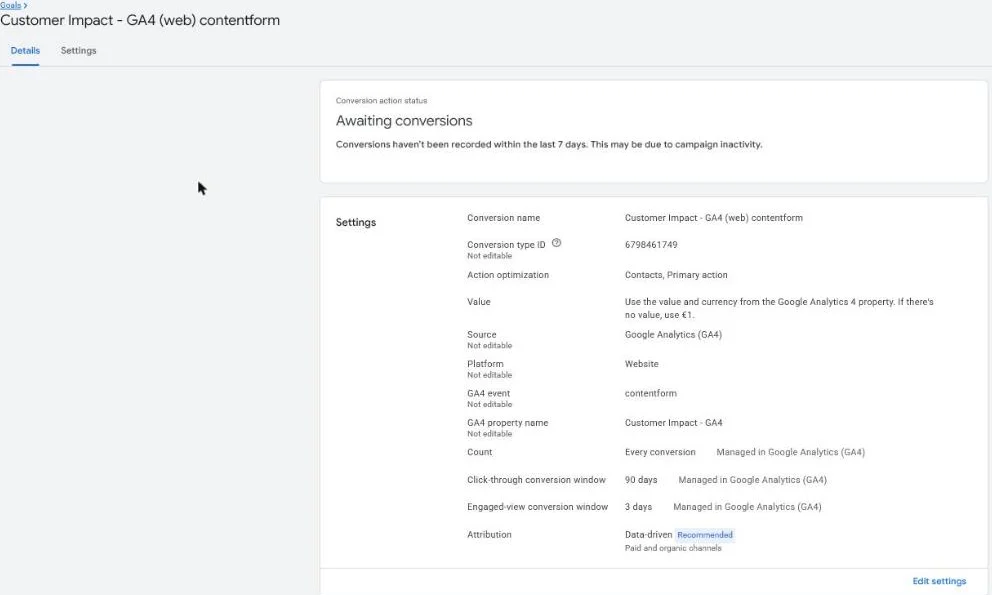 The contact form conversion action in our own Google Ads account, October 2026. Because it’s primary, bidding optimises on real enquiries.
That’s the signal the algorithm chases. Point it at a click or a page view, and that’s what you’ll get more of.
So it isn’t an administrative checkbox. It’s the most important strategic choice in your campaign.
Pick one that doesn’t match your business question, and you’ll spend the campaign working against yourself.
Which objective counts for B2B?
Almost always one aimed at leads or conversions.
You have a long sales cycle and several decision-makers. So you want qualifiable enquiries in your pipeline, not mountains of clicks.
When awareness does have a place
Awareness objectives make sense in a few cases, usually at the top of a B2B social ads funnel, for example:
- you’re entering a new market
- you have to explain a new category
Then judge awareness the right way, not on reach alone. Our article on vanity metrics explains why reach and clicks give a false sense of progress.
Our rule of thumb
Start with the business question, such as more qualified leads. Then pick the objective that sits closest to it.
At Facilicom, that focus delivered a media saving of 25%. Budget no longer flowed towards the wrong result.
Frequently asked questions
What happens if I choose the wrong campaign objective?
The platform optimises towards it anyway. Choose awareness while you want leads, and you’ll get plenty of impressions and few enquiries.
Can I change the objective later?
On most platforms you can’t simply change it on a running campaign. Usually you create a new campaign with the right objective instead of tinkering with the old one.
Which campaign objective is best for B2B lead generation?
One aimed at leads or conversions. The platform then optimises for people who fill in a form or get in touch, which fits a long B2B sales cycle.
Is an awareness campaign pointless for B2B?
No, but judge it the right way. Awareness helps in a new market or category, as long as you know it builds reach and doesn’t deliver leads directly.
Choose the objective that fills your pipeline
If you need leads, pick a leads objective and feed it a real enquiry.
Not sure which objective fits your business question? Contact us. We’ll start from your revenue goal and sketch the campaign structure that fits it.
Free website scan
Enter your website and get an automatic scan within minutes, with concrete technical and SEO improvements. No sales pitch.
We only use your details for your scan. No spam, unsubscribe anytime.