
Advertising
Does my Google Ads account really need a rebuild? When it's warranted, when it's a red flag

Copy for AI
A Google Ads account rebuild is sometimes the right call, but rarely on day one.
A new agency looks at your account for five minutes and says: “We need to completely rebuild this.” You feel hope and suspicion at the same time.
Both are fair.
A rebuild can be exactly what you need, or a billing trick that throws away years of data.
The verdict: only agree to a Google Ads account rebuild after an audit shows a concrete reason. Restructure inside your existing account wherever you can.
Here’s a framework to tell the difference.
What do they actually mean by “rebuild”?
“Rebuild” is a stretchy word, and that’s precisely where the problem lies.
One party means a few new campaigns alongside your existing structure. Another means a brand-new Google Ads account, everything gone, starting from scratch.
New structure or new account?
That difference is enormous:
- New structure, same account: your conversion history, keywords and settings stay.
- New account: that history stays behind in the old one.
- Mixed: new campaigns next to old ones that are paused, not deleted.
Before you agree to anything, have the marketing agency map out exactly what gets torn down and what stays. Ask it concretely, not in jargon.
How a clean account is laid out is covered in our guide to Google Ads account structure.
The one question that matters
The question you keep asking is simple: what is kept, and why?
When is a Google Ads account rebuild warranted?
Sometimes starting over is the right choice. A good partner backs that up with what they see in your account, not with a gut feeling.
Four defensible reasons
A rebuild is defensible if:
- Account structure: so disorganized that fixing it costs more than starting fresh.
- Broken tracking: all bidding runs on the wrong conversion data.
- Outdated campaign types: formats Google is phasing out that no longer perform.
- Wasted spend: years of budget on search terms that never delivered a customer.
Think of hundreds of loose keywords with no logic for the first one.
For the second, your history is worthless anyway, so there’s little to protect. A conversion tracking audit shows whether that’s really the case.
For the third, compare what you run with today’s Google Ads campaign types. And how to recognize the last one is in wasted spend in Google Ads.
Notice the pattern
In each case there’s a demonstrable reason. The party looked first, then judged.
That’s the difference between a warranted rebuild and a sales pitch.
The healthy order: look first, then decide
A reliable partner always does a Google Ads account audit before touching anything.
That audit shows what works, what leaks and what should be kept. Only then comes the advice: adjust or rebuild.
If you want to set that in motion yourself, you can request an audit without throwing anything away.
Here’s the decision in one picture:
Rule of thumb: if the tracking works, keep the account and rebuild the campaigns inside it.
When is “start everything over” a red flag?
Now the other extreme. The question many entrepreneurs ask, and rightly so, is: is a Google Ads account rebuild a red flag?
It depends on the moment the word is dropped.
”Rebuild” before any audit
If a new party shouts “we’ll rebuild everything” before an audit, that’s a warning sign. Nobody can know in five minutes whether your account is hopeless.
The other variant of that same doubt sounds like this: “new Google Ads agency wants to rebuild everything, is that necessary or will I lose my good data?”
That’s exactly the right question to ask out loud.
Other red flags
Watch for these signs:
- No word on what stays: only on what has to go.
- A hefty setup fee: the rebuild happens to bring extra hours.
- Vague ownership: nobody says who’ll own the new account.
- No figures: only general talk, nothing from your own data.
Ownership is crucial, so read about account ownership with an agency.
Google’s access levels help page explains why: only an Admin can give access and change other users’ access levels.
Watch out: Google also recommends a second admin. With one admin, you can lose access if that person becomes unavailable.
Why agencies like to rebuild
Some agencies know a rebuild is a handy way to bill hours with every new client.
Not because they’re malicious.
Starting over simply sells more easily than patiently adjusting.
What do you lose if you tear down too fast?
Here lies the real heart of it. The question “does a new agency really have to rebuild my whole Google Ads account or is that to bill extra?” revolves around what you throw away.
Your conversion history
Your conversion history is worth gold. Smart Bidding and all automated bidding strategies train on that data.
Google’s own wording is telling: “If you have past conversion data in your account, Smart Bidding never starts from scratch” (Google Ads help on bid strategy learning).
Start an empty account and that advantage is gone.
The learning period
The same page says a new bid strategy typically needs 1 to 2 conversion cycles to calibrate. A conversion cycle is the time between a click and the conversion.
Conversion data from previous campaigns speeds up that learning period. The “Learning” label itself never lasts more than 7 days, but stable results take the full cycles.
For example, say your B2B leads take three weeks from first click to form. One to two cycles then means three to six weeks of unstable results.
That’s no detail. It costs you return.
Your conversion setup
The conversion actions themselves, such as a form or a booked call, are part of that history. Which action is primary decides what the bidding optimizes for.
Here’s what that setting looks like in our own account:
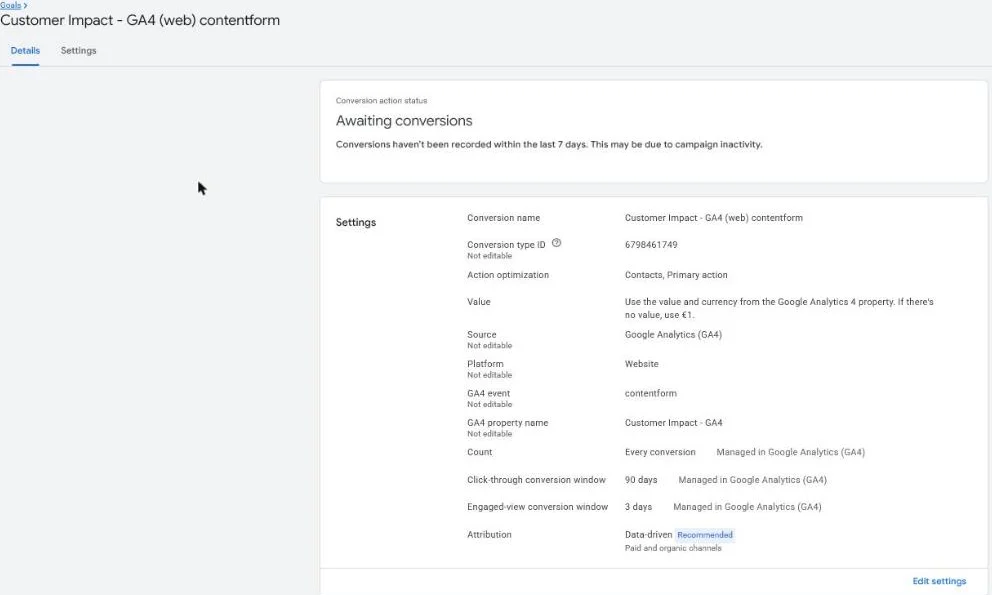 The contact form conversion action in our own Google Ads account, October 2026. It’s set as primary, so campaigns optimise on real enquiries.
A rebuild that redefines these actions changes what the algorithm learns from. Our explainer on primary vs secondary conversions shows why that choice matters.
Keywords, Quality Score and evidence
You also lose:
- Keyword data: and your list of negative keywords, built from years of search terms.
- Quality Score history: the 1 to 10 diagnostic per keyword.
- Evidence of what works: so the new party can repeat old mistakes.
Quality Score is built on three components: expected CTR, ad relevance and landing page experience.
Google notes that Quality Score itself is not an input in the ad auction. Its history still tells you where to improve, as explained in quality score in Google Ads.
The account’s change history is evidence too. It shows which edits helped and which didn’t.
Switching agencies doesn’t mean losing it
Much of this data doesn’t have to be lost, even if you change agencies.
We wrote earlier about how that works in do you lose your data when you switch Google Ads agencies.
Rebuild or restructure: what carries over?
Put the two options side by side and the cost of a new account becomes visible:
| What | Restructure in the same account | Brand-new account |
|---|---|---|
| Conversion history for Smart Bidding | Kept | Lost |
| Conversion actions and goals | Kept, can be cleaned up | Set up again |
| Negative keyword lists | Kept | Rebuilt or copied by hand |
| Search term and Quality Score history | Kept | Starts empty |
| Change history as evidence | Kept | Starts empty |
| Learning period | Per changed campaign | Account-wide |
Agencies often run many accounts from one manager account (MCC). That makes it easy to compare accounts, and just as easy to open a fresh one.
Here’s our own manager account view:
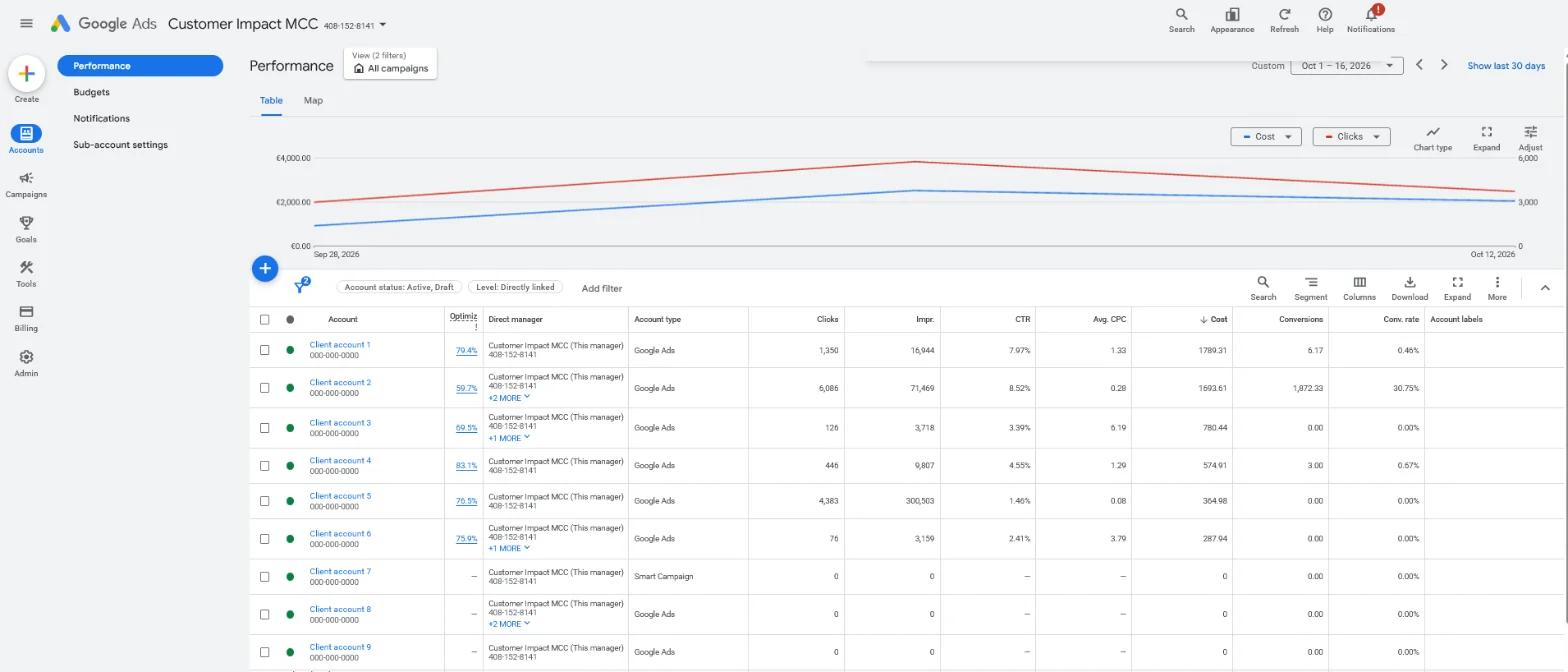 Our own manager account (MCC) in Google Ads, October 2026. Client names and IDs are replaced. Compare the CTR column with the conversions column.
A new account is one click away in an MCC. That’s exactly why you should ask whose name it’s under.
How an MCC works is covered in our guide to the Google Ads manager account.
Which questions do you ask before you agree?
Use this list literally in your conversation with a new party, agency or marketing partner. The answers tell you more than any sales pitch.
Five questions for the proposal
- Did you do an audit first? Without an audit, “rebuild” is a gamble.
- What exactly is kept, and why? Account, conversion history, bid history, keywords.
- Who becomes owner of the account? It has to be on your own ID.
- How long does the learning phase last after the rebuild? Expect temporarily worse results.
- How do you report the difference before and after? Without a baseline, nobody knows whether it worked.
Realistic expectations for question 4 are in how long Google Ads needs to become profitable.
How to read the answers
Clear, honest answers mean you’re in good hands.
If it gets vague or uncomfortable, you know enough.
What you can expect anyway from a professional partner is in expecting results from a Google Ads agency. More questions for the intake are in questions to ask a Google Ads agency.
Tip: even inside the same account, change one campaign at a time. Our guide to editing a live Google Ads campaign shows how.
Frequently asked questions
New Google Ads agency wants to rebuild everything, is that necessary or will I lose my good data?
Sometimes it’s necessary, often not. A rebuild within your existing account keeps your history, a completely new account throws away conversion and bid history. Always ask whether it’s really a new account or a new structure, and have them justify why your good data can’t be kept.
Does a new agency really have to rebuild my whole Google Ads account or is that to bill extra?
That depends on what an audit shows. If your structure or conversion tracking is fundamentally broken, a rebuild is defensible. If the advice comes without an audit and with a hefty setup fee, there’s a fair chance it’s partly about billing. Ask for figures from your own account, not for general talk.
Is a Google Ads account rebuild a red flag?
Not automatically. It becomes a red flag if the party shouts “start everything over” before anyone has even looked at your data, or if nobody can explain what stays. A good partner first shows what works and only tears down afterward, with reason.
Will I lose my return if they rebuild my campaigns?
Temporarily, usually yes. A new account or new campaigns start in a learning phase in which the bidding strategy has to train again. Count on a few weeks of less stable results. An honest partner says that up front instead of concealing it.
How do I know whether my current account is really bad or whether they are scaring me?
Request an independent account audit. It objectively shows your wasted spend, your structure and your conversion tracking. Only with those facts on the table can you judge whether a rebuild is warranted or a sales argument.
Not sure whether your account really needs to start over?
Before you throw away years of learning, get a second opinion.
We look at what works first, explain what can be kept and say so when a rebuild isn’t needed.
Customer Impact advises and executes: strategy, lead generation, Google Ads, SEO, GEO and web. We’re a small team, so we move fast.
Contact us with read access to your account, and we’ll tell you whether it needs a rebuild or just good steering.
Free website scan
Enter your website and get an automatic scan within minutes, with concrete technical and SEO improvements. No sales pitch.
We only use your details for your scan. No spam, unsubscribe anytime.