
SEO & GEO
Writing Quora Answers That AI Cites

Copy for AI
An in-depth Quora answer is one of the most direct routes to AI citations.
If you want ChatGPT, Perplexity or Google’s AI overviews to cite your expertise, Quora answers SEO deserves a spot in your plan.
The verdict: Quora works when your answer is complete, honest and useful without your brand in it. Sales pitches don’t get cited.
Quora is a question-and-answer platform.
Its pages have exactly the structure language models like: a clear question with a detailed, human answer beneath it.
Below: why AI cites Quora answers, what makes one citable, and how to do it without slipping into spam.
Why does AI actually cite Quora answers?
Because every Quora page holds a question phrased the way people ask an AI.
The question match
Say someone asks ChatGPT “what is the best CRM for a small B2B team?”.
The system looks for sources that already answer exactly that kind of question.
A Quora thread with the same question and a thorough answer is then a natural match.
Here’s what such an answer looks like in ChatGPT today. Look at the source it cites:
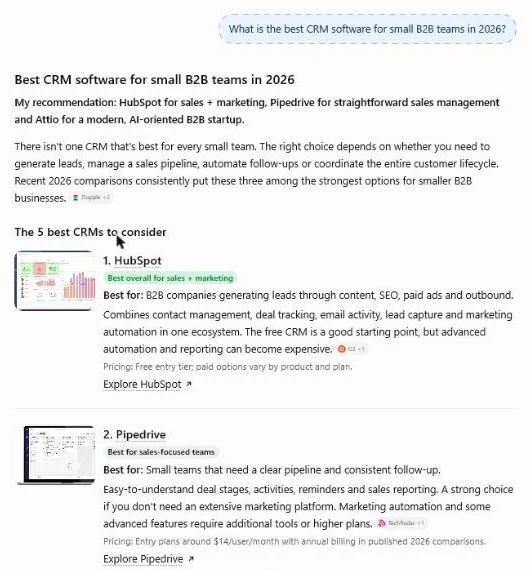 ChatGPT (free), 17 October 2026: three CRM suppliers named in one answer, with a review platform cited as a source.
The citation goes to a third-party page, not a vendor’s own site. That’s the slot a strong Quora answer competes for.
Three reasons Quora matters for AI visibility
There are three reasons this platform matters for your visibility in AI answers:
- The question form itself. A Quora title is a real user question. It fits the conversational searches AI systems are trained on and retrieve in real time.
- Real experience over marketing language. People write how something works in practice, with trade-offs. Models read that as more trustworthy than a polished product page.
- Open and searchable. Quora content is public and long-lived, so it surfaces more often in the sources AI systems consult.
Google’s AI features even widen the net on purpose.
AI Overviews and AI Mode may use “query fan-out”: several related searches across subtopics to build one answer (Google Search Central).
More searches per answer means more chances for a well-matched Q&A page.
What the citation data says
Analyses of AI citations keep showing the same picture: community sources carry weight.
In Peec AI’s March 2026 study of 30 million cited sources, Reddit was the most-cited domain overall, ahead of YouTube and LinkedIn.
Watch out: Quora didn’t make that overall top 10. Treat it as a supporting source, not a guaranteed one.
The share varies by platform, for example in Perplexity, and by topic.
But the direction is consistent: useful answers on the right questions raise your chance of being cited.
So pick questions first. The answer comes second.
What makes a Quora answer attractive to a language model?
It has to work as a complete, honest answer on its own, whoever wrote it.
A model likes to clip a passage that holds up without context.
The more your answer is built for that, the bigger the chance it gets picked up.
Four traits of answers that score
In practice, the answers that score well share four traits:
- They start with a direct answer. The first sentence gives the stance or core, then the explanation. Models extract that structure easily, as our guide on content architecture for AI extraction shows.
- They’re concrete and specific. Real examples, steps and limits read as knowledge, not opinion. Vague generalities are rarely cited.
- They’re honest about downsides and alternatives. A balanced answer that names other options is trusted faster, by humans and models alike.
- They use clear language. Short sentences, logical subheadings and lists help a model isolate the right passage.
Questions beat statements, in Google too
Buyers really do search in questions. Our own Search Console shows question queries earn more clicks per impression:
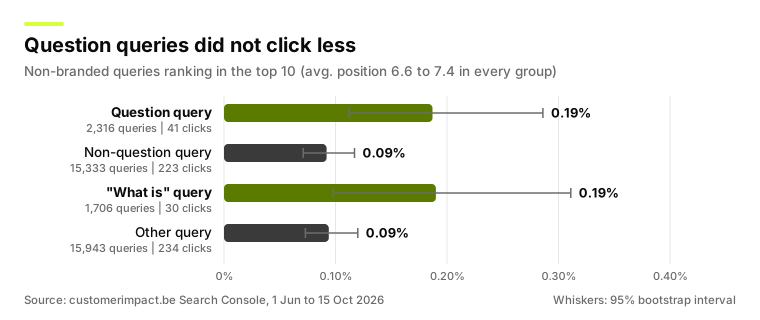 Non-branded queries ranking in the top 10, customerimpact.be, 1 June to 15 October 2026. From our CTR study.
That’s 0.19% against 0.09%. Question-shaped content matches question-shaped search.
A weak opening vs a strong one
For example, take the question “is HubSpot worth it for a 10-person B2B team?”.
- Weak: “Great question! At our agency we love helping teams like yours…”
- Strong: “Often yes, if you’ll use the marketing automation. If you only need a pipeline, a lighter CRM is cheaper.”
The strong version answers in the first line. It also names a limit. That’s the passage a model can lift.
Takeaway: write for the reader who genuinely wants an answer. A useful answer for a human is the one an AI dares to cite.
How do you write a Quora answer that gets cited?
Add value first, and only name your own brand where it fits.
Quora’s own rules on promotion
Quora’s business guide says self-promotion is “permitted only in the context of a sincere, helpful, and direct response”.
Anything else risks being treated as spam.
Two more rules from that guide:
- affiliate links aren’t allowed
- promotional answers need a Professional Business Profile
An answer that reads like an ad gets downvotes or is hidden. Then it helps you nowhere.
The steps below form a repeatable process:
Step 1: pick the right questions
Start with the questions your buyers actually ask, not with your brand name.
Search Quora for the problems you solve and for your product category.
Look for questions without a strong, recent answer yet. That’s where you make the most difference.
Tip: ask your key questions to ChatGPT and Perplexity, and check which Quora threads already show up as sources. Those are the discussions models already read.
Perplexity makes that check easy, because it lists every source behind an answer:
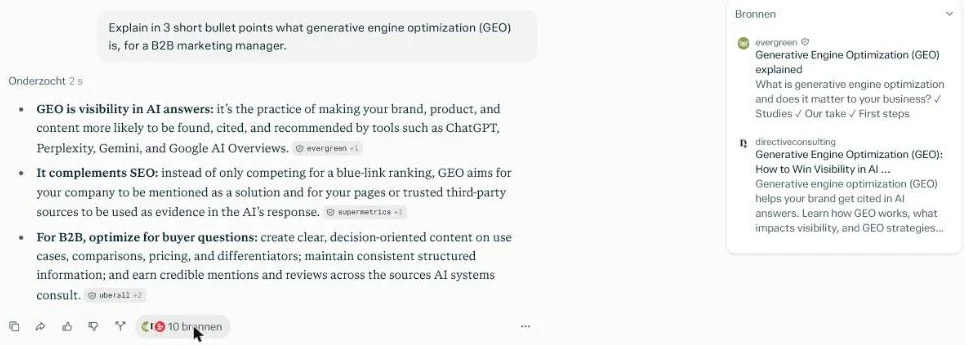 Perplexity’s sources panel for our own test prompt, 17 October 2026: 10 web pages behind one answer.
Scan that list for quora.com. If a thread shows up, that’s your first target.
Step 2: write a standalone, complete answer
Answer the question as if your brand doesn’t matter.
Use this structure:
- Core: the answer in one or two sentences
- Explanation: concrete steps, examples and limits
- Close: a short conclusion or decision rule
Aim for depth, not length. A thorough answer of a few paragraphs beats ten lines of marketing language.
Weave the question naturally into your text, so the match with the search stays clear.
For example, say the question is “how long does an SEO migration take?”.
Open with the range you’d give a client, then the factors that shift it.
Step 3: name your brand only where it’s relevant
Mention your own solution only when it genuinely makes the answer more complete. Be transparent about who you are.
If you work for a company, say so. Hidden interests are almost always seen through, and they turn against you.
An honest mention in an otherwise neutral answer beats an answer that’s about you from start to finish.
It’s the same dynamic as brand mentions that carry more weight than backlinks: credible context, not volume.
Step 4: build consistency
One strong answer is a start, not a strategy.
Answer questions in your field regularly, so you build a recognisable profile with real expertise.
An account that only talks about one brand reads like advertising.
One that’s given useful answers for months builds authority models weigh in.
Four steps, repeated every week. That’s the whole method.
Quora or Reddit: where do you place your focus?
It’s not one or the other, but each platform needs a different tone.
How the two platforms differ
Here’s the difference in one table:
| Quora | ||
|---|---|---|
| Format | question and answer | conversation threads |
| Culture | more formal, expertise-led | looser, community-led |
| Self-promotion | only inside a sincere answer | stricter, often banned per community |
| Best use | citable answers to buying questions | presence where your audience talks |
Quora is explicitly a Q&A platform, so a structured answer fits right in.
Reddit is looser and stricter on self-promotion. But for some models it weighs heavily as a source of real user experience.
The practical choice for B2B in the Benelux
Use Quora for thorough, citable answers to buying questions.
Use Reddit community marketing to be present where your audience talks among themselves.
How to do that last part without getting penalised is in our article on how Reddit makes your brand visible in ChatGPT.
Our Reddit SEO guide covers the search side.
Rule of thumb: on both platforms, give more value than you ask.
Start with Quora if your buyers ask how-to questions. Add Reddit later.
How do you measure whether your Quora presence works?
Measure it by your visibility in AI answers and the leads that follow.
Upvotes and views on Quora don’t count for much.
Those numbers are nice, but they say little about whether a model cites or recommends you.
The signals we steer on
We prefer four signals that truly matter:
- your citation rate in AI answers to your buyers’ questions
- the tone and quality of the context you’re mentioned in
- your branded search volume, which often rises as people see your name in AI answers
- the conversations and leads that come out of it
Which indicators to track and why is in the five core indicators of AI visibility.
To compare yourself with competitors, track your AI share of voice.
How to run the check
Keep it simple and repeatable:
- list 20 to 30 buyer questions you answered on Quora
- ask each one in ChatGPT, Perplexity and Google’s AI features
- log whether your brand or your thread is named
- repeat the same prompts every month
That gives you a baseline and a trend, without any special tooling.
Watch out: we don’t promise guaranteed citations, because no platform gives those. We raise the chances systematically and measure honestly what works.
Our starting point stays the same: we steer on revenue and leads, not on vanity numbers.
If leads don’t follow after a few months, change the questions. Not the platform.
The short summary
Quora answers are a direct route to visibility in AI answers.
Every page holds a real user question that fits how people talk to ChatGPT and Perplexity.
The method in four lines:
- write answers that are complete, honest and concrete on their own
- name your brand only where it fits
- build consistency instead of scoring once
- measure citation rate and leads, not upvotes
That makes Quora a building block in a broader GEO approach, next to answer engine optimization on your own site.
Want to know how often AI answers already mention your brand, and which sources matter most?
Explore our approach to AI search optimization or contact us for a first read of your prompts.
Free website scan
Enter your website and get an automatic scan within minutes, with concrete technical and SEO improvements. No sales pitch.
We only use your details for your scan. No spam, unsubscribe anytime.