
Advertising
Facebook Ads B2B: When Facebook and Instagram Make Sense Alongside LinkedIn

Copy for AI
Facebook ads in B2B work best as cheap warm-up, not as your closing channel.
Many B2B companies assume social advertising means LinkedIn. That’s understandable, because that’s where your audience sits in a professional capacity.
But the same decision-makers also scroll Facebook and Instagram in the evening. There, a click costs a fraction of what you pay on LinkedIn.
The verdict: Meta doesn’t replace LinkedIn in B2B. It’s a strong, cheap channel for reach, retargeting and warming up an audience you then close on LinkedIn.
Below you’ll see when Facebook ads B2B campaigns make sense, and when you’re better off leaving them alone.
Tip: check whether your ad budget pays off with our free ROAS calculator.
Do Facebook ads actually work for B2B?
Yes. But not the way they work for a webshop.
On Meta you aren’t buying direct demo requests at a low cost. You’re buying cheap attention from people you can warm up later, as practice with B2B advertising on Facebook also shows.
Two differences with LinkedIn
The big difference comes down to two things:
- Purchase intent: people on LinkedIn are in work mode; on Meta they’re relaxing.
- Targeting: LinkedIn targets job title, industry and company size; Meta barely has that layer.
So on Meta you work with interests, behaviour and lookalikes instead.
The price difference
Upside: Meta is a lot cheaper per click.
In benchmark research, the average cost per click on Facebook sits well below a dollar. That’s considerably lower than on Google’s search network, as the Google Ads benchmarks by industry show.
LinkedIn is another step up. The click price there typically runs to several dollars, far higher than on most other channels.
Our overview of average CPC in B2B puts those channels side by side.
What that means for your funnel
For the price of a single LinkedIn click you buy a handful of Meta clicks.
At the top of your funnel, where you mainly build reach and recognition, that’s a serious argument. At the bottom, where a concrete request is at stake, LinkedIn is often still stronger.
Our page on social media advertising covers the channel trade-off as a whole.
When is Meta a sensible addition?
In B2B, Meta pays off mainly in four situations.
1. You have a long funnel
B2B buyers rarely decide at first contact. The decision journey runs in circles across several touchpoints, not as a straight funnel (McKinsey, The Consumer Decision Journey).
Meta is excellent for building those early touchpoints cheaply, before someone’s ready for a conversation.
Our guide to lead generation with a long sales cycle shows how those touchpoints add up.
2. You want broader reach than LinkedIn allows
Gap: not every decision-maker is active on LinkedIn.
And those who are scroll there less often than through their private feed. Meta fills that gap, on Facebook and on Instagram for B2B.
3. Your budget is limited
With a small investment you build a recognisable audience faster on Meta than on LinkedIn.
On LinkedIn, a small budget disappears fast. Clicks there are expensive.
4. You want to retarget
This is perhaps the strongest B2B argument. It’s cheap and warm.
Put the pixel on your site and show follow-up ads to people who already came in via LinkedIn, SEO or a newsletter. You then advertise to a warm, valuable audience at low cost.
What the pixel does: Meta describes it as “a snippet of JavaScript code that allows you to track visitor activity on your website”. Those visits become your retargeting audience.
Our guide to the Meta Pixel covers the setup, and our article on remarketing the follow-up.
The division of roles
The pattern is always the same: Meta does the cheap groundwork, LinkedIn does the expensive closing.
That division of roles is the core of a healthy B2B mix:
The B2B social ads funnel works this split out stage by stage.
When are you better off leaving Meta alone?
When your audience is tiny and job-bound, when there’s no follow-up, or when you expect direct leads.
Good advice also means saying when something doesn’t pay off.
Your audience is extremely niche and job-bound
Do you only want procurement directors at hospitals with more than 500 beds?
Then LinkedIn’s professional targeting is indispensable. On Meta you’d burn budget on the wrong people, and our LinkedIn Ads service is the better fit.
You have no funnel or follow-up
Meta leads are colder. Much colder.
Without retargeting, email follow-up and a converting landing page behind the click, it stays at cheap clicks that go nowhere.
You expect a direct lead machine
Anyone who expects an immediate stream of qualified requests from Meta will be disappointed.
Reality check: the channel warms up. It doesn’t close.
The cost that really counts
A cheap click that never turns into a meeting is more expensive than an expensive click that does.
That’s why we don’t look at the PPC cost as such. We look at what comes out at the bottom of the funnel: qualified leads and pipeline.
How do you target B2B on Meta without job titles?
You stack three layers: warm retargeting, lookalikes and cold interests.
Because Meta doesn’t offer sharp professional targeting, you steer more creatively.
Layer 1: Retargeting (warm)
Your website visitors, your email list, people who interacted with your content. For example, everyone who read a pricing page in the last 30 days.
That’s warm.
This is your cheapest and best converting audience. Our explainer on custom audiences shows how to build one.
Watch out: when you upload a customer list, usually only part of your contacts match with Meta users. Count on a smaller but highly relevant audience.
Layer 2: Lookalikes
Ask Meta to build an audience that resembles a seed, such as your best customers or your website visitors.
You reach new people with a higher chance of relevance, without guessing job titles yourself.
Meta’s lookalike audience documentation sets three rules:
- Seed: a Custom Audience of at least 100 people.
- Size: 1% to 20% of a country’s population, in steps of 1%.
- Refresh: every 3 days while the lookalike sits in an ad set.
Rule of thumb: start at 1%, the slice that most resembles your seed, and widen only when reach runs dry.
You build it in Ads Manager under Audiences:
Our guide to lookalike audiences goes deeper on seed choice.
Layer 3: Interests and behaviour (cold)
The broadest and coldest layer. For example, people interested in logistics software or HR tools.
It’s usable for brand awareness and for filling your retargeting audience. But don’t expect direct conversions here; our article on Facebook interest targeting explains why.
Borrow ideas from the competition
For ad inspiration, look at what rivals run. With the Meta Ads Library you can do smart competitor research, without logging in.
Start on the public search page and pick your country and ad category:
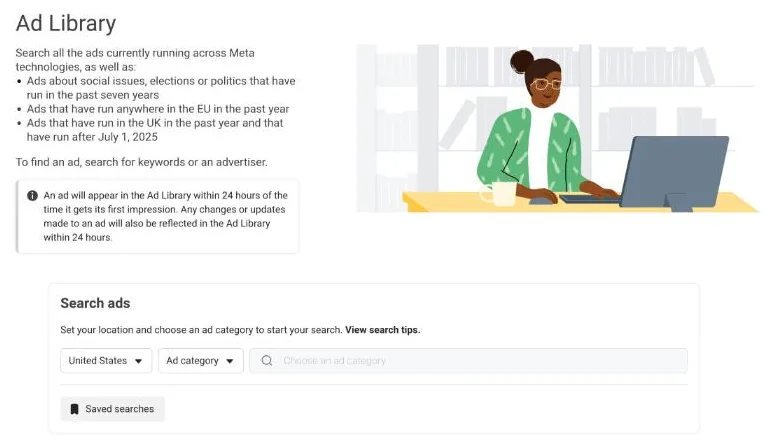 The Meta Ad Library without logging in, October 2026. Search a competitor’s page name to see every ad it runs.
Each result shows when an ad started running and on which platforms:
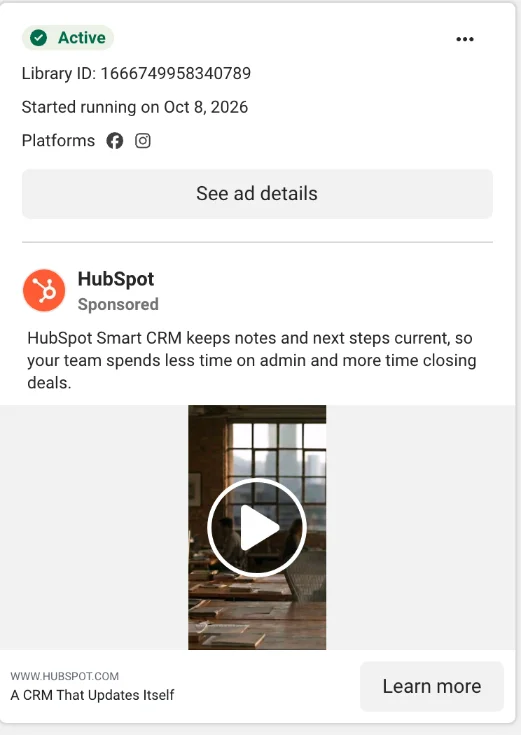 One ad card in the Meta Ad Library, October 2026. An ad that has run for months is often one that works.
Shift budget towards what converts
The logic: cold reach feeds your warm audiences, and you gradually shift budget to the layers that convert.
Anyone already on LinkedIn will find in LinkedIn ads the counterpart where the closing happens.
What can you realistically expect from ROAS on Meta?
Not a direct one. In B2B, a direct ROAS on Meta is a misleading yardstick.
The sales cycle is long and there are several decision-makers. Someone who clicks your ad today may only sign six months from now.
So don’t steer on click cost or reach. Steer on how many qualified leads, and ultimately how much revenue, your mix delivers.
How to measure it
Concretely, that means:
- Measure Meta as a contribution to the funnel, not as a standalone sales figure.
- Count on months, not weeks, before the audience trickles through to a meeting.
- Judge the channel on lead quality at the bottom, not cheap clicks at the top.
For example, compare the share of Meta-touched leads that sales accepts with the share from other channels.
Our guide on how to measure ROAS in B2B walks through that setup, and the lead value calculator puts a euro figure on one lead.
Measure server-side too
Browser tracking can miss conversions when cookies or scripts are blocked.
The Meta Conversions API sends events from your server, so your audiences and reports stay complete.
Run it yourself or outsource?
For anyone without the time or appetite for this, outsourcing social advertising can be a logical choice.
Condition: the agency has to steer on customers, not on vanity metrics.
Frequently asked questions about Facebook advertising in B2B
Is Meta cheaper than LinkedIn for B2B?
Per click, almost always. Benchmarks show a cost per click on Facebook well below a dollar, while a LinkedIn click typically costs several dollars.
But cheaper per click doesn’t mean cheaper per customer: LinkedIn often delivers higher purchase intent. It’s about the right division of roles, not the lowest rate.
Can I target as sharply on Meta as on LinkedIn?
No. Meta lacks the professional layer (job title, industry, company size) that LinkedIn has.
You compensate with retargeting, lookalikes and interest targeting, but for tightly job-bound niches LinkedIn remains superior.
Do Facebook ads work as the only B2B channel?
Rarely well. Meta is a warm-up and reach channel.
Without a closing channel such as LinkedIn and without solid follow-up, it stays at cheap clicks. See it as the top of your funnel, not the whole funnel.
How much budget do I need to start on Meta?
Because the click price is low, a modest budget is enough to build a recognisable audience and a retargeting pool.
More important than the amount: your follow-up and landing page must be in order, or you burn even a small budget.
Ready to organise your social mix more intelligently?
Meta alongside LinkedIn only works if the roles are right: cheap warm-up on Meta, sharp closing on LinkedIn, everything measured on qualified leads.
We build that mix around your sales cycle, and we’ll say so when a channel adds no value for you.
Contact us and we’ll check your current mix before you spend another euro.
Free website scan
Enter your website and get an automatic scan within minutes, with concrete technical and SEO improvements. No sales pitch.
We only use your details for your scan. No spam, unsubscribe anytime.