
Growth & Strategie
AI marketing for B2B: concrete applications without the hype

Copy for AI
AI marketing pays off where it saves time or wins customers, nowhere else.
The term has come to mean everything and nothing. For a B2B business the question isn’t “are we doing something with AI?”, but “where does it deliver, and where is it noise?”.
The verdict: use AI for research, drafts, personalisation, lead scoring, analysis and AI search visibility. Leave it out where your fundamentals, your data or your human check are missing.
Below are the concrete applications, without the hype, and the places where you’re better off leaving it.
What does AI marketing mean in practice?
It’s a set of techniques you deploy where they work faster or better than manual work.
AI in marketing isn’t a single tool you switch on. It’s a collection of techniques: language models, predictive analysis and automation.
The goal stays the same: more of the right customers, at lower cost.
Steer on requests, not output
The danger is that AI tempts you to steer toward the wrong things.
A model that spits out ten blogs a day feels productive. But if those texts reach or convince no one, you’ve mostly produced noise.
Rule of thumb: steer toward requests and revenue, not toward output.
Good input, good output
Our experience: AI models now do most of the production work. Good output needs strong input on three levels: your data, your company strategy and your company knowledge.
Without those three, every model sounds the same.
Where does AI really deliver time and revenue?
In five places, for most B2B teams. Salesforce lines up AI marketing use cases in a comparable way.
Here they are:
- Research and first drafts: faster briefings and rough texts, sharpened by a human
- Personalisation at scale: emails and landing pages per segment
- Lead scoring: predicting which leads can become customers
- Data analysis: spotting patterns faster than in a spreadsheet
- AI search visibility: getting cited when buyers ask a chatbot
That last point deserves attention. Our GEO optimization service revolves precisely around being found in that new context.
Research and first drafts
AI speeds up research, briefings and the blank page.
Here’s what a single prompt returns in an AI assistant:
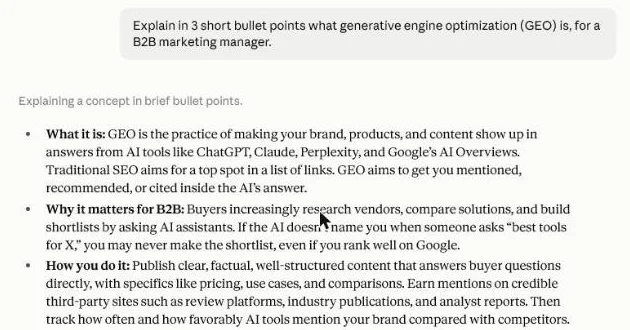 Claude, 17 October 2026, our own test prompt in an incognito chat: a usable first draft of about 150 words in one turn.
That’s a solid start. It isn’t a finished article, because it holds no point of view, no example from your market and no proof.
A human then turns it into something sharp. Our AI marketing prompts help you get better first drafts.
Our experience: we use Claude and ChatGPT daily, also for design and dashboards. They speed up the work; they don’t replace the judgment.
Personalisation at scale
AI adapts emails and landing pages per segment, without ten versions built by hand.
For example, the same webinar invite can open with a logistics pain for one segment and a compliance pain for another. Our guide to AI email marketing shows how.
Watch out: personalisation only works with sharp segments. Without them, you personalise noise.
Lead scoring
Lead scoring predicts which leads can become customers, so sales spends its time well.
It works best on top of clear lifecycle stages, like these in HubSpot:
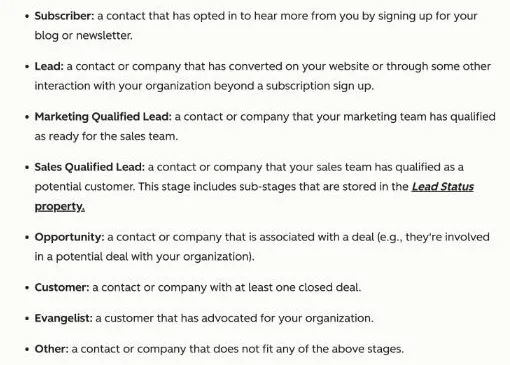 HubSpot’s lifecycle stage definitions, checked 18 October 2026.
A model can only predict a move from MQL to SQL if those stages are defined and filled in consistently.
Data analysis
AI spots patterns in campaign data faster than you ever would in a spreadsheet.
But it still needs someone who asks the right question and checks whether the pattern makes business sense.
Each application at a glance
Here’s what each one delivers and where the pitfall sits:
| Application | What it delivers | Pitfall to avoid |
|---|---|---|
| Research and drafts | Faster from blank page to rough text | Publishing uncontrolled without a human check |
| Personalization at scale | More relevant message per segment | Personalizing without sharp segments |
| Lead scoring | Sales focuses on the right leads | Too little data to predict reliably |
| Data analysis | Patterns you miss in a sheet | Blindly trusting numbers without interpretation |
| Visibility in AI search engines | Getting cited where buyers now search | Waiting until competitors are already there |
So you see straight away whether an application fits your situation.
How do AI search engines change how you get found?
They decide whether you’re cited, not just where you rank.
Your customer increasingly searches via ChatGPT, Perplexity or Google’s AI overviews. There, what counts is whether a language model cites you as a source.
We call that GEO, generative engine optimization.
Citations replace clicks
An AI answer is built on a handful of sources:
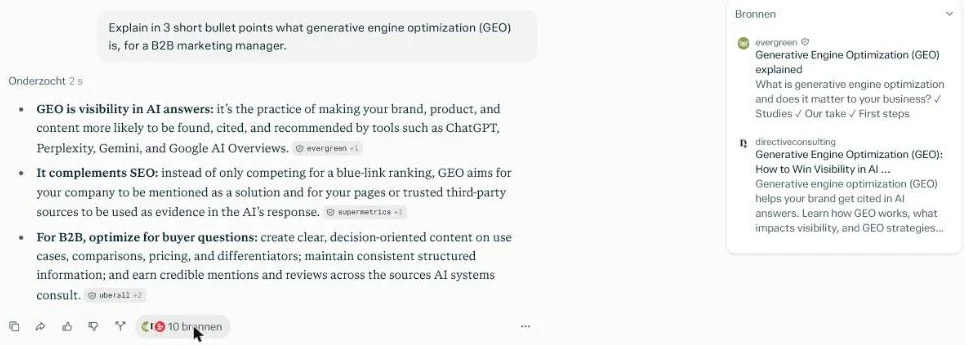 Perplexity’s sources panel for our own test prompt, 17 October 2026: 10 web pages behind one answer.
Those pages get the credit. The rest stays invisible.
Clicks are shrinking at the same time. In a Pew Research study of March 2025, 18% of searches showed an AI summary. Users then clicked a result in 8% of visits, against 15% without one.
Only 1% clicked a link inside the summary itself.
Move early
Want to understand how to respond? Read our guide on GEO.
It’s one of the domains where moving early delivers a clear advantage, because most competitors still do nothing with it.
Check where you stand with the free AI visibility checker.
How does automation cut manual work?
By making the tedious work disappear, which is where much of the gain sits.
Workflows that run by themselves
The gain isn’t always spectacular AI. Think of:
- leads that land automatically in your CRM
- follow-up emails that go out at the right moment
- reports that fill themselves
That’s marketing automation: workflows that run while you do something else.
AI makes those workflows smarter
AI can choose the right message per contact itself, instead of one fixed sequence for everyone.
Read how we deploy AI automation to relieve processes, or see our marketing automation service.
Our experience: most sales admin can be automated from call transcripts. An agent wraps up the call and triggers the follow-up actions.
Your website should move fast too
Being able to move fast applies just as much to your website.
See how Webflow for marketing teams lets you publish without needing a developer every time.
Where are you better off not using AI (yet)?
Wherever the fundamentals, the data or the human check are missing.
Fair is fair: not everything is ready for AI, and not every business needs it.
Four places to hold back
- Missing fundamentals: without a sharp audience and proposition, AI accelerates wrong choices.
- Sensitive or legal content: checking costs more than the AI saves.
- Fully autonomous publishing: unchecked AI texts damage your credibility.
- Thin data: predictive models need volume to say anything meaningful.
We’d rather say this up front than have you put money into a tool that doesn’t help.
Trust is on the line
Salesforce reports that 68% of customers say advances in AI make it more important for companies to be trustworthy (Salesforce).
One AI mistake costs trust. That’s expensive.
Our comparison of AI vs human content shows where each one wins.
How do you approach AI tools for businesses?
Start with the problem, not the tool.
Here’s the order we follow:
Pick one task
Which task costs your team the most time, or where does revenue leak away?
Pick one application there. Measure the result. Expand only once it works.
For example, if briefings eat half a day per article, start with AI research briefs and measure the hours saved.
A low-threshold entry point
A practical entry point is ChatGPT for businesses: low-threshold and quick to test.
You learn straight away where AI does and doesn’t move you forward, without starting a big project.
Want an overview of the tools? See our list of AI tools for marketers.
How do you go from experiment to result?
By judging AI on customers, not on an impressive demo.
At Tinrate we deployed smart content and distribution to turn free advice into real reach and momentum, not vanity metrics.
Speed from AI, judgment from people
The art sits in the combination: AI for speed and scale, humans for sharpness and judgment.
That’s where a small team that moves fast makes the difference.
Our experience: Google doesn’t punish AI-written content as such. But it must carry your own point of view, approach and experience, or it sounds like everyone else.
Frequently asked questions
What is AI marketing exactly?
AI marketing is the deployment of techniques like language models, predictive analysis and automation in places in your marketing where they work faster or better than manual work. It’s not a single tool, but a way to speed up existing tasks such as research, personalization and lead scoring. The goal stays the same: more of the right customers at lower cost.
Does AI marketing also work for small B2B businesses?
Yes, but start small. A small team in particular gains a lot from AI for research, drafts and automating tedious work. What you need is a sharp audience and enough data to measure something meaningful. If those fundamentals are missing, AI mainly accelerates your wrong choices.
Does AI replace the marketer?
No. In practice AI provides speed and scale, while the human provides sharpness and judgment. AI texts without a human check damage your credibility faster than they deliver. The gain sits in the combination, not in replacement.
Curious where AI pays off for you?
Tell us your situation and your goal.
We’ll tell you where AI really delivers in your marketing, and where your money works harder elsewhere.
We’re a small team, so we move fast and do more than you expect. Contact us and you’ll hear within 24 hours where your opportunities lie.
Free website scan
Enter your website and get an automatic scan within minutes, with concrete technical and SEO improvements. No sales pitch.
We only use your details for your scan. No spam, unsubscribe anytime.