
SEO
SEO maintenance: why it is not a one-off project (and what it delivers)

Copy for AI
SEO maintenance is ongoing work, not a one-off project you tick off and forget.
The verdict: an agency that sells you a one-off optimisation and then disappears delivers no lasting result. Keep maintaining the basics and you build a lead channel that grows stronger month after month.
Maintenance keeps your findability, leads and conversion up to standard while three things keep changing:
- your competitors
- the search behaviour of your customers
Below: why ongoing SEO is needed, what a small team realistically does each month, and how you steer on customers instead of rankings.
How much does SEO deliver? Check it with our free SEO ROI calculator.
Why is SEO not a one-off project?
Because the ground under your rankings keeps moving, every single month.
Many B2B companies think SEO is a one-off job: have an agency optimise your site, and done.
That’s not how it works.
Three things change under your feet
Three forces shift constantly:
- Google changes: the algorithm gets updates continuously. What scores well today can drop after a core update without you doing anything wrong.
- Your competitors move: every month they publish new content and earn links. Standing still means falling behind.
- Your customers search differently: the search intent behind a term shifts. Last year’s informational question now gets commercial answers.
What Google says about core updates
Google makes broad changes to its ranking systems several times a year.
Those updates don’t target specific sites.
A page that drops isn’t necessarily “bad”; other pages simply became more useful.
Google’s advice after a drop is about content, such as rewriting or restructuring pages. Avoid quick fixes.
And improvements can take months to show.
Why the big gains take patience
Long questions often move within weeks.
Broad search terms and leads can take up to a year.
And you keep that position only by continuing to work.
That’s not a sales pitch to make you pay longer. That’s how organic visibility works.
You’ll find our full approach with our SEO specialist.
The market keeps investing
Roughly 82.5% of marketers plan to invest more in SEO, not less.
That’s no coincidence.
Companies that take the channel seriously see ongoing effort compound: each month builds on the previous one.
What does SEO maintenance concretely involve?
A handful of recurring monthly tasks that really move leads.
Maintenance sounds vague, so let’s make it concrete.
For a small B2B team, it revolves around four tasks.
1. Content audits
Which pages perform, which sink away, and which draw traffic but no enquiries?
Old articles that still rank, you refresh with current figures and a stronger call-to-action.
Our guide to a content refresh shows the routine.
Spot it early: traffic that slowly slides is content decay, and it’s the most common maintenance job.
2. Technical checks
Do your internal links still work? Have broken pages or slow load times appeared after an update or a new plugin?
Small maintenance prevents big leaks.
Search Console’s Crawl Stats show what Google hits on your site:
 Crawl Stats in our own Search Console for customerimpact.be, October 2026. The breakdown by response shows how many requests hit a 301 or a 404.
A rising share of 404 responses is the first sign that links broke.
For load times, run a page through our free website speed test and check your Core Web Vitals.
3. Tracking shifting search intent
Does your content still match what people search for today on your most important terms?
If not, rewrite in a targeted way instead of stacking new content.
For example, say a term that used to show how-to guides now shows comparison pages. Then your guide needs a comparison section, not a sister article.
4. New content around buying questions
Not publishing for the sake of publishing.
Respond to concrete questions your sales team hears back from prospects.
Content is the biggest part of the work
Those last two aren’t content-driven by chance.
A large majority of marketers see high-quality content as one of the most effective ways to strengthen your SEO.
So maintenance isn’t a technical chore on the sidelines. It largely revolves around keeping your content sharp and relevant.
A good starting point for your technical checks is our technical SEO guide.
For a structured check, read the article on the SEO audit.
What a month looks like
Here’s the split in one table:
| Task | Typical question | What it protects |
|---|---|---|
| Content audit | which pages slide or don’t convert? | existing rankings and leads |
| Technical check | what broke since last month? | crawling and load time |
| Intent tracking | does the page still match the search? | relevance |
| New content | what are prospects asking now? | new demand |
How long does it take before maintenance pays off?
On long, specific questions, sometimes within weeks. The big gains only come after months.
The value sits in perseverance.
Pages climb gradually and your domain gains trust.
Over time a flywheel gets going: new content ranks faster because the foundation is in place.
The three phases
What that means for you:
- Month 1 to 3: you lay the basis, fix the biggest technical problems and refresh existing content. Results are still limited.
- Month 4 to 8: rankings start to move, organic traffic rises and the first enquiries via search come in.
- From month 9: the compounding effect becomes noticeable. Traffic costs relatively less effort because you’ve built authority.
Our experience: in B2B we usually see three months of fixing the basics, then three months of structure.
The curve changes from month six.
Why a single week tells you little
Rankings move up and down every day, such as this page over three months:
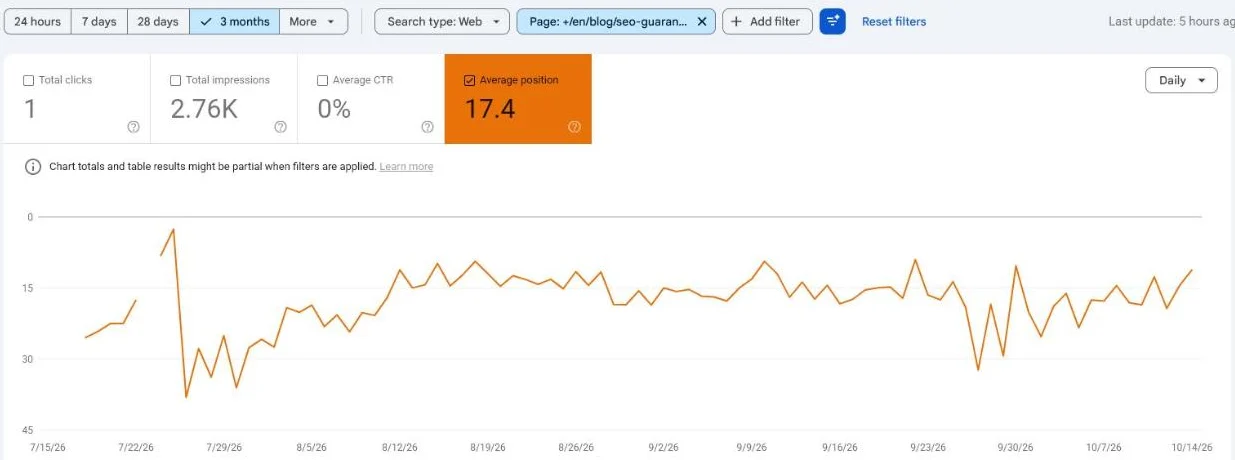 Our own Search Console: average position of one page over three months, 17.4 on average. Any single week could look like a drop.
Judge maintenance on the trend line, not on one dip.
Watch out: Google sometimes holds a new article back for up to two months before traffic breaks through.
Don’t rewrite it in week three.
What happens when you stop
Stop maintenance halfway and the flywheel stalls again. Three things follow:
- competitors overtake you
- content ages
- technical problems pile up
The difference between a site that keeps growing and one that sinks away is usually not talent or budget. It’s consistency.
How do you measure whether SEO maintenance really delivers?
By counting qualified leads and revenue from search, not rankings and traffic.
This is where many agencies go wrong.
They report on rankings and traffic as if that’s the goal.
For us that’s a means.
The question that counts: does your SEO deliver more qualified leads and revenue?
Steer on outcomes, not vanity numbers
So steer on outcomes that touch your business:
- Enquiries and demos from organic traffic, not only sessions.
- Conversion rate of your key landing pages, because traffic that doesn’t convert is no gain.
- Rankings on commercially relevant terms, not keywords with volume but no buying intent.
Search Console gives you the raw input: clicks, impressions and position per page.
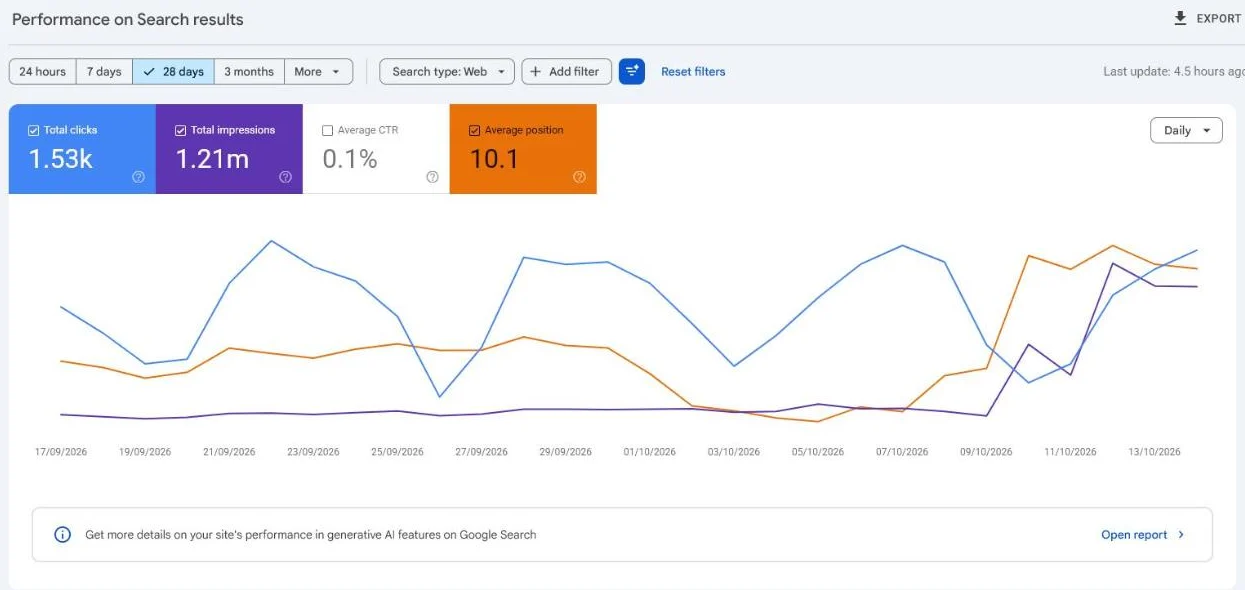 Our own Search Console for customerimpact.be, last 28 days, October 2026. Clicks are the number we steer on, not impressions.
The leads behind those clicks live in your analytics and CRM.
Our guide to B2B SEO KPIs shows which ones to pick.
Our experience: we report cost of acquisition, total revenue, impressions and traffic with ICP fit.
Per lead, we show which articles it read.
Noise vs signal
A dashboard full of charts feels impressive.
But if it doesn’t tell you whether customers come out of it, it’s noise.
Our thesis is simple: we also tell you when something doesn’t pay off.
Example: a piece of content that draws a lot of traffic but never delivers an enquiry is maintenance hours in the wrong basket.
We’d rather steer that time to pages that bring leads.
Our guide to SEO reporting shows what a useful monthly report contains.
Do maintenance yourself or outsource it?
Do part yourself, outsource the technical line and the prioritisation.
A small B2B team can handle part of the maintenance itself, certainly the content work and following up questions from sales.
Where it gets hard
The technical side and the prioritisation are often the hardest.
Knowing which 20% of the tasks delivers 80% of the result takes experience.
The hybrid model
You don’t have to outsource everything.
A hybrid model works best for most Belgian B2B companies.
You supply the content. A partner guards the technical line and strategy.
Our experience: the best mix with an in-house person is that in-house owns the content strategy and the agency does the execution.
What to avoid
Avoid the agency that invoices a one-off optimisation and then disappears.
Avoid the one that fills you up with hours without leads to show for it.
Unsure about the choice? Our article on outsourcing SEO helps you further.
Our explainer on the SEO retainer shows how ongoing contracts usually work.
With us: you count on results per lead, not on a timesheet.
Frequently asked questions about SEO maintenance
Is SEO maintenance really needed if my rankings are good?
Yes. Keeping good positions requires maintenance, because Google and your competitors don’t stand still. As soon as you stop, your content and technical basis age, and pages gradually sink away. Maintenance not only protects your position, it also builds new leads.
How much time does SEO maintenance cost per month?
For a small B2B company it usually comes down to a fixed number of hours per month, spread across content audits, technical checks and new content around buying questions. The exact allocation depends on your competition and your goals. More important than the hours is that you aim them at tasks that deliver leads.
What happens if I stop SEO maintenance?
In the short term you notice little. After a few months the flywheel begins to stall: content ages, technical problems pile up and competitors overtake you. The traffic and enquiries you’d built up slowly crumble away.
Is SEO maintenance different from an SEO audit?
An audit is a snapshot that exposes problems. Maintenance is the ongoing work that solves those problems and keeps your site relevant. An audit is often the starting point, but without follow-up maintenance little changes for your leads.
Ready to turn SEO into a lasting lead channel?
SEO maintenance isn’t a cost you drag along. It’s the engine behind a lead channel that grows stronger every month.
We’re a small team that moves fast and steers on customers and revenue, not vanity rankings. B2B lead gen that pays off, no webshop overkill.
Want to know whether your site is ready for ongoing growth? Contact us and we’ll start with a look at your Search Console data.
Free website scan
Enter your website and get an automatic scan within minutes, with concrete technical and SEO improvements. No sales pitch.
We only use your details for your scan. No spam, unsubscribe anytime.